Importing Electrical Cables From Bangladesh to Spain: Costs, Duties and Suppliers
The Spanish importer file, language and marking duties, UNE-EN papers, three gateways and the broker-confirmed duty and IVA file for importing electrical cables from Bangladesh to Spain, with a worked landed-cost example in euros.
Short answer
Importing electrical cables from Bangladesh to Spain works when the Spanish importer file, the language and marking duties, and the cable papers are settled before price is discussed. Name the importer and EORI holder, agree Spanish labels and papers, hold the declaration of performance with the fire class for the exact construction, choose the gateway by terminal, and have a broker confirm the heading 8544 line, duty and IVA in writing.

On this page
Key takeaways
Settle the Spanish importer file first: EORI holder, NIF link, Spanish labels and the customs representative before the first sailing.
Hold papers that name the exact construction: UNE-EN reference, EN 50575 fire class with additional ratings, voltage-band scope and restricted-substances declaration.
Choose the gateway by terminal and onward service: Algeciras for the south, Valencia for the east and interior, Barcelona for Catalonia and the north-east.
No duty rate is stated: the broker must confirm the full CN and TARIC line, the measures on the import date and the origin preference from the opened schedule.
Price from the worked landed-cost table in euros, including freight, broker, terminal, inland, inspection and bank costs, with duty added from the broker's written figure.
Spain rewards a buyer who arrives with paperwork ready. Before any supplier quotation can be judged, the Spanish side of the order has to exist on paper: a named importer with a working EORI number, Spanish wording on labels and documents, a fire class tied to the building, and a port and terminal that match the delivery address. Price comparisons only make sense once those four items are fixed, because two quotations at different prices usually describe different cables, different documents, and different arrival points. This guide follows the sequence a Spanish import actually demands. It starts with the importer dossier, moves to the installation question, then to the cable documents, the supplier check, the gateway, the delivery terms, and the border file, and it ends with a worked cost example in euros.
Start with the Spanish importer file, not the cable catalogue
Fix the importer while the order is still a draft. One party in Spain places the cable on the European Union market, and the obligations of that role stay with that party through the whole import. When the buyer also resells the cable onward, distributor obligations can attach to the same business for the onward sale. The order dossier should therefore name, person by person, who imports, who distributes, and who keeps the conformity documents. Customs officers and market surveillance officers both ask for a responsible party by name. A quotation cannot answer that question, so roles left undecided at the port turn into delays at the first inspection.
EORI registration in Spain runs through the electronic office of the Agencia Tributaria (AEAT). The office takes the operator's name, address, date of incorporation or birth, and type of person from the census of taxpayers, together with any VAT identification numbers from other Member States that the operator reports.1 For operators whose Spanish tax identification number (NIF) starts with a letter other than N, M, X, or Y, registration happens on the administration's own initiative. Those operators can consult and correct the registered data online, and registration can also take place when customs declarations are lodged.1 An operator whose NIF starts with N, M, X, or Y and who needs an EORI number in Spain must apply through the electronic office. The regional office for the tax domicile handles the application, and the customs department decides it.1 An operator holding a number issued by another Member State does not take a second Spanish number. That number is reported through the electronic office so the AEAT can link it to the Spanish NIF.1 An operator established outside the European Union who needs a Spanish EORI number and is not required to hold an AEAT NIF applies by submitting the form published on the AEAT customs and taxes portal.1
The number itself works across the whole Union. Malta's customs service describes it as a single reference valid throughout the European Union, used as the common reference for a trader's dealings with the customs authorities of any Member State, and required in all customs declarations since 1 July 2009.2 Every declaration lodged by the trader, or on the trader's behalf, must carry it, in whichever Member State the declaration is lodged, and no substitute number may be used in its place.2 Before the first sailing, confirm three things: that an EORI number exists for the importing entity, that it is active, and that the name and address attached to it match the name on the import declaration and the commercial invoice. A mismatch discovered at a Spanish terminal takes days to put right, and a supplier in Bangladesh cannot put it right for the buyer.
Language and marking belong in the same dossier, and the time to settle them is in the order, not on site. The Low Voltage Directive places a pre-market check on the importer: before the product is placed on the market, the importer must be satisfied that the manufacturer prepared the technical documentation, applied the conformity marking, met the traceability duties, and, where relevant, supplied instructions and safety information in a language easily understood by consumers and other end users, as the Member State concerned determines.3 For Spain, fix Spanish in the purchase order as the language for instructions and safety information, for the drum label the installer reads, and for every document the installer or the person signing off the work will handle. Request a Spanish label proof before production starts. Distributors carry a parallel check before making a product available: the required marking must be present, the relevant documents and the instructions and safety information in a language end users can readily understand must travel with the product where the legislation requires them, and the manufacturer and importer must have shown their name, registered trade name or trademark, and contact address on the product, or, where the size or physical characteristics of the product rule that out, on the packaging or the accompanying documentation.3
Marking doubles as traceability. Supply-chain guidance on the directive presents traceability in its widest sense as the route by which every economic operator meets its duties with the least expense and waste, and it recommends marking the cable surface with the manufacturer's name, the number of a relevant national, European, or international standard, any recognized coding, and a year or date of manufacture, so that every operator down to the end user can have greater confidence in where the cable came from.3 Put the exact sheath marking into the order: what appears, at what intervals, and what each drum label carries. Then compare the sample length and the first drums against that wording. A label that names another construction, another standard, or another manufacturer than the declaration does not describe the cable inside the container.
Settle the Spanish installation question before the construction is chosen
Before any construction is picked, put the building question on record. A Spanish installation design names where the cable will live: held fixed within a building, exposed outdoors, laid underground, or built into a machine or a piece of equipment, and it names the person answerable for that design. The class the building demands, with any smoke, droplet and acidity ratings beside it, comes from that person, or from a project specification written under that person's control, and it is tied to one construction in one building. Handing that choice to a supplier in Dhaka asks the wrong party: the class tracks the building and the route the cable follows through it, so a supplier-chosen class is a guess whose cost lands on the buyer.
Send the same person a second written question, about installation rules rather than fire class. Ask which Spanish rules will govern assessment of the finished work, whether the cable, its labeling and its installation documents meet those rules, and whether the site wants anything more than the European product papers — a certificate or attestation, say, that the installer keeps in the installation file. Keep the replies in the order file. If a drum is later refused on site, those replies point straight to the fault: the cable, the documents, or a site demand nobody wrote down. Ask again at every site, even when supplier and construction have not changed. One building may accept a cable that the building beside it rejects, because the route through the second building calls for a different class.
Destination facts belong in the order beside the installation facts: the address of the project or warehouse, who accepts the drums, what storage waits for them, what unloading plant the site has, and the day the cable has to be on site. Most drum deliveries fail in the final meters. A site with no forklift, no covered store, or nobody empowered to sign for a heavy load will turn away or hold a load whose sea leg ran to schedule. Write into the order the unloading point, receiving hours and a named contact, and get supplier and forwarder to confirm one shared address. Where two constructions travel together, split the paperwork even though the shipment is one: a specification, a document set, a sample approval and a landed-cost line for each. Splitting them stops a hold-up on one construction vanishing into an averaged price for the other.
The papers that travel with a Spanish cable order
Spain receives European standards through UNE, the Spanish Association for Standardization. UNE is a private, independent, non-profit association recognized in Spain as the national standardization body. It represents Spain in the European Committee for Standardization (CEN), the European Committee for Electrotechnical Standardization (CENELEC), the European Telecommunications Standards Institute (ETSI), the Pan-American Commission for Technical Standards (COPANT), the International Organization for Standardization (ISO), and the International Electrotechnical Commission (IEC).4 CEN and CENELEC produce EN standards together with the national standardization organizations that make up their membership. An EN standard enters the Spanish catalogue as a UNE standard by adding the letters UNE in front of the European code, so EN 1234:2019 becomes UNE-EN 1234:2019.4 A UNE standard is voluntary on its own, yet a regulatory authority can make its content mandatory in whole or in part by citing it in legislation. Twelve percent of the UNE catalogue is cited in national legislation.4 On a cable order, require the supplier to quote the standard reference exactly as it will read on the documents and on the drum, with the UNE-EN adoption reference included where the Spanish catalogue entry is the version the installer will check. Then have the installer confirm that the reference supplied is the one the job will be measured against.
EN 50575 is the starting point for the fire-performance document. It lays down reaction-to-fire performance requirements, with the tests and assessment routes to go with them, for cables that supply electricity and cables used for control and communication, when they are fitted in construction works that carry reaction-to-fire performance requirements. The aim is to hold back the growth and spread of fire and smoke in buildings and other civil engineering works.5 The standard reaches power cables, cables for control and communication, and optical fiber cables.5 Two edges of its scope matter to a Spanish buyer. Cables that keep power or a signal running for safety installations in buildings and other civil engineering works — alarm circuits, escape-route guidance, firefighting systems — fall outside it when continuity of supply is essential, because they serve electricity supply, communication, or fire detection and alarm. A cable on a safety circuit therefore needs a compliance route of its own, not an EN 50575 class on its own.5 Nor does the standard displace the electrical, mechanical or environmental demands that other cable standards or specifications impose. A fire class is no substitute for the construction standard itself.5
The wording for the class itself comes from EN 13501-6. That standard grades cables Aca, B1ca and B2ca at the upper end, Cca and Dca in the middle, and Eca and Fca below, and it pairs the grade with separate smoke ratings (s1a, s1b, s1, s2, s3), droplet ratings (d0, d1, d2) and acidity ratings (a1, a2, a3).6 Classification rests mainly on five test methods: EN ISO 1716, EN 50399, EN 60332-1-2, EN 61034-2 and EN 60754-2, with further smoke and acidity testing for the s1a, s1b, a1 and a2 ratings.6 For each construction, keep the declaration of performance with its declared class and ratings, the CE marking details in the exact form they will take on the drum label, plus the test reports that sit behind the declaration. All three must name that construction and nothing else. Where the standard allows family grouping, the buyer still needs written proof — a sentence or a schedule — that the construction ordered sits inside the family named. Lacking that proof, the declaration gives the order no cover.
The Construction Products Regulation frames all of these documents. It treats a construction product as a product placed on the market to be incorporated into buildings and civil engineering works permanently, it supplies a common technical language for assessing performance, and it leaves the responsibility for choosing a product with the right characteristics for a given application to the designers, contractors, and local building authorities.7 A manufacturer whose construction product falls under a harmonized standard or matches a European Technical Assessment must prepare a declaration of performance before placing the product on the market, and construction products with a declaration drawn up should carry CE marking.7 The regulation sets obligations for manufacturers, authorized operators, importers, and distributors, and national authorities may set performance requirements through the harmonized standard or the European Assessment Document.7 The declaration of performance states how the product performs, while the assessment and verification of constancy of performance sets out how products are assessed and how the constancy of those assessment results is controlled.7 Hold the declaration, the test evidence, and a description of the production control behind the class, and verify that declaration, reports and drum labels all agree on construction, class and standard reference.
A second document set follows the rated voltage. The Low Voltage Directive applies to electrical equipment and components designed for a voltage rating in the AC band of 50 to 1,000 volts and the DC band of 75 to 1,500 volts.3 Work out from the rated voltage stated on the specification whether the cable falls inside or outside those bands, and request the EU declaration of conformity covering the cable where the band applies. A cable rated outside the bands, or a specialized cable outside the directive, needs a written scope answer naming the instrument that covers it instead. Do not settle for an assumption. The importer's supply-chain duties explain why a CE mark printed on a drum is not proof by itself: the importer must verify that the manufacturer fulfilled its obligations correctly, covering the conformity assessment, the technical documentation, the marking, and the instructions and safety information, and must hold the product back from the market while any doubt stands.3
Restricted substances form a third document set, handled apart from voltage and fire performance. The RoHS Directive caps ten substances in electrical and electronic equipment sold in the European Union. The caps, measured in each homogeneous material, are 0.1 percent for lead, mercury, hexavalent chromium, polybrominated biphenyls, polybrominated diphenyl ethers, bis(2-ethylhexyl) phthalate, butyl benzyl phthalate, dibutyl phthalate, and diisobutyl phthalate, and 0.01 percent for cadmium. A homogeneous material is one of uniform composition that mechanical separation cannot split into different materials.8 Cables and spare parts for products in scope are covered too. Products inside the scope carry the CE mark, and the EU declaration of conformity for them cites Directive 2011/65/EU alongside every other directive that applies.8 Put four questions in writing: does RoHS reach this cable in its intended use, which declaration covers it, is any exemption claimed, and what material-by-material test evidence backs the declaration for this exact construction? The importer must verify that the manufacturer completed the conformity assessment, that the technical documentation exists, that the CE mark appears on the product, and that the manufacturer's name and address are shown. The importer then adds its own name and address to the product or packaging, keeps a copy of the declaration of conformity for ten years, and produces the technical documentation when asked.8 A general company statement about RoHS cannot stand in for a declaration tied to the construction. Exemptions are temporary and need renewal, so the order should record any exemption relied on and its expiry date.8
The conductor itself has a separate standard, and the check belongs on the finished cable. IEC 60228:2023 fixes the nominal cross-sectional areas allowed for conductors fitted in power cables and cords, running from 0.5 mm2 up to 3,500 mm2, and it fixes the wire numbers and sizes, together with the resistance values that go with them.9 It covers solid, stranded and Milliken conductors for fixed-installation cables, in aluminium, aluminium alloy and copper, together with flexible copper conductors, and it leaves conductors for telecommunication purposes outside its scope.9 Unless a particular clause provides otherwise, the document speaks about conductors as they sit in the finished cable, rather than about a conductor as manufactured or supplied for fitting into a cable, and every size is metric.9 On quotation and test evidence alike, the supplier should name the cable type standard first, then the nominal cross-sectional area, the conductor class and the conductor material, and should confirm that size and resistance were measured on the finished cable. A quotation carrying only a trade size, without the standard behind it, cannot be verified against the test report.
Document | Has to show | Ask for before ordering |
|---|---|---|
Declaration of performance | Construction, class, added ratings, UNE-EN reference, exact in every detail | Proof placing the construction in the claimed family |
CE marking details | Class and ratings as printed on the Spanish drum label | Label proof in Spanish |
Test reports | Tested construction, standard plus edition, methods applied | Ordered construction or family member: which one was tested |
EU declaration of conformity | Cable, each directive covered, voltage band | Scope answer in writing if the cable falls outside a directive |
RoHS declaration with evidence | Construction, each material, exemption if claimed | Exemption text with expiry, if one is claimed |
Conductor evidence | Material, class, nominal area, finished-cable resistance | Edition of IEC 60228 and finished-cable measurement basis |
Check suppliers against the Spanish file
Send one identical request to every supplier on the shortlist. It should state the destination and the day the cable has to reach the site, describe the construction with its standard and edition and the declared class and ratings, set out the quantity and drum terms, name the delivery rule with its places, and settle Spanish for labels and documents. Replies built on unlike constructions, unlike classes or unlike delivery rules cannot be ranked against one another, and the cheapest headline figure in such a set usually comes from the quotation that left something out. Put the replies in one comparison table, side by side, and attach the written answers to each quotation, so any later dispute is decided from the file rather than from recollection.
Score every reply on four checks, taking the delivery position first. First, name the delivery rule in full, name the port and the terminal, and name the handover point. Second, the documents must name the construction and class asked for, with test evidence the buyer can read and a label proof in Spanish. Third, scope questions need straight answers: the voltage band, the RoHS scope, the UNE-EN reference, and any construction the supplier declines to cover. Fourth, drum, length and remainder terms must be given as figures rather than general assurances, and the supplier must agree to inspection under the buyer's written scope. A supplier that wins on price and fails on documents or scope answers usually ends the dearest on the list, because a refused delivery, a retest or a relabeling is paid for after the deposit.
A sample does double duty: it tests the document file as well as the cable. Give written approval to a sample length measured against the specification, and keep a marked piece that shows the construction and the approval date. Production drums must then agree with the approved sample on construction and on marking and labeling alike. Compare the Spanish label on the sample with the label proof, the sheath marking with the order, and confirm sample, test report and production drums all carry the same construction name. A sample that passes, followed by drums shipped under another construction name, proves nothing was tested at all. On a first order, a trial length for the installer to examine on site is worth more than a further round of catalogue claims, and its cost belongs in the first order's budget rather than in a complaint afterwards.
Check the company alongside the product. Ask for the registered legal name and the registered office, the standing of the export registration, and proof that quotation, invoice and bank account all sit under the same legal entity. Money goes only to the company account the documents name, never to a personal account. Ask which constructions the supplier has already sent to the European Union, what fire classes and substance evidence it holds for this exact construction, and whether third-party inspection is accepted at stages the buyer specifies. Answers that arrive slowly or in part on documents will arrive slowly or in part when a production problem appears. The pattern is visible before any money moves.
Fix quantities, drums, samples and price parts
Start with the order the installer needs the drums in. Drums arriving out of sequence are restacked in the warehouse, work that is slow, costly, and liable to damage the cable. Agree the sequence with the installer before loading and write it on the packing list. Then fix the lengths: cable is bought by the metre, carried on drums and laid in runs, so the order must settle the total length, what each drum carries, how much drum lengths may vary, and how short lengths and remainders are treated. It must also settle drum ownership, whether drums return to the supplier, and the cost in time and money when a drum arrives damaged or short.
No typical minimum quantity is stated here, because no source opened for this guide gives one for cables from Bangladesh. A supplier's minimum may bite on a construction, a cross-section, a color, or a production run. A buyer who reads it as a whole-order minimum will order too little or too much. Get the supplier to put the basis in writing — meters, kilograms, or per drum — and compare it with the installation lengths, allowing a stated margin for cutting, waste and spares. Meeting two minimums by dividing a small order between two constructions doubles the document file and the inspection load for a quantity that may justify neither. Where the minimum overshoots the need, ask what would move it: a different drum size, a run shared with another buyer, or a split delivery, and record the reply as a figure rather than an assurance.
Put the price breakdown in the same order document as the technical terms. Show the product price apart from the buyer's own charges after discharge — port, customs and inland haulage — and apart again from the freight and insurance position under the delivery rule chosen. The breakdown the landed-cost table sets out later in this guide follows that split. One all-in figure with no delivery rule named hides the boundary between seller-paid and buyer-paid costs. That point is where most quotation disputes begin. Restate every offer on one delivery basis before any ranking, and rank again whenever a supplier moves the basis. Agree the metal-price reference and the day it locks, with the consequence stated for a metal-price move between quotation and production. Conductor metal usually dominates the cost of a cable, and a quotation with no metal rule invites dispute.
Choose the Spanish gateway by terminal and onward leg
Three container gateways serve a shipment from Chattogram to Spain, and the decision is about the terminal, not only the port. Algeciras, on the Strait of Gibraltar, handles transshipment traffic as well as mainland Spain imports, so the buyer must confirm the booking discharges the container for import in Spain instead of transshipping it onward, and must confirm the road or rail leg from the terminal to the warehouse. Valencia serves the east coast and the interior, with rail links inland. Barcelona serves Catalonia and the north-east, with dual-gauge rail links into Spain and southern France. A buyer in Madrid, Zaragoza, or Bilbao weighs Valencia differently from a buyer in Seville, Barcelona, or Bilbao. Four facts turn the choice: the terminal, the service onward in the delivery week, the storage terms, and the customs office clearing the goods. Choosing a port on ocean freight alone, without those facts, is no decision.
At Algeciras, capacity and the expansion now under way are the facts to confirm. TTI Algeciras has formally presented an expansion project for Phase B of Isla Verde Exterior to the Port Authority of Algeciras Bay. The project adds 160,000 square meters, carries a planned investment of 150 million euros, lifts annual throughput by up to 500,000 TEU to a total handling capacity of 2.1 million TEU, and extends the concession period to 2065.10 The terminal took its first vessel on 5 May 2010, as the first semi-automated terminal in the Mediterranean and southern Europe, and has handled nearly 18 million TEU since then.10 The same report describes the port as a transshipment hub in southern Europe and a gateway for import and export flows across mainland Spain, on the European shore of the Strait of Gibraltar.10 For a Spanish import, have the carrier and forwarder confirm in writing that the container discharges at Algeciras for Spanish import, which terminal takes it, how many days of free storage apply, and which onward service moves the drums to the warehouse. A transshipment booking and an import booking can share a vessel and a port name and still differ on every charge after discharge.
At Valencia, two terminals carry the facts: the CSP Iberian Valencia Terminal at Muelle Principe Felipe and MSC Terminal Valencia. The CSP Iberian Valencia Terminal offers 2.3 kilometers of berthing line, 145 hectares of yard, a ferro-port terminal with direct connections to the dry ports of Madrid, Zaragoza, and Bilbao, and an automatic gate system for local cargo. The Port Authority of Valencia presents it as the main container gateway for the Iberian Peninsula, with a hinterland of influence spanning a radius of 350 kilometers in which 55 percent of Spanish gross domestic product is generated.11 MSC Terminal Valencia has operated since 2006. It is the only terminal in the Port of Valencia equipped with eight Malaccamax ship-to-shore cranes, and it handles an average of 1.6 million TEU per year.12 Its operator plans a future fully automated terminal of 4.8 million TEU, built in three phases with 22 ship-to-shore cranes, 50 automated stacking cranes, and 160 automated guided vehicles.12 Have the forwarder name the terminal rather than only the port, and confirm the unloading point for the container, the drum storage position if an inspection holds the box, and how the rail or road leg onward to Madrid, Zaragoza, or the Valencian warehouse runs in the delivery week.
At Barcelona, the BEST terminal offers a rail-first route. Hutchison Ports BEST runs 13 Super Post-Panamax dock cranes, 68 automated cranes, and 40 shuttle carriers along 1,500 meters of dock with a draft of 16.5 meters, on a storage area of 90 hectares with 34 automated blocks.13 The rail terminal there has eight dual-gauge railways in Iberian and UIC gauges, linking BEST daily with points across Spain and southern France, and the terminal handles 16 trains per day.13 A buyer in Catalonia, Aragon, or southern France can find the landed cost changed by that rail link, even when ocean freight to Barcelona costs more than ocean freight to Valencia or Algeciras. A buyer in Andalusia or the south usually finds the inland leg shorter through Algeciras. Have the forwarder confirm the terminal, the rail or road service in the delivery week, and the storage terms, and price all three gateways on the same delivery basis, inland haulage and extra handling included, rather than on the sea leg alone.
Gateway | Suits | Onward movement to confirm | First question to settle |
|---|---|---|---|
Algeciras | Andalusia, the south, Strait routes | Road or rail from the named terminal to the warehouse | Import discharge confirmed, not transshipment, with storage terms |
Valencia | East coast, Madrid, Zaragoza, Bilbao | Rail or road from the named terminal, dry-port links included | Which terminal, and which onward service runs in the delivery week |
Barcelona | Catalonia, the north-east, southern France | Dual-gauge rail or road from BEST | Rail capacity and service for the delivery week, plus the drum unloading point |
This guide gives no transit time. Sailing schedules, terminal congestion, transshipment and onward rail or road transport all shift the arrival date, so a figure taken from a different route or a different season will mislead the installer. Get three figures from the carrier or forwarder for the actual shipment week: the sailing date, the onward service, and the expected arrival at the named terminal. Build the site date on those three, plus a buffer for inspection measured in days rather than optimism, and tell the installer the buffer is there, so a slip of one day does not shut the site down.
Delivery terms for drums in containers
Delivery rules decide who books the carriage, who bears the risk as the load moves, and who clears the goods through customs. The sea and inland-waterway-only rules are four — FAS, FOB, CFR, CIF; CPT is any-mode; DPU is any-mode; DDP is any-mode (seller clears import customs, pays duty); FCA is any-mode. Delivery and the transfer of risk do not always happen at the same place, and the Incoterms 2020 rules connect delivery with the transfer of risk. A vague port name in the contract can leave the seller free to pick a terminal the buyer never expected, and the inland cost then falls on the buyer.14 Write the rule, the named place or point, and the edition into the contract. Examples: DAP Madrid warehouse, Incoterms 2020, or FCA Chattogram container terminal, Incoterms® 2020. Do not reduce the named place to a bare city name when the drums must reach a particular depot.
With drums in containers, the FCA/FOB choice fixes the point at which risk changes hands. FCA puts delivery and the passing of risk at the named place: the goods arrive ready for unloading from the seller's means of transport, at the disposal of the carrier or another person the buyer nominates, where the named place is not the seller's premises — or, at the seller's premises, once loaded on the buyer's transport.14 Under FOB, delivery and the passing of risk happen when the goods go on board the vessel the buyer nominates at the named port of shipment. The ICC Academy notes that for goods in containers, FCA is typically a better choice than FOB, even for maritime transport.14 A Spanish buyer purchasing drums in containers on FOB terms should ask the forwarder who carries the risk during terminal handling, and write the answer into the contract. Containerized drums spend time at a terminal before loading.
Buyers often read the C rules backwards. The seller books the carriage and bears its cost as far as the named destination, yet the buyer bears the risk of the journey. That risk moves to the buyer when the carrier takes the goods, for CPT and CIP, and when loading on board is complete, for CFR and CIF.14 CIP adds to CPT a seller duty to insure the buyer against loss or damage in transit. CIF does the same beside CFR.14 The D rules work differently: delivery and the transfer of risk both take place at the named place or point of destination. DAP means the seller puts the goods at the buyer's disposal, ready for unloading from the arriving means of transport; DPU means the seller unloads them; DDP means the seller clears them for import as well, a step that may pose problems for the seller and calls for careful thought before the rule is picked.14 On a first Spanish order, naming a warehouse under DAP often produces the tidiest handover, with the seller organizing the move to Spain while the buyer retains control of the duty position and the customs file. A buyer who would rather the seller cleared the import can use DDP, provided the seller holds a Spanish VAT number, an EORI position, and a customs representative. Confirm all three exist before agreeing to that rule.
The Spanish border file: advance data, declaration, duty and IVA
The border file has five parts, each with a different owner. EORI number, NIF position, and IVA position sit with the buyer. The advance safety and security filing sits with the carrier. Import declaration, classification, and the duty and origin positions sit with the broker. Origin evidence and the commercial documents behind the declaration sit with the supplier. Handing all five parts to the forwarder stalls the file at the first customs question: no forwarder can supply an EORI number, a NIF or an IVA number the buyer has never given them.
Advance data comes before arrival. The buyer need not master the filing system, but three checks stay with the buyer: who files, which goods description the filing uses, and whether that description names the cable construction itself rather than a generic term. Give the carrier the order's construction description, worded exactly as the commercial invoice words it, and keep the filing reference with the shipment documents. The filing itself is a complete Entry Summary Declaration in ICS2, which economic operators must submit for every consignment moved to or through the European Union before it arrives, and it must carry every data element the mode of transport or business model calls for. Whether filing is single or multiple turns on the contractual arrangements and on the information available.15 On the information supplied, customs authorities carry out safety and security risk analysis before loading or before arrival.15 That analysis can call for more information, for high-risk cargo to be screened, or for loading to be held back. Any referral must be dealt with before the assessment can go on.15 Incomplete declarations may be turned down by customs authorities in the European Union, or referrals may issue in the pre-loading or pre-arrival phase, and either outcome can hold up processing and entry.15 Holding an EORI number from the customs authorities of one of the Member States is a condition of connection to ICS2.15
Classification begins at heading 8544, treated as indicative until the broker confirms the full line. Heading 8544 takes in wire, cable and other electric conductors, insulated, whether connectors are fitted or not, and optical fiber cables whose fibers are individually sheathed, with electric conductors or connectors fitted or not.16 At six digits, the subheadings divide winding wire into copper (854411) and other materials (854419), then list coaxial cable (854420), ignition wiring sets and other wiring sets of a kind used in vehicles, aircraft, or ships (854430), conductors for a voltage not exceeding 1,000 volts fitted with connectors (854442) and without connectors (854449), conductors for a voltage exceeding 1,000 volts (854460), and optical fiber cables (854470).16 The broker fits the exact construction to the subheading matching its cable type, voltage, and connector position, then extends the code into the European tariff. Goods in the European Union are named with the six-digit HS heading, the eight-digit Combined Nomenclature code, and the ten-digit TARIC code. TARIC joins the Common Customs Tariff with commercial and agricultural measures, covering preferences, quotas, suspensions, anti-dumping duties, and import restrictions.17 The European Commission maintains TARIC measures daily, and the exact eight- and ten-digit line has to be confirmed in the official TARIC consultation before declaring.17 National VAT rates do not appear in TARIC. VAT and excise duties are national levies fixed by each Member State, outside TARIC.17 No duty rate appears in this guide, because no tariff schedule with rates for heading 8544 was consulted while it was written. Before the buyer prices the order, the broker must confirm from the opened schedule, in writing, the full European code, the preference position, and the measures applying on the import date.
Preference turns on documents, not on a label. Under Everything but Arms, Bangladesh — as a least developed country — sends all its exports except arms and ammunition into the European Union free of duty and free of quota.18 The Commission records 19 billion euros of exports using the preferences in 2024, a 96 percent utilization rate, and 91 percent of exports from Bangladesh into the European Union entering duty- and quota-free.18 That picture covers the arrangement as a whole, not one shipment. Whether a particular cable construction earns the preference turns on its classification, the origin rule written for that code, and the evidence the supplier can produce. The broker should confirm the three in writing, and the supplier should have the origin evidence ready before loading. Evidence that turns up late, or in the wrong form, means the preference goes unclaimed at the border, and the buyer bears the duty under most delivery rules.
IVA in Spain follows the mainland rate structure, with the Canary Islands on a separate regime. Spain applies a standard VAT rate of 21 percent and reduced rates of 10 percent and 4 percent. The Canary Islands use IGIC instead, at a standard rate of 7 percent.19 Spain has no domestic VAT registration threshold. Applications for a Spanish VAT number go to the AEAT, and businesses based outside the European Union need a fiscal representative.19 The reverse-charge mechanism in Spain covers the transactions listed in the guide consulted, among them business-to-business cross-border services under general European Union rules, certain domestic supplies, and some intra-European Union acquisitions. The recipient accounts for both input and output VAT on the same return.19 That list does not settle how import IVA works for a cable load. Ask the accountant and the broker before sailing how import IVA is handled for this load: which rate applies to the construction, which base it falls on, whether it is paid at the border or settled through the return, and what changes when the destination sits in the Canary Islands rather than mainland Spain. Reconcile the IVA figure with the shipment documents before filing. A figure built on the wrong base, or the wrong destination regime, will be wrong by the full amount of the difference.
Border file item | Owner | Deadline |
|---|---|---|
EORI number, NIF link, name and address in agreement | Buyer | Before loading at Chattogram |
Advance filing, construction description as invoiced | Carrier with buyer data | Before the vessel departs |
Declaration, classification, customs value | Broker | Before arrival at the Spanish terminal |
Origin rule, evidence, preference stance | Broker and supplier | Before loading at Chattogram |
Spanish IVA number, treatment, mainland or Canary regime | Buyer and accountant | Ahead of the first import |
Worked landed cost in euros, with duty and IVA left to confirm
The table that follows is an illustration only. Treat each figure as an example. Leave the duty and IVA lines open until the broker and the accountant confirm the code, the measures, the preference, and the IVA treatment in writing. The basis is FCA Chattogram container terminal, Incoterms 2020, for 11,800 meters of one construction, discharged at Valencia and delivered onward to a warehouse in Madrid. Rework the table from real quotations and the broker's figures before pricing, and file that version with the order.
Line | Example amount (EUR) |
|---|---|
Cable, 11,800 m at EUR 2.15, FCA Chattogram | 25,370.00 |
Ocean freight to the named Valencia terminal | 2,240.00 |
Cargo insurance | 195.00 |
Subtotal, duty excluded | 27,805.00 |
Import duty at the broker-confirmed rate on customs value | Your figure |
Customs broker fee | 310.00 |
Terminal, storage and drayage at destination | 760.00 |
Inland haul to the Madrid warehouse | 485.00 |
Inspection and testing | 390.00 |
Bank and currency costs | 95.00 |
Landed total | 29,845.00 + your duty figure |
Cost per meter, duty excluded | 2.53 |
Check the arithmetic: 11,800 x 2.15 = 25,370.00; 25,370.00 + 2,240.00 + 195.00 = 27,805.00; 27,805.00 + 310.00 + 760.00 + 485.00 + 390.00 + 95.00 = 29,845.00; 29,845.00 / 11,800 = 2.53 per meter. Each meter, at 2.53 before duty against 2.15 quoted, runs about 18 percent higher once freight and shipment charges are counted. Add the duty figure divided by 11,800 to reach the final landed cost per meter before IVA, and price from that number. Pricing from 2.15 gives away freight, inspection, broker and delivery charges, plus the duty, out of margin. As an illustration only, IVA at the 21 percent standard rate on the customs value of 27,805.00 euros, before any duty, comes to 5,839.05 euros. The accountant recalculates that figure once the broker's duty figure is known, because IVA is worked out on the duty-paid value and the destination regime changes the answer.19 Compare suppliers against this table, line against line, on one delivery basis. Reject any comparison mixing delivery rules, or leaving the duty line blank without saying so.
Import checklist for a first Spain order
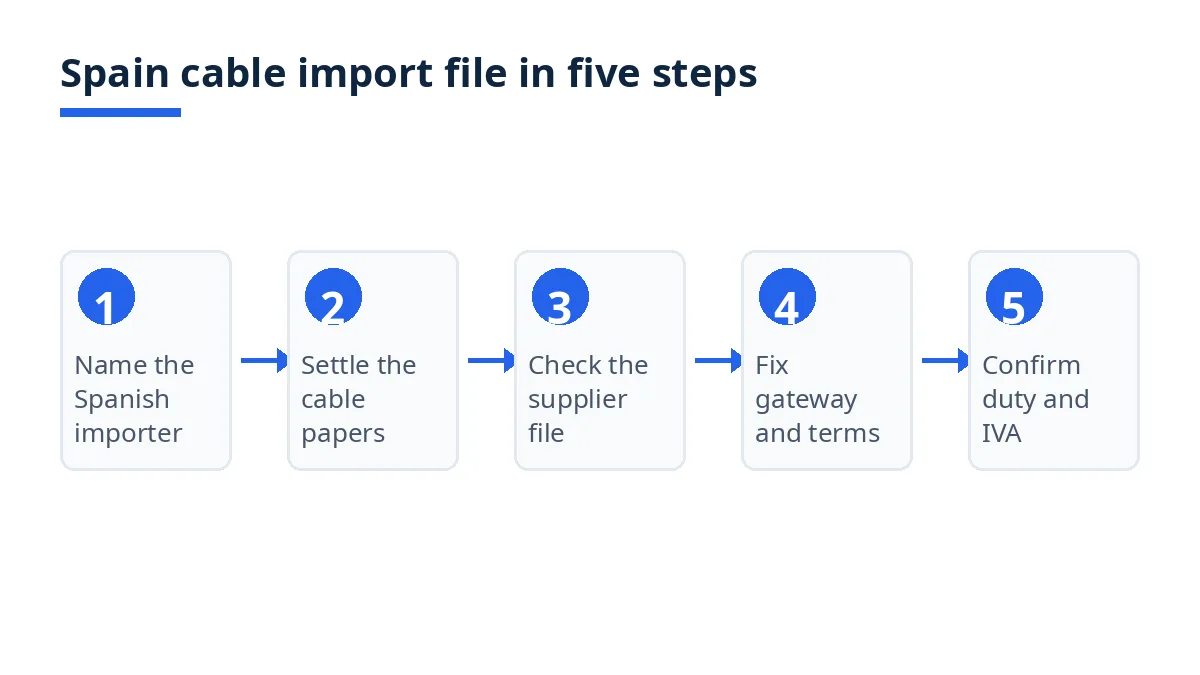
Follow the steps in order. Let no later step reopen an earlier one unless the change is recorded. First, name the importer, any distributor, and the holder of the file, and confirm the EORI number, the NIF link, and Spanish for labels and documents. Second, settle destination and installation setting, and get the class answer from the person answerable for the installation design. Third, settle the documents for the exact construction: the declaration of performance, the UNE-EN reference, the restricted-substances position, and the voltage-band position. Fourth, score suppliers against the Spanish file, approve a sample length in writing, and examine the Spanish label proof. Fifth, settle the quantity and the drum and length terms, and agree the drum sequence with the installer. Sixth, pick the gateway and its terminal, and ask the forwarder to confirm in writing the terminal, storage terms and onward service, with import discharge confirmed at Algeciras where that gateway is chosen. Seventh, choose the delivery rule with places named, and confirm the advance-data filer and the owner of the border file. Eighth, rebuild the landed-cost table from the broker and accountant figures, and price from the rebuilt total. A buyer who keeps to that order will see most problems appear as document questions, where they cost little, rather than as port problems, where they do not.
Questions Spain buyers ask before ordering
What EORI and tax numbers does a Spain buyer need before a cable shipment sails?
An active EORI number is needed, tied to the name that will appear on the declaration, with the Spanish NIF link settled through the AEAT where the number was issued in another Member State.1 Registration takes place on the administration's own initiative for operators whose NIF does not start with N, M, X, or Y. Operators whose NIF starts with those letters and who need an EORI number in Spain must apply through the AEAT electronic office.1 The number serves as a unique reference valid throughout the European Union, and it must appear in every declaration lodged by the trader or on the trader's behalf.2 Settle the IVA number and treatment with the accountant at the same time, covering the mainland or Canary Islands regime for the destination.19
Which Spanish gateway should a cable shipment from Bangladesh use?
Match the gateway to the destination: Algeciras for Andalusia and the south, Valencia for the east coast and the interior, Barcelona for Catalonia and the north-east. Inside each port, the terminal and the onward service decide the choice. At Algeciras, confirm the container discharges for import rather than transshipment, and confirm where the TTI Algeciras expansion stands, with capacity rising to 2.1 million TEU.10 At Valencia, the CSP terminal offers a 2.3 kilometer berthing line and rail links to Madrid, Zaragoza, and Bilbao, and MSC Terminal Valencia averages 1.6 million TEU per year.11 12 At Barcelona, BEST offers dual-gauge rail links into Spain and southern France.13 What decides is the terminal, the onward service that week, the storage terms, and the customs office clearing the goods.
Which fire class does a Spanish building require for its cable?
The class comes in writing from the project specification or from the person answerable for the installation design, for that construction and that building. EN 50575 lays down the reaction-to-fire requirements and test methods for cables in construction works, and EN 13501-6 supplies the scale of classes with their smoke, droplet and acidity ratings.5 6 Neither document picks the class for a building: ensuring a product has the correct characteristics for a particular application rests with the designers, contractors, and local building authorities.7 Ask for the class, the ratings, and the test evidence behind the declaration before ordering, and keep a record of the answer for each site.
What duty and IVA will a Spain buyer pay on electrical cables from Bangladesh?
No duty rate is given in this guide, because no tariff schedule with rates for heading 8544 was consulted while it was written. The rate depends on the code for the exact construction, the measures in force on the import date, and whether origin rule and evidence back a preference — the preference position set out in the border-file section above.18 Have the broker confirm in writing, from the opened schedule, the code, the duty that applies with no preference, the stance on preference, and every other measure in force. Have the accountant confirm the IVA rate, base, and destination regime, noting the 21 percent standard rate on the mainland and the separate IGIC regime in the Canary Islands.17 19 Enter both confirmed figures in the landed-cost table before pricing.
How should a Spain buyer vet a Bangladeshi cable supplier before ordering?
Send every supplier the same written request, and score the replies on documents that name the construction, straight answers on the voltage band, restricted substances and the UNE-EN reference, drum and length terms given as figures, a Spanish label proof, and a delivery rule with its places spelled out. Give written approval for a sample length, keep a marked piece, and require the production drums to agree with the sample on marking and labeling in Spanish. A supplier that will not answer a scope question, or whose documents name a different construction, has failed the check. Go to the next supplier while leaving still costs nothing. Check that the company name, address and bank account name match across quotation, invoice and documents, and pay only the company account the documents name.
How long does shipping take from Bangladesh to Spain?
No transit time is given in this guide. Sailing schedules, terminal congestion, transshipment and the rail or road leg onward all move the arrival date. Ask the carrier or forwarder to give the sailing date, the onward service, and the expected arrival at the named terminal in the actual shipment week, and set the site date from those three figures with a buffer added for inspection. A figure taken from a different route or a different season will mislead the installer. Any promise that treats berthing as release overlooks the declaration and examination work at the terminal.
Next steps on Exportain
Read the Bangladesh import sequence in full for the wider steps that sit around the Spanish file, compare cable makers listed on Exportain against the Spanish file in this guide, and rework your figures with the landed-cost arithmetic for Bangladesh shipments before accepting a quotation. For the code discussion with the broker, take the heading 8544 classification notes with you, and check the ordering route on Exportain before sending an enquiry: the Bangladesh import sequence in full, cable makers listed on Exportain, the landed-cost arithmetic for Bangladesh shipments, the heading 8544 classification notes, the ordering route on Exportain.
Post a free RFQ on Exportain and get quotes from verified Bangladeshi suppliers
Sources
- Registration and identification of economic operators (EORI) or association EORI-NIF. Agencia Tributaria (accessed )
- Economic Operators Registration Identification. Malta Customs (accessed )
- ACI calls on cable supply chain to note their LVD responsibilities. Approved Cables Initiative, (accessed )
- FAQs. UNE (accessed )
- CEI EN 50575 - Power, control and communication cables - Cables for general applications in construction works subject to reaction to fire requirements. Accuris Standards Store (accessed )
- Fire Test And Certification Procedure Of Cables. Efectis, (accessed )
- Construction Products Regulation (CPR) - Regulation (EU) No 305/2011. European Commission (accessed )
- RoHS Directive (2011/65/EU): Substance Restrictions. EUVerify (accessed )
- IEC 60228:2023 - Conductors of insulated cables. International Electrotechnical Commission, (accessed )
- TTI Algeciras submits €150M expansion plan to APBA. Port Technology International, (accessed )
- Valenciaport consolidates its leadership in Southern Europe with the entry of CMA CGM in the capital CSP Iberian Valencia Terminal. Port Authority of Valencia, (accessed )
- Spain - MSC Terminal Valencia - Port of Valencia. TiL Group (accessed )
- Facilities – Hutchison Port Best. Hutchison Ports BEST (accessed )
- Place of delivery & risk transfer in trade contracts. ICC Academy (accessed )
- Import Control System 2. European Commission (accessed )
- Classification Detail — HS 2017 Code 8544: Insulated wire, cable and other electric conductors. United Nations Statistics Division (UNSD) (accessed )
- EU TARIC Lookup — EU Customs Tariff & Combined Nomenclature. HSCODE.UK (accessed )
- EU trade relations with Bangladesh. European Commission, (accessed )
- VAT in Spain: Rates, Registration and Compliance Guide. Taxually, (accessed )
About the author
Sourcing from Bangladesh?
Post a request for quotation and suppliers on Exportain can send you their quotes directly.
Post an RFQ