Netherlands Electrical Cable Imports From Bangladesh: Rotterdam Gateway Guide
Rotterdam entry, EU CPR and CE checks, Dutch customs and a broker-confirmed duty file for importing electrical cables from Bangladesh to the Netherlands, with a worked landed-cost example in euros.
Short answer
Importing electrical cables from Bangladesh to the Netherlands works when the Rotterdam gateway, the European product file and the Dutch customs file are settled before price is discussed. Fix the entry point and first warehouse, hold the Declaration of Performance and fire class for the exact construction, and have the broker confirm the heading 8544 line, duty and any EBA preference.
On this page
Key takeaways
Fix the Rotterdam gateway first: the terminal, the first warehouse, the onward destinations and the delivery term with named places, before any cable is priced.
Settle the Dutch border file early: EORI number, a complete Entry Summary Declaration in ICS2 before arrival, and the DMS import declaration after unloading under the CVB step.
Hold the European product file for the exact construction: the Declaration of Performance with its EN 50575 fire class, the declarations of conformity, and the type-test reports.
No duty rate is stated in this guide: the broker must confirm the ten-digit heading 8544 line, the measures in force and any Everything But Arms preference in writing.
Price on a worked landed cost in euros with duty as a separate line to be inserted, and compare suppliers line by line on the same cost lines.
When a container of cable drums reaches Rotterdam, the hardest border on the journey is already behind it. Goods released for free circulation in the Netherlands can continue to a warehouse in Utrecht, a building site in Eindhoven, or a customer in another Member State with no second customs border on the way. Buyers should plan backwards from that fact: pick the Dutch entry point and the first warehouse first, settle the European product papers second, and shape the customs declaration around both. This guide follows that order for power, control and communication cables sent from Bangladesh in drums and containers to Rotterdam. No duty rate appears here; the broker must confirm it.
Rotterdam's pull comes from position and connections as much as from size. The port calls itself the largest in Europe, reachable around the clock by the biggest vessels, with deep-water terminals and no sea locks between the open sea and the quay, and it lists over 500 liner services of deep-sea, short-sea, feeder and roll-on roll-off type serving more than 1,000 ports.1 Onward links run by barge, train, lorry, feeder vessel and pipeline into the rest of Europe, and many lines make Rotterdam their first European call.1 For a cable buyer that means a real choice at the quayside: drums can travel on by Rhine barge, by rail, by feeder, or by road, and the choice should be made before the container is booked, since it fixes who unloads, who stores, and which delivery term makes sense.
The Rotterdam entry: terminal, first warehouse and onward destinations
Start with three places on one page: the Rotterdam terminal, the first warehouse, and every final destination. A load that will be stored in the Netherlands, split between two projects, and partly sent on to Belgium needs storage, splitting and onward papers arranged before sailing. A load that goes straight from the terminal to a single Dutch site needs a delivery slot and unloading hands at that site instead. Both loads need the same product papers and the same Dutch declaration, but storage, splitting, delivery terms and who pays each charge all differ. Write the three places down at enquiry stage and ask every supplier and forwarder to price that route, not a port name on its own.
Rotterdam is where three sets of papers come together: proof the cable may be sold in Europe, safety and security information sent before arrival, and the customs declaration with classification, origin evidence, duty and VAT. The next two sections deal with the customs set first, and the European product papers follow in condensed form after them.
Dutch customs at the border: EORI, advance filing and the DMS declaration
Identity comes first. Dutch Customs says a business needs an EORI number when it first submits a customs declaration, when it has one submitted for it, or when it applies for an authorisation, and the number costs nothing.2 A business filing its own declarations in the Netherlands can build its own number from the letters NL plus its RSIN padded with zeros to nine digits, use it at once, and have Customs check and register it on first use.2 A business that uses a third party to file, or that files abroad, must apply for the number instead.2 Settle this before the first sailing, because the carrier, the forwarder and the advance filing all need the number.
Safety and security information is sent before the goods arrive. Under the Import Control System 2, a complete Entry Summary Declaration goes into the ICS2 system for every load carried to or through the European Union ahead of arrival, and customs use it for pre-loading or pre-arrival risk analysis.3 That analysis can lead to referrals asking for more detail, for screening of high-risk cargo, or for cargo to be held back from loading, and the referral has to be answered before the assessment can continue.3 The buyer removes the two avoidable causes of referral by giving the filing party full, accurate data early: a complete commercial description of each cable type, the right code, the parties, the weights and the package count, in the form the carrier requests, with written confirmation of who files, at what level, and by which deadline.
The import declaration itself goes in electronically through the Dutch DMS system. The government business portal says goods brought in from outside the European Union must be declared to Customs, the declaration is made electronically via DMS, and a business with little experience should have a shipper, logistics provider or customs agent complete it, while a regular importer may file its own after contacting the National Helpdesk.4 The same portal describes the Container Release Message, the CVB, covering containers, trailers, general cargo and bulk cargo through a Dutch port, under which an import declaration can only be submitted once the goods have been unloaded.4 Build the timetable on that rule: unload, complete the CVB step, file the declaration, then take release. A delivery promise that assumes release at docking has missed a step.
The Chamber of Commerce step plan for importing into the Netherlands sets the commercial order: check restrictions and product requirements, find and check the supplier, agree quotation and Incoterms rule, arrange transport, payment and insurance, file the declaration, allow for import taxes, list documents, work out cost price, and put agreements in a written contract.5 Use that order as the spine of the Rotterdam file and add the cable papers to it: the Declaration of Performance, the declarations of conformity, the test reports, and the origin evidence. Keep one set of papers with the same names, the same construction description and the same quantities throughout, since the declaration, the invoice, the packing list and the bill of lading will be read side by side.
Duty, origin and VAT: what the broker must settle in writing
This guide gives no duty figure. TARIC, the European tariff database, brings together every measure tied to the Common Customs Tariff and to commercial and agricultural legislation, recording third-country duty, tariff preferences, autonomous suspensions, tariff quotas, customs unions, trade defence instruments, prohibitions and restrictions, and surveillance measures.6 That database is the broker's working tool. The broker must confirm the ten-digit code and the measures in force for that code, that origin and the import date, and give the confirmation in writing before the order is priced.
The preference frame for Bangladesh is favourable, and it still has to be claimed properly. Bangladesh, as one of the least developed countries, receives the most favourable treatment in the European Union Generalised Scheme of Preferences through the Everything But Arms arrangement, which opens duty-free, quota-free access to the 46 least developed countries, Bangladesh included, for all products except arms and ammunition.7 The Commission page notes that 91% of Bangladesh's exports to the European Union enter duty-free and quota-free.7 That does not guarantee zero duty on a given cable load. The broker must confirm the origin rule for the product code, whether the cable satisfies it on materials and processing, and which origin evidence must be held before the preference is claimed.7 Keep the origin evidence in the customs file before claiming the preference, and do not budget zero duty until the broker confirms the claim for the construction ordered.
Customs value and VAT are settled on the same papers. The Tax Administration says goods from outside the European Union must be declared to Customs, VAT must be paid to Customs on them, and the VAT may later be deducted or reclaimed as input tax where the goods are destined for the importer named in the declaration.8 For customs value, take the goods value and add carriage, insurance and like charges as far as the European Union's outer border.8 A foreign entrepreneur cannot use the reverse-charge mechanism on import, but a tax representative acting for the entrepreneur can, so that no VAT has to be paid to Customs on the import declaration.8 Ask the accountant or tax representative which route fits the buyer's establishment and registration, and whether import VAT can be settled through the VAT return rather than paid at the border, before the load sails. Dutch VAT runs at 0%, 9% and 21%, with 21% the general rate where no exemption, reverse-charge, 0% or 9% reason applies.9
Movement onward inside the European Union works differently from the import. The business portal says a sale to another Member State is an intra-Community supply and a purchase from another Member State is an intra-Community acquisition, with no declaration of goods to customs authorities needed in either case.4 Once released for free circulation in the Netherlands, a cable sent to a customer in Germany, Belgium or France is a VAT and commercial movement, not a second customs import. Settle the onward VAT treatment with the accountant together with the import treatment, so the invoice for the onward leg carries the right basis.
The European product file, condensed: CPR, CE marking and fire class
Cables that will stay permanently inside construction works fall under the Construction Products Regulation, Regulation (EU) No 305/2011. The regulation sets harmonised marketing conditions for construction products, a shared technical language for stating performance, and the conditions for CE marking.10 In its terms a construction product is placed on the market to stay permanently in construction works, buildings and civil engineering works, where its performance affects how those works perform.10 Apply that test first: a cable that will remain in a building or a civil work is inside the regulation, while one that will not needs another compliance route, and the supplier must say in writing which route covers the construction ordered.
For a product covered by a harmonised standard, the manufacturer draws up a Declaration of Performance, and drawing it up obliges the manufacturer to affix CE marking.10 The declaration states the product-type reference, the assessment and verification systems applied, the harmonised standard reference, the intended uses, and the declared performance for the essential characteristics that matter for those uses.10
EN 50575 is the harmonised standard for this role. In the standard's own scope wording it deals with cables for the "supply of electricity and for control and communication purposes" in construction works where reaction to fire matters, aiming to limit how fire and smoke are generated and spread.11 Put in plainer terms, it grades how power, signalling and fibre-optic cable types behave in a fire. Cable that must keep safety systems such as alarms, way guidance and fire fighting supplied during a fire sits outside this standard, and needs a separate fire-resistance route.11
Classes run from Aca down to Fca. Results are classified under EN 13501-6, weighing gross calorific potential, flame spread, total heat release, peak heat release rate and the Fire Growth Rate Index, alongside extra ratings for smoke, flaming droplets or particles, and acidity.11 The top class rests on the gross heat of combustion test, the middle classes on flame spread, smoke and acidity tests, the basic Eca class on a single-cable flame propagation test, and Fca means no performance was determined.11 No class suits every project. Fire safety rules for buildings and works stay with the Member States, so the class required comes from the Member State rules and the project specifier, not from the manufacturer or the supplier.10 Get the designer or specifier to name the class and the extra ratings, then write them into the purchase order with the standard reference and the declaration reference.
Performance has to stay constant, not just pass once. EN 50575 ties compliance to determination of the product type plus factory production control, with test reports kept for at least 10 years after the last production date of the cables they cover.11 A change in design, raw material, component supplier or production method that would significantly affect a characteristic triggers fresh product-type determination.11 In the higher and middle systems, testing happens by, or witnessed or supervised by, an independent third party, and in the top system under a product certification body.11 Factory production control spans procedures, inspections, incoming materials, equipment, production and the finished product, with each batch traceable to its origin.11 Ask for the declaration, the type-test reports for the class claimed, and a description of production control and traceability for the batch ordered, and hold all three before sailing.
Importers carry their own duties in the regulation summary: make sure the product bears CE marking and travels with the required documents, do not place it on the market when it appears not to match the Declaration of Performance, and make sure transport and storage do not harm its performance.10 A Dutch buyer importing the cable is part of the product file, not outside it: check the mark, the declaration and the documents, and stop goods that do not match.
Safety and substance rules beside the fire file
The Low Voltage Directive, 2014/35/EU, covers safety for electrical cables built to European harmonised standards: alternating-current cable rated from 50 volts up to 1,000 volts, and direct-current cable from 75 volts up to 1,500 volts, and it has applied as a mandatory regime since April 2016.12 Under it, CE marking applies and the manufacturer keeps the technical documentation together with a signed EC Declaration of Conformity.12 The directive sets up no pre-market approval step for cables; instead the manufacturer keeps the supporting papers and the declaration, and national authorities police the market against non-compliant or counterfeit marked cable.12 A cable above that voltage band, or a specialised cable outside the directive, needs its scope settled in writing: ask the supplier to list which directives cover the construction offered, and hold a declaration of conformity naming each one.
Substance rules need the same scope care. The Restriction of Hazardous Substances Directive, 2011/65/EU, restricts hazardous substances in electrical and electronic equipment, covering the equipment categories in Annex I.13 It defines cables in a narrow way: every cable rated below 250 volts that connects equipment to an outlet or links two or more items of equipment, while its prevention article says equipment placed on the market, cables and spare parts included, must not contain the Annex II substances.13 Get the supplier's written answer on whether the construction offered sits within the directive, and demand the same standard of evidence as the fire file when the answer is yes. Where an exemption is claimed, ask which Annex III exemption is relied on, what it covers, and when it expires, and have the compliance adviser confirm it for the construction ordered.
Where the directive bites, limits apply per homogeneous material, a material uniform throughout or one that cannot be taken apart by ordinary mechanical means.13 The Annex II list in the consolidated text opened for this guide names six substances, shown below.13 Later amendments added more substances to Annex II, so the compliance adviser must confirm the list as it stands for the construction and the order date before any table is treated as complete.
Substance | Maximum concentration by weight in homogeneous material |
|---|---|
Lead | 0.1% |
Mercury | 0.1% |
Cadmium | 0.01% |
Hexavalent chromium | 0.1% |
Polybrominated biphenyls (PBB) | 0.1% |
Polybrominated diphenyl ethers (PBDE) | 0.1% |
Keep test evidence or a supplier declaration naming the construction, the substances tested and the limits used, with the declaration of conformity covering the substance rules beside the other declarations. Ask the supplier to confirm in writing whether the construction is in scope, and have any claimed Annex III exemption confirmed by the compliance adviser.
Agreement at the checkpoint: code, conductor and compounds
At Rotterdam the question is agreement, not appearance. The customs declaration, the Declaration of Performance, the test reports and the drum label must all describe one and the same cable. When they differ, the load is not the load that was assessed, and the goods should stay put until the difference is explained in writing. Voltage band, connector position and conductor metal are the three entries that diverge most often, and each one moves classification, the fire file, or both, so fix each in the order and check each on arrival.
The classification the broker uses divides the heading by use and voltage: winding wire in copper and in other materials, coaxial cable, ignition wiring sets, conductors up to 1,000 volts with connectors fitted and without, conductors over 1,000 volts, and optical fibre cable.14 The United Nations detail for the heading gives the six-digit lines behind that split: 854411 and 854419 for winding wire, 854420 for coaxial, 854430 for wiring sets, 854442 and 854449 for conductors to 1,000 volts with and without connectors, 854460 for conductors above 1,000 volts, and 854470 for optical fibre cable.14 A building power cable usually lands on the 854449 or 854460 lines, depending on voltage band and connector position, but the broker fixes the ten-digit European line from the exact construction.
Conductor detail belongs inside this checkpoint. The IEC conductor standard works in metric sizes, from half a square millimetre up to three thousand five hundred square millimetres, and pairs each nominal size with wire numbers, wire sizes and resistance figures, for solid, stranded and Milliken copper, aluminium and aluminium alloy conductors in fixed installations and flexible copper conductors.15 The order should cite the standard edition, the metal, the class or construction, and the nominal size, and the test evidence should show the resistance figures for that size and class.
Insulation and sheath compounds belong at the same checkpoint, since they shape the fire results. EN 50575 grades fire behaviour on heat release, flame spread, smoke and acidity, and the compounds in the insulation and the sheath help produce those results.11 Name the insulation compound and the sheath compound in the order exactly as the test evidence states them, whether PVC, cross-linked polyethylene (XLPE) or another compound, and require the same compounds in the production batch. A compound change after the type test can shift the declared class.11 Require written notice before any change to conductor, insulation compound, sheath compound, marking or factory, and treat an unannounced change as a reason to hold the batch and ask for fresh evidence.
Marking and traceability finish the checkpoint. EN 50575 production control keeps batches identifiable and traceable to their origin, with written procedures for traceability codes and markings and regular checks of the marking process.11 The low-voltage route adds sheath markings naming the manufacturer.12 At arrival, the receiver should read every drum label, set it against the declaration and the test reports for the same construction, note the batch or lot numbers, and photograph each label with the drum number in view. Whether the cable suits the installation is a separate matter from product conformity: the installer or designer must confirm cable type, voltage rating, installation method and location against the Dutch installation rules for the job, including any fire-performance demand the project sets, and that confirmation goes in the order file with the product papers.
The Rotterdam document pack: choosing a supplier on paper first
Lead with the Rotterdam customs file, not with a sales catalogue. Before any supplier is scored, write down what the Dutch declaration will need: the ten-digit code the broker confirms, the origin evidence, the Declaration of Performance, the declarations of conformity, the test reports, and the commercial papers. Then judge each supplier by whether it can fill that file for the exact construction, in the exact terms, before money moves. A supplier strong on price and weak on papers will cost more at Rotterdam than a supplier whose file is complete.
Group what you ask for into three files. The customs file holds business registration and factory details, the code and origin evidence, and the commercial invoice and packing list in matching terms. The product file holds the Declaration of Performance with its class and standard reference, the declarations of conformity for the directives the supplier says apply, the type-test reports for the standard and edition named in the order, the production control description, and photographs of the drum label and sheath marking. The commercial file holds the quotation in price parts, the drum-length schedule, the delivery term with named places, the deposit and payment terms, and the inspection and remedy terms. Use the Exportain supplier listings to find candidates, and score each listing against those three files. For the steps that sit around the cable decisions, the general Bangladesh import sequence lays out the wider order of work.
Agree the money terms in writing before a deposit: what the deposit covers, what follows a failed sample, and what follows production evidence that does not match the sample.
Check references for the same work, not for other work. A reference covering another cable family, another voltage band or another market does not support this order. Ask each reference whether the construction kept its class across batches, whether changes were notified before shipment, and whether rejected drums were replaced without a dispute. Ask the supplier three things: will it work to an inspection scope the buyer writes, will it stop a load that fails inspection, and how quickly does it swap a rejected drum?
Quantities, samples and price parts on a gateway timetable
Treat the sample as a production twin. It must match the bulk order in construction, conductor metal and size, insulation and sheath compounds, voltage rating and marking, and come cut from the same kind of drum the bulk load will use. Check it against the order and the test evidence: read the marking, measure the length, and have someone able to spot a report written for another construction read the test evidence. A sample that looks right and reads wrong has failed, and the failure should be recorded against the report reference that proves it.
No single minimum quantity fits every cable, because drum lengths, conductor sizes and production runs change with the construction, and a Rotterdam load adds the container and the onward leg to the count. Fix the counting basis before fixing the price: metres on each drum, drum count, and total metres, with the tolerance on drum length written into the order. For a first order, work from the job length, then add a named margin covering offcuts, testing and spares, and record that margin in the order. Put the drum-length schedule in the purchase order, with the rule for short drums, the total-length tolerance, and how a short drum is priced.
Keep the price in parts in every quotation: the cable price on the agreed delivery term, drum and packing charges, testing and inspection charges, international freight, insurance, import duty, import VAT, broker charges, terminal and storage charges at Rotterdam, and inland delivery to the warehouse or site. Metal prices move, so settle the pricing basis and the date it locks, with a written rule for a metal move between quote and production. Link each payment to a checkable paper: signed order and product file ahead of production, inspection findings ahead of shipment, and shipping papers that match the order.
Moving the container: delivery terms from Chattogram to the Dutch warehouse
Four Incoterms 2020 rules are confined to sea and inland waterway transport: FAS, FOB, CFR and CIF. CPT is any-mode. DPU is any-mode. DDP is any-mode, with the seller clearing import customs and paying duty, and the buyer unloading the goods.16 That split decides the Rotterdam plan. FAS and FOB place delivery beside or on the vessel, fitting cargo passed over at the quay, while FCA names a delivery place and usually fits boxed cargo better even with a sea leg to follow, because the carrier takes the box ahead of the port.16
For drums in boxes, the mode point matters at the terminal. A box is given to the carrier at the terminal days before loading, so a sea-only rule leaves the interval between handover and loading unclear on risk. FCA removes that gap by moving delivery and risk to handover at the named place, while FOB keeps the move at loading on board. Under CFR, CIF, CPT and CIP the seller books and pays the carriage to the agreed destination, yet risk moves to the buyer earlier, at handover to the carrier or at loading for the sea rules, and the two I-rules add seller-arranged insurance.16 Under DAP, DPU and DDP the seller carries the load to the named destination and risk moves there, with DPU adding unloading by the seller and DDP adding import clearance and duty payment by the seller.16 Pick the term that fits who will actually handle the box, the drums and the Dutch file, and name each place in full: factory or depot, loading port, Rotterdam, and the Dutch or onward delivery point.
Do not take DDP from a seller unable to show how it will clear import in the Netherlands and pay duty and VAT, and do not take DAP for delivery onward to another Member State without settling who handles the intra-Community VAT movement. Set the packing and stowage rule for drums in the same document: drum orientation, securing, protection from moisture and sheath damage, loading photographs of the container, and who bears the cost of damage found at unloading. No transit time is given here: nothing opened for this guide stated a sailing or routing time for cable loads on this lane. Ask the carrier for written confirmation of routing, sailing schedule, transhipment points and expected arrival, and ask the broker what declaration, examination and further checks may add at Rotterdam.
Worked landed cost in euros, with duty left for the broker
The figures below are examples only. Every figure is illustrative, duty is left out because no TARIC schedule was opened, and VAT appears as a separate calculation the accountant must confirm. The load in the example is 6,400 metres of a three-core cable in drums from Chattogram to Rotterdam, with the buyer arranging freight and insurance after the loading port.
Cost line | Example figures (EUR) | Basis |
|---|---|---|
Goods, 6,400 metres at EUR 4.25 per metre | 27,200.00 | Illustrative |
Ocean freight and marine insurance to Rotterdam | 2,350.00 | Illustrative |
Pre-shipment inspection and laboratory retest | 610.00 | Illustrative |
Customs broker and DMS declaration charges | 480.00 | Illustrative |
Terminal, storage and drayage to the warehouse | 940.00 | Illustrative |
Duty | Awaiting broker confirmation | Excluded from the total below |
Total before duty and VAT | 31,580.00 | Five example lines added together |
Cost per metre before duty and VAT | 4.93 | Total divided by the metre count |
The arithmetic runs: EUR 27,200.00 plus EUR 2,350.00 is EUR 29,550.00; plus EUR 610.00 is EUR 30,160.00; plus EUR 480.00 is EUR 30,640.00; plus EUR 940.00 is EUR 31,580.00; and EUR 31,580.00 divided by 6,400 metres is EUR 4.934375 per metre, shown as EUR 4.93. Customs value for duty and VAT in this example is EUR 29,550.00, the goods value plus freight and insurance to the external border of the European Union.8 VAT at the 21% general rate on that customs value, before any duty, would be EUR 6,205.50, and the accountant must rework the VAT figure once the broker confirms duty, since VAT is charged on the duty-paid value and the accounting route may change the cash position.9 Run the same lines for each quote, following the landed-cost method set out for Bangladesh trade, so suppliers are compared line by line rather than on one goods price.
Gateway sequence: from enquiry to onward delivery
Work the steps in order, filing each step's papers before starting the next. The diagram below puts the sequence on a single page.
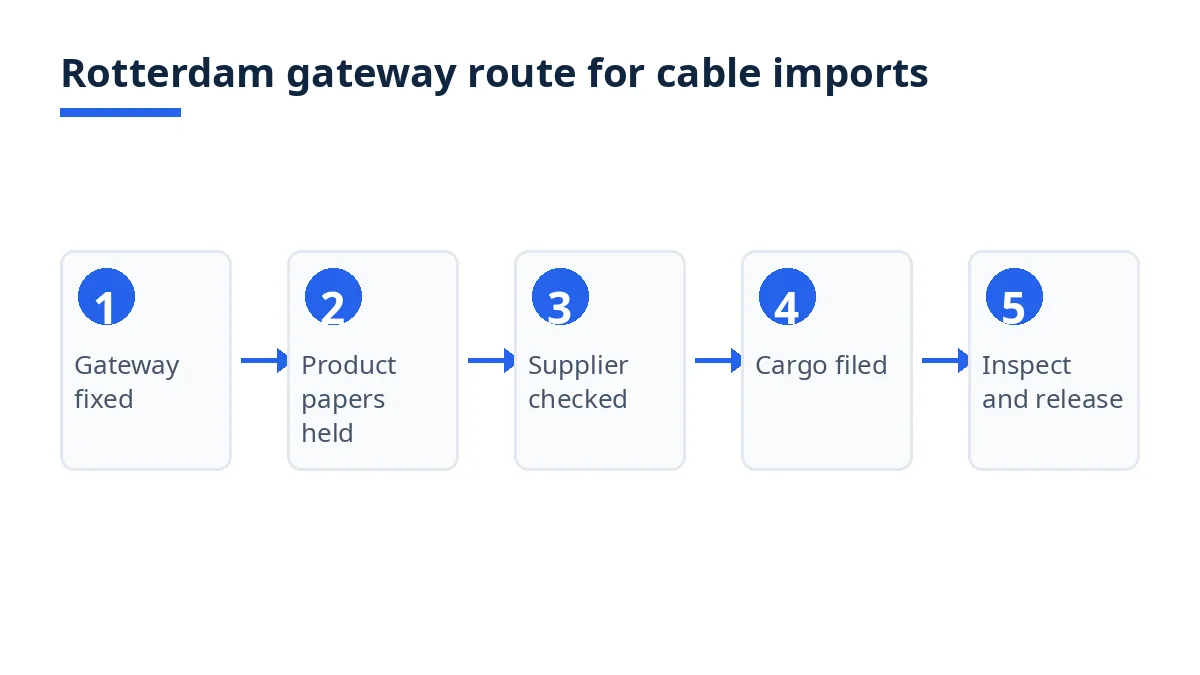
Fix the gateway: Rotterdam entry, first warehouse, onward destinations, and the delivery term with named places.
Hold the European product papers for the exact construction: Declaration of Performance with its class, declarations of conformity, and type-test reports.
Judge the supplier on the three-file document pack, with checkable references for the same cable family, and agree deposit, inspection and remedy terms in writing.
Take a sample twin of the production construction, set it against the order and the test evidence, and confirm counting basis, drum schedule and price parts.
Hand the filing party complete advance cargo data, confirm who files the Entry Summary Declaration and by when, and settle the EORI position.
Inspect drum by drum against the order: declaration and label agreement, length, condition and lot-matched test evidence, and hold any drum that fails.
Ship on the agreed term, file the DMS declaration after unloading under the CVB step, and clear the load with the broker-confirmed code, duty and VAT position.
Recheck drums, lengths and markings at the warehouse, release the cable to the project or the onward leg, and file order papers with the product and customs papers together.
How does a Netherlands buyer check a cable supplier before the first Rotterdam shipment?
Work from the papers, not the promises. Gather the Declaration of Performance for the exact construction with its fire class, the declarations of conformity for the directives the supplier says apply, the type-test reports for the standard and edition in the order, the production control description, and photographs of the drum label and sheath marking. Set the declaration beside the test reports for the same construction, and set the drum label beside the declaration on the sample and again at arrival. A supplier that cannot produce the file for the exact construction, or that refuses a buyer-written inspection scope, has not passed.
Which fire class does a cable need for a building project in the Netherlands?
This guide names no class for the question, because the class comes from the Member State rules and the project, not the manufacturer. EN 50575 offers the classes from Aca to Fca with extra ratings for smoke, flaming droplets and acidity, and the project specifier or designer must say which class and which extra ratings the building demands.11 Write that class into the purchase order with the standard reference and the declaration reference, and hold the declaration and type-test reports for the exact construction. Cable that must keep safety installations running falls outside EN 50575, and needs its own fire-resistance route.11 An offer naming a class with no declaration and no test reports for the construction ordered has not answered the question.
What import duty does a Netherlands buyer pay on electrical cables from Bangladesh?
This guide gives no rate, because no TARIC schedule for heading 8544 was opened while it was written. TARIC is the database the broker uses, bringing together the Common Customs Tariff measures, tariff preferences, suspensions, quotas and trade defence instruments.6 The broker must confirm the ten-digit code, the third-country duty, any preference, and any further measure fitting the construction, origin and import date, in writing before the order is priced. Bangladesh receives duty-free, quota-free access under the Everything But Arms arrangement for all products except arms and ammunition, but the preference still has to be claimed correctly with the origin evidence for the code.7
What order size should a first Netherlands cable order use?
Size the first order to the job and the route, not to a catalogue figure. Total the route lengths, add the named margin for offcuts, testing and spares, turn the total into drums at the drum length offered, and allow for the container and onward-leg limits at Rotterdam. Too small an order raises the per-metre cost and leaves nothing in hand when a drum arrives short or damaged; too large an order locks cash in a construction not yet installed. Fix the drum length and tolerance in the order, check the first drums against that tolerance before the balance ships, and phase the order where the project is phased, proving the cable and the supplier on the first phase before the later phases are committed.
Next steps on Exportain
Begin with the gateway decision, then build the shortlist. Read the Exportain supplier listings against the three-file document pack in this guide, check how ordering through Exportain works before sending enquiries, and take the heading 8544 classification notes to the broker when the code is in doubt.
Post a free RFQ on Exportain and get quotes from verified Bangladeshi suppliers.
Sources
- The port that will take you ahead. Port of Rotterdam (accessed )
- How to obtain an EORI-number. Dutch Customs (accessed )
- Import Control System 2. European Commission (accessed )
- Declaring goods to Customs. Business.gov.nl (accessed )
- Standard steps for importing into the Netherlands. Netherlands Chamber of Commerce (KVK) (accessed )
- EU Customs Tariff (TARIC). European Commission, Taxation and Customs Union (accessed )
- EU trade relations with Bangladesh. European Commission, (accessed )
- Import from non-EU countries to the Netherlands. Dutch Tax and Customs Administration (accessed )
- VAT tariffs. Tax Administration (Belastingdienst) (accessed )
- Construction products. EUR-Lex (accessed )
- SIST EN 50575:2014 - Power, control and communication cables - Cables for general applications in construction works subject to reaction to fire requirements. Slovenian Institute for Standardization (accessed )
- Low Voltage Directive. Eland Cables (accessed )
- Directive 2011/65/EU on the restriction of the use of certain hazardous substances in electrical and electronic equipment. EUR-Lex (accessed )
- Classification Detail — HS 2017 Code 8544: Insulated wire, cable and other electric conductors. United Nations Statistics Division (UNSD) (accessed )
- IEC 60228:2023 - Conductors of insulated cables. International Electrotechnical Commission, (accessed )
- FCA & FOB Incoterms 2020 explained: Key differences. ICC Academy (accessed )
About the author
Sourcing from Bangladesh?
Post a request for quotation and suppliers on Exportain can send you their quotes directly.
Post an RFQ