Germany Electrical Cable Imports From Bangladesh: CPR, Duty and Checks
Germany-first checklist for importing electrical cables from Bangladesh: CPR fire class and Declaration of Performance, Low Voltage Directive band, EMC and RoHS files, VDE-mark expectations, supplier evidence, drum inspection, Incoterms, broker-confirmed duty and a worked landed-cost example in euros.
Short answer
Importing electrical cables from Bangladesh to Germany works when the fire-performance file and the electrical-safety file are settled before price. Get the reaction-to-fire class from the German project, hold the Declaration of Performance and the EU declarations for the exact construction, screen suppliers on that evidence, and have the broker confirm the heading 8544 code, any EBA preference, and import VAT before quoting.
On this page
Key takeaways
Get the reaction-to-fire class from the German project first: the CPR does not set the class a building needs, so the designer or building specification must name the class and the smoke, droplet and acidity ratings.
Hold the Declaration of Performance for the exact construction and class, with the assessment-system evidence the class requires, plus the EU Declaration of Conformity covering the Low Voltage Directive, EMC and RoHS positions.
Place the cable in the Low Voltage Directive band by rated voltage, and settle the VDE-mark question, mark, body and certificate scope, before the order, not at the port.
Match the construction to IEC 60228 for the conductor and IEC 60502-1 for the cable, naming part, edition and voltage, and keep the EU file for the same construction.
Have the broker confirm the heading 8544 code, the TARIC rate, the EBA origin rule and evidence, and import VAT treatment in writing, and rework the landed-cost table with those figures; no duty rate is stated in this guide.
A German buyer ordering electrical cables from Bangladesh faces two files at once. One file is the fire-performance file for cables that stay in a building: the reaction-to-fire class, the Declaration of Performance, and the CE marking that follows it. The other is the electrical-safety file: voltage band, substances, and the German market's expectation of third-party testing. Price belongs after both files, not before them. The ten checks below run in the order a buyer in Germany should clear them, for power, control and communication cables that arrive on drums in containers, enter through a German port such as Hamburg, and are then fixed permanently in construction works. Where a figure depends on the broker or the project designer, the text says so.
Check 1 — Confirm the cable falls under the CPR fire rules, and get the class in writing
Regulation (EU) No 305/2011 lays down harmonised conditions for the marketing of construction products, and it defines a construction product as a product produced and placed on the market for permanent incorporation in construction works.1 A cable incorporated permanently in a building or civil engineering works can therefore sit inside that regulation, while a loose lead or patch cord may sit outside it. Settle which side of that line the cable on order falls on, with the project designer, not with the seller alone. Ask the designer to state whether a reaction-to-fire class is required for the building and route, and if so, which class and which additional ratings for smoke, droplets and acidity the project needs.
Where the regulation applies through the harmonised standard EN 50575, the manufacturer draws up a Declaration of Performance when the product is placed on the market, and by drawing it up the manufacturer takes responsibility for the conformity of the product with the declared performance.1 The declaration must state the product-type reference, the assessment system, the harmonised standard reference and date for each essential characteristic, and the intended use.1 The CE marking is then affixed to construction products for which a declaration has been drawn up, and it must not be affixed where no declaration has been drawn up.1 A CE mark on a drum label proves nothing on its own. Hold the declaration, and check its product-type reference and declared class against the order and the designer's answer.
EN 50575 is the standard that sets reaction-to-fire requirements, test and assessment methods for electric cables used for the supply of electricity and for control and communication purposes, intended for use in construction works and subject to performance requirements on reaction to fire.2 It covers power cables, control and communication cables, and optical fibre cables.2 The classes run from Aca at the highest end of reaction-to-fire performance down to Fca, where the requirements for Eca are not met and performance is undetermined: Aca, B1ca, B2ca, Cca, Dca, Eca and Fca.2 3 Alongside the class, additional ratings describe smoke production, the occurrence of flaming droplets or particles, and acidity.3 The class, with its additional ratings, is what the declaration must carry, and the test reports behind it must name the same cable type.
The assessment route changes with the class. For Aca, B1ca and B2ca the system is 1+, with a notified product certification body for type testing, factory production control inspection and audit testing.2 For Dca and Eca the system is 3, with a notified testing laboratory for initial type testing.2 For class Fca the system is 4: no reaction-to-fire performance is declared, and the manufacturer may carry out the type testing and assessment itself.2 Ask which system the offered class was assessed under, and hold the matching notified-body or notified-laboratory evidence.
One further point is where German orders most often stall. The Construction Products Regulation does not set the class a given building needs. It does not impose on Member States the requirements for types of buildings and associated cables with specific fire-reaction classes; those requirements rest on a risk analysis by the installation designer or on national formal and legal documents, and each Member State introduces its own requirements for buildings.3 The class answer must come from the German project — the designer, the building specification, or the accepting authority — and be recorded in the order file with the name of the person who gave it.
Check 2 — Place the cable in the Low Voltage Directive band, or outside it
The second file starts with voltage. The Low Voltage Directive, Directive 2014/35/EU, addresses safety requirements for electrical cables manufactured to European harmonised standards with a voltage rating of 50 V to 1,000 V for alternating current and 75 V to 1,500 V for direct current, and it has been mandatory since April 2016, superseding the earlier directive.4 Cables in that band need CE marking under the directive, denoting that the cable meets the relevant legal, health and safety requirements, and they must bear sheath markings identifying the manufacturer, so the cable can be traced through the supply chain.4 The directive requires a full range of technical documentation, including an EC Declaration of Conformity held on file by the manufacturer.4 There is no formal conformity-assessment process to complete before such cables are made available for sale, so the documentation file is the thing to hold.4
Place each cable on order against that band before anything else is agreed. A cable rated below 50 V AC or 75 V DC, a cable rated above 1,000 V AC or 1,500 V DC, and a specialised cable for ships, aircraft or railways that complies with safety provisions drawn up by international bodies may sit outside it.4 The exclusions sit in Annex II.4 Write the rated voltage in the Uo/U form on the enquiry, ask the supplier to state in writing whether the construction offered falls inside the directive, and hold the EU Declaration of Conformity that names the directive and the harmonised standards relied on, for the exact construction. A declaration that names only the Construction Products Regulation does not settle the Low Voltage Directive question, and the reverse is equally true.
Language belongs in this check as well. Under the Construction Products Regulation, the declaration must be supplied in the language or languages required by the Member State where the product is made available.1 For a cable made available in Germany, ask for the declaration and the accompanying instructions and safety information in German, or in German alongside English, and record the language agreed in the order.
Check 3 — Ask the EMC and RoHS questions separately, in writing
Electromagnetic compatibility and hazardous substances are two further questions, and each must be answered on its own, because a cable can pass one and fail the other. The Electromagnetic Compatibility Directive, Directive 2014/30/EU, aims to ensure that electrical and electronic equipment complies with an adequate level of electromagnetic compatibility in the EU, laying down uniform rules so equipment neither causes intolerable disturbance nor degrades in the presence of disturbance.5 Its scope covers fixed installations and other apparatus, with exclusions including radio equipment, custom evaluation kits, inherently benign equipment and certain airborne equipment.5 For apparatus, the manufacturer carries out a conformity assessment, draws up technical documentation and an EU Declaration of Conformity, and affixes the CE marking; importers check the assessment, documentation, marking and accompanying documents, and keep the documentation for 10 years.5
A plain power cable with no active electronics may be inherently benign. A cable assembly with control electronics, or a cable supplied as part of a fixed installation, may need a different answer. Ask the supplier to state, in writing and for the construction on order, whether the directive applies, and if it does, hold the same file as for the Low Voltage Directive: assessment, technical documentation, declaration, and marking. If it does not apply, hold the reasoning in writing.
The hazardous-substances question runs under Directive 2011/65/EU, the RoHS Directive. Member States must ensure that EEE placed on the market, including cables and spare parts, does not contain the Annex II substances above the maximum concentration values by weight in homogeneous materials.6 The Annex II list, as consolidated, contains ten substances: lead at 0.1%, mercury at 0.1%, cadmium at 0.01%, hexavalent chromium at 0.1%, polybrominated biphenyls at 0.1%, polybrominated diphenyl ethers at 0.1%, and the four phthalates DEHP, BBP, DBP and DIBP, each at 0.1%.6 The limits apply per homogeneous material, not per finished cable, so a declaration must name the materials tested, and any exemption relied on must be the current Annex III exemption for that use. Hold laboratory evidence or a supplier declaration naming the construction, substances and exemption, and the RoHS declaration of conformity.
Check 4 — Read the German market expectation: what a VDE mark does and does not do
German buyers, installers and distributors often ask for a VDE mark, and a Bangladeshi seller may offer one, or may offer a cable with no third-party mark at all. Both positions need the same treatment: name the mark, name the body, and name the scope. The VDE Institute states that the VDE mark has been a globally recognised safety mark for electrotechnical devices, components and systems since 1920, identifying products that comply with national and international standards and legal guidelines.7 It is a certification mark, not the CE marking: the CE marking is the manufacturer's statement of conformity with EU legislation, while a VDE mark shows a named body examined the product against named standards. A VDE mark on a catalogue page does not replace the Declaration of Performance or the EU Declaration of Conformity.
Ask three questions, and hold the answers in writing. First, which mark is offered, and which body issued it: VDE, another European certification body, or none. Second, which standards and cable types the mark covers, with the certificate number and scope, so the buyer can check scope and currency. Third, whether the German customer, installer, or distributor for this job requires a third-party mark at all, and if so, which one. Where the job requires a mark, write the mark, the body, and the certificate scope into the purchase order, and require the mark to appear on the drum label and the cable sheath in the form the certificate allows. Where the job does not require one, record that decision, and do not pay a premium for a mark the job never asked for.
The same discipline applies to national designations a seller may quote, such as harmonised-document (HD) types or German national cable types. Ask the seller to write the designation, standard and edition in full on the quotation, and treat a bare type code with no standard behind it as an unanswered question.
Check 5 — Match the construction to IEC 60228 and IEC 60502, without mixing the two files
Cable construction facts belong inside the German decisions above, not as a separate lecture. Two IEC standards carry most of the construction file for the cables in this article, and each does a different job. IEC 60228:2023 fixes the nominal areas for conductors in power cables and cords — 0.5 mm2 to 3,500 mm2 — with the wire numbers and sizes and the resistance values for each area.8 It covers copper, aluminium and aluminium-alloy conductors — solid, stranded and Milliken builds — for fixed installations, plus flexible copper conductors, but not telecommunications conductors.8 The standard speaks to conductors in the finished cable, not to a conductor as supplied for inclusion in a cable.8
IEC 60502-1:2021 sets out how power cables with extruded solid insulation are built, sized and tested, at the 1 kV and 3 kV ratings (Um 1.2 kV and 3.6 kV), for fixed installations such as distribution networks and industrial sites.9 It supersedes the 2004 edition with its 2009 amendment.9 Name part, edition and rated voltage in the specification, and require test evidence to match them. A quotation that names only "IEC 60502" with no part, no voltage and no edition is incomplete.
The IEC file proves how the cable is built and tested; the EU file proves the fire class, LVD, EMC and RoHS positions for the same construction. Require both sets of evidence for the same construction, metal, area, insulation compound and sheath. Where a seller offers only IEC evidence, do not treat it as EU evidence: ask, in writing, what further assessment the exact construction needs for the German market, and price and schedule it before a delivery date is promised. A Declaration of Performance does not prove the conductor area, and a conductor test report does not prove the fire class.
Name the insulation compound family, the core count and identification, the screen or armour, the sheath, the drum length and tolerance, and the cable and drum marking in the specification, and have the seller confirm the marking from a sample length and a drum photograph before production.
Check 6 — Screen suppliers on documents the German file needs, before any payment leaves your account
A supplier shortlist for Germany should be built from the file the German market needs, not from the breadth of a catalogue. Start from the class, voltage band and construction the project needs, and ask each supplier for the same pack: business registration and factory details; the Declaration of Performance for the exact construction and class, with the notified-body or notified-laboratory evidence for that class; the EU Declaration of Conformity covering the Low Voltage Directive, EMC and RoHS positions for the exact construction; laboratory reports tied to the named IEC part and edition; photographs of the sheath marking and drum label; and reference customers for the same cable family, whom the buyer may contact.
Use the Exportain supplier listings to build the shortlist, and read each listing against the pack. The wider import sequence is set out in the steps that sit around a Bangladesh shipment. Pay no deposit until the pack is in hand and the sample matches it. Put the deposit terms in writing: what the deposit pays for, the remedy if the sample fails, and the remedy if production papers differ from the sample. If a supplier will not put the construction, class, standard, marking and evidence in writing before a deposit, move to the next supplier.
Production control belongs in the same pack, and it is the part buyers most often skip. Ask how the factory holds a tested build steady, which changes trigger fresh testing or a fresh assessment, how changes are flagged before shipment, and how drums link to reports and material lots. Require written notice before any such change, and require the seller to hold shipment until the buyer, or the buyer's inspector, has seen the fresh evidence for the changed construction.
Check 7 — Order samples, quantities and prices on stated bases, not on totals
Treat the sample as a production length. Ask for it wound on a drum, carrying the sheath marking, voltage rating and drum label of the bulk order, and compare it line by line with the specification and the laboratory papers. Keep the sample, with its label, until the bulk order has been checked on arrival in Germany.
Minimum quantities differ by construction: drum lengths, conductor area and production runs all move them, and nothing opened for this article stated a minimum figure for electrical cables from Bangladesh. Fix the minimum with each supplier for each shipment, in writing, and in the same sentence fix how the quantity is counted — metres, drum count and total metres, the length tolerance per drum, and the rule for short lengths. A per-metre price stays open until drum length, drum count and tolerance are fixed; a per-drum price stays open until the metres on the drum are fixed.
Read every quotation in parts, and keep the parts separate in every comparison. Break each quotation into its parts and compare part with part: goods on the agreed delivery term, drums and packing, testing and inspection, freight, cover, duty, VAT, brokerage, and carriage to the German site. Agree the metal-price basis and the date it is fixed, and what happens if it moves between quotation and production. Link every payment to a paper you can read: signed specification and evidence first, then the inspection report, then shipping papers that match the order.
Check 8 — Inspect drums, lengths and labels before loading
Inspection is cheapest at the factory and most expensive at the German site. For a first order, have the drums inspected before loading, under an instruction that repeats the specification and the German file word for word: construction, conductor metal and area, insulation compound, voltage rating, cores, armour and sheath, the fire class and its additional ratings, drum lengths, and marking.
At the drum, four checks catch most problems, in this order. First, labels: read the drum label and the sheath marking, and compare the product-type reference, the class, the voltage rating, and the manufacturer identification with the declaration and the order. Second, lengths: have each drum length measured or witnessed against the order tolerance, write every length on the packing list, and agree the total with the invoice before the container is sealed. Third, outer condition: check flanges, battens and sheath for damage and damp, and set aside any drum unfit for the sea move. Fourth, papers: compare the laboratory reports for the production lot with the lot numbers marked on the drums, and check that the notified-body or notified-laboratory evidence matches the class and the assessment system. If a drum fails, hold it until the failure is corrected and rechecked, and record the hold, correction and recheck in writing.
Under the Construction Products Regulation, importers must ensure that, while a construction product is under their responsibility, storage or transport conditions do not jeopardise its conformity with the declaration and its compliance with the other applicable requirements.1 State the drum orientation, securing method, moisture protection, and who loads and unloads, in the same document as the inspection instruction, and require container loading photographs.
Check 9 — Choose the Incoterms rule for a container of drums, and name every place
Agree the delivery term before agreeing the price. Four Incoterms 2020 rules — FAS, FOB, CFR and CIF — are limited to sea and inland waterway carriage. CPT and CIP, DAP, DPU and DDP are not: each of those five works under any mode. DDP alone puts German import clearance and the duty bill on the seller, while the buyer still unloads; under DPU the seller both delivers and unloads, and the buyer clears the import.10 Under FCA the seller clears the goods for export and hands them to a carrier named by the buyer; under CPT and CIP the seller funds carriage to the named destination, with risk passing on handover to the first carrier; under CIP the seller also buys all-risks insurance, while under CIF the cover is the minimum level unless the parties agree more.10
For drums in containers, that division has a direct consequence. A container is handed to the carrier at a yard or terminal long before it is loaded on a vessel, yet under FOB risk stays with the seller until loading. For containerised cargo, FCA is the correct choice, because the handover to the carrier is the point that matches the physical move.10 CFR and CIF carry the same gap for containers.10 Name the places in full: factory or depot, port of loading, German port, German delivery point. Name the Incoterms edition too: FCA Chattogram, Incoterms 2020.
Agree the container and drum handling in the same conversation, and ask the forwarder for the sailing plan and a written transit estimate for that sailing. No transit time is stated here: nothing opened for this article gave a duration for the Bangladesh-Germany cable lane. Ask the carrier to confirm routing, sailing, transshipment points and scheduled arrival in writing, and ask the broker how long entry and examination may add at the German port. Have the border file ready before the vessel sails rather than after it docks.
Check 10 — Settle duty, preference and import VAT with the broker, in that order
Duty, preference, and import VAT must be settled in that order, because each one feeds the next. The broker settles classification first, from the cable facts fixed in the specification: conductor metal, voltage band, connector fitting, telecommunications kind, and optical fibre or electric conductor.
Broker question | Subheading area | What the answer changes |
|---|---|---|
Is the cable winding wire, and of copper or of another material | 8544.11 or 8544.19 | Winding-wire subheading |
Is the cable coaxial, or another coaxial conductor | 8544.20 | Coaxial subheading |
Is it an ignition or other wiring set for vehicles, aircraft or ships | 8544.30 | Wiring-set subheading |
Is the conductor fitted with connectors, at no more than 1,000 V | 8544.42 | Fitted-conductor subheading; separate telecoms line |
Is the conductor not fitted with connectors, at no more than 1,000 V | 8544.49 | Unfitted-conductor subheading; separate lines by voltage and kind |
Is the conductor for a voltage over 1,000 V | 8544.60 | Higher-voltage subheading |
Is the cable an optical fibre cable | 8544.70 | Optical fibre subheading |
The European Commission's TARIC consultation database is the route for looking up a goods code and a geographical area, and it is searched by goods code, origin or destination, and additional code.11 The TARIC schedule for heading 8544 was not opened with rates in the preparation of this article, so no duty rate for any 8544 line is stated here. Have the broker open the TARIC schedule for the exact TARIC code, the entry date, and Bangladesh as origin, and put the third-country rate, any preference rate, and any additional duty in writing before the purchase order is priced. Any specification change after confirmation must go back to the broker, because a change in metal, voltage band, or connector fitting can change the subheading.
Preference is the second step. Bangladesh, as a least developed country, benefits from the most favourable GSP regime, the Everything But Arms arrangement, which gives the 46 least developed countries access without duty or quota for every product except arms and ammunition.12 The Commission puts the 2023 preferential-rate share of eligible exports at 90%, and the duty- and quota-free share of exports at 91%.12 Those figures describe trade as a whole, not any particular cable. The broker must confirm the origin rule, the evidence the shipment must carry, and any suspension or graduation position, and hold the evidence in the border file before claiming. A claim without the evidence fails at the border.
German customs puts the import VAT base at the customs value plus the duty, with any excise duties added for excise goods, and sets the import VAT rate at 19% currently, with a reduced 7% rate for selected goods such as food products and books.13 Cables are not food products or books, so the buyer should budget on the 19% rate and have the broker or accountant confirm the treatment for the specific import. The worked example below applies the 19% rate to the customs value plus duty, and keeps duty open until the broker confirms it.
The border file itself runs through German customs. German customs states that an EORI number is needed to identify the operator for customs clearance, that an entry summary declaration must be lodged before goods enter the customs territory, and that customs duties must normally be paid on import.14 Give the broker the manufacturer details, code, duty position, origin evidence, invoice, packing list, bill of lading, and declaration and laboratory evidence in time for the declarations to be lodged. Keep the same names, cable description and lengths on every document: a mismatch is a reason for a hold.
Worked landed cost in euros, with two duty cases
Example figures throughout. The order is 8,000 metres of cable at 1.10 euros per metre, shipped on drums to a German port, with the customs value on a CIF basis at the EU border.
Cost item | Case A: preference accepted, duty 0 | Case B: duty not yet confirmed |
|---|---|---|
Cable, 8,000 m at 1.10 euros per metre | 8,800.00 euros | 8,800.00 euros |
International freight | 1,050.00 euros | 1,050.00 euros |
Insurance | 80.00 euros | 80.00 euros |
Customs value (CIF, EU border) | 9,930.00 euros | 9,930.00 euros |
Import duty | 0.00 euros | Broker rate × customs value |
Import VAT at 19% | 1,886.70 euros | 19% of customs value plus duty |
Inspection charges | 420.00 euros | 420.00 euros |
Broker charges | 260.00 euros | 260.00 euros |
Inland delivery to site | 310.00 euros | 310.00 euros |
Total landed cost | 12,806.70 euros | 10,920.00 euros before duty and VAT |
Landed cost per metre | 1.60 euros | To be reworked once duty is confirmed |
The cable price is 8,000 × 1.10 = 8,800.00 euros; freight and insurance bring the customs value to 9,930.00 euros. In Case A, import VAT at 19% of 9,930.00 euros is 1,886.70 euros, and adding inspection, broker charges and inland delivery gives 12,806.70 euros, or 1.60 euros per metre rounded. In Case B, the subtotal before duty and import VAT is 10,920.00 euros: add the broker-confirmed duty, then import VAT at 19% of the customs value plus duty, and rework the total together. Rebuild this table for every quotation, using the landed-cost working for Bangladesh shipments, so suppliers are judged line by line, not on one goods price.
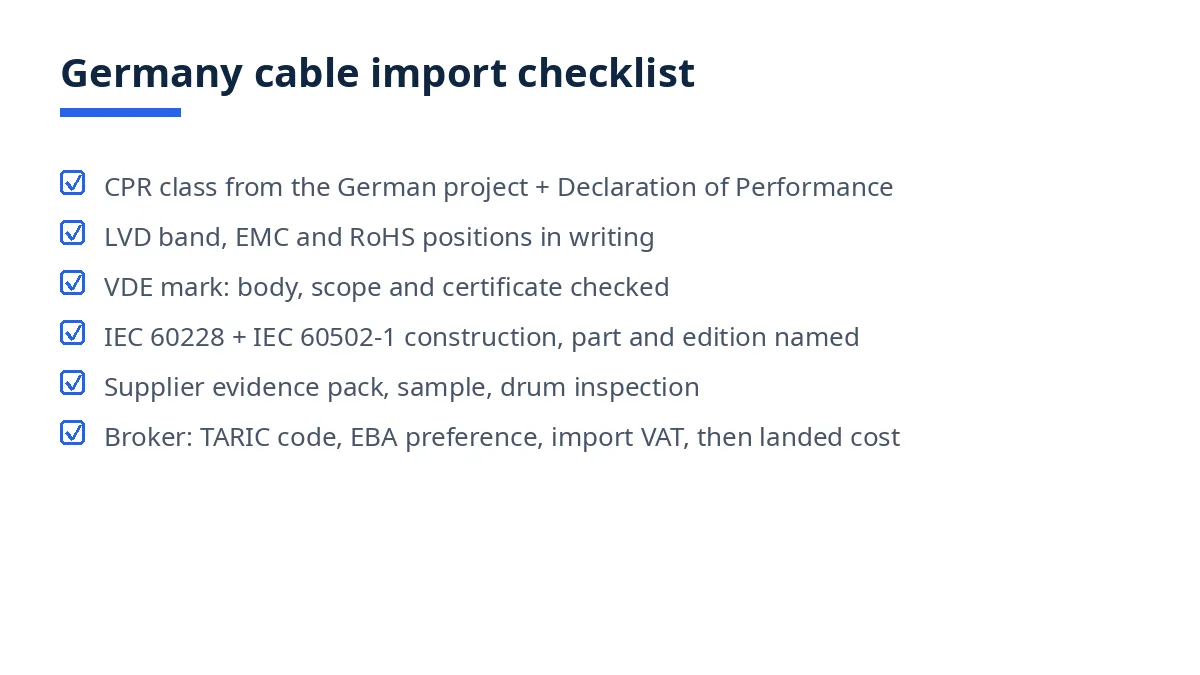
Run the checks in order: a sequenced list for the first German order
Get the class answer from the German project: class, smoke, droplet and acidity ratings, with the designer's name recorded.
Hold the Declaration of Performance for the exact construction and class, with the assessment-system evidence, in German.
Place the cable in the LVD band, hold the EU Declaration of Conformity, and answer EMC and RoHS separately, in writing.
Settle the VDE-mark question: mark, body, certificate scope, and whether the job requires one.
Fix the construction against IEC 60228 and IEC 60502-1, naming part, edition and voltage, with the EU file for the same construction.
Shortlist suppliers on the German file, hold the evidence pack, and agree deposit, failure and change terms before paying.
Order the sample as the bulk cable, and agree quantity, counting basis, drum lengths, price parts and metal-price rule in writing.
Inspect the drums before loading: labels, lengths, outer condition, lot-matched papers, photographs.
Choose the Incoterms rule for a container of drums, name every place, and agree handling, sailing and the border-file timetable.
Have the broker confirm code, TARIC rate, preference and origin evidence, and import VAT in writing, and rework the landed-cost table before pricing to a customer.
What fire class does a cable for a German building need?
No single class answers that question, and this article gives none. The class depends on the building, the route, and the risk analysis the installation designer carries out, or on the national formal and legal documents that apply to the building in the German Land where it stands.3 Ask the designer to name the class and the additional ratings for smoke, droplets and acidity, and to put the answer in the building specification. Where the designer names no class, record that fact. Where the designer names a class, put it in the order with the standard and the declaration reference.
How does a German buyer check the Declaration of Performance?
Check the product-type reference against the construction on order, the intended use against the building use, the harmonised standard reference and date against EN 50575, the declared class and additional ratings against the designer's answer, and the assessment system against the class. Importers must ensure, before placing a product on the market, that the assessment was carried out, the documentation and declaration exist, the CE marking is present, and the required documents accompany it.1 Importers must also put their own name and contact address on the product, the packaging, or a document that travels with it, and must keep a copy of the declaration for the period the regulation sets: 10 years after the product has been placed on the market.1 If any line does not match, do not place the cable on the market until the declaration is corrected or the cable is brought into conformity with it.1
What duty does a German buyer pay on electrical cables from Bangladesh?
Duty turns on the confirmed code, the rate applying when the goods arrive, and whether a preference claim is accepted, and no rate is stated in this article because the TARIC schedule for heading 8544 was not opened with rates. The broker must confirm the TARIC code, the current third-country rate, and the preference position for the exact construction before the buyer budgets or quotes.11 Bangladesh, as a least developed country, gets access without duty or quota under the Everything But Arms arrangement for every product except arms and ammunition, but a particular shipment gets that treatment only where the origin rule is met and the evidence is held.12 Budget the duty-unconfirmed case until the broker's written confirmation arrives.
How does a German buyer check a Bangladeshi cable supplier before ordering?
Start from the papers, not the promises, and test them against the German file. Hold the Declaration of Performance for the exact construction and class, the EU Declaration of Conformity covering the Low Voltage Directive, electromagnetic-compatibility, and RoHS positions, the laboratory reports tied to the named IEC part and edition, photographs of the sheath marking and the drum label, and the names of reference customers for the same cable family whom the buyer may contact. Check the sample marking against the standard, the laboratory lot numbers against the drums at inspection, and ask the supplier to state the delivery term, counting basis, price parts, and failure and remedy terms in writing. Importers in the EU must ensure the manufacturer has fulfilled its obligations before placing a product on the market, including the conformity assessment, the technical documentation, the labels and marking, and the traceability duties, and must mark the product, packaging or accompanying documentation with their own name and contact address.15 A supplier that provides that file has given the buyer something to check.
Next steps on Exportain
Start from the class answer, then build the shortlist. Read the Exportain supplier listings against the evidence pack in the checks above, check the buying walkthrough on Exportain before sending an enquiry. Send the class and construction to more than one supplier and compare evidence packs, not only prices. For the wider import sequence, read the wider import sequence for Bangladesh shipments, and rebuild the landed-cost table from broker-confirmed figures using the landed-cost working for Bangladesh shipments, rather than the example figures above. How heading 8544 is built is worth reading with the broker before the code is fixed.
Post a free RFQ on Exportain and get quotes from verified Bangladeshi suppliers → https://exportain.com/rfqs
Sources
- Regulation (EU) No 305/2011 laying down harmonised conditions for the marketing of construction products. European Union (accessed )
- Cable Testing and Certification of Construction Products Regulation. TÜV Rheinland (accessed )
- Construction Products Regulation (CPR) – coaxial and twisted-pair cables. Dipol (accessed )
- Low Voltage Directive. Eland Cables (accessed )
- Directive 2014/30/EU on electromagnetic compatibility — summary. European Union (accessed )
- Directive 2011/65/EU on the restriction of the use of certain hazardous substances in electrical and electronic equipment (RoHS) (consolidated version, 1 September 2020). European Union (EUR-Lex) (accessed )
- Testing, Inspection and Certification (TIC) portfolio. VDE (accessed )
- IEC 60228:2023 - Conductors of insulated cables. International Electrotechnical Commission, (accessed )
- IEC 60502-1:2021 – Power cables with extruded solid insulation for rated voltages of 1 kV and 3 kV. NBS (accessed )
- Incoterms 2020 Explained: All 11 Rules. Blue Ocean Academy (accessed )
- TARIC Consultation. European Commission (accessed )
- EU trade relations with Bangladesh. European Commission, (accessed )
- Assessment of taxes and duties. German Customs (Zoll) (accessed )
- Duties and taxes. German Customs (Zoll) (accessed )
- General product compliance. European Union (accessed )
About the author
Sourcing from Bangladesh?
Post a request for quotation and suppliers on Exportain can send you their quotes directly.
Post an RFQ