Canada Electrical Cable Imports From Bangladesh: CSA, Ports and Duty
Canadian acceptance, the CSA papers for the exact construction, the coast and terminal, and the CARM border file decide a cable import before price does. This Canada guide sets the decision order, with a worked landed-cost example in Canadian dollars.
Short answer
Importing electrical cables from Bangladesh to Canada works when Canadian acceptance is settled before price is discussed. Confirm the CSA certification route and the authority having jurisdiction for the exact construction and installation, choose the gateway by coast and terminal, and have a broker confirm the 10-digit tariff line, the Least Developed Country Tariff proof, direct shipment, and the GST position in writing.
On this page
Key takeaways
Settle Canadian acceptance first: the CSA certification route, the authority having jurisdiction, and the cable standard for the exact construction; European papers do not decide a Canadian installation.
Name the use in full: province or territory, installation setting, voltage, and cable type, and get the acceptance answer in writing for that use.
Choose the gateway by coast and terminal: Vancouver with Deltaport and Vanterm in the west, Montreal with four terminals in the east, and Halifax with two terminals on the Atlantic; confirm terminal, storage, and onward service.
No duty rate is stated: the broker must confirm the 10-digit tariff line in the Customs Tariff 2026 files, the LDCT origin rule and proof, direct shipment, and GST.
Price from the worked landed-cost table in Canadian dollars, with duty as a separate line to be inserted from the broker's written figure, and compare suppliers on the same delivery basis.
A drum of cable can cross an ocean without trouble and still never reach the installation it was bought for. The failure point in Canada is rarely the voyage. It is the acceptance evidence at the site, the registration behind the border entry, or a price that omitted duty and tax. A Canada buyer who settles acceptance, gateway, and border paperwork in that sequence spends the order budget on cable. A buyer who starts from unit price spends it on storage, retesting, and replacement freight. This guide follows the first sequence, for electrical cables shipped from Bangladesh to a Canadian destination.
Canadian acceptance comes before price: certification, the AHJ, and the cable family
Acceptance in Canada is granted locally, for a particular installation, by the authority having jurisdiction, the AHJ. The CSA Group model code for field evaluation notes that AHJs typically accept electrical equipment and products on the basis of certification by a certification body accredited by the Standards Council of Canada, where certification follows testing and evaluation of a representative sample and a follow-up inspection program that checks continued conformance.1 For a cable buyer, the practical meaning is narrow: obtain a certification record that identifies the construction, the standard, and the type, issued by a body whose accreditation covers that work. A company letter, a report on another construction, or a European conformity file does not meet that test. Before requesting prices, ask the AHJ for the province or territory where the cable will be installed what certification evidence it will accept for that cable type and that installation, and file the reply with the order.
Field evaluation will not rescue an uncertified drum. The model code describes field evaluation as a path for equipment whose certification is impracticable or otherwise unavailable, and it states that field evaluation is not intended to serve as a substitute for certification.1 It also places wire and cable products outside its scope when they stand alone, while permitting wire and cable to be assessed against the relevant standard as part of equipment under evaluation.1 The consequence is blunt: a standalone drum without certification has no field-evaluation route. Resolve certification while suppliers are still competing. At that stage the cost of a refusal is zero. Later, the cost is the shipment. Ask to see the listing or record entry, read the construction and standard it names, and confirm the follow-up inspection program reaches the plant that will produce the order.
Which standard the record must cite depends on the cable family. Three families cover most first orders, each governed by a CSA Group standard under the Canadian Electrical Code, Part II. CSA C22.2 No. 52 governs underground secondary and service-entrance cable: 600-volt-class copper and aluminum conductor cable for systems at 600 V nominal or less, installed underground by direct burial or inside duct systems.2 CSA C22.2 No. 51 governs armoured cable: single- and multi-conductor insulated cables with metallic interlocked armour, types AC90 and ACG90 with no overall jacket and ACWU90 and ACGWU90 with an overall jacket, for use under the Canadian Electrical Code, Part I, on systems up to 2,000 V, with ACG types confined to multi-conductor cable at 600 V or less.3 CSA C22.2 No. 38 governs thermoset-insulated wires and cables: single-conductor and multiple-conductor constructions rated 600 V, 1,000 V, 2,000 V, and 5,000 V, for use under the Canadian Electrical Code, Part I.4 Put the family on the enquiry. Ask which standard and edition the supplier certifies against. Treat a reply that names another family, or no standard, as no reply.
Describe the Canadian installation completely before asking for a price
Price comparisons only work when every supplier prices the same job. Describe the job in four parts, in one document, before any quotation is requested: the province or territory plus the site or warehouse address; the installation the cable serves, such as fixed building wiring, an underground service, a machine feed, or another defined use; the party who accepts the work, the AHJ, the electrical contractor, or the engineer of record; and the date the cable must be ready for installation. Family, voltage rating, and certification record all follow from the installation, so a cable accepted for one purpose may not be accepted for another. Record the unloading point for heavy drums, the hours when receiving is possible, and the name of the person who signs for the load, and have supplier and forwarder confirm the identical address in writing.
Two sites mean two acceptance questions, even for cable that looks the same. The AHJ, the setting, and the evidence required can change from one province or territory to another, and from one site to another. Two constructions in one shipment mean two files as well: separate specifications, separate certification records, separate sample approvals, and separate lines in the landed-cost table. Averaging two constructions into one price conceals the one whose certification file is harder to complete, and it hides which line caused a hold. Start with one construction for one site. Learn the acceptance route, the paperwork, and the supplier on that single basis. Add the second construction after the first has cleared and been accepted.
Cold handling is a Canadian question, not a generic one. CSA C22.2 No. 52 sets a cold impact and cold bend rating of minus 40 degrees Celsius for the cable within its scope.2 Do not transfer that figure to another family. For the construction ordered and the province of installation, ask what low-temperature performance the applicable standard demands and what evidence supports it. Cable handled in a Dhaka warehouse and cable pulled and terminated in a Canadian winter face different tests, and the order should record what evidence was requested and what arrived.
Papers for the exact construction: certification record, tests, conductors, marking
Four documents, all naming the same construction, make the paper file. The certification record or listing entry names the construction, the CSA Group standard and edition, the type designation where the standard provides one, and the certification body. The test reports behind the record name the construction actually tested, the standard, and the edition, letting the buyer confirm the report covers the ordered construction rather than a relative in the same family. The conductor evidence is covered in the next paragraph. The marking proof is a label or sheath-marking sample for the construction, supplied before production, so arriving drums carry the markings the standard and the certification record require. The current edition of the armoured-cable standard deals with markings covering flame-test performance and halogen-free claims; ask the supplier which markings apply to the construction ordered and what evidence stands behind each marking claimed on the drum.3 A marking promised in a quotation and missing from the certification record cannot be defended at the site.
Conductors are judged by IEC 60228:2023, an international standard with a Canadian job here. It fixes nominal cross-sectional areas for conductors in electric power cables and cords from 0.5 square millimeters to 3,500 square millimeters, and it lays down requirements for wire numbers and sizes and for resistance values, for solid, stranded, and Milliken copper, aluminum, and aluminum alloy conductors; it judges the conductor inside the finished cable, not the conductor as delivered to the cable plant.5 Require the quotation and the test evidence to state conductor material and class, nominal cross-sectional area, standard, and edition, and to confirm resistance was measured on the finished cable. A trade size alone, or a nominal figure with no standard behind it, cannot be checked against a test report.
Rated voltage forms the second check. The three Canadian standards are framed by voltage: 600 V or less for underground service-entrance cable, up to 2,000 V for armoured cable, and 600 V to 5,000 V for thermoset-insulated wires and cables.2 3 4 Match the cable to its rating from the rated voltage on the specification, and obtain the certification record that covers the cable at that rating. State control or signal duty on the enquiry where that is the use, since construction, standard, and acceptance may all shift, and a power-cable record does not automatically extend to a control cable.
Watch for three file defects that look complete until examined. A family document helps only when the record or the standard places the ordered construction inside the family, and the buyer still needs the sentence or schedule that places it there. A standard without its edition, or a report written to an earlier edition, leaves the buyer disputing which requirements governed the test. A drum marked for a different type, voltage, or temperature rating than the order is not marked as the ordered cable, whatever the packing list claims. Test all three against one construction name, on one order, before production begins.
Document | Must identify | Buyer asks |
|---|---|---|
Certification record or listing entry | Construction, CSA Group standard and edition, type designation | Issuing certification body, and whether follow-up inspection covers the producing plant |
Test reports | Construction tested, standard, edition | Ordered construction itself, or only a family member |
Conductor evidence | Material and class, nominal cross-sectional area, finished-cable resistance | IEC 60228 edition, and the resistance limit used |
Marking proof | Markings as they will appear on drum and sheath | Label proof before production, each claimed marking linked to evidence |
Pick the coast and the terminal: Montreal, Vancouver, Halifax
Three coasts offer container entry, and the right choice is a terminal on the coast nearest the site, not the lowest ocean freight. The west coast feeds British Columbia, the Prairies, and rail movement toward central Canada. The St. Lawrence gateway feeds Quebec, Ontario, and the northeast. The Atlantic gateway feeds Atlantic Canada. A Toronto, Calgary, or Halifax destination served from the wrong coast pays twice, in inland carriage and in waiting time. Decide from the site address, the terminal, and the onward service available in the delivery week, with the forwarder confirming all three in writing before freight rates are compared.
At Montreal, the decision is terminal-level. The Port of Montreal names four international container terminals, Viau, Racine, Maisonneuve, and Cast. Each can take two post-Panamax ships at once and each has dockside rail access. Storage capacity runs 12,500 TEU at Maisonneuve, 17,000 TEU at Viau, 20,000 TEU at Cast, and 15,000 TEU at Racine.6 The port states its location reaches 110 million consumers across Canada, the United States Midwest, and Northeast within two days by rail or truck.6 Have the forwarder name the terminal, state where the container comes off, state where drums sit if inspection holds the box, and state the free-storage period before charges begin. Terminals differ on each point, and the answers belong in the quotation comparison rather than in a call made after arrival.
At Vancouver, two terminals split the work between outer and inner harbour. The operator describes GCT Deltaport, in the outer harbour, as Canada's flagship marine terminal: three contiguous berths, 2.4 million TEUs of annual capacity, 12 ship-to-shore cranes, and 8,323 metres of on-dock rail. GCT Vanterm, in the inner harbour at Burrard Inlet, offers more than 1 million TEUs a year, a 619-metre berth, and 6 ship-to-shore cranes. Both are served by CN and CPKC, two Class I railways, with daily rail service to Canada and the United States Midwest, and together they provide nearly 3.5 million TEUs of handling capacity over four berths.7 The questions for a western or central Canadian buyer are which terminal receives the vessel, which railway hauls the container inland, and where drums come off for the last truck leg. "Vancouver", with no terminal named, answers none of them.
At Halifax, one operator runs both terminals. PSA Halifax operates Atlantic Hub and Fairview Cove in Halifax, Nova Scotia, having acquired the Halterm terminal in 2019 and Fairview Cove in 2021.8 The Halifax International Container Terminal began in 1969 as Canada's first common-user container terminal, Fairview Cove followed in 1981, and the port presents itself as a key intermodal gateway backed by wider rail services and investment in modern container handling infrastructure.8 An Atlantic Canada buyer may shorten both ocean and inland legs through Halifax, subject to the same terminal questions: which terminal, where drums come off, and which onward service operates in the delivery week. A United States port with onward road or rail movement into Canada is a fourth route, and it carries a warning: it adds a second border file and a second set of charges, plus a decision on where Canadian clearance takes place. Never select it on headline freight. Ask the broker which Canadian office clears the goods, what travels under transit, and what the route costs with both border files included.
Gateway | Best for | Confirm onward movement | First question |
|---|---|---|---|
Montreal: Viau, Racine, Maisonneuve, Cast | Quebec, Ontario, northeast, St. Lawrence destinations | Rail or truck out of the named terminal | Terminal name, and free-storage days there |
Vancouver: Deltaport, Vanterm | British Columbia, Prairies, central Canada by rail | Rail out of the named terminal, then truck to site | Vessel terminal, and railway hauling the box inland |
Halifax: Atlantic Hub, Fairview Cove | Atlantic Canada | Rail or truck out of the named terminal | Terminal name, and onward service in the delivery week |
United States port, then Canada | Only with the Canadian clearance file confirmed in advance | Road or rail into Canada after clearance | Canadian clearance office, and what moves under transit |
Carry drums from Chattogram to the Canadian site
A delivery rule settles three matters at once: who books carriage, who carries risk along the way, and who clears the border. Remember the mode split in this form: the sea/inland-waterway-only rules are FOUR — FAS, FOB, CFR, CIF; CPT is any-mode; DPU is any-mode; DDP is any-mode (seller clears import customs, pays duty); FCA is any-mode. The ICC Academy summary urges parties to name the delivery place or point precisely, since a loose port name can let the seller select a terminal the buyer never intended, leaving the inland bill with the buyer.9 The same summary observes that FCA usually beats FOB for containerized goods even on a sea leg, because FOB risk passes only once goods are on board, while containers wait at a terminal before loading.9 A buyer purchasing containerized drums on FOB should therefore ask the forwarder who carries terminal-handling risk, and write the answer into the contract.
C rules divide cost from risk, and buyers misread the division often. With CPT and CIP, and with CFR and CIF, the seller pays for carriage to the named destination, yet the buyer bears transit risk from an earlier moment: handover to the carrier under CPT and CIP, and loading on board under CFR and CIF.9 CIP and CIF oblige the seller to insure; CPT and CFR do not.9 D rules place handover at the named destination: DAP hands goods over ready for unloading from the arriving vehicle, DPU hands them over unloaded, and DDP adds import clearance by the seller.9 DAP to a named warehouse often suits a first Canada order, since the seller runs the movement to Canada while the buyer retains the border file and the duty position. DDP suits a buyer who wants the seller to clear the border, but the seller then meets Canadian registration facts described in the border section: a business number, CARM Client Portal registration, and a financial security position. Establish that the seller holds or can obtain each one before DDP is agreed, and settle who pays GST, since a DDP price silent on tax will reopen the question at the border.
No transit time appears in this guide. Sailings, transshipment, terminal congestion, and onward rail or truck services all shift arrival, and a figure borrowed from another route or season will mislead the contractor. Obtain the sailing, the expected terminal arrival, and the onward service for the actual shipment week from carrier or forwarder, then build the site date from those three figures plus an inspection buffer expressed in days. Tell the contractor the buffer exists, so a one-day slip does not shut the site down. Ask the carrier or forwarder who submits the advance commercial information and confirm the goods description names the cable construction instead of a generic label; vague descriptions draw questions and holds. Keep the filing reference with the shipment papers.
Judge suppliers by the Canadian file
Give every shortlisted supplier an identical brief: the Canadian installation in full, the construction with its CSA Group standard and edition, the certification record sought, the quantity and drum terms, the delivery term naming its places, and the date the cable must be at the site. Replies written against different constructions, standards, or delivery rules cannot be ranked, and the cheapest headline in such a set is usually the quotation that omitted the certification work. Rank replies on one table, line by line, with written answers filed beside each quotation so later disputes are settled from paper, not memory.
Apply four tests. Does the certification record and test evidence identify the construction and standard requested, through a listing entry the buyer can read. Does the supplier answer scope questions directly, covering family, voltage rating, low-temperature evidence where the installation demands it, and any construction it will not certify. Does the supplier state drum, length, and remainder terms as numbers, not assurances. Does it name the delivery rule, the Canadian gateway and terminal, and the handover point. A supplier strong on price and weak on the first two tests is the dearest on the list, because a rejected delivery, a retest, or a replacement shipment is charged after the deposit.
Samples test the file as well as the cable. Give written sign-off on a sample length against the specification. Retain a marked piece showing construction and approval date. Insist bulk drums match the approved sample in marking and labeling as well as construction. When a test report is supplied, confirm report, sample, and production drums all identify one construction. A passing sample followed by bulk drums under another construction name proves nothing about the bulk. A trial length the contractor or engineer can examine on site, on a first order, is worth more than another round of catalogue claims; budget its cost in the first order, not in a later complaint. The Bangladesh cable import sequence, from search to delivery, appears in the cable import sequence for Bangladesh, and the heading 8544 read appears in the heading 8544 classification read.
Settle lengths, drums, minimums, and cold handling in writing
Length, drums, and installation runs are three different quantities, and the order must fix each. Record total length, length per drum, tolerance on drum lengths, and the treatment of short lengths and remainders. Record drum ownership, whether drums go back to the supplier, and what a damaged or short drum costs in time as well as money. A drum that arrives in an order the installer cannot use means a second lift of a heavy load at the warehouse, which is slow, costly, and liable to cause damage. Settle the drum sequence with the contractor before loading, and write it on the packing list.
Minimums need equal precision. A supplier minimum can attach to a construction, a cross-sectional area, a type, or a production run, and a buyer who treats it as an order-level figure will order too little or too much. Ask for the basis in writing, test it against installation lengths plus a stated allowance for cutting, waste, and spares, and record what would change it: another drum size, a shared production run, or a split delivery later. Splitting a small order over two constructions to satisfy two minimums doubles the certification file and the inspection effort for a quantity that may justify neither. This guide states no typical minimum, since no one figure spans constructions, cross-sections, and drum formats; the supplier's written basis for the exact construction is the only figure worth using.
Separate the price into parts in the same order document: product price, freight and insurance position under the delivery rule chosen, and charges the buyer pays at the Canadian terminal, at customs, and on the inland leg. The landed-cost table near the end shows the split. One all-in figure that omits the delivery rule conceals where seller cost ends and buyer cost begins, and most quotation disputes start at that point. Bring every offer onto one delivery basis before ranking, and redo the ranking if a supplier changes basis. Add cold handling to the same document: describe storage and handling conditions between Canadian terminal and site, and ask the supplier to confirm in writing that construction and packing suit them, rather than finding a brittle sheath or cracked drum at unloading.
Assemble the Canadian border file: BN, CARM, tariff line, LDCT, GST
Five parts make the file, each with an owner. The buyer owns the business number and CARM registration. The carrier owns advance information. The broker owns the declaration, classification, and duty and origin positions. The supplier owns origin evidence and the commercial documents behind the declaration. The accountant owns GST. Handing all five to "the forwarder" guarantees a stall at the first customs question, since a forwarder cannot invent a business number or a tax position the buyer never supplied.
Identity comes first. The Canada Border Services Agency guide defines commercial goods as goods brought into Canada for business use, resale, or work, and the importer of record as the person named as importer on the customs declaration, identifying themselves by citing a business number through release and accounting.10 CARM, the CBSA Assessment and Revenue Management system, is the official system of record for duties and taxes on commercial goods imported into Canada, and registered businesses manage accounts and other CBSA online services through the CARM Client Portal.10 Two numbers govern registration. The business number is a 9-digit number issued by the Canada Revenue Agency, and a business must hold one to complete CARM Client Portal registration; a non-resident business must obtain its business number from the Canada Revenue Agency before trying to register, or registration fails.11 The RM account is a 6-digit number received on enrolment in a CBSA commercial program, and a business without one can enrol for a commercial program during portal registration.11 An importer registers its own business: a customs broker cannot register a client's business for the client.11 Importers should weigh enrolment in the Release Prior to Payment program and the financial security element of that enrolment.11 Confirm business number and RM account before loading in Chattogram, and confirm the name and address attached to them match the declaration name.
Classification begins at heading 8544, extended in Canada from six shared digits to ten. Heading 8544 in the Harmonized System covers insulated conductors and optical fiber cables, divided at six digits by cable type, voltage, and connector fitting.12 The CBSA guide explains the structure: the first six digits form the common identifier in every country using the Harmonized System, and the next four digits are peculiar to Canada, fixing duty rates and collecting statistics, producing a 10-digit Canadian number.13 The broker assigns the exact construction to the subheading matching its type, voltage, and fitting, then extends the code to the Canadian tariff item and statistical suffix. Treat heading 8544 as indicative here. The broker must confirm the full 10-digit number for the exact construction before filing. A wrong voltage or fitting statement on the specification shifts the whole consignment onto the wrong line.
Duty depends on tariff treatment, read in the Customs Tariff itself. The current Canadian Customs Tariff files display tariff treatments for countries with tariff arrangements and preferential treatments, are refreshed at least once a year or whenever necessary, and are amended through customs notices; the 2026 set runs from edition T2026, effective January 1, 2026, through amendments T2026-1 and T2026-2.14 The final two columns in each schedule chapter show the Most-Favoured-Nation rate and the applicable preferential tariffs, and the duty rate turns on tariff treatment and origin.13 Unilateral programs sit in the same framework as free-trade-agreement treatments: the General Preferential Tariff, the Least Developed Country Tariff, and the Commonwealth Caribbean Countries Tariff, alongside Australia and New Zealand tariffs.13 No duty rate is given in this guide. The broker must confirm in writing the full tariff line, the tariff measures effective on the import date, and any preference, before the buyer prices the order, reading the rate beside the confirmed line in the current files, not a rate borrowed from another country or year.
For Bangladesh, the preference file is the Least Developed Country Tariff. A preferential claim must satisfy the shipping requirements of its treatment, such as direct shipment, and the importer must hold proof of origin, since the CBSA can request the documents supporting the treatment claimed.13 For originating goods of a least developed country beneficiary, apart from textile and apparel goods in Harmonized System Chapters 50 to 63, a Form A certificate of origin or an exporter's statement of origin must be supplied as proof of origin to the CBSA when requested, completed and signed by the exporter in the least developed country where the goods were finished before importation into Canada.15 Cables fall in Chapter 85, outside Chapters 50 to 63, so the textile and apparel form has no application to a cable shipment; Form A or the exporter's statement is the route the broker must confirm. Entitlement turns on classification, the origin rule for the line, the direct-shipment position, and the supplier's origin evidence. Have the broker confirm all four in writing, and have the supplier prepare the evidence before loading. Importers must keep proof of origin and all other relevant commercial-import documents for six years, and failure to present proof of origin on request can attract a monetary penalty.15 Evidence that arrives late, or on the wrong form, leaves the preference unclaimed, and duty then falls on the buyer under most delivery rules.
Tax stands apart from duty, and the CBSA guide gives the calculation method. GST, the Goods and Services Tax, is a federal tax on most products and services imported into Canada or sold in Canada, except those exempt under the Excise Tax Act, calculated on the total value of the goods plus applicable duties.13 The guide illustrates the method with its own figures: US$100 at US$1 to CAN$1.37 gives a CAN$137.00 value for duty; a 4% duty gives CAN$5.48; the value for tax is CAN$142.48; 5% GST gives CAN$7.12; total duty and GST payable is CAN$12.60.13 Those are the guide's illustration figures at a 4% duty rate, not cable figures, and they must never be copied as a cable duty. Apply the method instead: value for duty plus broker-confirmed duty equals value for tax, and GST applies to that total. Value for duty usually starts from the price paid to the seller, adjusted where applicable, evidenced by a sales receipt or invoice showing a complete goods description, selling price, and sale conditions and terms, declared in Canadian currency at the exchange rate on the date the goods began their direct and uninterrupted journey to Canada.13 Provincial tax treatment varies by province and registration, so the broker and accountant must confirm in writing which provincial tax, if any, applies and how the GST position is reported. For genuinely doubtful classification, origin, or value, the CBSA issues advance rulings on tariff classification and national customs rulings on valuation, origin, and marking; an advance ruling assigns a 10-digit number and binds the CBSA and its recipient.13
File item | Owner | Confirm by |
|---|---|---|
Business number (BN9) and RM account, matching name and address | Buyer | Loading in Chattogram |
CARM Client Portal registration, Release Prior to Payment and financial security | Buyer, with broker advice | First import under the arrangement |
Advance commercial information, construction description | Carrier, with buyer data | Vessel loading |
Import declaration, 10-digit classification, customs value | Broker | Arrival at the Canadian terminal |
Origin rule, origin evidence, direct shipment, preference position | Broker and supplier | Loading in Chattogram |
GST and provincial tax position, exchange-rate date | Buyer and accountant | Accounting in CARM |
Landed cost in Canadian dollars, duty line open
The table is an illustration only. Treat each figure as an example. The duty line stays open until the broker confirms tariff line, measures, and preference in writing. The basis is FCA Chattogram, Incoterms 2020, 12,400 metres of a single construction, DAP to a named warehouse in the Greater Toronto Area after clearance at Montreal. GST stays outside the total, since the tax figure depends on value for duty, the duty figure, and registration and province facts the broker and accountant must confirm. Rework the table from real quotations and broker figures before pricing, and file the reworked table with the order.
Line | Example figures (CAD) |
|---|---|
Product cost: 12,400 metres at 2.85 per metre, FCA Chattogram | 35,340.00 |
Ocean freight, Chattogram to the named Montreal terminal | 2,480.00 |
Cargo insurance | 265.00 |
Subtotal before duty | 38,085.00 |
Import duty: value for duty x broker-confirmed tariff rate | Your figure |
Customs broker fee | 340.00 |
Destination terminal charges at Montreal | 465.00 |
Inland delivery, Montreal terminal to the Toronto-area warehouse | 640.00 |
Inspection and testing | 520.00 |
Bank and currency costs | 135.00 |
Total landed cost | 40,185.00 + your duty figure |
Landed cost per metre before duty | 3.24 |
Adding the lines gives 35,340.00 + 2,480.00 + 265.00 = 38,085.00, then 38,085.00 + 340.00 + 465.00 + 640.00 + 520.00 + 135.00 = 40,185.00, and 40,185.00 / 12,400 = 3.24 per metre. Each metre costs 3.24 before duty against a quoted 2.85, about 14% higher, from freight and shipment charges alone. Divide the duty figure by 12,400 and add it for the final per-metre cost, then price from that number. GST applies on the value for tax, the value for duty plus duty, at the rate and treatment the broker and accountant confirm. It sits outside the per-metre figure above and must not be guessed from the table. Pricing from 2.85 surrenders freight, inspection, broker, and delivery cost, plus duty and tax, from margin. Rank suppliers on this table, line by line, on one delivery basis, and turn down any comparison that combines different delivery rules or hides an empty duty line. The arithmetic behind the table follows the landed-cost arithmetic for imports from Bangladesh.
Decide in this sequence
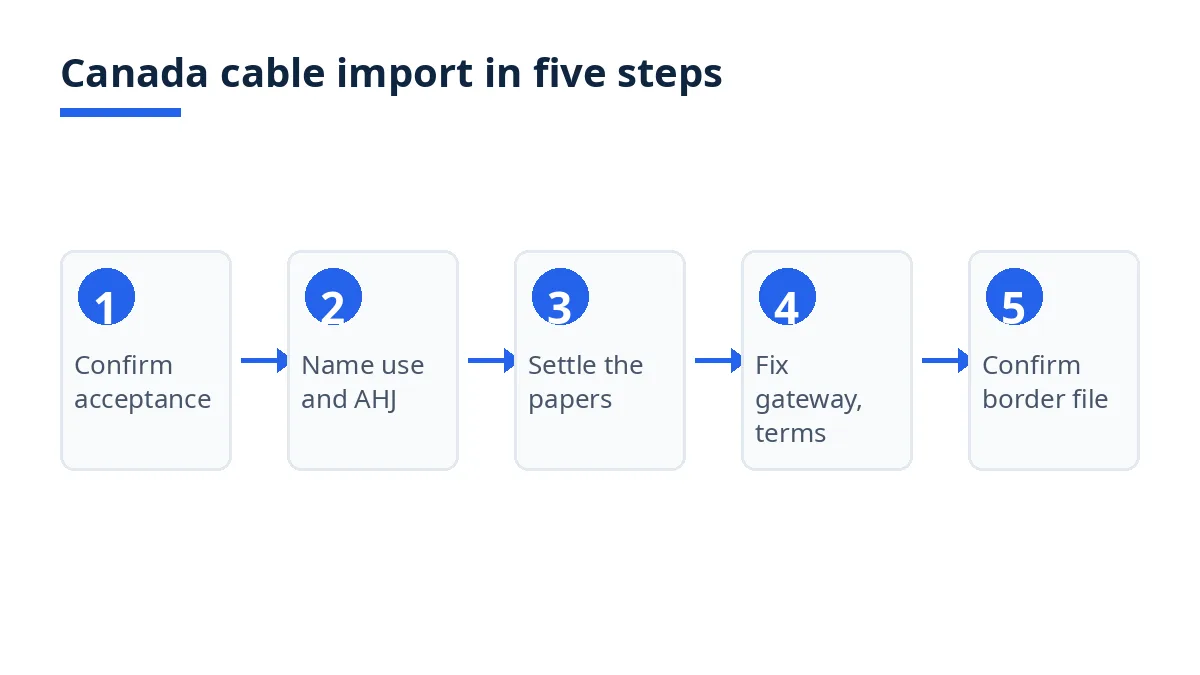
Work through six decisions in order, recording any change that reopens an earlier one. First, settle the Canadian installation, the site, and the AHJ acceptance answer for the province or territory. Second, settle the papers for the exact construction: certification record, test evidence, conductor evidence, marking proof. Third, judge suppliers on the Canadian file and give written sign-off on a sample length. Fourth, fix quantity, drum, length, and cold-weather terms, with the drum sequence agreed with the contractor. Fifth, pick gateway, terminal, and delivery term naming its places, and confirm who submits advance information and who owns each border-file part. Sixth, rework the landed-cost table from broker figures, duty line and GST method included, and price from the reworked total. Problems found in that order appear as paper questions, where answers are cheap. Found later, they appear as terminal or site problems, where they are not.
Questions from Canada buyers
Is there a standard minimum order for cables from Bangladesh?
No one minimum spans cable constructions. A supplier minimum can attach to a construction, a cross-sectional area, a type, or a production run, and its basis must be stated in writing for the exact construction ordered. Test the stated figure against installation lengths plus a stated allowance for cutting, waste, and spares, and record what would change it: another drum size, a shared production run, or a split delivery later. A minimum above the need, forcing a second construction into the order, doubles the certification file for cable the site may not need.
When will the cable reach the Canadian site?
No transit time is stated in this guide. Sailings, transshipment, terminal handling, onward rail or truck service, and inspection holds all shift arrival, and a figure borrowed from another route or season will mislead the contractor. Obtain the sailing, the vessel's expected terminal arrival, and the onward connection for the shipment week from carrier or forwarder, then build the site date from those three figures plus an inspection buffer in days. Tell the contractor the buffer exists, so a one-day slip does not shut the site down.
What duty and tax will the shipment attract in Canada?
No rate is stated in this guide. Duty turns on the full 10-digit Canadian tariff line for the exact construction, the tariff measures effective on the import date, and whether the origin rule, direct shipment, and origin evidence support a Least Developed Country Tariff preference.13 15 Have the broker confirm in writing the tariff line, the duty with no preference claimed, the preference position, and every other measure effective then, reading the rate in the current Customs Tariff files, and enter the confirmed figure in the landed-cost table before pricing.14 GST is separate, calculated on the total value of the goods plus applicable duties, with the broker and accountant confirming the tax treatment for the shipment.13
What checks separate a sound supplier from a risky one?
Use one written brief for every supplier, then score replies on a certification record naming construction and standard, direct answers on family, voltage rating, and low-temperature evidence, numbered drum and length terms, and a delivery term naming its places. Give written sign-off on a sample length, retain a marked piece, and require bulk drums to match the sample in marking and labeling. Count reluctance on a scope question, a certification record naming another construction, or papers promising field evaluation for standalone cable as a failed check, and move on while exit is still free. The ordering route appears in the buying steps on Exportain, and suppliers can be compared in the supplier directory on Exportain.
Next steps on Exportain
Read the how to import from Bangladesh guide for the full import sequence behind this Canada guide, compare suppliers in the supplier directory on Exportain, and rework your figures with the landed-cost method for imports from Bangladesh before accepting a quotation. For the ordering route, see the buying steps on Exportain.
Post a free RFQ on Exportain and get quotes from verified Bangladeshi suppliers
Sources
- CSA SPE-1000:25 - Model Code for the field evaluation of electrical equipment. CSA Group (accessed )
- C22.2 NO. 52-15 - Underground secondary and service-entrance cables. CSA Group (accessed )
- CSA C22.2 No. 51-2026 - Armoured cables. CSA Group (accessed )
- CAN/CSA-C22.2 NO. 38-05 - Thermoset-Insulated Wires and Cables. CSA Group (accessed )
- IEC 60228:2023 - Conductors of insulated cables. International Electrotechnical Commission, (accessed )
- Containers. Port of Montreal (accessed )
- GCT Terminal Overview - Facts Sheet (GCT Vanterm / GCT Deltaport). Global Container Terminals (accessed )
- Company Info – PSA Halifax. PSA Halifax (accessed )
- Place of delivery & risk transfer in trade contracts. ICC Academy (accessed )
- Who should use this guide. Canada Border Services Agency (accessed )
- Get started with CARM. Canada Border Services Agency (accessed )
- Classification Detail — HS 2017 Code 8544: Insulated wire, cable and other electric conductors. United Nations Statistics Division (UNSD) (accessed )
- Select the duties and taxes that apply. Canada Border Services Agency (accessed )
- Customs Tariff 2026. Canada Border Services Agency (accessed )
- Memorandum D11-4-2 - Proof of Origin of Imported Goods. Canada Border Services Agency (accessed )
About the author
Sourcing from Bangladesh?
Post a request for quotation and suppliers on Exportain can send you their quotes directly.
Post an RFQ