Belgium Electrical Cable Imports From Bangladesh: Antwerp Gateway Guide
Antwerp entry, condensed CPR and CE papers, Belgian customs, fiscal representation and VAT, and a broker-confirmed duty file for importing electrical cables from Bangladesh to Belgium, with a worked landed-cost example in euros.
Short answer
Importing electrical cables from Bangladesh to Belgium works when the Antwerp route, the European product file, and the Belgian customs file are settled before price is discussed. Fix the terminal, first warehouse, and onward destinations, hold the Declaration of Performance and fire class for the exact construction, and have the broker confirm the heading 8544 line, duty, and any Everything But Arms preference in writing.
On this page
Key takeaways
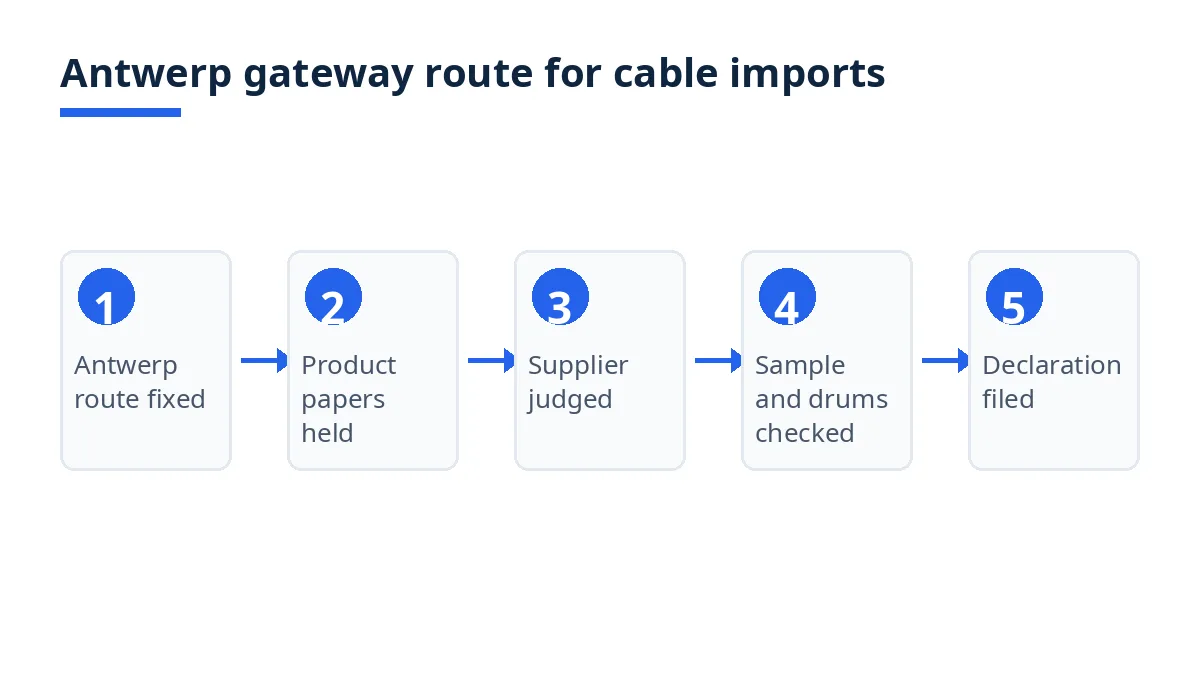
Fix the Antwerp route first: the terminal, the first warehouse, every onward destination, and the delivery term with named places, before any cable is priced.
Settle the Belgian border file early: one EORI number, a complete Entry Summary Declaration in ICS2 before arrival, and a declaration drafted from settled papers, with bonded storage and fiscal representation decided in advance.
Hold the condensed European product file for the exact construction: the Declaration of Performance with its EN 50575 fire class, the declarations of conformity, and the type-test reports.
No duty rate is stated in this guide: the broker must confirm the full TARIC heading 8544 code, the measures in force, and any Everything But Arms preference in writing.
Price on a worked landed cost in euros with duty as a separate line to be inserted, and compare suppliers line by line on the same cost lines.
A Belgian cable purchase turns on three decisions made before any price is compared: who stands as the importer in Belgium, where the drums rest after discharge at Antwerp, and which construction the papers describe. Antwerp-Bruges describes its two ports as a double gateway, combining an inland position with direct sea access, and it operates more than 200 regular maritime liner services.1 For a buyer, the gateway's value is the ability to clear goods in Belgium, hold them under bond, and send them on to Belgian projects or customers elsewhere in the European Union from one place. This guide opens with the Belgian importer role, moves through warehousing, customs, and the condensed European product file, and ends with a worked landed-cost example in euros. No duty rate is stated. The broker confirms the rate for the exact code, origin, and import date.
Start with the Belgian importer, not the cable catalogue
European product law puts duties on the importer that no supplier quotation can discharge. An importer is a person established in the European Union who places a product from a non-EU country on the EU market.2 Before placing a product on the market, the importer must confirm that the manufacturer carried out the appropriate conformity assessment, drew up the technical documentation, affixed the relevant labels and markings, and met the traceability duties, and the product, its packaging, or its accompanying documentation must carry the importer's name and contact address.2 Instructions and safety information must accompany the product in a language easily understood by end users, under the rules of the country of import.2 For Belgium, that language question is not a detail. The country has Dutch-speaking, French-speaking, and German-speaking communities, and a file written only in English can satisfy the port while failing the project. Agree the languages for labels, instructions, and installation papers with the designer before ordering, and record the agreement in the purchase order.
The distributor role needs the same early attention. A distributor is a person in the supply chain who makes a product available on the EU market after acquiring it from a manufacturer, importer, or another distributor, and distributors include retailers and wholesalers.2 A distributor must be able to show a market surveillance authority that the supplier followed the relevant rules, and must be able to name the manufacturer or authorised representative so the authority can obtain the declaration of conformity and the technical documentation.2 If the buyer will resell cable inside Belgium, the buyer or the buyer's customer carries that distributor duty, and the order file must let them discharge it: declarations, test reports, and batch records held together, in the agreed languages, for the exact construction supplied. Decide at enquiry who imports, who distributes, and who holds the file. Questions asked late are answered slowly, and a file assembled after shipment is assembled under pressure.
What the importer decision changes
The importer decision changes who files, who pays, and who answers the authorities. Where the buyer is established in Belgium and imports in its own name, the buyer holds the EORI number, the declaration, and the product file. Where a logistics provider acts as fiscal representative, the provider's VAT number and representation carry the formalities for a company not registered in Belgium, and the brochure for Antwerp-Bruges says VAT deferral at import applies in that arrangement as well.1 Neither arrangement removes the importer's product duties described above. A fiscal representative settles tax formalities; it does not make the cable conform. Keep the two roles separate in the order file, with a named person for each, and confirm in writing whether import VAT is deferred through the return or paid at the border for this load.
Antwerp as a warehouse decision: bonded storage and fiscal representation
Most buyers choose Antwerp for its storage as much as for its quays. Under the bonded-warehouse system described by the port, goods can be stored for an unlimited period with duties and tax deferred, and no VAT or customs dues are payable until the goods have been delivered to the customer in the European Union.1 While goods are held, value-added services and processing to customer requirements can be carried out, and the warehouses can operate as distribution centers.1 In practice, a buyer with several Belgian projects, or with customers in more than one Member State, can release drums in tranches and settle duty and tax as each tranche leaves bond, rather than settling the whole container on arrival. The broker and the warehouse should agree in writing which drums stay in bond, which are released for free circulation, and what paper accompanies each release. A release made to the wrong customer, or under the wrong paper, creates a tax record that takes far longer to correct than the release took to make.
Fiscal representation follows the same logic. Foreign companies do not need a Belgian VAT number to import through the port, according to the port brochure, because Antwerp-Bruges logistics providers act as fiscal representatives and hold a VAT number enabling them to complete customs formalities for companies not registered in Belgium.1 A VAT guide describes the tax side of the same arrangement: non-European companies generally cannot register for VAT in Belgium themselves and must register through a VAT representative, a local company that represents the business to the local VAT authorities and accepts responsibility for its VAT obligations, sometimes asking for a bank guarantee or deposit first.3 European companies are not obliged to appoint a VAT representative, though they may appoint a proxyholder to handle formalities while remaining responsible for their VAT debts.3 Whichever route applies, name the representative in the order file before sailing.
VAT arithmetic belongs to the accountant. Belgium has three VAT rates: a standard rate of 21%, an intermediate rate of 12%, and a reduced rate of 6%, with a zero rate for certain exceptional cases.3 The worked example in this guide uses the 21% standard rate for illustration only. The accountant reworks the figure once the broker confirms duty, because VAT falls on the duty-paid value and the accounting route changes the cash position. For a business not established in Belgium supplying goods, a special reverse-charge rule can apply where the customer is a taxable person established in Belgium who files ordinary returns, or a taxable person not established in Belgium with a VAT number and a VAT representative in Belgium.3 Ask the accountant which route fits the buyer's establishment and registration, and treat import VAT as a cash-flow item where it is recoverable, not as a final cost. Belgian periodic VAT returns are generally filed monthly, with quarterly filing available under conditions, through the Intervat platform.3
Onward distribution from Antwerp rests on the single market. Customs formalities can be completed in Antwerp or Bruges for destinations in any of the 27 Member States, under the same customs regulations, duties, rules of origin, and quotas across the customs union.1 Once goods are released for free circulation, the leg to a customer in another Member State is a commercial and tax movement rather than a second import, so the accountant should settle the onward VAT treatment alongside the import treatment. The warehouse, the broker, and the accountant all need the destination pattern before sailing: which drums stay in Belgium, which go onward, and which stay in bond awaiting a customer. A pattern decided after discharge is paid for in storage and re-handling.
Getting goods through Belgian customs: EORI, advance data and the declaration
An EORI number is mandatory for clearance of customs operations in the customs territory of the European Union, such as import, export, and transit, and a person can hold only one valid EORI number at a time.4 A single customs authority assigns the number: for an operator established in the EU customs territory, the authority of the country of establishment, and for an operator with no establishment there, the country where the operator intends to carry out its first customs operation.4 The number is the two-letter code of the issuing country followed by an identifier of up to 15 alphanumeric characters.4 Obtain or confirm the number well before the first sailing. The carrier, the forwarder, and the advance filing all use it, and a number obtained late delays the declaration while the vessel waits for nothing.
Advance cargo data goes in under the Import Control System 2. A complete Entry Summary Declaration must be submitted in ICS2 for all goods transported to or through the European Union before arrival, and customs use the data for pre-loading or pre-arrival risk analysis.5 Risk analysis can produce referrals requesting more information, screening of high-risk cargo, or a direction not to load, and a referral must be answered before the risk assessment can resume.5 Incomplete declarations may be rejected, or referrals may be issued in the pre-arrival phase, delaying processing and entry.5 Supply the filing party with complete data in good time: a full commercial description of each cable type, the code, the parties, weights, and package count, in the form the carrier asks for. Confirm in writing who files, whether filing is single or multiple, and the deadline for each part. Under multiple filing, more than one party may file parts of the declaration, depending on contractual arrangements and on who holds the information.5 Two parties each assuming the other holds a data element is how a referral starts.
Presentation and declaration follow arrival. The operator of a sea-going vessel must lodge an arrival notification at the customs office of first entry, and goods must be presented to customs on arrival.5 The port brochure states that the import process can begin up to 30 days before the vessel arrives, using prelodged declarations of type D, which require no customs authorisation and help goods move from the vessel to the hinterland.1 Use that period. Send the broker the invoice, packing list, bill of lading, code confirmation, origin evidence, and product papers before sailing, so the declaration is prepared from settled documents. Apply one construction description, one set of party names, and one set of quantities across the declaration, invoice, packing list, and bill of lading. Any difference between those documents should be explained in writing before the load is released.
The product file in brief: CPR, CE marking and the fire class
Cables intended for permanent installation in a building, where reaction-to-fire performance is relevant, are governed by Regulation (EU) No 305/2011, the Construction Products Regulation. That regulation sets harmonised conditions for marketing construction products in the EU, including requirements for drawing up a Declaration of Performance and for CE marking.6 The Declaration of Performance states the performance of a product in relation to its essential characteristics, and a manufacturer issuing it assumes responsibility for the declared performance.6 CE marking follows, signalling that the product conforms with the declared performance and with the applicable requirements of the regulation and other EU legislation.6 Since 1 July 2013 the regulation has applied in full, and for the purposes of this guide it is the framework the buyer tests the file against, not a paper to collect and forget.
EN 50575 is the harmonised standard for power, control, and communication cables, including optical fiber cables, supplied for use in construction works, subject to reaction-to-fire requirements.7 It sets six classes from Aca down to Fca, classified under EN 13501-6 with fire behaviour, smoke production, flaming droplets, and acidity as factors.7 Cables used in installations for safety purposes, such as fire-resistant types, sit outside its scope.7 Assessment and verification of constancy of performance depends on the class: systems 1+, 3, and 4 appear in the standard, with product-type determination and factory production control duties attaching to them.7 The standard also requires traceability: the manufacturer must keep a record of the batches of raw materials and the batches of products, and type-test reports and the evidence of factory production control are held for at least 10 years after the last production date of the products concerned.7 Those mechanics matter because they define what a buyer can demand: a declaration naming the product, a class earned by a test on the same construction, and a factory control record behind it.
Ask for these four items together, and refuse a file that arrives as a single sheet:
Item | What the paper must show | Ground for refusal |
|---|---|---|
Declaration of Performance | Product identity, the fire class, the standard, and the manufacturer | A declaration naming a different construction, or no construction |
Type-test evidence | Test reports for the class on the construction offered | A report for another family, voltage band, or market |
Factory production control | A working control system behind the declared class | No control evidence, or a certificate outside its scope |
Batch records | Batch identity that can be matched to the drums delivered | Drums that cannot be tied to a batch |
Compare the declaration, the reports, and the drum labels before the load leaves bond. A mismatch found at the warehouse costs a retest or a return; on a building site it costs a stop-work.
The fire class is a project decision, not a supplier preference. Member States keep responsibility for safety in construction works, including fire safety, and each applies its own requirements.6 The designer or specifier states the class required, and the buyer writes it into the purchase order alongside the standard reference. If a supplier offers a construction without stating its class, or states a class without a declaration and test evidence for that construction, the offer has not answered the question. A claim of performance for a cable that is not in the order is a claim the buyer cannot enforce.
Three further checks: voltage band, restricted substances and Belgian installation rules
The Low Voltage Directive, 2014/35/EU, covers electrical equipment designed for use within a voltage band of 50 to 1,000 volts alternating current and 75 to 1,500 volts direct current, and it has applied mandatorily since April 2016.8 Cables inside that band carry CE marking under the directive as well, and the sheath must carry the manufacturer's marking.8 A cable above that band, or a specialised cable that falls outside the directive, needs a written scope ruling before ordering: which directive or standard governs it, and which paper proves it. Silence on scope is a question unanswered, not a detail for after production.
Substance limits sit under the RoHS Directive, 2011/65/EU, which covers electrical and electronic equipment and restricts certain hazardous substances, with Annex II setting maximum concentration values by weight in homogeneous materials.9 The directive defines cables as cables with a rated voltage of less than 250 volts that serve as a connection or an extension to connect electrical and electronic equipment to the mains or to connect two or more pieces of such equipment.9 The values in the 2015 consolidated text read in this guide are:
Substance | Limit in the text read |
|---|---|
Lead | 0.1% |
Mercury | 0.1% |
Cadmium | 0.01% |
Hexavalent chromium | 0.1% |
Polybrominated biphenyls (PBB) | 0.1% |
Polybrominated diphenyl ethers (PBDE) | 0.1% |
A supplier's RoHS evidence must relate to the construction offered and state the basis of the result. Because substance rules are amended, ask the adviser whether the list above matches the rules in force for the construction and the import date, and do not treat a declaration written for another construction as evidence for this one.
Belgian installation control is a separate question from product conformity. The rules for electrical-installation control in Belgium sit in the RGIE, the General Regulation on Electrical Installations, known in French as the Règlement général sur les installations électriques and in Dutch as the Algemeen Reglement op de Elektrische Installaties, and control is reserved to approved inspection bodies.10 New installations must be controlled before commissioning, a new control is required after an extension, reinforcement, or modification of an installation, and periodic control applies every 25 years.10 The buyer should settle with the Belgian designer which installation rules govern the work, and confirm that the cable, its labelling, and its installation papers fit those rules. A product file that satisfies customs and a project that fails inspection are two different outcomes, and the order must serve both.
The tariff code in Europe: eight digits, one construction, one set of papers
The European tariff code is built from the six-digit Harmonized System heading plus further digits for the European classification and for TARIC measures. For electrical cables, the heading is 8544: insulated wire, cable, and other insulated electric conductors, whether or not fitted with connectors, and optical fiber cables, made up of individually sheathed fibers, whether or not assembled with electric conductors or fitted with connectors.11 The six-digit subheadings in the classification read opened for this guide run from winding wire through coaxial cable, ignition wiring sets, conductors fitted with connectors, and other conductors, to optical fiber cables.11 The broker extends the code to the full European line from the exact construction, the origin, and the import date. Conductor sizes under IEC 60228 run from 0.5 to 3,500 mm², covering solid, stranded, and Milliken forms in copper, aluminium, and aluminium alloy for fixed installations, with flexible copper conductors included, while telecom conductors are excluded.12 Tell the broker the construction in full: conductor metal and size, insulation and sheath materials, voltage band, connector position, and the intended use. A code chosen from a short product name invites a reclassification at the border.
TARIC is the database that combines the Common Customs Tariff with trade measures: third-country duty, tariff preferences, tariff suspensions, tariff quotas, trade defence measures, prohibitions and restrictions, import and export surveillance, and agricultural measures.13 It does not hold national VAT rates or excise duties.13 The interactive TARIC schedule for heading 8544 was not opened for this guide, so no duty rate appears here. That omission is deliberate: a rate copied from another heading, another origin, or another date would mislead the buyer. The broker puts the code, the third-country duty, any preference, and any other measure that applies to that construction, origin, and import date into writing, and the order is not priced until that letter arrives.
Bangladesh's position in European trade gives the broker something real to check. The Everything But Arms arrangement grants 46 least developed countries, including Bangladesh, duty-free and quota-free access to the EU market for all products except arms and ammunition.14 In 2023, 91% of Bangladesh's exports to the EU entered duty- and quota-free, and 90% of eligible exports entered at preferential rates.14 Whether a given cable construction earns a preference depends on the code, the origin rule, and the origin evidence. Ask the broker to confirm the origin rule for the construction, the origin document required, and the preference that follows. Origin evidence prepared late, or on the wrong form, does not earn a preference at the border.
Scoring suppliers for a first Belgian order
A first Belgian order is judged on papers and responsiveness more than on price. Price is visible in every quotation; the file that supports the cable, the drum discipline, and the speed of answers are visible only when tested. Test them before the order. Score each supplier on the same criteria, on the same evidence, and keep the scores in the order file so the choice can be defended later.
Criterion | Evidence to demand | Fail signal |
|---|---|---|
Product file | Declaration, type tests, factory control, batch records for the exact construction | A file for another construction, or a single sheet offered as a file |
Scope answers | Written answers on voltage band, substance rules, and fire class | Vague answers, or a class claimed without a declaration |
Origin and code | Broker-confirmed code and origin evidence for the construction | A code taken from a short product name |
Drum discipline | Agreed drum sizes, tolerances, labelling, and damage remedy in writing | Drums left to the supplier's discretion |
Inspection scope | Agreed inspection scope, attendance, and a rejection and replacement rule | An inspection scope that covers appearance only |
Language and marking | Labels, instructions, and papers in the agreed Belgian languages | English-only papers for a project that needs Dutch or French |
Responsiveness | Complete answers inside the agreed time, with named contacts | Repeated partial answers, or a new contact at every turn |
A supplier strong on price and weak on papers costs more in delays, retests, and storage than a dearer supplier whose file is complete. Compare quotations only among suppliers whose files pass, on the same construction, delivery rule, and drum terms. Where two pass on papers, choose the one that answers completely and quickly; the habit visible at enquiry predicts the habit when a drum is damaged.
Belgium's three language communities mean a label or paper written for one region can be wrong for another, and the importer duty on language applies in the country of import.2 State the language for each document in the order and check a sample label before production.
Quantities, samples and a split quotation
Order size follows the work, not the catalogue. Start from the route lengths the project needs, add a stated allowance for waste, retesting, and spares, and record that allowance as a number in the order. Then settle drum sizes: a drum length that suits the route lengths reduces joints and waste, and a drum length that suits nobody creates both. State the drum length, the tolerance, and the labelling in the purchase order, with the batch identity tied to each drum. If a drum arrives short, damaged, or labelled for another construction, the order must already say what happens: who inspects, who pays for the retest or the return, and how quickly the supplier replaces it. A remedy agreed after the event is a negotiation; a remedy agreed before it is a term.
No quantity is typical for this market, and this guide states none. A supplier's minimum quantity is its own production constraint, not a rule of the trade. For a first order, use the smallest quantity covering the work plus the stated allowance, on one construction, with one inspection scope. An order split across constructions tests everything at once and proves nothing.
Samples decide the construction before production decides it. Ask for a sample matching the production construction in conductor, insulation, sheath, marking, and fire class, and compare it with the order, the declaration, and the test evidence in writing, recording any difference. Keep the sample until the load is released. A sample that differs from the order is a warning: refuse it and require a matching one before production starts.
Quotations must be split into parts. Ask each supplier to price the cable, the drums and packing, the inspection, the freight and insurance, and any other charge as separate lines, each with its own basis, validity, and currency. A single total hides which part moves when metal prices shift or freight changes, and a quotation without a validity date hides whether the price survives the time the papers take. Compare the parts across suppliers, not only the totals, and write the agreed parts into the purchase order. Where a supplier prices on a metal basis, record the basis, the date, and the adjustment rule. A price that moves without a rule is a dispute waiting for a sailing.
Choosing the delivery rule for drums in containers
The Incoterms 2020 rules allocate cost, risk, and formalities between seller and buyer, and the choice changes who controls the load between the factory gate and the Antwerp quay. Eleven rules exist.15 Four rules apply only to sea and inland waterway transport: FAS, FOB, CFR, and CIF. CPT is any-mode. DPU is any-mode. DDP is any-mode, with the seller clearing import customs and paying duty, and the buyer unloading the goods. The delivery point and the risk-transfer point are not the same thing: delivery is the point where the seller's obligation to deliver the goods is fulfilled, and risk transfer is the point at which risk of loss or damage passes from seller to buyer.15 Write the named place precisely, with the terminal or warehouse named, because a rule name without a place leaves the handover point open.
For drums in containers, the any-mode rules usually serve the buyer better than the sea-only rules. The ICC Academy notes that FCA is typically better than FOB for containers, because containers are handed to the carrier at a terminal rather than loaded across a ship's rail.15 Under FCA, the seller delivers the goods to the carrier nominated by the buyer at the seller's premises or another named place, cleared for export.15 Under CPT and CIP, the seller contracts and pays for carriage to the named destination, with risk passing on delivery to the first carrier, and CIP adds insurance.15 Under DAP, the seller delivers at the named place ready for unloading, and DPU adds unloading; DDP adds import clearance and duty.15
Rule | Who arranges the main carriage | Who clears import customs | Risk passes |
|---|---|---|---|
FCA named place | Buyer | Buyer | On delivery to the carrier |
CPT named destination | Seller | Buyer | On delivery to the first carrier |
CIP named destination | Seller, with insurance | Buyer | On delivery to the first carrier |
DAP named place | Seller | Buyer | At the named place, before unloading |
DPU named place | Seller | Buyer | At the named place, after unloading |
DDP named place | Seller | Seller | At the named place, before unloading |
No transit time is stated in this guide, because no routing source was opened while it was written. Ask the carrier or forwarder for the sailing schedule, the transshipment points, and the door-to-door time in writing, and add a buffer for the advance filing, the declaration, and the warehouse release. Record the buffer in the project plan, and confirm the vessel and cut-off dates once the booking is made. A drum load that misses its cut-off waits for the next sailing.
Landed cost worked in euros, duty still to confirm
The example below uses example figures only, and duty is excluded throughout. The broker's confirmed duty, once known, is added to the customs value before the final VAT figure is worked. All figures are in euros.
Line | Example figure (EUR) | Basis |
|---|---|---|
Cable: 9,600 metres at EUR 2.85 per metre | 27,360.00 | 9,600 × 2.85 |
Freight and insurance to Antwerp | 2,150.00 | Forwarder quotation |
Customs value | 29,510.00 | Goods plus freight and insurance |
Inspection | 480.00 | Agreed inspection scope |
Broker and filing | 350.00 | Broker quotation |
Terminal, storage, and drayage | 820.00 | Terminal and warehouse charges |
Total before duty and VAT | 31,160.00 | Sum of the lines above |
Cost per metre before duty and VAT | 3.25 | 31,160 ÷ 9,600 = 3.2458, rounded |
For illustration, VAT at the 21% standard rate on the customs value of EUR 29,510.00 would be EUR 6,197.10. The accountant must rework that figure once the broker confirms duty, since VAT falls on the duty-paid value, and the accounting route — paid at the border, deferred through the return, or handled through a fiscal representative — changes the cash position. Treat the per-metre figure of EUR 3.25 as a planning figure, not a quotation. A real order reworks every line from the supplier's split quotation, the forwarder's quotation, the broker's duty confirmation, and the warehouse charges for the actual dwell time.
A Belgian order checklist
Each row below is a gate: the next starts when the gate is met, and a gate met on a promise is a gate left open.
Stage | Gate | Party |
|---|---|---|
Importer and file holder named | Importer, distributor, and file holder recorded, with languages agreed | Buyer and designer |
Code and duty confirmed | Full code, origin rule, and duty confirmed by the broker in writing | Broker |
Supplier scored | Scoring table completed; only passing suppliers compared on price | Buyer |
Sample matched | Sample matched to the order, the declaration, and the test evidence | Supplier and buyer |
Order written | Construction, class, drum terms, inspection scope, delivery rule, and remedy in one order | Buyer and supplier |
Advance data filed | Complete entry summary declaration filed, with the filer named | Filing party |
Declaration prepared | Declaration, invoice, packing list, and bill of lading checked against one another | Broker |
Goods presented and released | Declaration lodged, goods presented, and release or bond entry confirmed | Broker and warehouse |
Drums checked at release | Declaration, labels, and batch records matched to the drums | Buyer or inspector |
Onward movement settled | Bond, Belgian, or onward movement recorded for each drum | Warehouse and accountant |
FAQs
What should a Belgium buyer ask a supplier before a first Antwerp shipment?
Ask for the product file for the exact construction, the scope answers on voltage band and substances, the code and origin evidence, the drum terms, the inspection scope, and the language of labels and papers. Score the answers on the table in this guide, and compare prices only among suppliers whose files pass. A supplier that answers completely and quickly at enquiry is the supplier most likely to answer completely and quickly when a drum is damaged or a label is wrong.
What fire class should a cable have for a Belgian building?
The designer or specifier for the building states the class, because Member States keep responsibility for fire-safety requirements in construction works. The buyer writes the class, the standard reference, and the construction into the purchase order, and requires a declaration and type-test evidence for that construction and class. A class claimed without a declaration and test evidence has not been shown, and an offer that does not state a class has not answered the question.
How much duty will a Belgium buyer pay on cables from Bangladesh?
No rate is stated in this guide. The broker confirms, in writing and before pricing, the full code, the third-country duty, any preference, and any other measure that applies to that construction, its origin, and its import date. Bangladesh benefits from duty-free and quota-free access under the Everything But Arms arrangement for all products except arms and ammunition, but whether a given construction earns a preference depends on the code, the origin rule, and the origin evidence. Origin evidence prepared late or on the wrong form does not earn a preference at the border.
How big should a first Belgium cable order be?
As big as the work plus a stated allowance for waste, retesting, and spares, on one construction, with one inspection scope. Work from the route lengths, settle the drum pattern, and record the allowance as a number. A first order split across constructions tests everything at once and proves nothing. A supplier's minimum quantity is its own production constraint, not a rule of the trade; test it against the work and negotiate the quantity against the drum pattern.
Next steps on Exportain
Open the supplier pages on Exportain to compare Bangladeshi cable suppliers, read the wider sequence for importing from Bangladesh for the full import sequence, and check the landed-cost arithmetic used for Bangladesh shipments before finalising a quotation. The classification detail for heading 8544 sets out the subheadings under which the broker will place the construction. For the ordering route, see the ordering route described by Exportain.
Post a free RFQ on Exportain and get quotes from verified Bangladeshi suppliers
Sources
- Supply Chain. Port of Antwerp-Bruges (accessed )
- General product compliance. European Union (accessed )
- VAT in Belgium. European VAT Desk (accessed )
- Economic Operators Registration and Identification number (EORI). European Commission, Taxation and Customs Union (accessed )
- Import Control System 2. European Commission (accessed )
- Construction products. EUR-Lex (accessed )
- SIST EN 50575:2014 - Power, control and communication cables - Cables for general applications in construction works subject to reaction to fire requirements. Slovenian Institute for Standardization (accessed )
- Low Voltage Directive. Eland Cables (accessed )
- Directive 2011/65/EU on the restriction of the use of certain hazardous substances in electrical and electronic equipment. EUR-Lex (accessed )
- Contrôle électrique chez les particuliers. OCB (accessed )
- Classification Detail — HS 2017 Code 8544: Insulated wire, cable and other electric conductors. United Nations Statistics Division (UNSD) (accessed )
- IEC 60228:2023 - Conductors of insulated cables. International Electrotechnical Commission, (accessed )
- EU Customs Tariff (TARIC). European Commission, Taxation and Customs Union (accessed )
- EU trade relations with Bangladesh. European Commission, (accessed )
- Place of delivery & risk transfer in trade contracts. ICC Academy (accessed )
About the author
Sourcing from Bangladesh?
Post a request for quotation and suppliers on Exportain can send you their quotes directly.
Post an RFQ