Denim Jeans From Bangladesh to Canada: A Buyer's Import Checklist
How Canada buyers import denim jeans from Bangladesh: CARM and broker setup, supplier verification, samples, HS duty, GST and a worked landed-cost example.
Short answer
To import denim jeans from Bangladesh to Canada, register your business in the CARM Client Portal and delegate authority to a customs broker first, then classify each style under 6203.42 or 6204.62, confirm the duty treatment in force on your entry date, verify the factory, approve pre-production samples in production fabric and wash, and build the landed cost before bulk production.
On this page
Key takeaways
Register in CARM and delegate authority to your customs broker before the supplier ships: a broker who has not been delegated in CARM cannot file for you, and using a broker does not transfer the importer's legal responsibility.
In the T2025 schedule opened for this guide, the MFN rate for 6203.42.00 and 6204.62.00 is 17 percent, with LDCT listed among the applicable preferential tariffs; your broker must confirm the rate and any preferential qualification in force on your entry date.
Canadian denim labels must show fibre content in English and French, plus dealer identity and a country-of-origin statement where an import representation is made; agree the label artwork at sampling stage.
There is no single typical MOQ, price or transit time for denim jeans, so confirm each one in writing for your exact style, wash, size range and route; all figures in this guide are labelled example figures.
For a Canada buyer, the order of work is different: customs setup comes first, supplier selection second, and price negotiation only after both are settled. A Canadian commercial import cannot clear on a supplier quotation alone. You need a Business Number and import-export account in the CARM system, a broker delegated in that system, and a confirmed tariff classification before you price the order.
This checklist follows that broker-first order: CARM registration, tariff lines, GST, supplier verification, samples, quality checks, Incoterms, shipping, documents and a worked landed-cost example. Every price, freight and transit figure is labelled as an example figure.
Why source denim jeans from Bangladesh
Bangladesh is a practical place to shortlist denim suppliers because cutting, sewing, washing and finishing are established parts of its garment sector, and a buyer can compare several factories that already make jeans. That depth is a reason to shortlist, not a substitute for checking one factory: wash range, fit consistency and fabric sourcing differ by factory.
Decide your range plan first: rigid, comfort-stretch or super-stretch denim, fits and rises, washes, and any wash claim your customer can audit. A factory strong on rigid five-pocket jeans may not suit a stretch skinny programme, and indigo wash skill does not guarantee black denim shade. Ask for current production in your exact product type, and treat a catalogue photo as a claim to check.
Find and verify suppliers
Where should you start the search?
Write the specification before you contact anyone. For each style, fix fabric composition and weight, stretch percentage where specified, fit block and size range, wash and shade reference, pocket, rivet, button and stitching details, label and hang-tag requirements, and packing per carton. Send every candidate the identical specification and ask for the same reply format: fabric assumed, price inclusions, validity, and the minimum split by style, colour and wash.
Browse suppliers on Exportain and shortlist factories whose current range already includes denim jeans. A supplier that makes only knitwear or woven tops is not a close substitute, because denim washing, laser and ozone work, and fit approval follow different steps. Ask which washes each candidate does in-house, which it outsources, and what its monthly denim capacity is for your fabric weight.
How do you verify a supplier before you pay?
Verification has three layers. The first is company documents: trade licence, export registration and association membership where applicable, checked so that name, address and bank account name agree across every document. The second is capability: denim capacity, fabric source and whether fabric is woven in-house or bought in, wash capacity and route, and recent denim styles from current production. A finished pair from current production shows more than a catalogue photograph: waistband finish, pocket setting, wash consistency and shade matching.
The third layer is payment discipline. Keep payments to the company account named in the documents, never to a personal account, and verify any change of bank details separately. On Exportain, supplier profiles carry document and photo review badges: a review of documents and photos, not a factory inspection or a guarantee, and Exportain is not a party to the goods contract.
MOQ, pricing and samples
What is the typical MOQ for denim jeans from Bangladesh?
There is no single typical minimum order quantity for denim jeans from Bangladesh. The minimum is usually set per style and often per colour and wash, because fabric is woven or dyed in batches and a wash programme is set up per shade. A rigid indigo jean and a stretch black skinny jean will not carry the same minimum. Ask how the minimum splits by style, wash, colour and size range, and get the split in writing before you approve samples.
How is the price built, and how should you compare quotes?
Fabric is usually the main cost element in a jean, followed by cutting and sewing, washing and finishing, trims, testing, packing and the factory margin. Wash adds operations a plain trouser does not carry: stone, enzyme or laser work, ozone or softening, and shade correction. Two quotes can differ because one assumes a lighter fabric, a simpler wash, fewer sizes, or no special trims. Ask what each price is based on, in writing, so a lower quote is judged as a different specification rather than accepted as a saving.
Compare quotes on the same basis: same style and wash, same size range, same delivery term and same packing. Ask each supplier to state what is excluded, for example wash development charges, special trims, testing, or special packing.
Which samples do you need, and how do you approve them?
Work in stages. A development sample shows whether the factory can cut your fit block and construct the jean. A proto sample in the intended wash shows shade and hand feel. A pre-production sample, made in the actual production fabric, wash, trims and labels, is the sample you approve for bulk. Fit, shade and wash cannot be approved from a sample in substitute fabric, because washing changes dimensions, shade and hand feel.
Test samples as your customers will use them: measure waist, hip, inseam and leg opening against your size chart after washing, check shade match across sizes in the same wash batch, work the zipper and buttons, and wash one pair following your care label to check shrinkage and colour loss. Approve in writing and keep one sealed counter-sample of each style and wash.
Quality control and certifications needed
Which quality checks are specific to denim jeans?
Against the approved sample and chart, check fabric composition and finished weight, measurements after washing within your agreed tolerances, and consistency across the size range. Then check construction pair by pair: waistband attachment, fly and zipper function, pocket setting and bartacks, rivet and button security, stitch density, and wash evenness with no unintended streaks, white seam lines, or shade drift between legs. A pair can pass measurements and still fail if one leg is a shade darker than the other.
Agree the inspection method and defect limits before production. Inspect in stages: an inline check during sewing and washing catches drift while correction is still possible, and a final random inspection on packed goods checks quantity, workmanship, measurements, labels and packing. Name who inspects, when, and what happens to a failed lot, in the purchase order.
Which label rules apply in Canada?
Canada's textile labelling rules are the part of this checklist most often missed by first-time denim buyers, because the label must be right in two languages. The Competition Bureau guide states that fibre content information on a disclosure label must be shown in both English and French, except in an area where only one official language is used for consumer purchases.1 The Textile Labelling and Advertising Regulations require a disclosure label to show the fibre content, the name and postal address of the dealer, and, where a representation is made that the article or its fabric or fibre is imported, the country of origin.2
For denim jeans sold in Canada, that means: fibre percentages by generic fibre name in English and French, dealer identity (name and address, or a CA number where that route is used), and a country-of-origin statement where an import representation is made. Agree the label artwork at sampling stage, in both languages, and check the finished label before bulk sewing begins. A label error found after packing is a relabelling job, not a paperwork fix.
Which certifications do you actually need?
No single certificate covers every denim order. A retailer may name a restricted-substance list, a wash-chemical standard, or a social-compliance audit in its supplier manual. Name any such requirement in the specification, ask for the matching report, and check its scope, product, issuing body and date.
Incoterms, shipping and transit time
Which delivery term should a first order use?
For a first container order, weigh FOB at the Bangladeshi port against FCA at the named terminal. The ICC Academy summary of Incoterms 2020 delivery and risk points states that under FOB the seller delivers and risk passes when the goods are on board the vessel nominated by the buyer at the named port of shipment, and it notes that for goods in containers FCA is typically a better choice, even for maritime transport.3 A container is handed to the carrier before it is on board, so a sea-only rule mistimes the risk transfer.
Under FCA, delivery happens when the goods are handed to your carrier, which matches how containerised cargo moves. Under FOB, the factory delivers the goods on board and your forwarder handles the sea leg. In all rules except DDP, the buyer carries out import formalities, so your CARM registration and broker delegation are your work under either term, not the seller's. Read the EXW guide for Bangladesh to Canada before considering EXW, under which the buyer takes on export-side work most first-time buyers should not accept.
How long does shipping take?
There is no single typical transit time for denim jeans from Bangladesh to Canada. Sea freight is the standard route for bulk orders and it takes weeks rather than days, varying by port, routing, transshipment and season. Plan from your forwarder's current sailing schedule, and add clearance and delivery time at the Canadian end. Keep production time separate: an order is ready only when every pair has finished sewing, washing, inspection and packing.
Import duty, taxes and documents
How are denim jeans classified for duty in Canada?
Duty follows the classification of each style in the Canadian tariff, not the supplier's product name. Canada's tariff classification number has 10 digits: the first six are the international Harmonized System digits, the seventh and eighth distinguish Canadian break-outs, and the last two are statistical.4 Men's cotton trousers of denim sit in tariff item 6203.42.00, statistical suffix 41, and women's cotton trousers of denim sit in 6204.62.00, statistical suffix 11.5 Knitted jeans, stretch blends with a different fibre balance, and denim shorts sit on different lines, so classify every style separately and confirm each full 10-digit code with your broker.
What import duty applies?
In the Canadian Customs Tariff chapter 62 schedule opened for this guide (T2025), the Most Favoured Nation (MFN) rate for both 6203.42.00 and 6204.62.00 is 17 percent, and the schedule lists the Least Developed Country Tariff (LDCT) among the applicable preferential tariffs for those lines.5 That schedule is the line to start from, not the rate to price from: your broker must confirm the rate in force on your entry date and whether your goods qualify for a preferential treatment.
The reason for that caution is specific to Bangladesh. Canada has extended duty-free access for Bangladesh under its General Preferential Tariff framework, with the extension running to 2034, and Bangladeshi products have had duty-free and quota-free access under the LDCT scheme.6 But preferential treatment is never automatic: it depends on origin rules and correct proof of origin. Bangladesh's scheduled graduation from least-developed-country status makes the entry-date check essential. Price your order twice: once at the 17 percent MFN fallback, and once at any preferential rate your broker confirms in writing.
What about GST and other taxes?
Most commercial goods imported into Canada are subject to 5 percent GST at importation, collected by the CBSA, calculated on the value for duty plus any applicable customs duties and certain other charges.7 For a GST-registered business, GST paid on imports is generally recoverable through input tax credits, while customs duty is not recoverable and directly affects landed cost.7 Duty is a cost; GST is usually a timing item for a registered importer.
Two Canada-specific points follow. First, the value for duty is not the CIF value: Canada values goods on the price paid or payable adjusted to the place the goods were shipped directly to Canada from, so international freight and insurance from that point stay out of the duty base where they can be documented.8 Second, if your warehouse province is an HST province, confirm with your broker what tax is collected at entry and what is recoverable, because provincial treatment differs by province.
Which documents do you need for clearance?
The standard import set is the commercial invoice, packing list, bill of lading or air waybill, and proof of origin where a preference is claimed. The CBSA's archived importing checklist lists the same core steps: business number, origin, 10-digit classification and duty rate, GST, invoices and origin certificates, and value for duty.9 The invoice should name each style plainly, for example men's cotton denim jeans, five-pocket, rigid indigo wash, with composition, wash, sizes, quantities, unit prices and the delivery term, on its own line. Keep men's, women's, knitted and woven styles on separate lines. Quantities, weights and carton counts must agree across every document.
What is CARM, and what must you do before the first shipment?
CARM is the CBSA system of record for collecting duties and taxes on commercial goods imported into Canada, and registration in its Client Portal is the step that most often delays a first Canadian shipment. A business needs a nine-digit Business Number and an import-export (RM) program account to register, and the importer must register its own business in the portal: a broker cannot complete the initial registration on a client's behalf, but once registered the importer can delegate authority to its broker.10
Do this before the supplier ships, not while the container is on the water. Register the business, confirm the RM account, delegate authority to your broker, and agree how duties, GST and the monthly statement of account will be paid, including whether you will use Release Prior to Payment (RPP) with financial security or pay before release. A broker who has not been delegated in CARM cannot file for you, and using a broker does not transfer the importer's legal responsibility.10
Landed cost example
A landed cost is the full cost of one pair of jeans, ready to sell in Canada. Every number below is an example figure only.
Example figures: 3,000 pairs of men's cotton denim jeans, FOB Chattogram, sea freight to Canada, duty at the 17 percent MFN fallback rate only, GST shown separately.
Cost element | Example figures (per pair) | How to obtain your figure |
|---|---|---|
Product price, FOB | $9.80 | Confirmed pro forma invoice |
International freight | $1.20 | Forwarder quote divided by pairs shipped |
Insurance | $0.08 | Policy or forwarder quote |
Duty at 17 percent MFN on the FOB value for duty | $1.67 | Broker calculation from confirmed codes and rates |
Port, clearance and broker fees | $0.45 | Broker invoices divided by pairs |
Local delivery to warehouse | $0.35 | Local carrier quote divided by pairs |
Total landed cost excluding GST | $13.55 | Sum of all lines above |
GST at 5 percent on value for duty plus duty | $0.57 | Broker calculation; generally recoverable for a GST-registered importer |
Total cash outlay including GST | $14.12 | Landed cost plus GST |
The duty line uses the FOB value because, under Canada's valuation basis, international freight and insurance from the place of direct shipment stay out of the value for duty.8 If your broker confirms a preferential rate of Free on your entry date, the duty line falls to zero, the landed cost excluding GST falls to $11.88, and GST falls to $0.49, for a cash outlay of $12.37. Work the calculation twice: at quote stage, and again after shipment. See landed cost for imports from Bangladesh for the full method.
Step-by-step import checklist
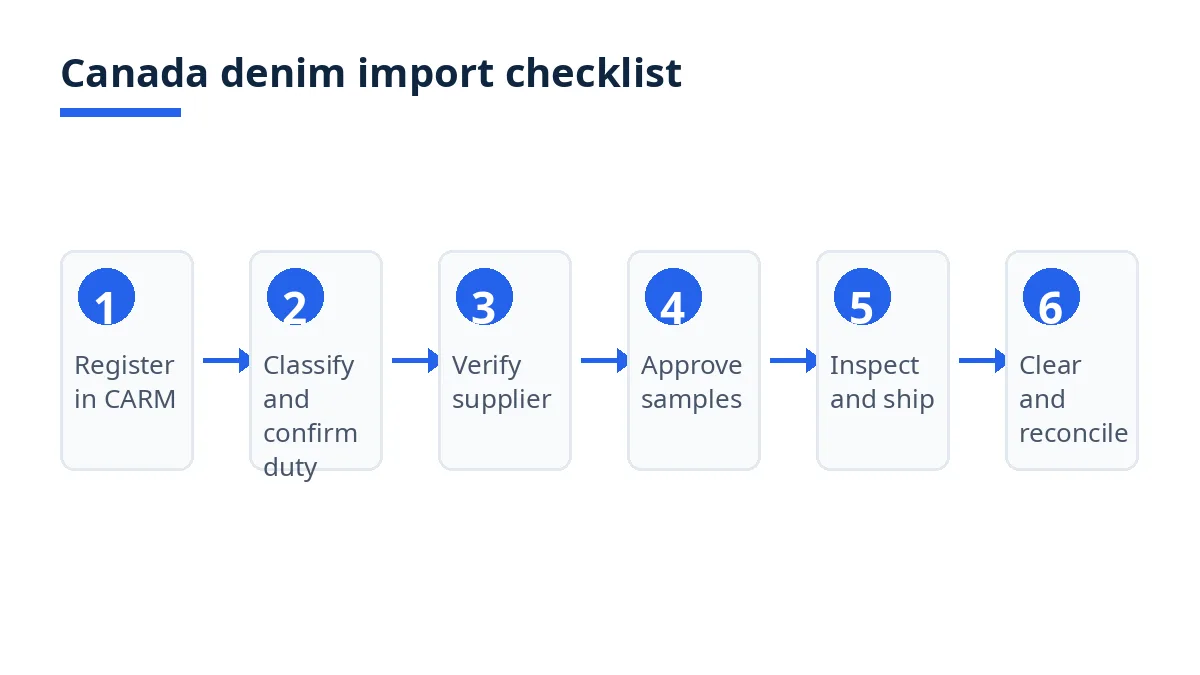
Register in CARM: obtain the Business Number and RM import-export account, register the business in the portal, and delegate authority to your customs broker.
Classify every style from 6203.42.00 for men's cotton denim trousers and 6204.62.00 for women's, confirm each full 10-digit code, and get the duty treatment in force on your entry date confirmed in writing by your broker, including any preferential claim and proof of origin.
Write the specification style by style and wash by wash: fabric, stretch, fit block, size range, wash reference, trims, labels in English and French, and packing.
Shortlist denim factories whose current range already includes jeans, and request comparable quotes on the identical specification and delivery term.
Verify the chosen supplier: company documents, denim capacity, fabric source, wash route, and a video or in-person factory check for a first order.
Order samples in stages, measure after washing, check shade match across sizes, then approve a pre-production sample of each style and wash in production fabric and wash.
Confirm the order in writing: purchase order, pro forma invoice, delivery and payment terms, inspection plan with defect limits, labelling, packing and shipment date.
Inspect during production and again on packed goods against the approved samples, checking fit, wash evenness, shade consistency and label accuracy.
Ship, clear customs through your delegated broker with the confirmed code for each style, pay duty and GST as advised, and reconcile the actual landed cost.
How Exportain helps
Browse suppliers for Bangladeshi denim exporters and compare their ranges against your style list. Then post your specification and target quantity as an RFQ and compare replies on the same terms before choosing a factory for sampling. Read how to buy for the buying steps on the platform. Exportain is a B2B marketplace where buyers post RFQs, receive quotations and message suppliers. It does not inspect goods, book freight or clear customs.
FAQs
What is the typical MOQ for denim jeans from Bangladesh?
There is no single typical minimum. It is usually set per style and often per colour and wash, because fabric is woven or dyed in batches and a wash programme is set up per shade.
How long does shipping take?
Production time and transit time are separate, and neither has a single typical figure. Sea transit takes weeks rather than days and varies by port, routing and season. Plan from your forwarder's sailing schedule, and add clearance and delivery time.
What import duty applies?
Duty follows the confirmed classification of each style and the treatment in force on the entry date. In the T2025 schedule opened for this guide, the MFN rate for 6203.42.00 and 6204.62.00 is 17 percent, with LDCT listed among the applicable preferential tariffs.5 Your broker must confirm the current rate and any preferential qualification before you price.6
How do I verify a supplier?
Check company documents first, so name, address and bank account agree across the trade licence, export registration and invoices. Then check capability: denim capacity, fabric source, wash route and recent denim production in your product type. Keep payments to the company account named in the documents, and approve a pre-production sample of each style and wash before bulk production.
Next steps on Exportain
Read how to import from Bangladesh for the process, then work through landed cost for imports from Bangladesh with broker figures. When ready, browse suppliers and compare factories on the same specification.
Sources
- Guide to the Textile Labelling and Advertising Regulations. Competition Bureau Canada (accessed )
- Textile Labelling and Advertising Regulations. Justice Laws Website (accessed )
- Place of delivery & risk transfer in trade contracts. ICC Academy (accessed )
- Frequently asked questions - Canadian Importers Database. Innovation, Science and Economic Development Canada (accessed )
- Chapter 62: T2025 - Articles of apparel and clothing accessories, not knitted or crocheted. Canada Border Services Agency (accessed )
- Canada extends duty-free access for Bangladesh till 2034. The Business Standard (accessed )
- Duties, taxes, and trade agreements. SupplyPro (accessed )
- Canada Customs and Duty: What Canadian Importers Actually Pay. CanFlow Global (accessed )
- Checklist for Importing Commercial Goods into Canada. Canada Border Services Agency (accessed )
- Importing Commercial Goods into Canada: Guide for Businesses. MTFX Group (accessed )
About the author
Sourcing from Bangladesh?
Post a request for quotation and suppliers on Exportain can send you their quotes directly.
Post an RFQ