EXW Shipping From Bangladesh to Canada: Costs, Steps and Timeline
EXW shipping from Bangladesh to Canada: the factory-gate handover, the buyer-side cost lines, the Canada import setup, and the documents for export clearance and CBSA entry.
Short answer
Under EXW (Ex Works), Incoterms 2020, a Canadian buyer takes over a Bangladesh shipment at the factory gate: the seller places the goods at the buyer's disposal at the named place, and the buyer then arranges loading, export clearance, ocean freight, insurance, and Canadian import clearance. Before shipment, the buyer needs a CRA business number, a CBSA import-export account, CARM access, and a licensed customs broker, and must confirm who files the Bangladesh export declaration.
On this page
Key takeaways
Under EXW, the seller's job ends when goods are placed at the buyer's disposal at the named place, and the buyer arranges loading, export clearance, freight, insurance, and Canadian import clearance.
Confirm who files the Bangladesh export declaration before the order is confirmed, because under strict EXW that filing is the buyer's job.
Set up the Canada import account first: a CRA business number, a CBSA import-export account, CARM access, and a delegated licensed customs broker.
Compare EXW quotations on landed cost in Canada, not on the factory-gate price, and insure the goods from the named place onward.
Under EXW, a Canadian buyer takes over a Bangladesh shipment at the factory gate and carries it the rest of the way. That shapes every decision in this guide: who files the export papers, who books the freight, who clears the goods in Canada, and who pays each charge. If you buy on EXW without a forwarder and a Canadian customs broker already lined up, the shipment can stall before it leaves the factory.
This guide is for a Canadian buyer comparing an EXW quotation with other terms, or running one already accepted. It follows the shipment from the named place in Bangladesh to a Canadian warehouse, with the Canada-side setup treated as the first job, not the last one.
Why this matters for buyers and sellers
What should I know first about EXW?
EXW (Ex Works) is one of the 11 Incoterms 2020 rules, which give a clear allocation of cost, risk and obligations between seller and buyer.1 Under EXW, the seller's job ends when the goods are placed at the buyer's disposal at the named place, usually the factory or warehouse, and the seller is not required to load them onto the buyer's collecting vehicle.2 From that point, the buyer bears every cost and risk: loading, inland transport, export clearance, ocean freight, insurance, Canadian import clearance, duty and tax, and inland delivery.2
That allocation is what makes EXW different from the terms most Bangladesh exporters use every day. Under FOB, the seller clears the goods for export and loads them on the vessel. Under EXW, export clearance is the buyer's responsibility, even though the buyer is a foreign party with no office in Bangladesh.2 In practice, the buyer's forwarder appoints a local agent to collect the goods and file the export declaration, and that appointment must be confirmed before the goods are ready, not after.
For the seller, EXW is simple: one factory-gate price, no freight booking, no export filing. For the buyer, EXW is a logistics project. The factory-gate price usually looks lower than an FOB or CIF price, because none of the onward costs are in it. The comparison that matters is the landed cost in Canada, not the factory-gate price.
The Canada-side setup is the part buyers most often leave too late. To import commercial goods for use or sale, a business needs a CRA business number and access to the CARM Client Portal.3 A broker cannot complete the first registration for you: register the business in CARM first, then delegate authority to the broker.3 If that setup is not finished when the vessel sails, the goods can arrive with no one able to clear them.
Step-by-step: how it works
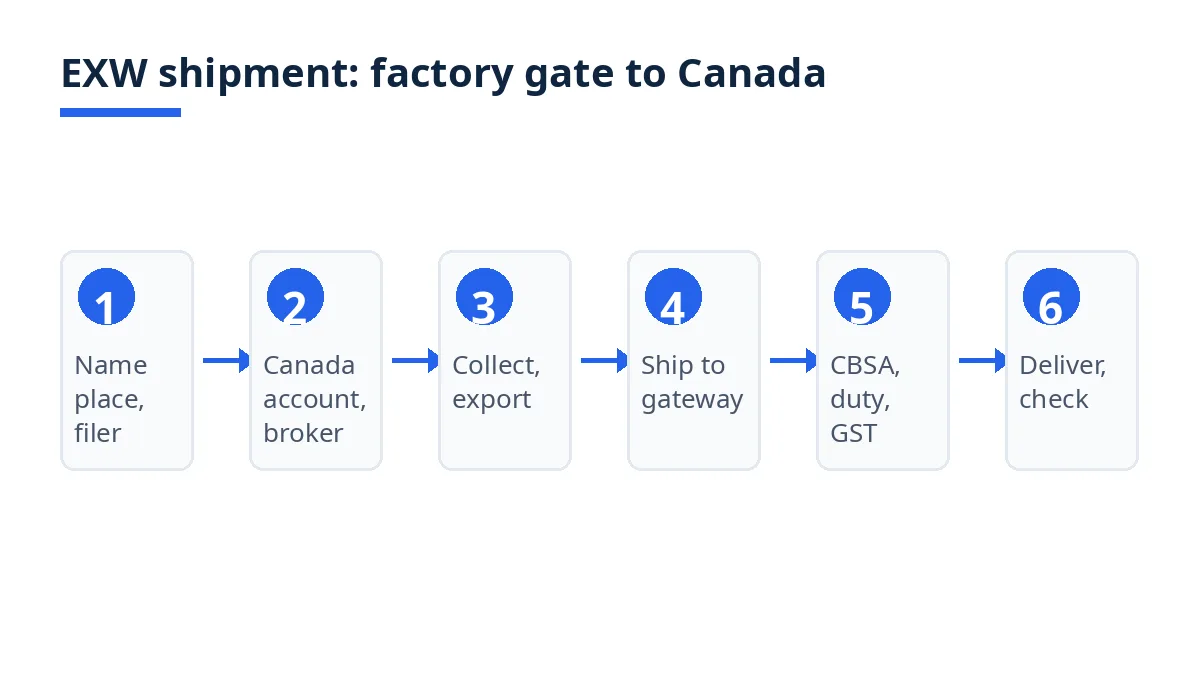
Name the place in writing. Write the EXW term as "EXW [factory name and address], Incoterms 2020" on the purchase order. A vague named place, such as a city or a district, is not enough for a truck to collect from. Confirm the collection address, contact person, ready date, and whether the seller will load the truck as a separately agreed service.
Set up the Canada import account. Obtain a nine-digit business number (BN) from the CRA if you do not already have one, then register for an import-export (RM) program account with the CBSA. Importers, exporters, or customs brokers acting for a client need a BN before registering for an RM account.4 List every business name that may appear on customs release forms when you register, because the CBSA's records must match the release documents.4
Appoint the broker and the forwarder. Delegate authority to a licensed Canadian customs broker in CARM, and give the broker the product description, HS classification, value, and origin before shipment.3 Appoint a freight forwarder with a Bangladesh agent who can collect at the factory, file the export declaration, and book the sea leg. Give both parties the same invoice, packing list, and purchase order.
Confirm who files the export declaration. Under strict EXW, the buyer files it, through its local agent.2 Confirm in writing that the forwarder's agent will do so, and confirm what the seller must supply: the commercial invoice, packing list, and any product certificates. If no one can file, stop and renegotiate before production finishes. Switching to FCA, under which the seller clears the goods for export, is often the cleaner fix.
Collect, clear for export, and load. The buyer's agent collects the goods, loads the vehicle, and completes the export formalities. Goods may not be loaded or shipped for export unless an export declaration, known as the Bill of Export or Shipping Bill, is submitted to Customs and approved.5
Ship to the Canadian gateway. The forwarder books the sea leg from Chattogram to the Canadian gateway you chose, and arranges cargo insurance, which is the buyer's responsibility under EXW and is not automatic.2 Choose the gateway with the inland leg in mind: a west coast arrival suits a western destination, while an east coast arrival suits an eastern one. Ask the forwarder to quote the gateway-to-warehouse leg separately so you can compare gateways on total cost.
Clear the CBSA entry and take delivery. On arrival, the broker files the import entry through CARM, and duty and tax are assessed. Goods imported into Canada are generally subject to the 5% Goods and Services Tax (GST) and potentially subject to customs duties, based on tariff classification, country of origin, and value.3 If you enrolled in the Release Prior to Payment (RPP) program, release can come before payment, but your business must post its own financial security to enroll.3 After release, arrange inland delivery and check the goods against the packing list.
Costs, timelines and documents
What are the typical costs and timelines?
There is no single typical cost for an EXW shipment from Bangladesh to Canada, because every buyer-side line is priced for your goods, weight, volume, gateway, and destination. What is fixed is the list of lines. Under EXW, the buyer pays for loading, inland transport, export clearance, origin handling, ocean freight, insurance, destination clearance and duties, and inland delivery.2 The seller's price covers the goods and export packaging only.
Cost line | Paid by |
|---|---|
Factory-gate goods price | Buyer |
Loading at the factory | Buyer |
Inland transport to Chattogram | Buyer |
Bangladesh export clearance | Buyer |
Origin terminal handling | Buyer |
Ocean freight to Canada | Buyer |
Cargo insurance | Buyer |
Canadian customs brokerage | Buyer |
Canadian duty | Buyer |
GST, generally 5% | Buyer |
Inland delivery in Canada | Buyer |
Example figures: a Canadian buyer imports a consolidated garment shipment with an EXW factory-gate value of CAD 40,000. The forwarder quotes CAD 1,800 for collection, inland transport, and export clearance combined; CAD 4,200 for ocean freight to the chosen gateway; CAD 350 for cargo insurance; CAD 450 for brokerage; and CAD 2,100 for inland delivery. Duty depends on classification and origin, and GST at 5% generally applies to the duty-paid value.3 The example shows how the lines stack, not a market rate.
For timelines, treat every leg as a range, not a date. Factory readiness depends on production and correction rounds. The sea leg depends on the sailing schedule, transshipment, and the gateway chosen. Canadian clearance depends on whether the CARM registration, broker delegation, and documents were ready before arrival. Example figures: one week from factory-ready to departure; three to six weeks on the water; and one week from arrival to delivery, assuming documents were complete.
Which documents are needed?
On the Bangladesh side, the documents enclosed with the Bill of Export for customs clearance include the export letter of credit or, where there is none, the export contract or purchase order approved by the negotiating bank; the commercial invoice with a detailed description of goods signed by the exporter; the packing list with quantity, weight, and packing information; the EXP form certified by an Authorized Dealer; the certificate of origin issued by the Export Promotion Bureau (EPB) or a Chamber of Commerce and Industry; the VAT registration certificate; and the Taxpayer Identification Number (TIN).5 Product-specific certificates, such as an ERC for jute, jute goods, and tea, apply for some categories.5
On the Canada side, the broker needs the commercial invoice, packing list, bill of lading, certificate of origin, and the importer's BN and RM account details, plus any permits or certificates required by other government departments for the product.3 Some goods need permits, certificates, or inspections from other departments before release.3 If you are unsure about classification, value, or origin, the CBSA offers advance rulings.3
Bangladesh-specific rules and tips
Confirm the export filer before the ready date. Goods shall not be loaded or shipped unless the Bill of Export is submitted and approved.5 Under EXW, that filing is the buyer's job, arranged through a local agent.2 Ask the forwarder to name the agent and confirm the seller will hand over the signed commercial invoice and packing list on the collection day.
Keep one legal name across every paper. The export declaration names the exporter and the foreign buyer,5 and the CBSA requires the names on file to match the customs release documents.4 The buyer name on the purchase order, invoice, packing list, bill of lading, and CARM registration should be identical.
Check product-specific papers early. The standard export set is not always the full set. Jute, jute goods, and tea require an ERC, and other products carry their own certificates.5 Ask the seller and the forwarder whether your product needs anything beyond the standard set, and get the answer in writing.
Price the gateway, not just the ocean leg. The ocean freight quotation to one gateway can look cheaper while the inland leg to your warehouse costs more than the saving. Ask for three figures per gateway: ocean freight, destination charges, and inland delivery.
Mistakes and red flags
What are the most common mistakes?
Signing EXW without a confirmed export filer. Under EXW, export clearance belongs to the buyer.2 If the buyer's forwarder has no Bangladesh agent able to file, the goods sit at the factory while the parties renegotiate. Confirm the filer before you confirm the order.
Comparing an EXW price with an FOB or CIF price. An EXW price excludes every onward cost, while FOB includes export clearance and loading, and CIF includes freight and insurance. Compare only landed costs in Canada, built from the same goods, quantity, and gateway.
Leaving the CARM setup until the vessel sails. Commercial imports need a CRA business number and CARM access,3 and a broker cannot register the business for you. Register and delegate authority before shipment.
Using different names on different documents. The CBSA's registered business names must match the release documents.4
Skipping cargo insurance. Insurance is the buyer's responsibility under EXW and is not automatic, and risk passes to the buyer when goods are placed at the buyer's disposal, before loading.2
Treating a profile or a badge as a guarantee. A supplier profile is a starting point. Exportain badges record document and photo reviews, not factory inspections, and are not a guarantee of capacity, quality, or delivery.6 7
Checklist
Before you confirm, every line should be answered in writing.
EXW named place written in full on the purchase order, with collection address and contact.
Export filer confirmed: the forwarder's Bangladesh agent named, with documents it will hold.
Loading at the factory agreed in writing, or the buyer's agent booked to load.
CRA business number obtained and RM import-export account registered.4
CARM registration complete and broker delegation active before shipment.3
Forwarder appointed for the sea leg and inland delivery, with gateway options priced as totals.
Cargo insurance placed for the full journey, from the named place to the warehouse.
Classification, value, and origin confirmed with the broker.
Bangladesh export set agreed: contract or purchase order, invoice, packing list, EXP form, certificate of origin, VAT certificate, TIN.5
Canada entry set ready: invoice, packing list, bill of lading, certificate of origin, BN and RM details.
Product-specific permits or certificates confirmed with the broker before shipment.3
Inland delivery booked from the gateway to the warehouse.
How Exportain helps
On Exportain, browse suppliers and post a request for quotation (RFQ) on the RFQ board with the EXW named place, the collection address, and the Canadian gateway, so suppliers quote the same factory-gate terms.
Read the badges for what they record. Exportain Verified means Exportain has checked identity, phone, email, and business registration, and Export Verified means it has checked the Export Registration Certificate (ERC).6 Factory Verified means it has reviewed photos of the manufacturer factory, while Trading Company Verified means it has reviewed photos of the trading company office or warehouse.6 Verification is a document review by staff, free, and never granted by membership plans.7 It is not a factory inspection.6 7
FAQs
What should I know first about EXW?
Under EXW, the seller places the goods at your disposal at the named place in Bangladesh and the seller's obligations end there.2 You arrange loading, export clearance, carriage, insurance, Canadian import clearance, duty and GST, and inland delivery, and risk passes to you when the goods are placed at your disposal, before loading.2
What are the typical costs and timelines?
There are no typical figures a guide can state as fact, because every line is priced for your goods and gateway. The cost lines are fixed: loading, inland transport to Chattogram, export clearance, origin handling, ocean freight, insurance, brokerage, Canadian duty, GST at generally 5%, and inland delivery.2 3 Timelines depend on factory readiness, sailing and routing, and whether the CARM setup and documents were ready before arrival.
Which documents are needed?
The Bangladesh export set enclosed with the Bill of Export includes the contract or purchase order, commercial invoice, packing list, EXP form certified by an Authorized Dealer, certificate of origin, VAT certificate, and TIN, plus product-specific certificates where they apply.5 The Canada entry set includes the invoice, packing list, bill of lading, certificate of origin, and your BN and RM account details, plus any other-department permits for the product.3
What are the most common mistakes?
The most common mistakes are signing EXW without a confirmed export filer, comparing an EXW factory-gate price with an FOB or CIF price instead of comparing landed costs, leaving the CARM registration and broker delegation until the vessel sails, using different business names across documents, and skipping cargo insurance.2 3 4
Next steps on Exportain
Browse suppliers, then post the EXW named place, collection address, and Canadian gateway on the RFQ board so suppliers quote the same factory-gate terms. Before you confirm, read the EXW definition guide, the Incoterms for shipments from Bangladesh guide, and the landed cost for imports from Bangladesh guide.
Sources
- Incoterms® 2020. International Chamber of Commerce (ICC) (accessed )
- Ex Works (EXW) Incoterms 2026: Complete Guide for Freight Forwarders. GoFreight (accessed )
- The CBSA shares tips on importing commercial goods to Canada for FIFA World Cup 2026. Canada Border Services Agency (accessed )
- Getting or making changes to a nine-digit business number for importing and exporting. Canada Revenue Agency (accessed )
- Customs Clearance Procedures for Export. Bangladesh Customs, National Board of Revenue (accessed )
- Trust & Safety Center. Exportain (accessed )
- Supplier verification: Earn trust badges buyers can see. Exportain (accessed )
About the author
Sourcing from Bangladesh?
Post a request for quotation and suppliers on Exportain can send you their quotes directly.
Post an RFQ