

Bed Sheets From Bangladesh to Germany: A Buyer's Import Checklist
Bed sheets from Bangladesh to Germany: specification, supplier checks, samples, heading 6302 duty and EBA preference, EU labelling, Hamburg shipping, 19% import VAT, and a landed cost example.
Short answer
To import bed sheets from Bangladesh to Germany, fix your sheet set specification first, including fiber, weave, finish, sizes, and packing, then shortlist bed-linen mills, verify documents and capability, and approve a pre-production sample with the label proof. Classify each style under heading 6302, confirm the Everything But Arms preference and origin evidence with your broker, budget import VAT at 19 percent, and build the landed cost to Hamburg before bulk production.
On this page
Key takeaways
Bed sheets sit in heading 6302: 6302.10 for knitted or crocheted bed linen, 6302.21, 6302.22 and 6302.29 for printed bed linen, and 6302.31, 6302.32 and 6302.39 for other bed linen.
Everything But Arms gives Bangladesh duty-free, quota-free access to the EU for all products except arms and ammunition, subject to origin rules; the schedule opened shows 12 percent third-country duty on most bed linen lines, so confirm the TARIC rate with a broker.
Multi-fiber products must be labelled with the name and percentage by weight of all constituent fibers in descending order under Regulation (EU) No 1007/2011.
Budget import VAT at 19 percent in Germany, separate from duty, and confirm the VAT base and recovery position with a tax adviser; work the landed cost at both the preference and third-country duty rates.
To import bed sheets from Bangladesh to Germany, start at the Hamburg end of the order and work backward. A sheet set that clears German customs cleanly, carries the right fiber label, and arrives at a known landed cost is the result of decisions made before any fabric is cut. This guide follows that order: German entry requirements first, then supplier, sample, and shipment decisions.
Bed sheets from Bangladesh reach Germany as a specification order, not as a catalog purchase. You set the fiber, weave, finish, size set, hem, and packing, and the mill quotes against that specification. The same choices decide the tariff line, the label wording, and the inspection checks.
Why German buyers source bed sheets from Bangladesh
For a German buyer, Bangladesh offers a home-textile production base that already works to European retail programs: wide fabric, long cutting tables, hemming at sheet length, and packing of matched sets.
The commercial reason to look at Bangladesh for a German program is the tariff preference, and it is conditional, not automatic. As a least developed country, Bangladesh benefits from the most favorable regime under the European Union Generalised Scheme of Preferences, the Everything But Arms arrangement, which grants duty-free, quota-free access to the EU for all products except arms and ammunition.1 In 2024, 91 percent of Bangladesh exports to the EU entered duty-free and quota-free, at a 96 percent utilization rate.1 A bed sheet order benefits only when the goods meet the origin rules and the proof of origin is in order, so agree the origin evidence at order stage.
German retail also shapes the specification. Decide three items before you ask for prices: the finished measurements after washing for each piece, the care wording you will print, and the fiber composition in the words you want on the label. Plan by season and shelf date, working backward from the warehouse date with a buffer for a second sample round and for clearance at Hamburg.
Find and verify suppliers for the German market
Where should you start the search?
Start with mills and exporters whose current range already includes bed linen in your fiber and construction. Send every candidate the identical specification and ask for the same reply format: fiber and fabric assumed, pieces per set, price inclusions, validity, and the minimum per design and color. Browse suppliers on Exportain and read how to import from Bangladesh for the full process.
Ask each candidate how it handles the German-facing parts of the order: fiber composition labelling, care labelling, and the test reports your retail customer names. Record the answers in writing, because the label proof and the test scope are the items a German retailer checks first. Check the bed sheets manufacturers guide to compare ranges, and shortlist three or four suppliers.
How do I verify a supplier?
Verification has three layers. The first is company documents: trade licence, export registration, and association membership where applicable, checked so that name, address, and bank account agree across every document. The second is capability: monthly sheet capacity, whether weaving is in-house or fabric is bought in, fabric width, dyeing and printing route, and recent sheet sets from current production.
The third layer is payment discipline. Keep payments to the company account named in the documents, never to a personal account, and verify any change of bank details through a separate channel. On Exportain, supplier profiles carry document and photo review badges where the checks have been completed. A badge records a review of documents and photos, not a factory inspection or guarantee, and Exportain is not a party to the goods contract. For a first order, add a video or in-person check of sheet production: cutting tables, hemming lines, and set packing.
MOQ, pricing and samples
What is the typical MOQ for bed sheets from Bangladesh?
There is no single typical minimum order quantity for bed sheets from Bangladesh. The minimum is set per design and usually per color or print, because fabric is woven, dyed, or printed in batches and a cutting plan is set up per size range. A plain white set and a printed set in several colors will not carry the same minimum. Ask how the minimum splits by design, color, size, and set composition, in writing.
How is the price built, and how should you compare quotes?
Fabric is usually the largest cost element in a bed sheet, followed by cutting and sewing, dyeing or printing, finishing, hemming and elastic work, testing, packing, and the factory margin. Detail adds operations and can move the sheet to a different tariff line. Two quotes can differ because one assumes a lighter fabric, a smaller size, less pocket depth, no trim, or a simpler finish, so ask what each price is based on, in writing.
Compare quotes on the same basis only. Ask each supplier to state what is excluded, for example testing, special packing, or label printing. A quote that excludes testing is not cheaper than one that includes it when your German customer requires a test report; it is incomplete.
Which samples do you need, and how do you approve them?
Work in stages. A development sample shows whether the factory can construct the sheet, form the hem evenly, fit the elastic, and complete a matched set to your size chart. A pre-production sample, made in the actual production fabric, color or print, and finish, is the sample you approve for bulk.
Test the samples as your German customer will use them: wash the set following your care label, measure every piece against your size chart after washing, and check set matching in shade and print. Approve in writing and keep one sealed counter-sample of each style as the inspection reference.
Quality control and certifications needed
Which quality checks are specific to bed sheets?
Against the approved sample and size chart, check fiber composition and finished fabric weight, finished dimensions within your agreed tolerances, and consistency across the size matrix. Then check construction: hem width and stitching, elastic type and coverage on fitted sheets, seam strength, print registration, and shade consistency across fabric batches.
Agree the inspection method and defect limits before production: sample size, acceptance and rejection limits, and the list of critical, major, and minor defects. Inspect in stages: an inline check during sewing and finishing, and a final random inspection on packed goods covering quantity, workmanship, measurements, labels, and packing. See the bed sheets quality control checklist for the full check sequence.
Which label rules apply in Germany and the EU?
Fiber labelling is the first label decision, and it is set by EU law, not by the supplier. Under Regulation (EU) No 1007/2011, a multi-fiber textile product shall be labelled or marked with the name and percentage by weight of all constituent fibers in descending order.2 Agree the wording at sampling stage, check that the percentages match the fabric you bought, add care, size, and origin marking as your market requires, and confirm the language requirement for Germany with your broker before label printing.
Which certifications do you actually need?
No single certificate covers every bed sheet order. What you need follows your market and your customer: a German retailer or hotel group may name a specific test or scheme in its own supplier manual. Name any such requirement in the specification, ask for the matching report or certificate, and check its scope, product, issuing body, and date.
OEKO-TEX Standard 100 is the certification German buyers ask about most often for bed linen. Standard 100 is a label for textiles tested for harmful substances, from yarn to finished product, and every item bearing the label is certified as having passed safety tests for the presence of harmful substances.3 Every thread, button, and accessory is tested against a list of over 1,000 harmful substances, and the more intensive the skin contact, the stricter the requirements and tests.3 Bed linens fall in Product Class 2, products with direct skin contact.3 The certification states compliance with international requirements, including the annexes XVII and XIV of REACH and the ECHA substances of very high concern candidate list.3 If you require Standard 100, state the product class, ask for the certificate number, and check scope, products covered, and expiry date in the OEKO-TEX label check. A voluntary label does not by itself settle a REACH legal question: confirm any restricted-substance position with your broker or adviser before shipment.
Incoterms, shipping and transit time
Which delivery term should a first German order use?
The Incoterms 2020 rules allocate delivery, risk, and cost between seller and buyer for each rule. Under FCA, risk passes when the goods are handed to the buyer's nominated carrier, and under FOB risk passes when the goods are loaded on board the vessel, while under CIF the seller pays freight and minimum insurance to the destination port but risk still passes on board at origin.4 The four sea rules are written for port-to-port shipments, and a container is handed to the carrier before it is on board, so a sea-only rule mistimes the risk transfer for container cargo.4 For a first container order to Hamburg, weigh FCA at the named terminal against FOB at Chattogram, and record the named place in full in the contract.
How long does shipping take to Hamburg?
There is no single typical transit time for bed sheets from Bangladesh to Hamburg. Sea freight is the standard route for bulk orders and takes weeks rather than days, varying by port pair, routing, transshipment, and season. Hamburg is the natural gateway: the Port of Hamburg is described by Hamburg Port Authority as Germany's largest seaport, with container terminals and rail links serving the German hinterland.5 Plan from your forwarder's current sailing schedule for the Chattogram to Hamburg route, add clearance and delivery, and confirm carton dimensions and weight in the specification, because bed sheets are light for their size and carton volume can limit a shipment before weight does.
Import duty, taxes and documents
How are bed sheets classified for duty?
Duty follows the classification of each style in the EU tariff, not the supplier's product name. The Harmonized System is a multipurpose international product nomenclature developed by the World Customs Organization, comprising about 5,000 commodity groups, each identified by a six-digit code, used by more than 200 countries and economies as a basis for customs tariffs.6 The first six digits are shared worldwide, and the EU adds further digits in the Combined Nomenclature and TARIC for its own tariff lines.
The central heading is 6302, bed linen, table linen, toilet linen, and kitchen linen. Within bed linen, the structure splits first by construction and print, then by fiber: 6302.10 for bed linen, knitted or crocheted; 6302.21, 6302.22, and 6302.29 for other bed linen, printed; and 6302.31, 6302.32, and 6302.39 for other bed linen.7 Confirm the full EU code for each style before you price or ship. Every HS heading in this guide is indicative: verify it on the official tariff, ask your broker to confirm the code in writing, and read the HS code guide for bed sheets for the classification factors.
What import duty applies in Germany?
Your rate depends on the confirmed code for each style, the origin, and any preference in force on the entry date. The schedule opened for this guide shows a third-country duty of 12 percent on most bed linen lines in heading 6302, with a lower rate on certain nonwoven lines, and a tariff preference of 0 percent under the GSP Everything But Arms arrangement.7 Treat every duty line as indicative and verify it with your broker for your exact code and entry date, and mark any unopened duty or tax line as confirm with broker. The preference grants duty-free, quota-free access for all products except arms and ammunition, and Bangladesh is the European Commission's largest beneficiary under the arrangement.1 If the origin evidence fails, the third-country rate applies, so work the landed cost at both rates before you commit to a selling price.
Import VAT and the German entry process
Import VAT is separate from duty. The standard VAT rate in Germany is 19 percent under section 12, paragraph 1 of the German VAT Act, with a reduced rate of 7 percent for certain listed goods and services.8 Budget import VAT at 19 percent for bed sheets and confirm the treatment with your tax adviser or broker. Import VAT is a cash cost at clearance even where a VAT-registered buyer later recovers it as input tax, so include the cash timing in your plan and confirm the VAT base and recovery position in writing.
At the German border, the entry is an EU customs entry, and the importer needs an EORI number. The EORI number is an operator identification number valid throughout the European Union that replaces the German customs number, and since 2009 it has been a prerequisite for customs clearance in the European Union.9 Apply for it before the first shipment, and ask your broker to walk through one entry in advance: EORI number, commodity codes, customs value, origin evidence, and VAT treatment.
Which documents do you need for clearance?
The standard import set is the commercial invoice, packing list, bill of lading, and proof of origin where a preference is claimed. The invoice should name each style plainly, with fiber composition, sizes, pieces per set, quantities, unit prices, and the delivery term, on its own line. Quantities, weights, and carton counts must agree across every document, and the invoice composition must match the approved label proof. Confirm with your broker whether any additional document is needed, and mark any unconfirmed requirement as confirm with broker.
Landed cost example
A landed cost is the full cost of one sheet set, ready for the German warehouse. Every number below is an example figure only, not a quote, and the duty line is shown at the Everything But Arms preference rate only because the example assumes the origin evidence is in order.
Example figures: 5,000 cotton sheet sets, FOB Chattogram, sea freight to Hamburg, duty at the example preference rate only.
Cost element | Example figures (per set) | How to obtain your figure |
|---|---|---|
Product price, FOB | 9.20 euros | Confirmed pro forma invoice |
International freight | 0.85 euros | Forwarder quote divided by sets shipped |
Insurance | 0.07 euros | Policy or forwarder quote |
Duty | 0.00 euros | Broker calculation from confirmed codes and rates, EBA preference assumed |
Port, clearance and broker fees | 0.42 euros | Broker invoices divided by sets |
Local delivery to warehouse | 0.38 euros | Local carrier quote divided by sets |
Total landed cost, excluding import VAT | 10.92 euros | Sum of all lines above |
Import VAT is not included in the total, because its treatment depends on your tax position. In this example, import VAT at 19 percent on the example customs value plus freight and insurance of 10.12 euros would be 1.92 euros per set, shown as a memo line only. Work the calculation twice, at quote stage and after shipment, using the landed cost guide, and do not reuse another country's landed cost numbers for a German program.
Step-by-step import checklist: import bed sheets from bangladesh to germany
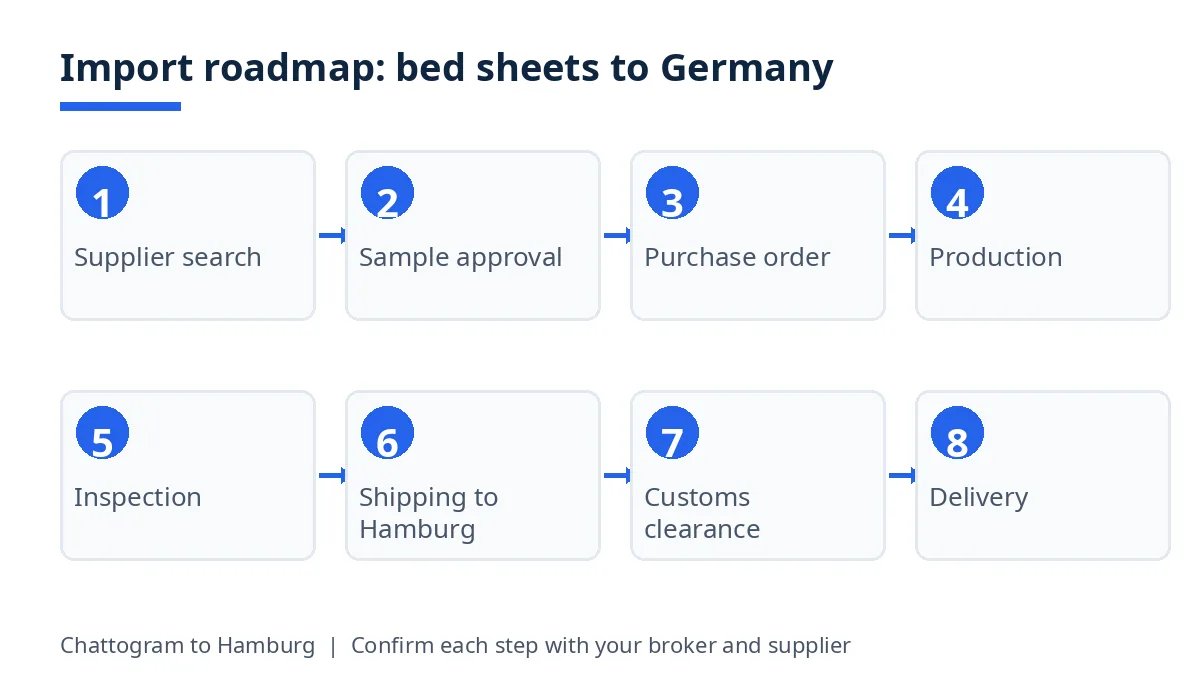
Write the specification set by set: fiber composition in label words, weave and finish, finished sizes after washing, pocket depth on fitted sheets, hem widths, elastic, colors or prints, labels, and packing.
Classify every style from heading 6302, confirm each full EU code and duty with your broker, and mark every heading indicative until confirmed.
Confirm the Everything But Arms origin position and proof of origin, and work the landed cost at both the preference rate and the third-country rate.
Shortlist mills whose range includes bed linen, and request comparable quotes on the identical specification and delivery term.
Verify the chosen supplier: documents, sheet capacity, fabric source and width, dyeing and printing route, and a video or in-person check for a first order.
Order samples in stages, wash and measure them, then approve a pre-production sample of each style with the label proof.
Confirm the order in writing: purchase order, pro forma invoice, delivery and payment terms, inspection plan, labelling, packing, origin evidence, and shipment date.
Inspect during production and again on packed goods against the approved samples and sealed counter-sample.
Ship to Hamburg, clear customs with the confirmed codes, EORI number, and origin evidence, and reconcile the actual landed cost.
How Exportain helps
Browse suppliers for Bangladeshi home-textile exporters, compare their ranges against your sheet set list, and check how to buy for the steps from enquiry to order. Post your specification and target quantity as an RFQ and compare replies on the same terms before you choose a supplier for sampling. Exportain does not inspect goods, book freight, or clear customs, and supplier badges record document and photo reviews, not factory inspections.
FAQs
What is the typical MOQ for bed sheets from Bangladesh?
There is no single typical minimum. It is set per design and usually per color or print, because fabric is woven, dyed, or printed in batches and a cutting plan is set up per size range. Ask how the minimum splits by design, color, size, and set composition, and get the answer in writing.
How long does shipping take?
Production time and transit time are separate, and neither has a single typical figure. Sea transit from Bangladesh to Hamburg takes weeks rather than days and varies by route, transshipment, and season. Plan from your forwarder's current sailing schedule for the Chattogram to Hamburg route, and add clearance and delivery to your German warehouse.
What import duty applies?
Duty follows the confirmed classification of each style, the origin, and the preference in force on the entry date. Bed sheets sit in heading 6302: 6302.10, 6302.21 to 6302.29, and 6302.31 to 6302.39.7 Under Everything But Arms, Bangladesh benefits from duty-free, quota-free access to the EU for all products except arms and ammunition, subject to the origin rules.1 Every duty line is indicative: confirm the current TARIC rate with your broker before you commit to a selling price.7
How do I verify a supplier?
Check company documents first, so that name, address, and bank account agree across the trade licence, export registration, and invoices. Then check capability: sheet capacity, fabric source and width, dyeing and printing route, and recent sheet production. Keep payments to the company account named in the documents, and approve a pre-production sample of each style, with the label proof, before bulk production.
Next steps on Exportain
Read how to import from Bangladesh for the full process, then use the landed cost guide to build your Hamburg calculation at both duty rates. When ready, post your sheet set specification as an RFQ on Exportain and compare quotes on the same terms, with the broker-confirmed codes beside each style.
Sources
- EU trade relations with Bangladesh. European Commission, (accessed )
- Regulation (EU) No 1007/2011 on textile fibre names and related labelling and marking of the fibre composition of textile products, Article 9: Multi-fibre textile products. legislation.gov.uk (accessed )
- OEKO-TEX Standard 100. OEKO-TEX (accessed )
- Incoterms 2020 Explained: Complete Guide (2026 Update). Inecta (accessed )
- Port of Hamburg: Throughput figures for 2025 at a glance. AJOT, (accessed )
- Classification Detail: Harmonized Commodity Description and Coding System. United Nations Statistics Division (accessed )
- Bed linen, table linen, toilet linen and kitchen linen - Northern Ireland Online Tariff. UK Government (accessed )
- VAT and sales tax in Germany explained. Stripe (accessed )
- EORI number. German Customs (Zoll) (accessed )
About the author
Sourcing from Bangladesh?
Post a request for quotation and suppliers on Exportain can send you their quotes directly.
Post an RFQ


