

How to Import Bath Towels to the Netherlands From Bangladesh: Step-by-Step Guide
How to import bath towels from Bangladesh to the Netherlands: Rotterdam entry, HS 6302 duty, EBA preference, Dutch VAT and a landed cost example for Dutch buyers.
Short answer
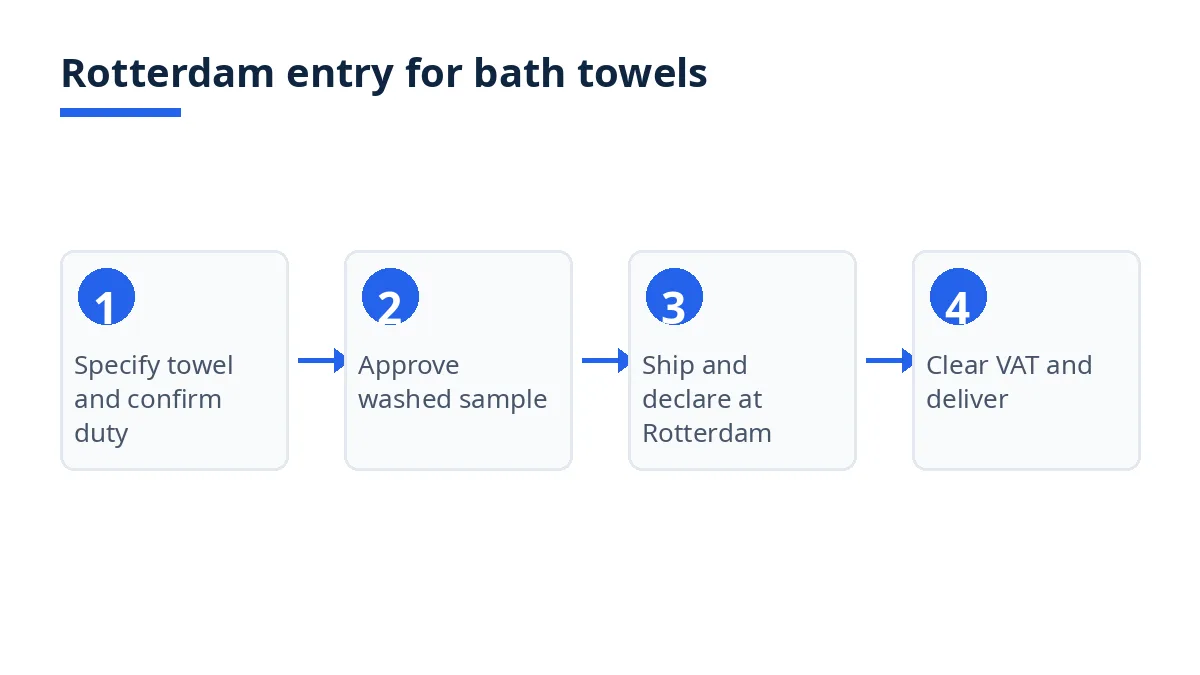
To import bath towels from Bangladesh to the Netherlands, fix the towel specification first, then clear the Rotterdam gate: confirm the HS 6302 code, the EBA preference claim and the statement on origin, and settle the 21 percent import VAT route. Shortlist terry towel suppliers on the same matrix, approve a washed pre-production sample, ship on a container-suited term, and declare at Rotterdam after unloading with the EORI number and proof of origin in hand.
On this page
Key takeaways
Bath towels sit in heading 6302, with cotton terry towels in 6302.60 as an indicative heading: the schedule line opened for this guide shows 12.00 percent third-country duty for the 6302.60 lines, to be confirmed with a broker for the exact code and entry date.
Everything But Arms grants full duty-free and quota-free access for least developed countries, but the buyer must confirm the preference claim and the REX statement on origin before pricing any order at 0 percent.
Dutch import VAT is charged at the 21 percent standard rate on the customs value; a foreign entrepreneur needs a tax representative to use the Article 23 reverse-charge route.
At Rotterdam, the import declaration is filed electronically through DMS only after unloading, under the CVB step, and an EORI number is required for the declaration.
There is no single typical MOQ, price or transit time for bath towels: set the specification matrix, approve a washed pre-production sample, and set the buyer's own inspection limits before production.
A bath towel order for the Netherlands is decided twice: once in Bangladesh, where the towel is woven, dyed and hemmed, and once in Rotterdam, where the container is released, declared and cleared. Planning the Rotterdam side first avoids the commonest failure in this trade: a towel ready to sell, a file not ready to clear. This guide follows that order: the Dutch entry, the towel specification, duty, VAT and preference, supplier checks, samples, shipping terms and a landed cost with two duty outcomes. For Dutch retailers, wholesalers, hospitality buyers and brands buying from Bangladesh for sale in the Netherlands or onward in the European Union, it states no single minimum order, price or transit time: none is fixed across towel sizes, fibers and shipment dates. Every cost figure is an example figure.
Start at Rotterdam: the entry decision that shapes a towel order
Rotterdam is the entry point because the Dutch declaration, the container release and the VAT treatment are all set there. Treating Rotterdam as a detail for after loading leaves the buyer unable to file until unloading, with VAT depending on an earlier permit decision and duty on a preference claim agreed before shipment.
Goods imported from outside the European Union must be declared to Dutch Customs, filed electronically through the DMS system.1 A buyer with little import experience is advised to have a shipper, logistics provider or customs agent complete the declaration; a regular importer can file its own after contacting the Dutch Customs National Helpdesk.1 For a first order, use a customs representative and keep the buyer decisions to the commodity code, the preference claim, the VAT route and the delivery address.
Who files the Rotterdam declaration, and what does the CVB change?
The Container Release Message, known by the Dutch initials CVB, applies to containers, trailers, general cargo and bulk cargo arriving through a Dutch port, and an import declaration can only be submitted after the goods are unloaded.1 That sequence sets the arrival timetable: unloading, CVB, declaration, and only then does Dutch Customs calculate duty.1 Ask the forwarder or broker, before booking, who holds the CVB step and which documents must already be in hand. An EORI number is also required for exchanging data with customs when trading with countries outside the European Union.1 Apply before the first order if you do not hold one.
Fix the towel before you ask for a price: the specification matrix
A bath sheet, a bath towel, a hand towel and a face towel differ in size, weight and use, and a single order often mixes them. Price, minimum and quality checks all follow the specification, so write it before asking any supplier to quote. The matrix below is the document to send; every cell is a buyer decision, not a supplier default.
Specification line | What to fix in writing |
|---|---|
Size set | Finished size of each piece, measured after washing, with the tolerance accepted |
Fiber | Fiber content of each piece, including any blend, as percentages by weight |
Weight | Weight per square metre for each size, as your own target, by the method named |
Pile and loops | Loop height and pile density as described by your sample, not a grade name alone |
Edges and hems | Hem width, stitching, dobby or jacquard border, and any hanging loop |
Color and dye | Color reference, dye method and the shade tolerance accepted across lots |
Label | Fiber composition wording, care wording, size wording and the label position |
Packing | Pieces per retail set, pieces per carton, carton size and weight, and any polybag or band |
Weight per square metre misleads most when stated as a single number. Set it as your own target for each size, name the method, and compare quotes only at the same weight; do not accept a weight without the size it applies to. Agree the color reference and the bulk tolerance before production, and keep one sealed, washed counter-sample of each piece as the reference for shade, size and hand feel.
Duty, VAT and the EBA preference: the gate before you price
How are bath towels classified for Dutch duty?
The Harmonised System, developed by the World Customs Organization, is organized in sections, chapters, headings and subheadings; countries subdivide the six-digit categories further, and the European Union uses eight-digit Combined Nomenclature codes built on the same six-digit base.2 Bath towels sit in heading 6302, which covers bed linen, table linen, toilet linen and kitchen linen.3 For cotton terry towels the key line is 6302.60, toilet linen and kitchen linen of terry towelling or similar terry fabrics, of cotton, splitting into knitted or crocheted and other towels, each with its own ten-digit code.3 Other towels fall in 6302.91 for cotton, 6302.93 for man-made fibers and 6302.99 for other textile materials.3 Every code here is indicative: verify the full code for each towel type with a broker before pricing or shipping.
The schedule line opened for this guide shows third-country duty of 12.00 percent for the 6302.60 lines, for both splits, and for most other 6302 lines, with 6.90 percent for certain nonwoven lines in 6302.22, 6302.32, 6302.53 and 6302.93.3 Confirm the current rate for the exact code and entry date with a broker: a towel that is not cotton terry towelling, or one with a different fiber mix, can sit on a different line, and the line decides the duty before any preference is applied.
What must you confirm before pricing at 0 percent?
Everything But Arms (EBA) is a special arrangement for least developed countries, granting full duty-free and quota-free access to the European Union Single Market for all products except arms and ammunition.4 The updated Generalised Scheme of Preferences, approved for application from 1 January 2027, continues to include EBA.5 Before pricing at 0 percent, confirm for the entry date that Bangladesh holds EBA access, that the preference claim is entered correctly on the Rotterdam declaration, and that the proof of origin meets the scheme's origin rules.
Proof of origin certifies where a product was made, and is essential for claiming preferential treatment such as reduced or zero tariffs.6 Under the Generalised Scheme of Preferences, exporters registered in the REX system make out a statement on origin on the invoice or another commercial document.6 An unregistered exporter may do so only for a consignment whose total value, based on the ex-works price, does not exceed EUR 6,000.6 Most commercial towel orders exceed that value, so ask at order stage whether the exporter is REX-registered, which origin criterion the statement cites, and agree it travels with the shipment documents.
What VAT applies at Rotterdam, and what does Article 23 change?
In the Netherlands, the standard VAT rate is 21 percent.7 Import VAT is charged on the customs value: the value of the goods plus transport, insurance and similar charges up to the external border of the European Union.8 Build VAT on the delivered-to-border value, not on the factory price alone.
The cash timing of that VAT depends on the Article 23 route. Under the reverse-charge mechanism, the buyer need not pay VAT on import immediately; it is paid with the VAT return, but an Article 23 permit is needed.9 A foreign entrepreneur cannot apply directly, but a tax representative can apply and declare and deduct the VAT on the same return, so none is paid in advance.9 Decide before the first shipment whether to appoint a tax representative or pay import VAT at Customs and deduct or reclaim it later; without a representative, the VAT must be paid to Customs on the declaration.8 Do not price a first order as if Article 23 applied when no permit or representative is in place.
Find and verify suppliers without a ranked list
This guide names no ranked list, because a ranking made without the buyer's specification, quantity and delivery date would mislead. Start with the specification, not with names: send the identical matrix to every candidate and ask for the same reply format covering fiber and weight assumed, sizes quoted, price inclusions, validity, minimum per design and per color, and the delivery term. A supplier whose current range already includes terry towels in the sizes and weights you need is a candidate; one that makes only bed linen or only apparel is not a close substitute.
Verification has three layers, each checked before payment: company documents (trade licence, export registration and association membership where applicable, with name, address and bank account name agreeing across every document); capability (terry weaving or fabric source, loom width, dyeing route, cutting and hemming capacity, and current towel programs where loop evenness, hem finish and shade consistency can be seen); and payment discipline (pay only the company account named in the documents, never a personal account, and verify any change of bank details through a separate channel before paying).
On Exportain, supplier profiles carry document and photo review badges: a document and photo review, not a factory inspection, and no guarantee of capacity, quality or delivery.10 Treat a badge as one input to the three-layer check, not as a substitute for it. Browse suppliers on Exportain and compare quotes only on the same basis: size set, fiber and weight, hem and border, packing, delivery term and validity period. Ask what is excluded, for example testing, special packing or a hanging loop. The Dutch Chamber of Commerce agrees: ask for a clear quotation stating the Incoterms rule, which settles who arranges transport and who bears the risk.11
Samples and quality: approve the washed towel, not the catalogue towel
Approve in writing at each stage. A development sample shows whether the factory can form the loop, finish the hem and hold the size. A pre-production sample, in the actual production fiber, weight, color and finish, is the sample to approve for bulk, because washing, dyeing and finishing change dimensions, shade and hand feel.
Wash each piece as the care wording directs, measure it against the size chart, check shade against the counter-sample, and check the loop does not snag or pull after washing. Keep one sealed counter-sample of each piece, and write the approval against the specification matrix, not against a photograph.
Agree the inspection method and defect limits before production; do not adopt another buyer's figure. ISO 2859-1:2026 defines acceptance sampling plans for inspection by attributes: AQL, the acceptance quality limit, is the maximum average percentage of defective items considered acceptable during random sampling, used to set sample sizes and acceptance and rejection thresholds.12 The standard gives a method for setting a plan, not the buyer's limit. Set the limit, defect classes and sample size in writing, and inspect inline during production and finally on packed goods.
Which label wording must be agreed at sampling?
Agree fiber labelling at sampling stage, because the label wording is also the composition the classification is built on. Under Regulation (EU) No 1007/2011, Article 9, a textile product shall be labelled or marked with the name and percentage by weight of all constituent fibers in descending order.13 Agree the exact wording, check the percentages against the fiber actually bought, and check the finished label before bulk sewing begins. If a customer names a specific test or scheme, name it in the specification, ask for the matching report, and check scope, product, issuing body and date; a report for a different fiber, weight or unwashed sample does not cover the towel ordered.
Shipping terms and the container point: FCA, FOB and the Rotterdam arrival
The Incoterms 2020 rules deal with delivery, risk, cost, mode of transport and customs obligations, varying across the 11 rules in the point of delivery, the transfer of risk and the mode of transport.14 Risk passes at the same point and time as delivery; in all rules except EXW the seller carries out export formalities, and in all rules except DDP the buyer carries out import formalities.14 That division is why the Rotterdam declaration sits with the buyer under most towel terms, even when the seller pays the freight.
For a first container order, weigh FCA against FOB. The four sea rules, FAS, FOB, CFR and CIF, are only intended for port-to-port bulk or break-bulk shipments and are not suitable for container shipments in their current form, because a container is handed to the carrier before it is on board.14 Under FOB the seller must place the goods on board, while under FCA the seller delivers to the carrier, which matches how containerised cargo moves.14 Under CIF or CFR the seller contracts freight to Rotterdam, but risk still passes at origin, so the buyer still needs cargo insurance and must still handle the Rotterdam declaration and VAT route.
Sea freight, the standard route for bulk towel orders, takes weeks rather than days, varying by port, routing, transshipment and season. Plan from the forwarder's current Chattogram to Rotterdam sailing schedule, add CVB and declaration time after unloading, and clearance and delivery to the warehouse. Confirm pieces per carton, dimensions and weight in the specification: towels are bulky, and carton volume can limit a shipment before weight does.
Landed cost example: two duty outcomes for one towel
A landed cost is the full cost of one towel, ready in the warehouse. Every number below is an example figure only, not a quote, assuming 6,000 bath towels, FOB Chattogram, sea freight to Rotterdam, and the customs value built as factory price plus freight and insurance to the European Union border.
Example figures: 6,000 bath towels, one size, cotton terry towelling, FOB Chattogram to Rotterdam.
Cost element | Example figures, per towel, EBA confirmed | Example figures, per towel, MFN rate |
|---|---|---|
Product price, FOB | $2.60 | $2.60 |
International freight | $0.42 | $0.42 |
Insurance | $0.03 | $0.03 |
Customs value | $3.05 | $3.05 |
Duty | $0.00 at 0 percent | $0.37 at 12 percent |
Port, clearance and broker fees | $0.18 | $0.18 |
Local delivery to warehouse | $0.12 | $0.12 |
Total landed cost, excluding import VAT | $3.35 | $3.72 |
Import VAT is shown separately: its treatment depends on the buyer's tax position and on whether Article 23 applies. At 21 percent, the VAT on customs value plus duty here would be $0.64 per towel in the EBA case and $0.72 in the MFN case, as example figures. Under Article 23, that VAT is declared and deducted on the same return through a tax representative, so none is paid in advance on import.9 Without that route, it is paid to Customs and later deducted or reclaimed as input tax where the rules allow.8 Work the calculation twice: at quote stage, and again after shipment with the actual invoices, confirmed code and preference. See the landed cost guide.
The Rotterdam checklist: bath towels from specification to delivery
Write the specification matrix for every piece: size after washing, fiber percentages, weight target, pile, hem, border, color reference, label wording and packing.
Classify every towel type under heading 6302 and the 6302.60 line; confirm each full code, duty line and preference position with a broker. Mark every code indicative until confirmed.
Confirm the EBA position for the entry date, the preference claim and the REX statement on origin, including registration and the origin criterion cited.
Settle the VAT route before booking: Article 23 through a tax representative, or import VAT paid at Customs with later deduction or reclaim; confirm the customs value.
Shortlist suppliers whose current range includes terry towels in the sizes and weights specified, send the identical matrix, and compare quotes on the same basis and term.
Verify the chosen supplier in three layers, and approve a pre-production sample in production fiber and color, after washing.
Confirm the order in writing: purchase order, pro forma invoice, delivery and payment terms, inspection plan with the buyer's own AQL limits, labelling, packing and shipment date.
Ship on the agreed term, file the Rotterdam declaration after unloading under the CVB step with the EORI number and proof of origin in hand, clear with the confirmed code, and reconcile the actual landed cost against the example.
How Exportain helps
Browse suppliers on Exportain against the specification matrix, rather than a catalogue photograph, then post the matrix and target quantity as an RFQ and compare replies on the same terms before choosing a factory for sampling. Exportain is a B2B marketplace for RFQs, quotations and supplier messages; it is not a party to the contract for goods, does not inspect goods, book freight or clear customs.10 Keep the Rotterdam decisions, preference claim and VAT route with the buyer, broker and tax representative.
Questions Dutch towel buyers ask before ordering
What is the typical MOQ for bath towels from Bangladesh?
There is no single typical minimum order quantity. The minimum is set per design and usually per color, because terry fabric is woven and dyed in batches and a cutting and hemming plan is set up per size range. Ask how each supplier's minimum splits by design, color, size and pieces per set.
How long does shipping take?
Production and transit time are separate, and neither has a single typical figure. Sea transit from Chattogram to Rotterdam takes weeks rather than days, varying by routing, transshipment and season, and the Rotterdam side adds unloading, the CVB step, declaration and delivery. Plan from the forwarder's current sailing schedule; confirm the shipment date only after sampling approval.
What import duty applies?
Duty follows the confirmed classification, the entry date and the origin. Bath towels sit in heading 6302, with cotton terry towels in 6302.60 as an indicative heading, and the schedule line opened for this guide shows a third-country duty of 12.00 percent for the 6302.60 lines.3 Under Everything But Arms, least developed countries are granted full duty-free and quota-free access for all products except arms and ammunition, but confirm the preference claim and the proof of origin before pricing at 0 percent.4 Confirm the current line and the preference position with a broker.
How do I verify a supplier?
Check documents first, so name, address and bank account agree across the trade licence, export registration and invoices, then capability: weaving or fabric source, dyeing route, cutting and hemming, and recent production in the sizes and weights specified. Keep payments to the company account named in the documents, and treat any badge as a document and photo review, not a factory inspection or guarantee.10
Next steps on Exportain
Read how to import from Bangladesh for the full process from supplier search to clearance, then use how to write an RFQ to set out the towel matrix in a form suppliers can quote against. When ready, post a free RFQ on Exportain and compare quotes on the same specification, delivery term and Rotterdam VAT route.
Sources
- Declaring goods to Customs. Business.gov.nl (accessed )
- Harmonised System. European Commission (accessed )
- Bed linen, table linen, toilet linen and kitchen linen - Northern Ireland Online Tariff. UK Government (accessed )
- Trade arrangements. European Commission, Access2Markets (accessed )
- New Generalised Scheme of Preferences approved for application in 2027. European Commission, (accessed )
- Proof of origin. European Commission (accessed )
- VAT rates and exemptions. Government of the Netherlands (accessed )
- Import from non-EU countries to the Netherlands. Dutch Tax and Customs Administration (accessed )
- Reverse-charge mechanism on import: Article 23. Belastingdienst (accessed )
- About Exportain. Exportain (accessed )
- Standard steps for importing into the Netherlands. Netherlands Chamber of Commerce (KVK) (accessed )
- ISO 2859-1:2026 - Sampling procedures for inspection by attributes — Part 1: Sampling schemes indexed by acceptance quality limit (AQL) for lot-by-lot inspection. International Organization for Standardization (accessed )
- Regulation (EU) No 1007/2011 on textile fibre names and related labelling and marking of the fibre composition of textile products, Article 9: Multi-fibre textile products. legislation.gov.uk (accessed )
- Insider thoughts: Bob Ronai on Incoterms 2020 Rules; What are they about?. International Chamber of Commerce (accessed )
About the author
Sourcing from Bangladesh?
Post a request for quotation and suppliers on Exportain can send you their quotes directly.
Post an RFQ


