

Baby Clothes From Bangladesh to Canada: A Buyer's Import Checklist
Baby clothes from Bangladesh to Canada: supplier checks, samples, HS 6111 and 6209 duty, LDCT origin rules, GST at import, bilingual labelling, sleepwear rules and landed cost for Canadian buyers.
Short answer
To import baby clothes from Bangladesh to Canada, confirm the classification first: knitted garments sit in heading 6111 and woven garments in heading 6209, and the lines in the schedules opened for this guide carry a Free rate. Then verify the supplier, approve a pre-production sample, agree the bilingual label and sleepwear file, confirm the LDCT origin proof, and clear the goods through the port that matches your warehouse.
On this page
Key takeaways
Baby garments are classified in heading 6111 when knitted or crocheted and heading 6209 when woven, for young children of a body height not exceeding 86 cm; the lines in the schedules opened for this guide carry a Free most-favoured-nation rate.
Qualifying goods can enter duty-free under the LDCT if they meet the origin rules, are shipped directly to Canada and carry the correct proof of origin, Form B255 for textile and apparel goods.
Canada requires bilingual textile labelling: fibre content in percentages by mass, in English and French, plus dealer identity shown as a name and address or a CA number.
Children's sleepwear in sizes up to and including 14X has distinct tight-fitting and loose-fitting flammability requirements; decide the category at specification stage and keep the matching test report in the order file.
GST at 5 percent is payable at import and is generally recoverable through input tax credits for a GST-registered importer, while duty is not recoverable, so classification and origin work decides the permanent cost.
To import baby clothes from Bangladesh to Canada, start from the Canadian border and work backward. The duty line is not the problem in this lane: the Canadian tariff lines for babies garments in the schedules opened for this guide carry a Free rate, and qualifying goods can also enter duty-free under the Least Developed Country Tariff. The work that decides whether a first order succeeds sits earlier, in the specification, the sample approval, the bilingual label and the sleepwear flammability file. This guide is written for a Canada-based buyer, a retailer, brand or distributor, placing a first or second order of knitted or woven baby clothes from Bangladesh for sale in Canada.
The route in this guide runs from supplier search in Bangladesh to a Canadian port of entry, Vancouver for western distribution or Montreal for eastern distribution, then to clearance and delivery to your warehouse. Every cost figure in the landed cost section is an example figure only, not a quote. Duty and tax figures are indicative for the entry date and must be confirmed with your customs broker before you commit to a selling price.
Why source baby clothes from Bangladesh
Baby clothes reward a supplier whose current production already matches your construction. A knitted romper, a woven dress and a footed sleeper are different operations: knitting and cutting small pieces, setting snaps, attaching trims that stay attached, and sewing to a size chart that runs from newborn to 24 months. Shortlist factories whose current range already includes baby garments in your construction, knitted or woven, rather than a general apparel factory that would be learning baby sizes on your order.
Find and verify suppliers
Where should you start the search?
Start with the specification, not with factory names. Send every candidate the identical document and ask for the same reply format: fabric assumed, sizes included, price inclusions, validity period and minimum per style and per colour. Browse suppliers on Exportain, read finding suppliers in Bangladesh, and compare your approach with the generic baby clothes import guide, which covers the same product for a general destination rather than the Canadian route set out here.
How do you verify a supplier before you pay?
Verification has three layers. The first is company documents: trade licence, export registration and association membership where applicable, checked so that name, address and bank account name agree across every document. The second is capability: monthly baby-garment capacity, fabric source, dyeing and printing route, snap and trim setting, and which recent baby styles the factory can show from current production. The third layer is payment discipline. Keep payments to the company account named in the documents, never to a personal account, and verify any change of bank details separately.
MOQ, pricing and samples
What is the typical MOQ for baby clothes from Bangladesh?
There is no single typical minimum order quantity for baby clothes from Bangladesh. The minimum is set per style and usually per colour, because fabric is knitted, dyed or printed in batches and a cutting plan is set up per size range. A plain cotton romper in three sizes and a printed dress-and-bloomer set in six sizes will not carry the same minimum. Ask each supplier how its minimum splits by style, colour, print and size range, and whether a size curve can be weighted toward the sizes that sell fastest in your stores rather than spread evenly.
How is the price built, and how should you compare quotes?
Fabric is usually the largest cost element in a baby garment, followed by cutting and sewing, dyeing or printing, trims such as snaps and buttons, testing, labelling and packing. Small sizes use less fabric but need the same number of operations as larger sizes, so the price per piece does not fall in proportion to the size. Snaps, applique, embroidery and special packing each add operations. Two quotes can differ because one assumes a lighter fabric, fewer sizes, simpler trims or a different packing unit.
Which samples do you need, and how do you approve them?
Work in stages. A development sample shows whether the factory can construct the style, set the snaps cleanly and sew to your size chart. A pre-production sample, made in the actual production fabric, colour, print and trims, is the sample you approve for bulk. Size, shade and snap performance cannot be approved from a sample in substitute fabric, because washing and finishing change dimensions and shade.
Quality control and certifications needed
Which quality checks are specific to baby clothes?
Against the approved sample and chart, check fibre and fabric, measurements for every size, seam finish, snap setting and function, trim attachment, print and embroidery quality, shade consistency across the size range, and label accuracy. A garment can pass piece by piece and still fail as a range if one size runs small or one colour sits in a different shade batch. Agree the inspection method and defect limits before production. ISO 2859-1:2026 defines a system of acceptance sampling plans for inspection by attributes, and its summary states that AQL stands for acceptance quality limit, the maximum average percentage of defective items considered acceptable during random sampling, used to determine sample sizes and acceptance and rejection thresholds.1
Which label rules apply in Canada?
Canada requires bilingual textile labelling, and this is the rule that most often catches a first-time importer. The Competition Bureau guide states that the disclosure label must bear fibre content information expressed in percentages by mass and dealer identity information, that the generic name of each fibre present in an amount of 5 percent or more must be stated as a percentage of the total fibre mass, and that the required fibre content information must be bilingual, in English and in French, except in areas where only one official language is used in consumer transactions.2 Dealer identity may be shown as the dealer name and full postal address or as a CA identification number issued by the Competition Bureau.2 Agree the label artwork in both languages at sampling stage, and confirm the French presentation for Quebec sales before the order ships.
Which certifications do you actually need for sleepwear?
If your range includes sleepwear, the Canadian sleepwear rules are a separate gate from the labelling rules. Health Canada guidelines state that the Children's Sleepwear Regulations apply to children's sleepwear in sizes up to and including 14X that is manufactured, imported, advertised or sold in Canada, and that there are distinct flammability requirements for tight-fitting and loose-fitting sleepwear.3 Loose-fitting sleepwear, when tested under the Regulations, must show an average char length for five specimens that does not exceed 178 millimetres, with not more than one specimen at the full specimen length.3
Incoterms, shipping and transit time
Which delivery term should a first order use?
The Incoterms 2020 rules set out, for each rule, where delivery takes place, and risk passes from seller to buyer at the same point and time as delivery.4 Under FOB, CFR and CIF the seller must place the goods on board the vessel.4 On customs, in all rules but EXW the seller must carry out export formalities, and in all rules but DDP the buyer must carry out import formalities.4 The same ICC Academy summary notes that the four sea rules, FAS, FOB, CFR and CIF, are only intended for port-to-port bulk or break-bulk shipments and are not suitable for container shipments, because a container is handed to the carrier before it is on board.4 For a first order shipped in containers, weigh FOB at the Bangladeshi port against FCA at the named terminal, since FCA delivery matches how containerised cargo moves.
How long does shipping take, and which port should you use?
There is no single typical transit time for baby clothes from Bangladesh to Canada. Sea freight is the standard route for bulk orders and it takes weeks rather than days, varying by port, routing, transshipment and season. Plan from your forwarder's current sailing schedule, and add clearance and delivery time. Keep production time separate: an order is ready only when every piece has finished sewing, inspection and packing. Choose the entry port by your warehouse, not by habit: a western warehouse points to a Pacific entry at Vancouver, and an eastern warehouse points to a St. Lawrence entry at Montreal. Ask your forwarder to compare the two routings on total door-to-door cost and time, including inland rail or trucking.
Import duty, taxes and documents
How are baby clothes classified for duty in Canada?
Duty follows the classification of each style in the Canadian Customs Tariff, not the supplier's product name. For the purpose of headings 6111 and 6209, babies garments and clothing accessories means articles for young children of a body height not exceeding 86 cm, and articles that are prima facie classifiable both in heading 6111 and in other headings of the chapter are to be classified in heading 6111.5 Knitted or crocheted baby garments sit in heading 6111, and other, not knitted or crocheted, baby garments sit in heading 6209.5 6 In the schedules opened for this guide, the most-favoured-nation rate for the 6111 lines is Free: 6111.20 for cotton, 6111.30 for synthetic fibres and 6111.90 for other textile materials.5 The 6209 lines show the same Free rate: 6209.20 for cotton, 6209.30 for synthetic fibres and 6209.90 for other textile materials.6 Those figures are schedule lines in the editions opened, indicative for your entry date, so confirm the current rate beside each style's code before you commit to a selling price. A style that exceeds the 86 cm limit is not a babies garment for tariff purposes and falls under a different heading.
What import duty applies under the LDCT?
The Least Developed Country Tariff is a preferential tariff treatment, and imported goods that qualify for it enter Canada duty-free if they meet specific origin rules.7 To qualify for the LDCT or the General Preferential Tariff rate, imported goods must satisfy the rules of origin, meet proof of origin requirements and be shipped directly to Canada from an LDCT or GPT beneficiary country.7 If goods do not meet LDCT requirements, they may still be eligible for a reduced rate through the GPT, and if there is no LDCT or GPT rate for the goods, they are subject to the most-favoured-nation treatment.7 For apparel, the origin rules turn on where the garment is made, not only where it is shipped from. The goods must be finished in an LDCT beneficiary country in the form in which they are imported into Canada, and for apparel goods the goods must be cut, or knit to shape, and sewn or otherwise assembled in that country.8 Under the general LDCT route, at least 20 percent of the ex-factory price of the goods as packed for shipment to Canada must originate in one or more least developed countries or Canada.8 Textile and apparel goods must be certified as entitled to LDCT benefits on Form B255, the Certificate of Origin for textile and apparel goods originating in a least developed country.8 Agree the proof of origin at order stage, and keep the fabric origin in the order file. The June 2026 memorandum notes that the General Preferential Tariff Plus is still under development and is not yet in effect, so do not price an order on a treatment that has not come into force.8 Use tariff treatment code 08 for LDCT and code 02 for most-favoured-nation treatment in the commercial accounting declaration.7
What taxes apply at import?
Duty is only part of the border cost in Canada. The value for tax of imported goods is the value for duty plus all duties and taxes payable on the goods other than the GST itself.9 For taxable commercial goods imported by a person resident in a participating province, only the GST is payable by the importer at the time of importation, and the importer may then be obliged to self-assess the provincial component of the HST.9 The federal GST rate is 5 percent, applied nationwide, while provinces that use HST combine it into a single rate and provinces with a separate PST charge that tax in addition to GST.10
Which documents do you need for clearance?
The standard import set is the commercial invoice, packing list, bill of lading, and proof of origin where a preference is claimed, in this lane Form B255 for textile and apparel goods claiming LDCT treatment.8 The invoice should name each style plainly, for example knitted cotton baby romper with snap closure, with fibre composition, sizes, quantities, unit prices and the delivery term, on its own line. Keep knitted, woven, cotton and synthetic styles on separate lines matching their classifications. Quantities, weights and carton counts must agree across every document. Before the first shipment, set up your import account: a customs account requires a registered business number with the Canada Revenue Agency, plus the import-export RM account and registration in the CARM Client Portal.11
Landed cost example
A landed cost is the full cost of one baby garment, ready to sell. Every number below is an example figure only, not a quote.
Example figures: 5,000 knitted cotton baby rompers, FOB Chattogram, sea freight to Montreal, duty at the Free rate shown in the schedules opened for this guide.
Cost element | Example figures (per romper) | How to obtain your figure |
|---|---|---|
Product price, FOB | CAD 4.50 | Confirmed pro forma invoice |
International freight | CAD 0.56 | Forwarder quote divided by rompers shipped |
Insurance | CAD 0.07 | Policy or forwarder quote |
Duty | CAD 0.00 | Broker calculation from confirmed codes and rates |
Port, clearance and broker fees | CAD 0.18 | Broker invoices divided by rompers |
Local delivery to warehouse | CAD 0.22 | Local carrier quote divided by rompers |
Total landed cost | CAD 5.53 | Sum of all lines above |
GST at import is not included in the total, because a GST-registered importer recovers it through input tax credits. In this example, GST at 5 percent on the value for tax would be about CAD 0.23 per romper, a cash cost at clearance rather than a permanent cost. Work the calculation twice: at quote stage, style by style, and again after shipment with the actual invoices. See landed cost for imports from Bangladesh for the full method.
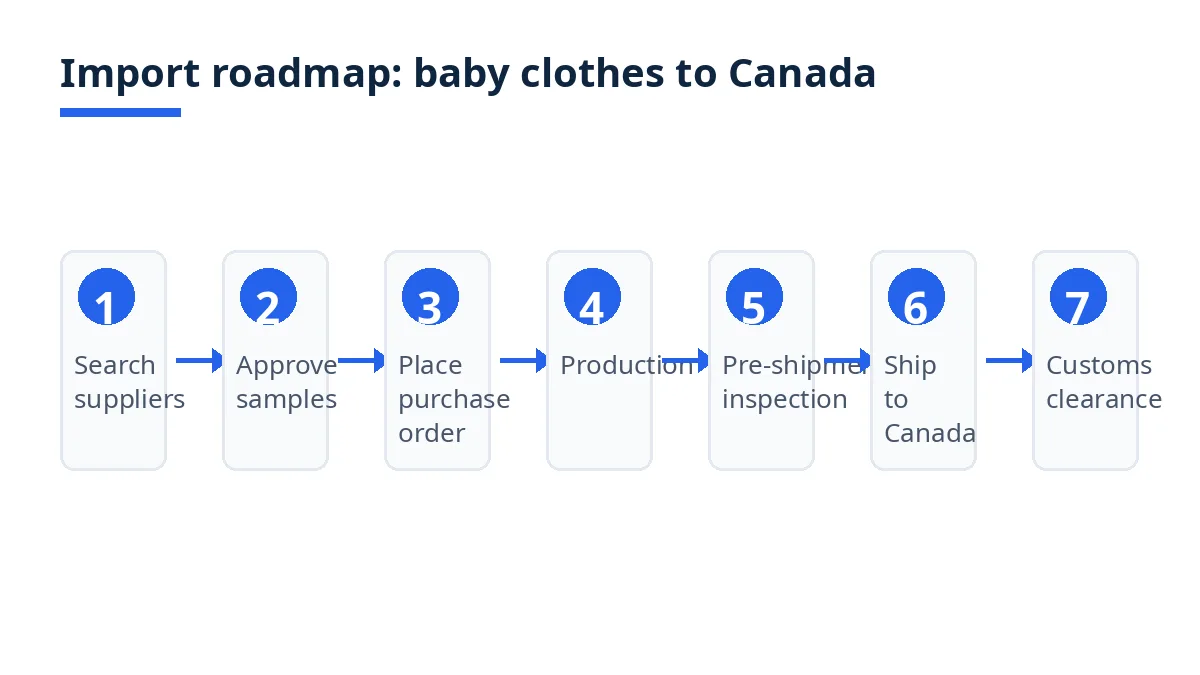
Step-by-step import checklist: how to import baby clothes from Bangladesh to Canada
Write the specification style by style: construction, fibre, size range, closures and trims, print or embroidery, labels in English and French, and packing unit.
Classify every style, starting from heading 6111 for knitted or crocheted garments and heading 6209 for other garments, and confirm each full code and rate with your broker.
Shortlist suppliers whose current range includes baby garments in your construction, and request comparable quotes on the identical specification and delivery term.
Verify the chosen supplier: company documents, baby-garment capacity, fabric source, snap and trim route, and a video or in-person factory check for a first order.
Order samples in stages, measure every size, test snaps and trims, wash following your care label, then approve a pre-production sample of each style in production fabric and trims.
Confirm the order in writing: purchase order, pro forma invoice, delivery and payment terms, inspection plan with AQL and defect limits, bilingual label artwork, sleepwear assessment where the range includes sleepwear, packing and shipment date.
Agree the proof of origin at order stage, including the fabric origin and the LDCT route the goods will claim, and keep it in the order file.
Inspect during production and again on packed goods against the approved samples, checking measurements, snap function, shade consistency and label accuracy.
Ship through the entry port that matches your warehouse, Vancouver for western distribution or Montreal for eastern distribution, and clear customs with the confirmed code for each style and the treatment code for the treatment claimed.
Reconcile the actual landed cost against the quote, keep the broker calculation, test reports and proof of origin in the order file, and review the range before reordering.
How Exportain helps
Browse suppliers for Bangladeshi baby-garment exporters and compare their ranges against your style list. Then post your specification and target quantity as an RFQ and compare replies on the same terms before you choose a factory for sampling. Read how to buy on Exportain for how RFQs, quotations and messages work. Exportain is a B2B marketplace where buyers post RFQs, receive quotations and message suppliers. It does not inspect goods, book freight or clear customs.
FAQs
What is the typical MOQ for baby clothes from Bangladesh?
There is no single typical minimum. It is set per style and usually per colour, because fabric is knitted, dyed or printed in batches and a cutting plan is set up per size range. Ask each supplier how its minimum splits by style, colour, print and size range.
How long does shipping take?
Production time and transit time are separate, and neither has a single typical figure. Sea transit takes weeks rather than days and varies by port, routing, transshipment and season. Plan from your forwarder's current sailing schedule, and add clearance and delivery time.
What import duty applies?
Duty follows the confirmed classification of each style and the treatment claimed on the entry date. Baby garments sit in heading 6111 for knitted or crocheted garments and heading 6209 for other garments, and the lines in the schedules opened for this guide carry a Free most-favoured-nation rate.5 6 Qualifying goods can also enter duty-free under the LDCT if they meet the origin rules and are shipped directly to Canada.7 Confirm the current rate and treatment with your broker before you price.
How do I verify a supplier?
Check company documents first, so that name, address and bank account agree across the trade licence, export registration and invoices. Then check capability: baby-garment capacity, fabric source, snap and trim route and recent baby production. Keep payments to the company account named in the documents, and approve a pre-production sample of each style in production fabric and trims before bulk production.
Next steps on Exportain
Read how to import from Bangladesh for the full process, then work your landed cost with the landed cost guide. When ready, browse suppliers on Exportain and compare baby-garment exporters against your style list before you request samples.
Sources
- ISO 2859-1:2026 - Sampling procedures for inspection by attributes — Part 1: Sampling schemes indexed by acceptance quality limit (AQL) for lot-by-lot inspection. International Organization for Standardization (accessed )
- Guide to the Textile Labelling and Advertising Regulations. Competition Bureau Canada (accessed )
- Guidelines for the flammability requirements of the Children's Sleepwear Regulations. Health Canada (accessed )
- Insider thoughts: Bob Ronai on Incoterms 2020 Rules; What are they about?. International Chamber of Commerce (accessed )
- Customs Tariff, Chapter 61: Articles of apparel and clothing accessories, knitted or crocheted (2024). Canada Border Services Agency (accessed )
- Chapter 62: T2025 - Articles of apparel and clothing accessories, not knitted or crocheted. Canada Border Services Agency (accessed )
- Claim the least developed countries preferential tariff rate. Canada Border Services Agency (accessed )
- Memorandum D11-4-4: Rules of Origin Respecting the General Preferential Tariff and Least Developed Country Tariff. Canada Border Services Agency (accessed )
- Memorandum D13-2-5 - Customs Valuation: Effects of the Goods and Services Tax. Canada Border Services Agency (accessed )
- GST PST and HST in Canada: rates and registration guide. Xero (accessed )
- Payment of duties and taxes on imported commercial goods - Memorandum D17-5-1. Canada Border Services Agency (accessed )
About the author
Sourcing from Bangladesh?
Post a request for quotation and suppliers on Exportain can send you their quotes directly.
Post an RFQ


