HS Code Full Form, Meaning and Structure Explained
Definition
HS stands for Harmonized System. The hs code full form is a six-digit code under the Harmonized Commodity Description and Coding System, a product nomenclature developed by the World Customs Organization (WCO). Customs authorities use the code to identify what a traded product is, apply tariff treatment, check controls and record trade statistics consistently across countries.
Published 8 min read
On this page
Key takeaways
HS stands for Harmonized System, short for the Harmonized Commodity Description and Coding System developed by the World Customs Organization.
The first two digits of an HS code are the chapter, the first four are the heading, and all six are the subheading.
Countries add national digits after the shared six digits, so a United States or European Union code is longer than the HS code.
The importer is normally legally responsible for the code declared in the destination country.
If you are buying from Bangladesh, you will meet the hs code full form on almost every quotation, invoice and shipping document. HS stands for Harmonized System, short for the Harmonized Commodity Description and Coding System. It is the shared language customs worldwide uses to identify what a product is, what it is made of, and how it is processed.
Quick answer: HS code full form
The hs code full form is Harmonized System code. An HS code is a six-digit code under the Harmonized Commodity Description and Coding System, a multipurpose international product nomenclature developed by the World Customs Organization (WCO).1 The system has more than 5,000 commodity groups, each identified by a six-digit code, arranged in a legal and logical structure.1 Customs uses the code to apply tariff treatment, check controls and record trade statistics.
What HS code means in plain English
In plain English, an HS code is a product's identity number for international trade. Product names change between languages and catalogs, but the same six digits mean the same category of goods in every country that uses the system.
Broad groups such as textiles, seafood or machinery narrow step by step to a specific product type. Customs uses the code to apply duty treatment, check licenses and record trade statistics. The Harmonized System is used by more than 200 countries and economies as a basis for their customs tariffs and for the collection of international trade statistics, and over 98 percent of merchandise in international trade is classified in terms of the HS.1 A wrong code can hold a shipment at the port.
The World Customs Organization maintains the system, and its Harmonized System Committee prepares amendments updating the HS every 5 to 6 years.1 See HS code and the Harmonized System for the wider background.
How it works step by step
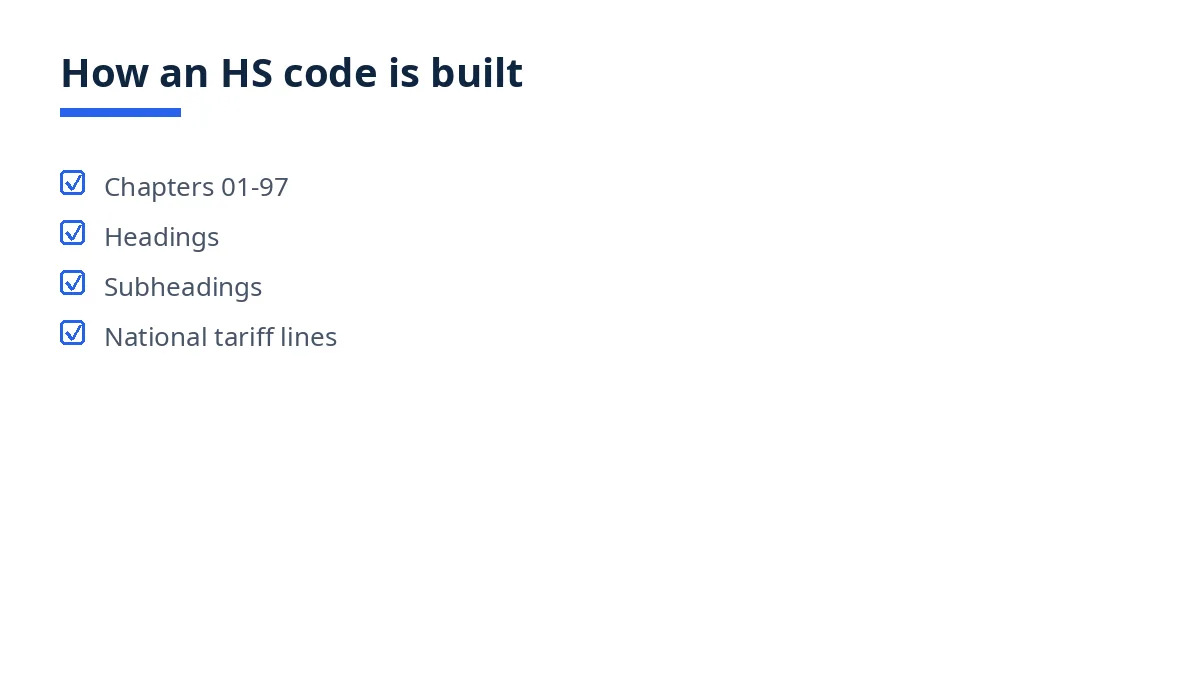
The international HS code has six digits, and each pair adds detail. The nomenclature is organized hierarchically by sections, chapters at 2 digits, headings at 4 digits and subheadings at 6 digits.2
Level | Digits | What it covers |
|---|---|---|
Chapter | First 2 digits | A broad family, such as knitted clothing or fish |
Heading | First 4 digits | A narrower family, such as T-shirts |
Subheading | All 6 digits | A specific product type inside the heading |
National lines | After the six | A country's own tariff detail |
Step 1: Chapter. The broadest level. The structure has 21 major sections and 97 chapters.2
Step 2: Heading. The heading narrows the group to a family of related products, such as T-shirts and singlets, or frozen fish fillets.
Step 3: Subheading. The most detailed international level, with more than 5,000 subheadings across more than 1,200 headings.2 It separates products by material, function or processing. Two similar garments can sit in different subheadings if one is mainly cotton and the other mainly synthetic fibers.
Step 4: National extensions. Countries add extra digits after the six-digit code for their own tariff and statistics, subdividing the categories into regional or national subheadings.2 The first six digits stay harmonized internationally, so compare those first across countries.
Step 5: Use on documents. Once agreed, use the code consistently on the commercial invoice, packing list and export declaration. If documents disagree, customs may ask for clarification before release. See export documents from Bangladesh.
The current version is HS 2022, because the latest amendment came into force in 2022.2 Read how to classify your product with HS codes to classify a specific product.
Who is responsible for what
The exporter or seller usually proposes the code first, because the seller knows the product in most detail: its materials, construction and processing. A Bangladeshi supplier should state composition clearly, for example whether a polo shirt is mainly cotton or a cotton-polyester blend, because composition often decides between subheadings.
The buyer or importer is normally legally responsible in the destination country for the declaration made to its customs authority. Never accept a code without checking it against your own country's tariff, and ask a customs broker if the product sits near a boundary between headings.
The customs broker or freight forwarder helps check the code and prepares declarations. Their advice does not remove the importer's legal responsibility. Customs authorities make the final decision in a dispute and can reclassify goods, so getting the code right before shipping is far cheaper than arguing after arrival.
Worked example with numbers (Bangladesh shipment)
Consider a buyer in Europe ordering men's cotton T-shirts from Dhaka. This example shows the structure only; the exact subheading depends on fiber content and construction.
First, the product is clothing, so it falls in the textiles part of the system. Next, knitted clothing forms its own chapter, separate from woven clothing: the first 2 digits. Then the heading narrows to T-shirts and singlets, knitted or crocheted: the first 4 digits. Finally, the subheading separates those garments by fiber, for example cotton from other materials: all 6 digits.
What decided each step was the broad family, how the garment was made (knitted, not woven), what it is, and what it is made of. In mainly polyester fabric, the chapter and heading would stay the same but the subheading would change, which can affect duty treatment.
HS code vs related terms
HS code vs HTS code. HTS stands for Harmonized Tariff Schedule. The United States schedule is based on the Harmonized Commodity Description and Coding System administered by the World Customs Organization, and its 4-digit and 6-digit categories are subdivided into 8-digit rate lines and 10-digit statistical categories.3 The first six digits align with the HS code. See the 10-digit HS code guide.
HS code vs commodity code. In the United Kingdom and the European Union, traders often say commodity code for the longer regional code used on declarations. The European Union's Combined Nomenclature uses eight-digit codes, built from the HS code with further subdivisions.2
HS code vs tariff code. Tariff code is a general term for the code in a country's tariff. It may mean the HS code or the longer national version, so ask which length someone is quoting.
HS code vs SKU. A SKU is a company's private stock-keeping number. It has no customs meaning, and must never replace an HS code on trade documents.
In short, the HS code is the international foundation; national systems build on it, and company codes sit outside it.
Common mistakes to avoid
Copying a code from a similar product. A knitted polo shirt and a woven shirt may look alike in photos but classify differently. Classify the actual product, not a lookalike.
Ignoring fiber composition. For textiles and garments, the main material often decides the subheading. Get the percentage composition from the supplier in writing; a vague description such as mixed fabric invites delays.
Using different codes on different documents. If the invoice, packing list and declaration show different codes, expect questions. Agree one code before shipping and use it everywhere.
Assuming a code never changes. The WCO revises the system periodically, and national tariffs update too. Recheck an old code before reuse.
Choosing a code because it looks cheaper. Selecting a code mainly for a lower duty risks penalties and back payments. Classification must follow the product, never the preferred outcome.
Forgetting national digits. Quoting only six digits when the destination requires a longer code can cause a filing error. Confirm the full code your broker will declare.
How Exportain helps
Exportain is a B2B export marketplace based in Dhaka. On Exportain, buyers can find Bangladeshi suppliers, exporters and trade service providers, post RFQs (requests for quotation), receive quotations, message suppliers and place orders. You can describe your product in an RFQ and discuss specifications, including material composition, before you commit.
Exportain is not a party to the contract for goods, and it does not inspect goods, book freight or clear customs. It does not replace your customs broker, and no platform can confirm a customs ruling for you.
Frequently asked questions
What is HS code?
An HS code is a six-digit number under the Harmonized Commodity Description and Coding System, developed by the World Customs Organization.1 Customs worldwide uses it to identify traded products, apply duty treatment, check controls and compile trade statistics.
How does HS code work in practice?
In practice, you identify what the product is, what it is made of and how it is made, then narrow it from chapter (2 digits) to heading (4 digits) to subheading (6 digits). You then use the result consistently on invoices and declarations, with extra national digits where a country requires them.
Is HS code used for shipments from Bangladesh?
Yes. Shipments exported from Bangladesh use HS codes on export documents, just as imports into Bangladesh do. Bangladeshi exporters of garments, seafood, leather goods and jute products state HS codes so that both customs authorities identify the same products in the same way.
What are common mistakes with HS code?
The most common mistakes are copying a code from a similar product, ignoring material composition, using inconsistent codes across documents, relying on an outdated code, and choosing a code for a lower duty instead of the code that correctly describes the goods.
Next steps on Exportain
Browse Bangladeshi suppliers by category, then post an RFQ that states the product, its material composition and the code you expect to use. See how to buy on Exportain for the buying process from first inquiry to order.
Sources
- What is the Harmonized System (HS)?. World Customs Organization (accessed )
- Harmonised System. European Commission (accessed )
- About Harmonized Tariff Schedule (HTS). United States International Trade Commission (accessed )
Reviewed by Naim Islam
About the author
Sourcing from Bangladesh?
Post a request for quotation and suppliers on Exportain can send you their quotes directly.
Post an RFQ