

HS Code for Toiletries: Classification Guide for Importers
Toiletries have no single HS code: a mixed shipment is classified product by product, by where it is used and what it does — skin care in heading 3304, hair care in 3305, oral care in 3306 and shaving, bath and deodorant preparations in 3307 — and every heading is indicative until you confirm the full national code.
Short answer
Toiletries have no single HS code. Each product is classified by where it is used and what it does: skin care and makeup in heading 3304, hair preparations in 3305, oral hygiene preparations in 3306, and shaving, bath and deodorant preparations in 3307. Perfumes sit in 3303, while soap bars test against heading 3401. Every heading is indicative: confirm the full 8- or 10-digit national code for each product before filing.
On this page
Key takeaways
Toiletries span four Chapter 33 headings by use: 3304 for skin care and makeup, 3305 for hair care, 3306 for oral care and 3307 for shaving, bath and deodorant preparations — there is no single toiletries code.
Chapter 33 excludes soap: bars and retail liquid or cream skin washes test against heading 3401, and laundry or surface cleaners test against heading 3402, not against any toiletry heading.
Heading 3304 excludes medicaments, so a preparation presented as treating a skin condition needs a separate test against the pharmaceutical headings of Chapter 30.
Only the first six digits are shared worldwide: the EU uses eight-digit Combined Nomenclature codes and the United States and United Kingdom use ten-digit codes, so confirm the full national code per product.
For a borderline product, check published rulings and apply for a binding decision before shipping: a BTI in the EU, an Advance Tariff Ruling in the UK, or a CBP binding ruling in the US.
If your shipment mixes face cream, shampoo, toothpaste and deodorant, there is no single hs code for toiletries to put on the entry. Toiletries are classified product by product, by where each preparation is used and what it does, across four headings of Chapter 33. This guide maps that split, shows how the national codes extend it, and lists the boundary cases where importers most often file the wrong heading. Every heading below is indicative: confirm the full national code for each product before filing.
Quick answer: indicative HS heading (with verify note)
Toiletry group | Indicative heading (verify) | Typical products |
|---|---|---|
Skin care and makeup | 3304 | Face cream, lipstick, eye makeup, manicure preparations |
Hair care | 3305 | Shampoo, conditioner, hair lacquer, waving preparations |
Oral care | 3306 | Toothpaste, dental floss, mouthwash |
Shaving, bath and deodorant | 3307 | Shaving cream, deodorant, bath salts, depilatories |
Perfumes and toilet waters sit apart in heading 3303, and essential oils in heading 3301 and odoriferous mixtures in heading 3302 are raw materials, not finished toiletries.1 Background reading: the harmonized system guide and the how to classify guide.
How HS codes are structured (2-4-6 digits)
The Harmonized System is a multipurpose international product nomenclature developed by the World Customs Organization (WCO), comprising more than 5,000 commodity groups, each identified by a six-digit code, and used by more than 200 countries and economies as a basis for their customs tariffs.2 The structure runs by sections, chapters (2 digits), headings (4 digits) and sub-headings (6 digits), supported by general rules for interpretation.3 The current version is HS 2022.3
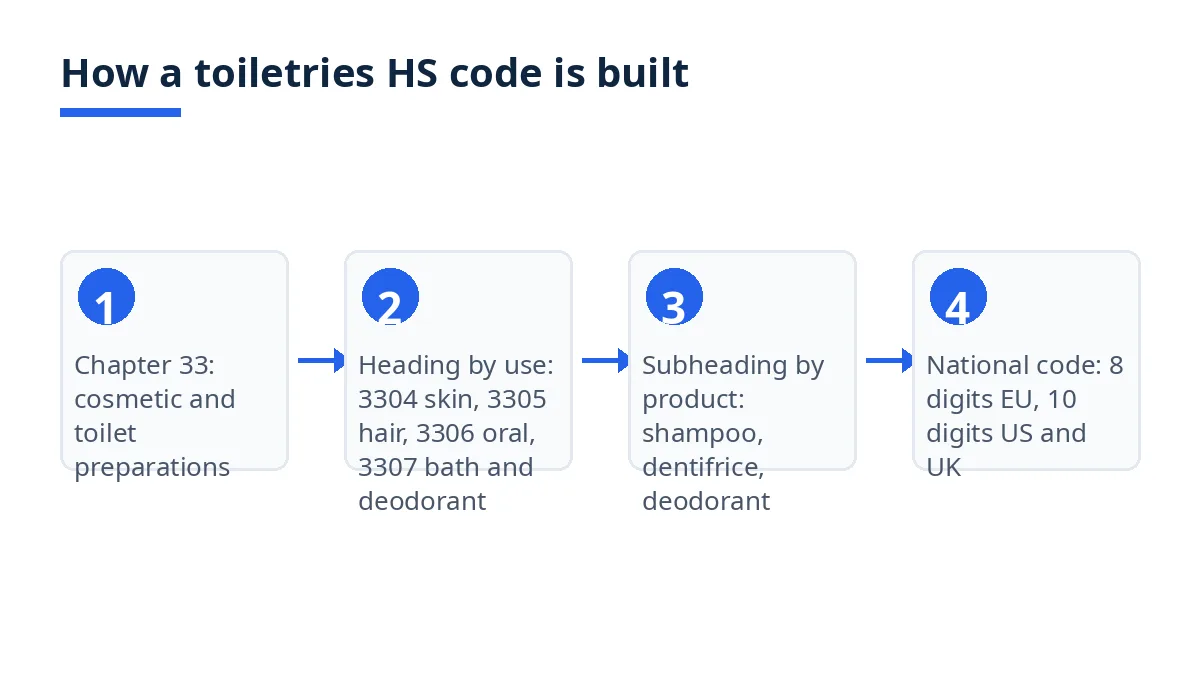
Each pair of digits narrows the category: Chapter 33 covers essential oils and resinoids and perfumery, cosmetic or toilet preparations; heading 3305 covers preparations for use on the hair; and subheading 3305.10 covers shampoos.1 Countries then subdivide the six-digit categories into national subheadings for their tariffs and statistics, and the Combined Nomenclature of the European Union uses eight-digit codes.3 The 6-digit HS code guide explains the same structure for other products.
Factors that decide the code for toiletries
Use and body part come first. The heading follows where the preparation is used and what it does, not the word toiletries on a carton. A face cream, a hair wash and a toothpaste are three different headings even in one carton, because headings 3304, 3305 and 3306 each name a different use.1
The named subheading inside the heading. Heading 3304 splits into lip makeup (3304.10), eye makeup (3304.20), manicure or pedicure preparations (3304.30), powders (3304.91) and other skin preparations (3304.99).1 Heading 3305 splits into shampoos (3305.10), waving or straightening preparations (3305.20), hair lacquers (3305.30) and other hair preparations (3305.90).1 Heading 3306 splits into dentifrices (3306.10), dental floss (3306.20) and other oral preparations (3306.90), and heading 3307 into shaving preparations (3307.10), deodorants (3307.20), bath preparations (3307.30), room preparations (3307.41 and 3307.49) and other preparations (3307.90).1
Retail packing is part of the heading test. Headings 3303 to 3307 apply, among other things, to products suitable for use as goods of those headings and put up in packings of a kind sold by retail for such use.1 A finished shampoo in a retail bottle fits the heading wording directly, while a bulk chemical input is tested on its own composition and purpose.
The medicament boundary. Heading 3304 covers skin preparations other than medicaments.1 A preparation presented as treating a skin condition, rather than caring for or making up the skin, needs a separate test against the pharmaceutical headings of Chapter 30 before you settle on 3304.
The soap boundary. Chapter 33 does not cover soap or other products of heading 3401.1 A bar of soap, even a bar sold for toilet use, tests against heading 3401, and a liquid or cream skin wash put up for retail sale also tests against heading 3401, not against heading 3307. The HS code for soaps covers that split in full.
The detergent boundary. Heading 3402 covers organic surface-active agents and surface-active, washing and cleaning preparations, other than those of heading 3401.4 A laundry or surface cleaner is a 3402 product even when it looks like a toiletry liquid. The reverse also holds: shampoos, dentifrices, shaving creams and bath preparations stay in headings 3305, 3306 and 3307 even when they contain soap or another surface-active agent.
Impregnated products need the 3307 note test. Heading 3307 also covers perfumed papers, papers impregnated or coated with cosmetics, and wadding, felt and nonwovens impregnated with perfume or cosmetics.1 A wipe or pad carrying a cosmetic preparation therefore needs the 3307 note test before you settle on 3304 or 3305.
Ingredient origin does not move the heading. A herbal or plant-based skin cream is still classified by use: a face cream is a skin preparation in heading 3304 whatever its plant content. There is no separate herbal heading inside Chapter 33, and a natural label never moves a hair wash out of heading 3305 or a toothpaste out of heading 3306.
A mixed set does not take one heading by default. A gift set holding a shampoo, a shower preparation and a skin cream contains products from more than one heading. List each item and its code on the invoice, and check how the destination tariff treats goods put up in sets for retail sale: the interpretation rules give sets their own rule, with the most specific description preferred first and essential character deciding the rest.5
National codes: US HTS, EU CN/TARIC, UK commodity code
United States: HTS, ten digits. Shampoos sit at 3305.10.00, dentifrices at 3306.10.00 and personal deodorants and antiperspirants at 3307.20.00.1 Shaving preparations split further by alcohol content, at 3307.10.10 and 3307.10.20.1 Read the full ten-digit line for each product, not the heading alone.
European Union: CN at eight digits, TARIC for measures. The Combined Nomenclature integrates the HS and adds EU subdivisions, producing eight-digit codes.3 Take the eight-digit CN code for the product, then read the confirmed TARIC line for the entry date and the measures that apply. The first six digits match the headings in this guide.
United Kingdom: commodity code, ten digits. The United Kingdom builds its commodity code on the same first six digits, with its own extension after them. The UK tariff page for other skin preparations lists the full ten-digit code 3304 9900 00, and gives the export code as 3304 9900.5 Take the full code from the UK Trade Tariff for your product and entry date.
How to confirm the code officially
Write a precise description for each product: body part, function, form, retail packing, any therapeutic claim, and any soap or detergent character.
Start from the destination tariff: the USITC HTS, TARIC or the UK Trade Tariff, and read the heading text and chapter notes.1
Check published rulings for similar preparations. For the United States, the USITC advises traders to use the Customs Rulings Online Search Service (CROSS), where the correct classification of many items can be found.6
For a borderline product, apply for a binding decision before you ship. In the EU, a Binding Tariff Information application needs a separate application for each type of product and a detailed description of the goods.7 In the United Kingdom, a legally binding decision is generally valid for 3 years, through an Advance Tariff Ruling, and you can only get one if you have an EORI number that starts with GB and intend to import into or export from Great Britain.8 In the United States, if the merchandise is not described in any ruling on CROSS, you may request a binding ruling from U.S. Customs and Border Protection, which can take up to 30 days if all of the necessary information is submitted.6
Give your broker the description and confirmed code for each product, and use the same codes on the invoice, packing list and entry.
Common classification mistakes
Filing a mixed basket under one heading. Toiletries span headings 3304 to 3307 by use.1 One code for a carton of face cream, shampoo and toothpaste is wrong for at least two of the three products.
Filing soap as a toiletry in Chapter 33. Chapter 33 does not cover soap or other products of heading 3401.1 Bars and retail liquid or cream skin washes test against heading 3401 first.
Filing a surface cleaner as a toiletry. Heading 3402 covers washing and cleaning preparations other than those of heading 3401.4 A product made to clean laundry or surfaces is not a toiletry because it comes in a similar bottle.
Filing a deodorant as a perfume, or the reverse. Perfumes and toilet waters sit in heading 3303, while personal deodorants sit at 3307.20.1 A perfumed body spray is tested by its primary function and presentation.
Ignoring a therapeutic claim. Heading 3304 excludes medicaments.1 A skin preparation sold as a treatment needs the Chapter 30 test, and filing it as an ordinary skin cream misses that boundary.
Copying a code from another country. Only the first six digits are shared worldwide. The EU uses eight-digit Combined Nomenclature codes,3 and the United States and the United Kingdom use ten-digit codes,1 5 so a code copied across borders is incomplete at best.
Related duties and documents
This guide states no duty rates: the code decides which duty line customs applies, and a rate on a skin preparation line does not carry to a hair or oral care line. Read the rate beside your confirmed code for your origin and entry date, and check the proof of origin a preference claim requires. The Harmonized System nomenclature lets you identify your product and determine which tariffs and requirements apply.3
Keep the shipment file consistent: the product description, the confirmed code for each item, any binding decision and the origin evidence together, with each toiletry as its own invoice line. A legally binding decision helps calculate customs duties and other restrictions in advance,8 which is the reason to get one for a borderline product rather than arguing the heading after arrival. This guide covers classification only, not product approval or labeling, so check the destination rules for cosmetic products separately.
FAQs
What is the HS code for toiletries?
There is no single code. Skin care and makeup test against heading 3304, hair preparations against heading 3305, oral hygiene preparations against heading 3306, and shaving, bath and deodorant preparations against heading 3307, each indicative until you confirm the full national code.1
Is the HS code the same in every country?
Only the first six digits are harmonised. Countries subdivide the six-digit categories into national subheadings,3 so the EU uses eight-digit codes and the United States and the United Kingdom use ten-digit codes.3 1 5
How do I confirm the correct code?
Describe each product precisely, read the heading text and chapter notes in the destination tariff, and check published rulings such as CROSS.6 For a borderline product, apply for a binding decision before shipping: a Binding Tariff Information decision in the EU,7 an Advance Tariff Ruling in the United Kingdom,8 or a CBP binding ruling in the United States.6
What happens if I use the wrong code?
Duty, licensing and quota treatment are worked out from the code on the declaration, so a wrong code brings the wrong treatment. A legally binding decision helps calculate customs duties, export refunds, licensing requirements, quotas or other restrictions in advance.8
Next steps on Exportain
Browse Bangladeshi suppliers on Exportain and post a free RFQ at Exportain RFQs with the confirmed code stated for each toiletry in the shipment. If the shipment also contains soap bars or liquid skin washes, read the HS code for soaps before filing, since those products test against heading 3401 rather than Chapter 33. Exportain is not a party to the goods contract and does not inspect goods, book freight or clear customs, so keep your broker and any binding decision at the center of the entry.
Sources
- Harmonized Tariff Schedule of the United States, Chapter 33 (2025 Revision 14). U.S. International Trade Commission (accessed )
- What is the Harmonized System (HS)?. World Customs Organization (accessed )
- Harmonised System. European Commission (accessed )
- HS, 2017 - Code 3402. United Nations Statistics Division (accessed )
- Commodity code 3304990000: Other - UK Integrated Online Tariff. GOV.UK, HM Revenue and Customs (accessed )
- MTB 2019: Get Out Ahead of the Pack with a Binding Ruling from CBP. U.S. International Trade Commission (accessed )
- European Binding Tariff Information (EBTI). European Commission, Taxation and Customs Union, (accessed )
- Check what you'll need to get a legally binding decision on a commodity code. GOV.UK, HM Revenue and Customs (accessed )
- HS Codes
- Customs Classification
- importing from Bangladesh
- tariff codes
- Cosmetics Bangladesh
- Import documents
About the author
Sourcing from Bangladesh?
Post a request for quotation and suppliers on Exportain can send you their quotes directly.
Post an RFQ


