

HS Code for Sportswear and Activewear: Classification Guide for Importers
Sportswear and activewear spread across headings 6112, 6114 and 6211 by construction, garment type and fibre. This guide explains the deciding factors and how to confirm the full national code in the US, EU and UK.
Short answer
Sportswear and activewear have no single hs code. Knitted or crocheted track suits, ski suits and swimwear point to heading 6112, other knitted garments to 6114, and woven equivalents to 6211, with the subheading set by fibre and wearer group. Many items sit elsewhere, from T-shirts at 6109 to sports bras tested under 6212. Confirm the full national code in the destination tariff before filing.
On this page
Key takeaways
Knitted or crocheted track suits, ski suits and swimwear point to heading 6112, other knitted garments to 6114, and woven equivalents to heading 6211.
Track suits under 6112 split by fibre: 6112.11 for cotton, 6112.12 for synthetic fibres and 6112.19 for other textile materials.
Many activewear items sit in more specific headings: T-shirts and singlets at 6109, leggings tested as trousers, and sports bras tested under heading 6212.
Chapter notes move garments between headings: coated garments go to 6113 if knitted or 6210 if woven, ahead of the heading their shape suggests.
Only the first six digits are harmonized worldwide; the full code runs to eight digits in the EU and ten digits in the US HTS.
If you import sportswear or activewear, there is no single hs code for sportswear and activewear. The Harmonized System behind the code is a multipurpose international product nomenclature developed by the World Customs Organization (WCO), used by more than 200 countries and economies as a basis for their customs tariffs and trade statistics.1 Sportswear spreads across two chapters, and the right heading depends on how each garment is made.
Quick answer: indicative headings 6112 and 6114, with 6211 for woven garments
For knitted or crocheted sportswear, the two starting headings are 6112 and 6114. In the Harmonized Tariff Schedule of the United States (HTS), published by the U.S. International Trade Commission (USITC), heading 6112 covers "Track suits, ski-suits and swimwear, knitted or crocheted," and heading 6114 covers "Other garments, knitted or crocheted."2 The woven mirror is heading 6211, "Track suits, ski-suits and swimwear; other garments," in Chapter 62.3
Treat those headings as indicative until you have tested your exact garment against the heading text and chapter notes. Many activewear staples, such as T-shirts, leggings and training shorts, are not classified in 6112 or 6114 at all, because a more specific heading claims them first.
How HS codes are structured
The HS comprises more than 5,000 commodity groups, each identified by a six-digit code, arranged in a legal and logical structure.1 The first two digits give the chapter, the first four give the heading and the first six give the subheading, the level harmonized worldwide. Countries then add their own digits for duty rates, statistics and controls.
Level | Digits | For sportswear and activewear |
|---|---|---|
Chapter | 2 digits (61 or 62) | Knitted or crocheted apparel in 61; other apparel in 62 |
Heading | 4 digits (for example 6112) | Track suits, ski-suits and swimwear, knitted or crocheted |
Subheading | 6 digits (for example 6112.11) | The same garments, split by fibre or garment group |
National extension | 8 to 10 digits | Set by the importing country for its tariff and statistics |
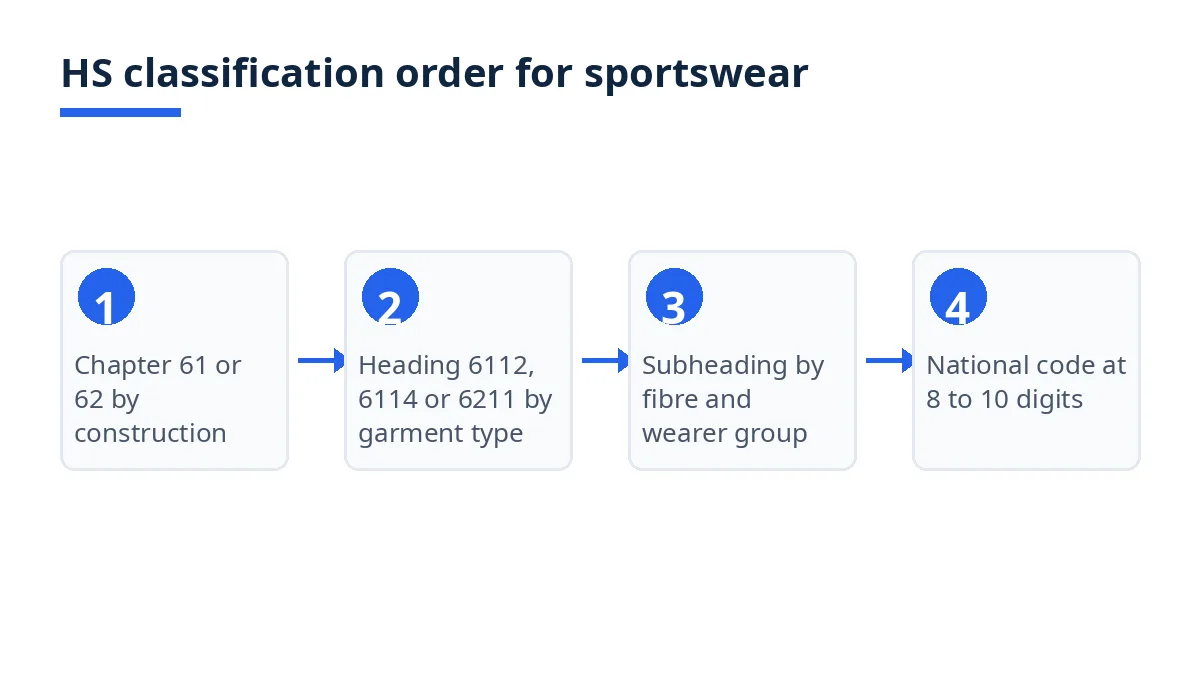
Chapter comes first because Chapter 61 applies only to made up knitted or crocheted articles,2 while Chapter 62 applies only to made up articles of textile fabric, excluding knitted or crocheted articles other than those of heading 6212.3 If you are new to the system, read the HS code explainer first, then how to classify your product.
The diagram below shows the decision order, from chapter to the national code you file.
Factors that decide the code for sportswear and activewear
Classification follows the wording of the headings and the chapter notes, not the product name on a retail label. Check these factors in order. Knitted or crocheted construction versus woven. This decides the chapter before anything else. A knitted track suit is tested in Chapter 61 and its woven equivalent in Chapter 62.2 3 Confirm construction from the supplier specification, not a photograph or a trade name such as jersey.
Whether the garment is a track suit, ski suit or swimwear. Access2Markets defines track suits by their general appearance and fabric, clearly meant to be worn exclusively or mainly for sporting activities, under heading 6112 or 6211 as appropriate.4 A track suit comprises an upper garment with long sleeves and tightening at the cuffs and bottom, and trousers with tightening at the waist and no opening at the waist.4 Knitted track suits must not be lined, while woven track suits may be lined.4
Ski suits and swimwear. Ski suits sit in the same two headings: both chapter notes define a ski-suit as a garment or set identifiable by appearance and texture as intended principally for skiing, built as a one-piece overall or an ensemble.2 3 Swimwear is also placed under 6112 or 6211 and is generally made of man-made fibres, and swimming shorts must have inner briefs sewn in or a lining in the front of the crotch, with a tight waist.4 Swimming shorts that fail those conditions are classified as shorts under 6103, 6104, 6203 or 6204.4
The other-garments headings 6114 and 6211. Activewear pieces that match no more specific heading fall to 6114 if knitted or crocheted, which the US HTS splits into 6114.20 for cotton, 6114.30 for man-made fibres and 6114.90 for other textile materials, with tops at 6114.30.10.2 Woven pieces fall to the other-garments lines of 6211: 6211.32, 6211.33 and 6211.39 for men's or boys' garments by fibre, and 6211.42, 6211.43 and 6211.49 for women's or girls'.3 A sleeveless men's training top is one example: Access2Markets notes that a man's sleeveless garment may be classified under 6114.4
More specific garment headings claim many activewear items first. A lightweight training T-shirt or singlet belongs to heading 6109, which covers T-shirts, singlets and other vests, knitted or crocheted, but 6109 does not cover garments with hoods, and a drawstring, ribbed waistband or other tightening at the bottom also excludes a garment from 6109.2 4 Leggings, training trousers and shorts are tested as trousers and shorts under 6103 and 6104 if knitted or crocheted, or 6203 and 6204 if woven.4 A sports bra is tested against heading 6212 before the knit headings, because Chapter 61 does not cover goods of heading 6212 and Chapter 62 keeps heading 6212 articles even when knitted or crocheted.2 3 Coated sports garments move again: garments prima facie classifiable both in heading 6113 and in other Chapter 61 headings are classified in 6113, and the Chapter 62 note gives heading 6210 the same priority.2 3
Fibre content and wearer group. Under 6112, track suits split into 6112.11 for cotton, 6112.12 for synthetic fibres and 6112.19 for other textile materials, ski suits sit at 6112.20, and swimwear splits by wearer group and fibre at 6112.31 and 6112.39 for men's or boys' and 6112.41 and 6112.49 for women's or girls'.2 Under 6211, swimwear sits at 6211.11 for men's or boys' and 6211.12 for women's or girls', and ski suits at 6211.20.3 For a blend, record the tested composition in percentages by weight: a garment described only as a polyester blend cannot be placed on a fibre line with confidence.
National codes: US HTS, EU CN and TARIC, UK commodity code
United States: HTS, ten digits. A knitted cotton track suit starts at 6112.11.00 and a synthetic-fibre one at 6112.12.00, and two statistical digits complete the ten-digit code.2 One trap for sets: the US statistical notes require a track suit under 6112.11 or 6112.12 to be reported statistically as separate articles, using the most appropriate ten-digit number for each garment within the same eight-digit line.2
European Union: CN at eight digits, TARIC for measures. Access2Markets classification guidance works in eight-digit codes, the length of the EU Combined Nomenclature built on the six-digit HS.4 Read the full line for your garment in TARIC and check the measures for the entry date and origin Bangladesh, because preferential treatment depends on origin rules and proof of origin, not on the code alone.
United Kingdom: commodity code. The UK publishes its own tariff, so confirm the full commodity code in the UK Trade Tariff for the import date instead of reusing a US or EU code, working through the same tests in order: construction, garment type, then fibre and wearer group.
Other destinations, including the UAE. Every HS destination shares the first six digits and sets its own lines after them. Confirm the full code in the destination tariff, or through your broker, before goods leave Bangladesh.
How to confirm the code officially
Use this sequence for each style, and keep the evidence with the shipment file.
Write a precise description: construction, fibre percentages by weight, whether the set is lined, waist tightening, any inner brief or lining in swim shorts, and the wearer group.
Start from the official tariff for the destination: the USITC HTS, TARIC or the UK Trade Tariff. Read the heading text and chapter notes, not only the search result line, because the notes move sports bras to heading 6212 and coated garments to 6113 or 6210.2 3
Test the garment against the published classification criteria for textiles, such as the Access2Markets definitions of track suits, ski suits and swimwear, and record which criteria it meets or fails.4
For a borderline garment, such as a shell suit in mixed fabrics or a coated training jacket, ask the destination customs authority for a binding decision before you ship.
Give your broker the description and confirmed code, and use the same code on the invoice, packing list and declaration.
Browse suppliers by category and align fibre content and construction before ordering samples, so classification stays stable across suppliers.
Common classification mistakes
Putting every activewear item under 6112. Heading 6112 covers track suits, ski suits and swimwear only.2 Leggings are tested as trousers under 6104 or 6204, and training T-shirts under 6109.4
Treating a two-piece set as a track suit when it fails the criteria. A knitted track suit must not be lined, and the trousers must have no opening at the waist.4 If the pieces fail the definition, classify the upper and lower garments separately.
Calling swim shorts swimwear without the construction test. Swimming shorts need inner briefs or a front crotch lining and a tight waist; without them, the garment is classified as shorts.4
Classifying a sports bra in the knit chapters. Chapter 61 does not cover goods of heading 6212, so support garments are tested under 6212 first.2 3
Ignoring a coating. A garment made from coated fabric can move to heading 6113 if knitted or 6210 if woven, ahead of the heading its shape suggests.2 3
Copying a code from a similar product or another country. Compare the hs code for polo shirts and the hs code for hoodies and sweatshirts: similar-looking knitwear lands in different headings because the garment type differs.
Related duties and documents
The code decides which duty line and measures customs applies, but this guide states no duty rate. Rates and preferences depend on destination, origin, tariff edition and entry date, and they change. Read the rate beside the confirmed code in the official tariff for your entry date, and check whether preferential treatment for Bangladesh is available and what proof of origin it requires.
FAQs
What is the HS code for sportswear and activewear?
There is no single code for the whole category. Knitted or crocheted track suits, ski suits and swimwear point to heading 6112, other knitted garments to 6114, and woven equivalents to 6211.2 3 Many items, such as T-shirts under 6109 and leggings tested as trousers, sit in more specific headings.4 Verify the full national code for your exact garment before use.
Is the HS code the same in every country?
Only the first six digits are harmonized. The HS gives each commodity group a six-digit code, and countries build their customs tariffs on that basis.1 Beyond six digits, each country sets its own lines: eight digits in the EU and ten in the US HTS.
How do I confirm the correct code?
Describe the garment precisely, look the code up in the destination tariff, and read the heading text and chapter notes. Test the garment against the published criteria for track suits, ski suits and swimwear,4 and for a borderline garment ask the destination customs authority for a binding decision before shipping.
What happens if I use the wrong code?
Duty, licensing and quota treatment are worked out from the code on the declaration, so a wrong code means those treatments come from the wrong line. A set entered under a track suit code can also be broken into its upper and lower garments for statistical reporting, as the US notes require for track suits under 6112.11 and 6112.12.2
Next steps on Exportain
Browse Bangladeshi suppliers whose range matches your specification, and read how to import sportswear and activewear from Bangladesh for the sourcing steps around this category. Confirm the full national code before the first order ships.
Sources
- What is the Harmonized System (HS)?. World Customs Organization (accessed )
- Harmonized Tariff Schedule of the United States Revision 18 (2026), Chapter 61. U.S. International Trade Commission (accessed )
- Harmonized Tariff Schedule of the United States Revision 18 (2026), Chapter 62. U.S. International Trade Commission (accessed )
- Classifying textiles. European Commission, Access2Markets (accessed )
About the author
Sourcing from Bangladesh?
Post a request for quotation and suppliers on Exportain can send you their quotes directly.
Post an RFQ


