HS Code for PET Bottles: Classification Guide for Importers
Finished PET bottles point indicatively to 3923.30, but preforms are borderline unfinished bottles and reusable bottles sold empty fall outside the heading; confirm the full US, EU or UK national code per bottle size.
Short answer
A finished PET bottle made to be filled with a commercial product and sold to the consumer points indicatively to subheading 3923.30, inside heading 3923. A preform is a borderline unfinished bottle that needs a ruling check, and a reusable bottle sold empty for the buyer to fill falls outside 3923.30. Confirm the full national code for the destination and bottle size before filing.
On this page
Key takeaways
A finished PET bottle made to be filled with a commercial product and sold to the consumer points indicatively to subheading 3923.30, inside heading 3923; confirm the full national code for the destination and bottle size before filing.
A PET preform is an unfinished bottle: it has the finished neck but not the body, so check a published ruling for the same preform or apply for a binding decision before filing a preform shipment.
A reusable personal bottle sold empty for the buyer to fill fails the 3923.30 test: United States rulings treat 3923.30 bottles as those designed to be filled and sold to the consumer with a beverage inside, so the reusable bottle falls to heading 3926.
Stage decides the code, not the letters PET: resin in primary forms sits at 3907.61 or 3907.69, PET waste at 3915.90, caps separately at 3923.50, and recycled feedstock does not move a finished bottle out of 3923.30.
Only the first six digits are shared worldwide: the United Kingdom splits 3923.30 at two litres and the United States uses a 50 ml statistical suffix, so never copy a full national code from one destination into another.
A supplier listing that says "PET bottles" does not settle the customs code: the same words can cover resin pellets, an unfinished preform, a finished empty bottle, and a reusable drinking bottle. This guide works from the stage of the goods outward: finished bottle first, then the preform test, then the filled-bottle test, then the national extension. Every heading in this guide is indicative: confirm the full national code in the destination tariff before filing. For the general method, read HS codes: how to classify your product.
Quick answer: indicative HS heading (verify before filing)
A finished, empty PET bottle made to be filled with a product and sold to the consumer points indicatively to subheading 3923.30, carboys, bottles, flasks and similar articles, inside heading 3923.1 2 Treat 3923.30 as the starting point: the destination extends it further, and the two tests below can move the goods elsewhere.
Goods as shipped | Indicative line | Why |
|---|---|---|
Finished empty PET bottle for a beverage or other commercial product | 3923.30 | |
PET preform, not yet blown into a bottle | Borderline: test before filing | Unfinished bottle; see the preform section |
PET resin pellets or granules | 3907.61 or 3907.69 | Poly(ethylene terephthalate) in primary forms1 |
PET waste, parings and scrap | 3915.90 | Waste of other plastics, with a PET line1 |
Cap, lid or closure shipped separately | 3923.50 | |
Reusable personal drinking bottle, filled by the end user | 3926, not 3923.30 | The filled-bottle test below3 |
How HS codes are structured (2-4-6 digits)
The Harmonized System is a multipurpose international product nomenclature developed by the World Customs Organization (WCO), comprising more than 5,000 commodity groups, each identified by a six-digit code, and used by more than 200 countries and economies as a basis for their customs tariffs.4 The European Commission describes the same hierarchy: 2-digit chapters, 4-digit headings and 6-digit subheadings, with national subdivisions beyond six digits.5
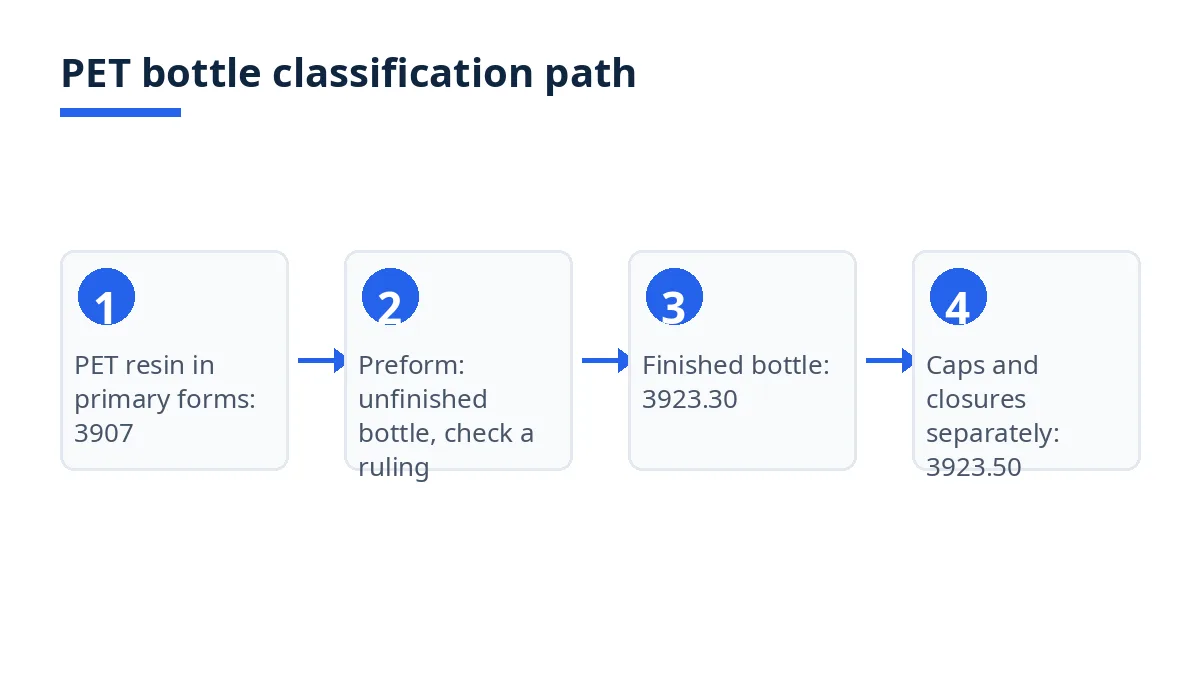
For PET bottles: Chapter 39 covers plastics and articles thereof; heading 3923 narrows that chapter to articles for the conveyance or packing of goods, of plastics, plus closures; subheading 3923.30 narrows the heading to carboys, bottles, flasks and similar articles.1 2 Everything after the sixth digit is national detail for one customs territory and does not travel to another. The current version is HS 2022.5
Factors that decide the code for PET bottles
The stage of the goods comes first. PET resin in primary forms differs from a finished bottle: the United States schedule lists poly(ethylene terephthalate) in primary forms at 3907.61 where the viscosity number is 78 ml/g or higher, and at 3907.69 otherwise.1 Chapter 39 note 6 limits "primary forms" to liquids, pastes, lumps, powders, granules, flakes and similar bulk forms.1 Resin and finished bottles therefore never share a code, even though both are PET.
The preform test: unfinished bottle or another article. A PET preform is a short, thick-walled tube with a finished neck, ready to be blown into a bottle at the destination: it has the neck of the finished bottle but not its body, so the question is whether customs treats it as an unfinished bottle or as something else. The HS general rules for interpretation cover incomplete and unfinished articles.5 Do not assume the answer from a supplier code: describe the preform (neck finish, weight, wall, whether sold only for blow-moulding into bottles) and check a published ruling for the same preform; if none matches, apply for a binding decision, as set out below.
The filled-bottle test: filled by the seller or by the end user. Heading 3923 covers articles for the conveyance or packing of goods, and United States rulings have drawn the line there. In HQ 952264, Customs held that 3923.30 bottles are bottles such as beverage bottles designed to be filled and sold to the ultimate consumer with a beverage therein, not containers to be filled by the end user.3 A reusable personal sports bottle, sold empty for the buyer to fill, therefore fails the 3923.30 test and falls to the residual heading for other articles of plastics, heading 3926.3
Capacity decides the national line, not the six digits. Subheading 3923.30 is the same for a 500 ml bottle and a 5 litre bottle; the split by capacity happens at national level, and the United Kingdom tariff splits 3923.30 at two litres.2 Record the nominal capacity of each bottle size on the invoice.
Caps and closures are their own line. Heading 3923 also covers stoppers, lids, caps and other closures, of plastics, at subheading 3923.50.1 2 A PET lid shipped separately takes 3923.50: in a 2025 ruling, a PET lid for a paper bowl took 3923.50.0000 while the bowl took a paper heading.6 Describe caps as a separate invoice line, unless the destination tariff directs otherwise for a bottle shipped with its cap fitted.
Recycled content does not change the heading. Nothing in the heading text splits bottles by virgin or recycled feedstock: a finished bottle made with recycled PET is still a bottle for the conveyance or packing of goods, and still points to 3923.30. Recycled-content claims and food-contact authorisation are separate files from classification. The stage rules still apply: PET waste sits at 3915.90,1 and waste of a single thermoplastic material transformed into primary forms falls back to the primary-forms headings.1
Check the neighbouring headings before settling. Chapter 39 note 2 excludes travel-goods containers of heading 4202, Chapter 94 furniture, Chapter 95 sports requisites and Chapter 96 vacuum-flask parts from the chapter.2 A bottle-shaped container that is really one of those needs the exclusion test before 3923 is claimed.
National codes: US HTS, EU CN/TARIC, UK commodity code
United States: HTS, ten digits. The United States schedule lists 3923.30.00 for carboys, bottles, flasks and similar articles, with statistical suffixes 10 (not exceeding 50 ml) and 90 (other), giving 3923.30.0010 and 3923.30.0090.1 Note what the United States schedule does not do: it does not split 3923.30 by PET or by the 2-litre line, so do not carry another country's suffix into a United States entry.
European Union: CN at eight digits, TARIC for measures. The Combined Nomenclature adds EU subdivisions, producing eight-digit codes.5 Read the confirmed line in TARIC for the entry date and origin Bangladesh. The EU capacity split sits at eight-digit level, so nominal capacity must be on the entry documents even though the six digits do not change.
United Kingdom: commodity code, ten digits. The United Kingdom builds its commodity code on the same first six digits.5 Its tariff splits 3923 30 into 3923 3010 00 (not exceeding two litres) and 3923 3090 00 (exceeding two litres), with the supplementary unit as the number of items.2 Take the code from the United Kingdom Trade Tariff for the bottle size and entry date.
How to confirm the code officially
Write a precise description for each bottle size: stage (resin, preform or finished bottle), feedstock, nominal capacity, neck finish, sold filled or empty, and whether caps ship with the bottle or separately.
Start from the destination tariff (USITC HTS, TARIC or the United Kingdom Trade Tariff) and read the heading text and Chapter 39 notes.1 2
Check published rulings for the same stage of goods; for a preform or reusable bottle, a ruling on the same product beats a supplier code.3
For a borderline product, apply for a binding decision before shipping: an Advance Tariff Ruling in the United Kingdom, generally valid for 3 years,7 Binding Tariff Information for Northern Ireland or the European Union, or the equivalent ruling from the destination country's customs authority.7
Give your broker the description and confirmed code per bottle size, and use the same codes throughout the entry, invoice and packing list.
Common classification mistakes
Filing resin pellets as bottles. PET in primary forms sits at 3907.61 or 3907.69, by viscosity number.1 A resin code on a finished-bottle entry, or a bottle code on a resin entry, misstates the stage of the goods.
Filing every preform at 3923.30 without checking. A preform is an unfinished bottle: answer the unfinished-article question for the exact preform, by ruling or binding decision, before filing.
Filing a reusable personal bottle as a commercial bottle. Bottles designed to be filled and sold to the ultimate consumer with a beverage therein sit at 3923.30; containers to be filled by the end user do not.3 A reusable sports bottle sold empty belongs in heading 3926, not 3923.30.
Filing caps on the bottle line. Caps, lids and closures shipped separately take 3923.50.1 6 Keep them as a separate line.
Copying another country's national suffix. The United Kingdom splits 3923.30 at two litres,2 the United States only at 50 ml,1 and the European Union builds its own eight-digit lines.5 A full national code copied across destinations is wrong even when the first six digits are right.
Filing PET waste as bottles, or bottles as waste. PET waste, parings and scrap sit at 3915.90,1 while a finished bottle sits at 3923.30. Waste transformed into primary forms moves back to the primary-forms headings.1
Treating recycled content as a classification. Recycled feedstock does not move a finished bottle out of 3923.30. Record the recycled content separately, and keep food-contact evidence in its own file.
Related duties and documents
This guide states no duty rates: the code decides which duty line customs applies, and a rate on one national line does not carry to another size, stage or destination. Read the rate beside your confirmed code for your origin and entry date, and check what proof of origin a preference claim requires.
Keep the shipment file complete: stage, capacity per size, feedstock statement, cap treatment, confirmed codes, any binding decision, food-contact declaration where the bottle holds food or drink, and origin evidence. The plastic household products classification guide shows how heading 3924 differs from this packaging heading.
FAQs
What is the HS code for PET bottles?
A finished PET bottle made to be filled with a product and sold to the consumer points indicatively to subheading 3923.30, inside heading 3923.1 2 Confirm the full national code per destination and size: the United Kingdom splits 3923.30 at two litres2 and the United States uses its own statistical suffixes.1
Is the HS code the same in every country?
Only the first six digits are shared: countries subdivide them into national subheadings, with the European Union Combined Nomenclature using eight-digit codes.5 The United States and the United Kingdom extend to ten digits, with different splits, so a full code copied from one destination does not transfer.1 2
How do I confirm the correct code?
Describe each bottle size, read the heading text and Chapter 39 notes in the destination tariff, and check published rulings for the same stage of goods.3 For a borderline product such as a preform, apply for a binding decision before shipping: an Advance Tariff Ruling in the United Kingdom, generally valid for 3 years,7 Binding Tariff Information for Northern Ireland or the European Union, or the equivalent ruling from the destination country's customs authority.7
What happens if I use the wrong code?
Duty, licensing and quota treatment follow the code on the declaration, so a wrong code brings the wrong treatment. A legally binding decision in advance provides assurance of the correct code and helps calculate the duties and restrictions that will apply.7
Next steps on Exportain
Browse Bangladeshi suppliers on Exportain, a B2B marketplace where supplier profiles carry document and photo review badges, and post a free RFQ at Exportain RFQs stating the stage, capacity and confirmed code per bottle size. The harmonized system explainer is the background read. Exportain is not a party to the goods contract and does not inspect goods, book freight or clear customs, so keep your broker and your binding decision at the centre of the entry.
Sources
- Harmonized Tariff Schedule of the United States, Chapter 39 (2026 Revision 18). U.S. International Trade Commission (accessed )
- Articles for the conveyance or packing of goods, of plastics: UK Integrated Online Tariff, heading 3923. GOV.UK, HM Revenue and Customs (accessed )
- HQ 952264: Plastic Sports Beverage Bottles and Plastic Sports Beverage Bottle Components. U.S. Customs and Border Protection (accessed )
- What is the Harmonized System (HS)?. World Customs Organization (accessed )
- Harmonised System. European Commission (accessed )
- N350215: Tariff classification of paper bowls with plastic lids. U.S. Customs and Border Protection (accessed )
- Check what you'll need to get a legally binding decision on a commodity code. GOV.UK, HM Revenue and Customs (accessed )
About the author
Sourcing from Bangladesh?
Post a request for quotation and suppliers on Exportain can send you their quotes directly.
Post an RFQ