HS Code for Plastic Household Products: Classification Guide for Importers
Plastic household products point indicatively to heading 3924, split between tableware and kitchenware at 3924.10 and other household articles at 3924.90, with the household-use test, the melamine overlap and US, EU, UK and UAE national codes explained.
Short answer
Plastic household products point indicatively to heading 3924: tableware and kitchenware at 3924.10 and other household articles at 3924.90. The deciding test is household function, not polymer, so melamine tableware stays in 3924 while buckets, packing boxes and permanently installed rails fall in other headings. Confirm the full national code in the destination tariff before filing.
On this page
Key takeaways
The indicative heading is 3924: tableware and kitchenware at 3924.10 and other household articles at 3924.90, both indicative until confirmed in the destination tariff.
Household function decides the code, not polymer: melamine tableware stays in 3924.10, while a melamine ornament falls in 3926.40.
Buckets, photo albums, packing boxes, permanently installed rails, chairs and toys all sit outside 3924, in 3926, 3923, 3925, 9401 or 9503.
Only the first six digits are shared: the EU extends to eight digits, the United States and United Kingdom to ten, and the United Arab Emirates is moving from eight to twelve.
For a borderline article, apply for a binding decision before shipping: Binding Tariff Information in the EU, an Advance Tariff Ruling in the UK, or a binding ruling from US Customs and Border Protection.
A dinner set, a set of storage boxes and a bucket can each need a different customs line even though all three are plastic. The Harmonized System is a multipurpose international product nomenclature developed by the World Customs Organization (WCO), comprising more than 5,000 commodity groups, each identified by a six-digit code, and used by more than 200 countries and economies as a basis for their customs tariffs.1 For plastic household products, the code turns on what the article is used for in the home, not on the polymer it is moulded from. All headings below are indicative: confirm the full national code in the destination tariff before filing. For the general method, read HS codes: how to classify your product.
Quick answer: indicative HS heading (with verify note)
The indicative heading for plastic household products is 3924, which covers tableware, kitchenware, other household articles and hygienic or toilet articles, of plastics.2 3 Inside it, 3924.10 covers tableware and kitchenware and 3924.90 covers other household and toilet articles.2 A plastic dinner plate therefore points to 3924.10, while a plastic soap dish points to 3924.90, subject to the boundary checks below.
Several look-alike plastic articles sit outside 3924 entirely:
Article | Indicative heading | Why it is not 3924 |
|---|---|---|
Plastic plates, cups, bowls, trays | 3924.10 | Named tableware and kitchenware in heading 39242 |
Plastic soap dish, toothbrush holder, home storage box | 3924.90 | Other household articles in heading 39242 |
Plastic bucket or pail | 3926.90 (United States: 3926.90.10) | Other articles of plastics, not named in 39242 |
Plastic photo album | 3926.90 (United States: 3926.90.48) | United States schedule: household articles in 3924 exclude photo albums2 |
Plastic bottle, cap or packing box | 3923 | Articles for the conveyance or packing of goods2 |
Wall-mounted towel rail, fixed permanently | 3925 | Fittings for permanent installation in or on walls, including towel rails3 |
Plastic chair or plastic toy | 9401 or 9503 | Chapter 39 excludes furniture (94) and toys (95)3 |
Verify every line in the destination tariff.
How HS codes are structured (2-4-6 digits)
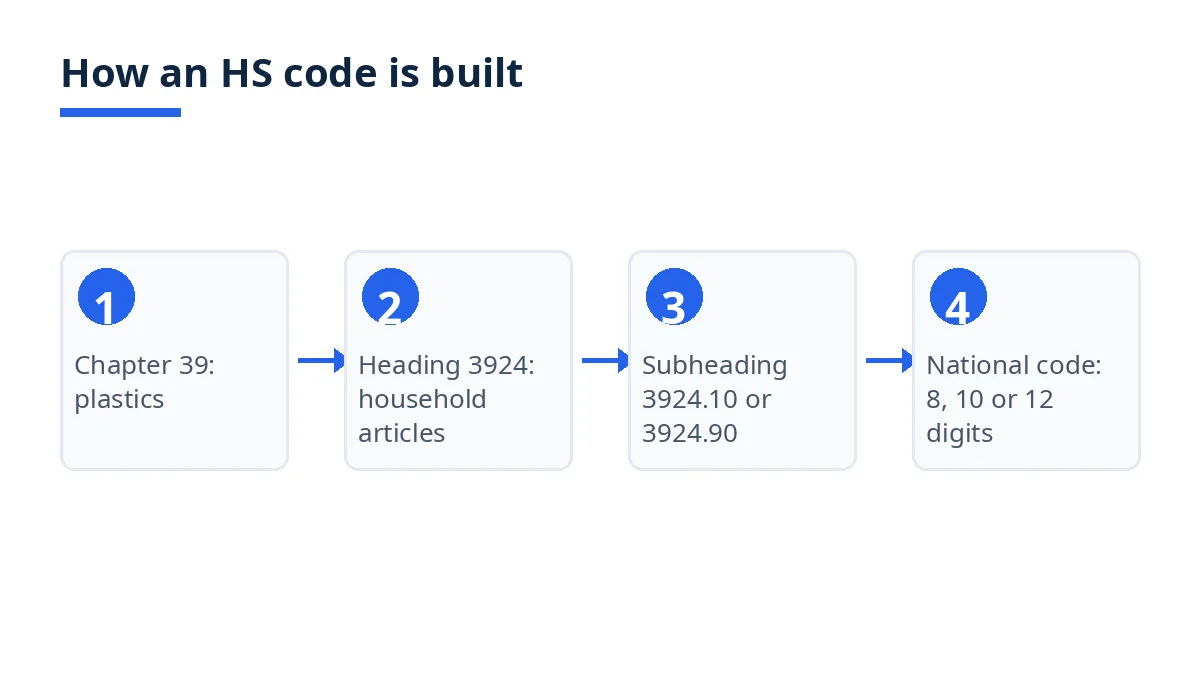
The Harmonised System is organised by sections, chapters (2 digits), headings (4 digits) and sub-headings (6 digits), and countries further subdivide the six-digit categories into national subheadings.4 The first two digits give the chapter, the first four the heading, and all six the internationally agreed subheading.
For this guide the ladder reads: Chapter 39, heading 3924, subheading 3924.10 or 3924.90, then the national extension.
The current version of the system is HS 2022.4 Read the HS code hub for the full structure and the difference between HS, HTS and TARIC.
Factors that decide the code for plastic household products
Work through these four tests in order. Most errors come from starting with the material instead of the function.
1. Household function first. Eating and food preparation points to 3924.10, while washing, tidying and general household use points to 3924.90. A serving platter and a laundry basket are both plastic household articles, but only the platter is tableware. If the article has no household function, it does not belong in 3924 even if it looks like houseware.
2. The named line inside 3924. Once household use is established, check whether the article is named in a national line under 3924.10 or 3924.90. In the United States schedule, 3924.10 covers dispensers, plates, cups, bowls, serving dishes, platters and trays.2 Under 3924.90, it names curtains and drapes, napkins, table covers, mats, furniture slipcovers and picture frames, plus a residual other line.2 In the United Kingdom tariff, 3924.90 names ironing boards, including sleeve boards, with a residual other line for the rest.3 If your article is not named, it falls to the residual other line of the matching subheading.
3. Material second, and melamine does not change the heading. Chapter 39 defines plastics as the materials of headings 3901 to 3914 that can be formed, usually by heat and pressure, into shapes retained when the external influence is removed.3 That definition confirms the article is plastic; it does not choose between 3924 and 3926. The melamine overlap is the clearest example. The United Kingdom tariff lists kitchenware containing polyamide or melamine as a national line inside 3924.10.3 A melamine dinner plate is therefore tableware in 3924.10, exactly like a polypropylene dinner plate: the product decides, not the polymer. A melamine article that is not tableware, kitchenware or a household article does not enter 3924 because it is melamine: a decorative melamine statuette is an ornamental article, and the United States schedule places statuettes and other ornamental articles in 3926.40.2 When a supplier describes goods only by material, ask for the article name and household function before accepting a code.
4. Sets, composites and permanent installation. A retail set is not automatically one code: classify each article by its own function. A composite article follows its essential character: a plastic storage box with a fitted textile cover is tested on which component gives it its character, not on the plastic alone. Installation also matters. Heading 3925 applies only to the listed articles, including fittings intended for permanent installation in or on walls or other parts of buildings, for example knobs, handles, hooks, brackets and towel rails.3 A towel rail screwed to a bathroom wall therefore points to 3925, while the same rail sold freestanding points to 3924.90. Record how the article is installed, not only what it looks like.
National codes: US HTS, EU CN/TARIC, UK commodity code
Only the first six digits are shared worldwide. Beyond six digits, each country adds its own lines.
United States: HTS, ten digits. The United States schedule extends 3924.10 and 3924.90 to ten-digit statistical reporting numbers. Under 3924.10, plates, cups, bowls, serving dishes and platters sit on one line, trays on another, and dispensers on a third.2 Under 3924.90, the schedule separates curtains and drapes with related furnishings, picture frames, and a residual other line that includes gates for confining children or pets.2 Read the full ten-digit line for each article.
European Union: CN at eight digits, TARIC for measures. The Combined Nomenclature of the European Union uses eight-digit codes, comprising the HS codes with further EU subdivisions.4 Take the eight-digit CN line for your article, then check TARIC for the measures that apply on your entry date.
United Kingdom: commodity code, ten digits. The United Kingdom tariff lists heading 3924 with ten-digit commodity codes, including the polyamide or melamine kitchenware lines under 3924.10 and the ironing board line under 3924.90.3 Take the full code from the UK Trade Tariff for your article and entry date.
United Arab Emirates: eight digits moving to twelve. The United Arab Emirates announced, via Cabinet Decision 119/2024, the expansion of its current eight-digit customs tariff code to a twelve-digit code, and Dubai Customs initiated flexible implementation of the twelve-digit Integrated Customs Tariff through Customs Notice 10/2025, in alignment with the Gulf Cooperation Council Integrated Customs Tariff.5 The existing eight-digit system remains operational during the transition period.5
How to confirm the code officially
Write a precise description: article name, household function, polymer, whether the article is tableware or another household article, how it is installed, and what is in the set.
Start from the official tariff for the destination: the United States International Trade Commission HTS, TARIC or the United Kingdom Trade Tariff, and read the heading text and the Chapter 39 notes.3
Check published rulings for similar articles. For the United States, the United States International Trade Commission advises traders to use the Customs Rulings Online Search Service (CROSS), because the correct classification of many items can be found there; if the merchandise is not described in any ruling on CROSS, a binding ruling may be requested from United States Customs and Border Protection.6
For a borderline article, such as a wall-mounted rail that could sit in 3924 or 3925, apply for a binding decision before you ship. In the European Union, a Binding Tariff Information decision requires a separate application for each type of product and a detailed description.7 In the United Kingdom, a legally binding decision is generally valid for 3 years, through an Advance Tariff Ruling.8
Give your broker the description and the confirmed code for each article, and use the same codes throughout the entry.
Common classification mistakes
Filing every plastic houseware item under 3924. Buckets, photo albums, packing boxes, permanently installed rails, chairs and toys all sit outside 3924.
Classifying by polymer instead of by product. Melamine tableware stays in 3924.10, and a melamine ornament does not enter 3924 at all.2 3 The polymer confirms the article is plastic; the household function chooses the heading.
Filing a packing box as a household storage box. Articles for the conveyance or packing of goods sit in 3923, while a box bought for household storage sits in 3924.90.2 State the intended use: the same box can point to either heading.
Filing a permanently installed fitting as houseware. Fittings intended for permanent installation in or on walls, including towel rails, belong in 3925, not 3924.3 A screw-fixed rail and a freestanding rail are different classification cases.
Copying a code from another country. The European Union extends the six digits to eight,4 the United States and the United Kingdom to ten, and the United Arab Emirates is moving from eight to twelve.5 A full code from one destination is not a valid code in another.
Filing a set under one code. A dinner set, a storage set and a bathroom set shipped together are three classification cases, not one.
Related duties and documents
This guide states no duty rates: the code decides which duty line customs applies. Read the rate beside your confirmed code for your origin and entry date, and check what proof of origin a preference claim requires.
Keep the classification file with the shipment documents: the article description, polymer and function, the confirmed code for each article, any binding decision, and the origin evidence. Put each article on its own invoice line. If the specification changes, for example from a freestanding rail to a wall-fixed rail, re-check the code before the next shipment.
FAQs
What is the HS code for plastic household products?
The indicative heading is 3924, for tableware, kitchenware, other household articles and hygienic or toilet articles, of plastics.3 Inside it, tableware and kitchenware point to 3924.10 and other household articles to 3924.90.2
Is the HS code the same in every country?
Only the first six digits are harmonised. Beyond six digits, each country adds its own lines: eight digits in the European Union,4 ten in the United States and the United Kingdom,2 3 and a move from eight to twelve digits in the United Arab Emirates.5
How do I confirm the correct code?
Describe each article precisely, read the heading text and Chapter 39 notes in the destination tariff, and check published rulings, such as CROSS for the United States.6 For a borderline article, apply for a binding decision before shipping: Binding Tariff Information in the European Union,7 an Advance Tariff Ruling in the United Kingdom,8 or a binding ruling from United States Customs and Border Protection.6
What happens if I use the wrong code?
Duty, licensing and quota treatment are worked out from the code on the declaration, so a wrong code brings the wrong treatment. A binding decision in advance helps you calculate the duties and restrictions that will apply.8
Next steps on Exportain
Browse Bangladeshi suppliers on Exportain and ask each supplier for the article name, household function and polymer in writing before you accept a code on a quotation. Read the HS code hub and HS codes: how to classify your product for the structure and the general method. Exportain is not a party to the goods contract and does not inspect goods, book freight or clear customs.
Sources
- What is the Harmonized System (HS)?. World Customs Organization (accessed )
- Harmonized Tariff Schedule of the United States, Chapter 39 (2026 Revision 18). U.S. International Trade Commission (accessed )
- Tableware, kitchenware, other household articles and hygienic or toilet articles, of plastics - UK Integrated Online Tariff, heading 3924. GOV.UK, HM Revenue and Customs (accessed )
- Harmonised System. European Commission (accessed )
- Dubai Customs implements expanded tariff code. Deloitte Middle East (accessed )
- MTB 2019: Get Out Ahead of the Pack with a Binding Ruling from CBP. U.S. International Trade Commission (accessed )
- European Binding Tariff Information (EBTI). European Commission, Taxation and Customs Union, (accessed )
- Check what you'll need to get a legally binding decision on a commodity code. GOV.UK, HM Revenue and Customs (accessed )
- HS Codes
- Customs Classification
- importing from Bangladesh
- tariff codes
- Plastic products
- Melamine tableware
About the author
Sourcing from Bangladesh?
Post a request for quotation and suppliers on Exportain can send you their quotes directly.
Post an RFQ