HS Code for Detergents: Classification Guide for Importers
Detergents test against heading 3402: raw surfactants at 3402.31 to 3402.49 by class, finished preparations at 3402.50 for retail packs and 3402.90 in bulk, with the 3401 and Chapter 33 boundaries and US, EU and UK codes to confirm.
Short answer
Detergents are classified under heading 3402, not under a single six-digit code. Raw surfactants test against 3402.31 to 3402.49 by surfactant class (anionic, cationic, non-ionic or other), while finished washing and cleaning preparations test against 3402.50 when put up for retail sale and 3402.90 in bulk. Every line is indicative: confirm the full national code for each variant before filing.
On this page
Key takeaways
Heading 3402 is the indicative heading for detergents, covering organic surface-active agents, washing preparations and cleaning preparations other than those of heading 3401.
Raw surfactants split by class at 3402.31 and 3402.39 (anionic), 3402.41 (cationic), 3402.42 (non-ionic) and 3402.49 (other); finished preparations split by packing at 3402.50 (retail) and 3402.90 (other).
HS 2022 renumbered the 3402 subheadings: pre-2022 numbers such as 3402.11 and 3402.20 must not be copied onto a new entry without checking the current tariff.
Skin washes in retail packs stay in heading 3401, shampoos and bath preparations fall under Chapter 33, and only the first six digits are shared worldwide, so confirm the full US, EU or UK code per variant.
An invoice that says only "detergent powder" does not give a broker enough to file. The broker still has to know whether the shipment is a raw surfactant or a finished washing preparation, whether it is packed for a shop shelf or a factory drum, and which surfactant class it belongs to. This guide answers those three questions for detergents under heading 3402, and marks the points where a neighbouring heading takes over instead. Background reading is the harmonized system guide and the how to classify guide.
Quick answer: indicative HS heading (with verify note)
Detergents test against heading 3402, which covers organic surface-active agents (other than soap), surface-active preparations, washing preparations (including auxiliary washing preparations) and cleaning preparations, whether or not containing soap, other than those of heading 3401.1
Shipment as presented | Indicative subheading (verify) | Why it lands there |
|---|---|---|
Anionic surfactant, including linear alkylbenzene sulphonic acids and their salts | 3402.31 | |
Other anionic surfactant | 3402.39 | Other anionic agents1 |
Cationic surfactant | 3402.41 | Cationic agents1 |
Non-ionic surfactant | 3402.42 | Non-ionic agents1 |
Other organic surface-active agent | 3402.49 | Other agents1 |
Finished washing or cleaning preparation put up for retail sale | 3402.50 | |
Finished washing or cleaning preparation not put up for retail sale, such as a bulk industrial supply | 3402.90 |
Watch out for old numbers. The 2013 United States schedule listed anionic agents at 3402.11, cationic at 3402.12, non-ionic at 3402.13, other agents at 3402.19 and retail preparations at 3402.20.3 The current United Kingdom tariff lists them at 3402.31, 3402.39, 3402.41, 3402.42, 3402.49 and 3402.50.1 If supplier paperwork still carries a pre-2022 number, do not copy it onto a new entry without checking the current tariff.
How HS codes are structured (2-4-6 digits)
The Harmonized System is a multipurpose international product nomenclature developed by the World Customs Organization (WCO), comprising more than 5,000 commodity groups, each identified by a six-digit code, and used by more than 200 countries and economies as a basis for their customs tariffs.4 It is organised by sections, chapters (2 digits), headings (4 digits) and sub-headings (6 digits), supported by general rules for interpretation.5 The current version is HS 2022.5
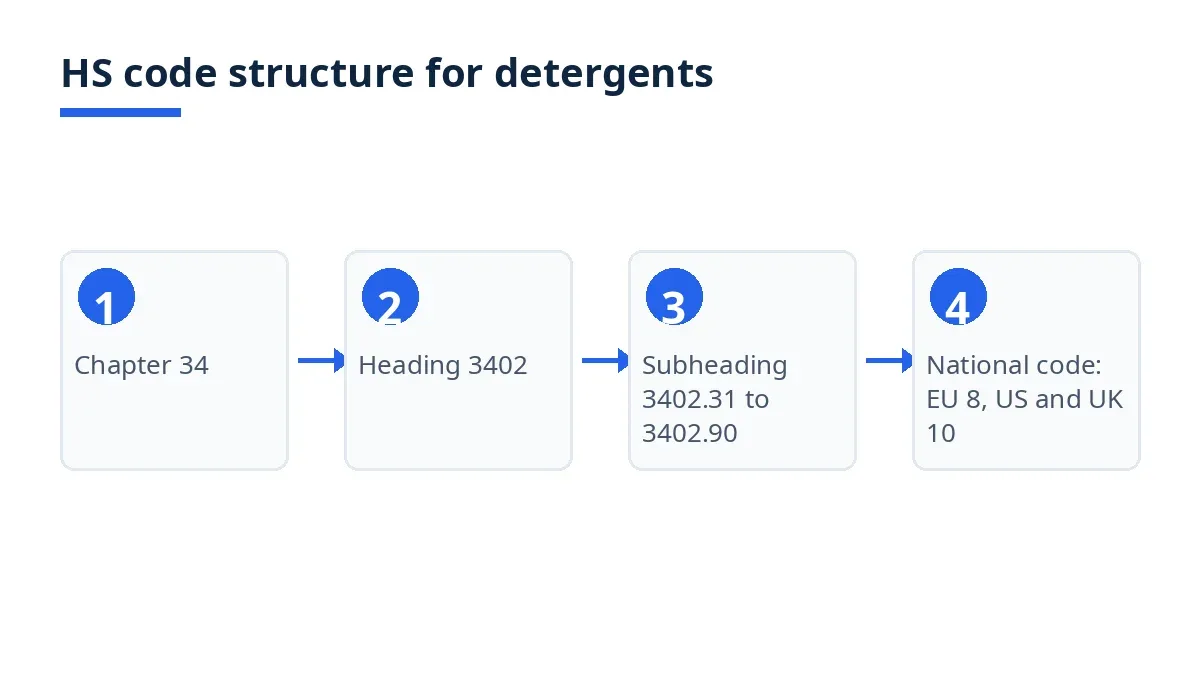
For detergents the build reads: Section VI, Chapter 34, heading 3402, then a six-digit subheading, then a national extension.1 2 Countries subdivide the six-digit categories into national subheadings for their tariffs and statistics, and the Combined Nomenclature of the European Union uses eight-digit codes.5 The 6-digit HS code guide explains the same structure for other products.
Factors that decide the code for detergents
Agent or finished preparation, first. A drum of a single surfactant is tested as an organic surface-active agent, at 3402.31 to 3402.49 by class. A blended powder or liquid sold to wash or clean is tested as a preparation, at 3402.50 or 3402.90. Do not file one on the other's line just because both contain the same surfactant.1 2
Surfactant class. Within the agents, the split follows ionic character: anionic at 3402.31 and 3402.39, cationic at 3402.41, non-ionic at 3402.42, and other agents at 3402.49.1 The supplier technical data sheet should state the class, and linear alkylbenzene sulphonic acids and their salts sit inside the anionic group at 3402.31.1 2 For a mixed-agent product, get the full composition from the supplier; the product name alone does not settle the class.
Retail packing or bulk packing. This is the split most detergent importers get wrong. The same washing preparation, put up for retail sale, tests against 3402.50, while the same preparation shipped in bulk for industrial use tests against 3402.90.1 Record pack size and type on the invoice and packing list. A bulk drum for a laundry plant and a shelf-ready bottle are not the same entry even when the liquid inside is identical.
The surface-active test in Chapter Note 3. For heading 3402, an organic surface-active agent is a product which, mixed with water at 0.5 percent at 20 degrees C and left one hour, gives a transparent or translucent liquid or stable emulsion without separation of insoluble matter, and reduces the surface tension of water to 4.5 x 10⁻² N/m (45 dyn/cm) or less.1 2 If a product does not meet that description, it is not an agent for this heading, so test it as a preparation or under another heading instead.
The 3401 boundary: form and skin use. Heading 3402 covers preparations other than those of heading 3401.1 Bars, cakes and molded pieces for use as soap, and liquid or cream skin washes put up for retail sale, stay in heading 3401, whether or not they contain soap.1 A retail liquid hand wash is therefore a 3401.30 question, not a 3402 question, while a retail laundry liquid is 3402.50. Compare the HS code for soaps guide when a shipment mixes bars and liquids. For heading 3401, soap means only soap soluble in water, and abrasive products stay in 3401 only in bar, cake or molded form; in other forms they fall in heading 3405 as scouring powders.1
The Chapter 33 exclusion. Chapter 34 does not cover shampoos, dentifrices, shaving creams and foams, or bath preparations containing soap or other organic surface-active agents; those go to headings 3305, 3306 or 3307.1 2 A bottle sold as a hair shampoo is not a 3402 shipment even if its label uses the word detergent. Skin-care preparations likewise stay in Chapter 33, even when they clean.
Auxiliary washing preparations versus treatment preparations. Heading 3402 expressly includes auxiliary washing preparations.1 A preparation that helps washing in a textile or industrial process can therefore still be a 3402 line. If it instead treats or finishes the material rather than washing it, test it against heading 3403 as well, since heading 3403 covers preparations of a kind used for the oil or grease treatment of textile materials, leather, furskins or other materials.2
National codes: US HTS, EU CN/TARIC, UK commodity code
United States: HTS, ten digits. The 2026 schedule, Revision 15, carries the same six-digit lines, then statistical suffixes, including 3402.31.10 and 3402.31.90 for anionic linear alkylbenzene sulfonic acids and their salts, 3402.50.11 and 3402.50.51 for retail preparations, and 3402.90.10 for synthetic detergents.2 Read the full ten-digit line for each variant.
European Union: CN at eight digits, TARIC for measures. The Combined Nomenclature of the European Union uses eight-digit codes.5 The Northern Ireland Online Tariff, which follows the EU structure, lists the same lines at 3402 3100 00 for linear alkylbenzene sulphonic acids and their salts, 3402 5010 00 and 3402 5090 00 for retail preparations, and 3402 9010 and 3402 9090 for other preparations.1 Read the confirmed line in TARIC for the entry date and origin, and check the origin rules behind any preference claim.
United Kingdom: commodity code. The United Kingdom builds its commodity code on the same first six digits, with its own extension after them.5 The UK Integrated Online Tariff lists the same heading with ten-digit codes, including 3402 3100 00, 3402 5010 00, 3402 5090 00, 3402 9010 and 3402 9090.1 Take the full code from the UK Trade Tariff for your product and entry date.
How to confirm the code officially
Write a precise description: agent or preparation, surfactant class, physical form, retail or bulk packing, pack size and type, intended use, and any abrasive content.
Start from the official tariff for the destination: the USITC HTS, TARIC or the UK Trade Tariff, and read the heading text and chapter notes. Classification follows the heading terms and relative notes, comparing only subheadings at the same level.1
Check published rulings for similar products; the USITC advises traders to use the Customs Rulings Online Search Service (CROSS).6
For a borderline product, apply for a binding decision before shipping: a Binding Tariff Information decision in the EU, needing a separate application per product type and a detailed description,7 an Advance Tariff Ruling in the United Kingdom, generally valid for 3 years,8 or a binding ruling from U.S. Customs and Border Protection if no ruling on CROSS describes the merchandise.6
Give your broker the description and confirmed code per variant, and use the same codes throughout the entry.
Common classification mistakes
Filing a pre-2022 number copied from old paperwork. Anionic agents were 3402.11, cationic 3402.12, non-ionic 3402.13, other agents 3402.19 and retail preparations 3402.20 in the 2013 schedule.3 The current lines are 3402.31, 3402.39, 3402.41, 3402.42, 3402.49 and 3402.50.1
Filing a retail skin wash under 3402. Liquid or cream skin washes put up for retail sale stay in heading 3401, whether or not they contain soap.1
Filing a retail preparation and its bulk twin on the same line. Retail preparations test against 3402.50 and other preparations against 3402.90.1
Filing a raw surfactant as a finished preparation, or the reverse. Agents test against 3402.31 to 3402.49 by class, while finished preparations test against 3402.50 or 3402.90.1 2
Filing a shampoo, shaving foam or bath preparation under 3402. Chapter 34 does not cover those products; they go to headings 3305, 3306 or 3307.1 2
Filing a scouring powder as a detergent without the form test. Abrasive products remain in heading 3401 only in bar, cake or molded form; in other forms they fall in heading 3405 as scouring powders.1
Copying a code from another country beyond six digits. The EU extends the six digits to eight, and the United States and the United Kingdom use ten-digit lines.5 2
Filing on the product name instead of the heading text and notes. The word detergent on a label does not decide the heading; the heading text, the chapter notes and the packing do.1
Related duties and documents
This guide states no duty rates: the code decides which duty line customs applies, so read the rate beside your confirmed code for your origin and entry date, and check what proof of origin a preference claim requires.
Keep the shipment file together: product description, surfactant class and composition, packing evidence, confirmed codes per variant, any binding decision, and origin evidence. Put retail and bulk variants on separate invoice lines.
FAQs
What is the HS code for detergents?
Detergents test against heading 3402, not a single six-digit code. Raw surfactants sit at 3402.31 and 3402.39 for anionic agents, 3402.41 for cationic, 3402.42 for non-ionic and 3402.49 for other agents, while finished preparations sit at 3402.50 for retail sale and 3402.90 otherwise.1 2
Is the HS code the same in every country?
Only the first six digits are harmonised. Countries subdivide the six-digit categories into national subheadings, and the Combined Nomenclature of the European Union uses eight-digit codes.5 The United States and the United Kingdom use ten-digit lines, so a code complete in one country is not automatically complete in another.2 1
How do I confirm the correct code?
Describe each variant precisely, read the heading text and chapter notes in the destination tariff, and check published rulings such as CROSS.6 For a borderline product, apply for a binding decision before shipping: a Binding Tariff Information decision in the EU,7 an Advance Tariff Ruling in the United Kingdom,8 or a binding ruling from U.S. Customs and Border Protection in the United States.6
What happens if I use the wrong code?
The code on the declaration drives the duty line and any licensing or quota treatment, so a wrong code brings the wrong treatment. A legally binding decision helps calculate those duties and restrictions in advance.8
Next steps on Exportain
Browse Bangladeshi suppliers on Exportain, and post a free RFQ at Exportain RFQs with the confirmed codes stated per variant. The HS code for soaps guide covers the 3401 side of the boundary. Exportain is not a party to the goods contract and does not inspect goods, book freight or clear customs, so keep your broker and any binding decision at the centre of the entry.
Sources
- Heading 3402: Organic surface-active agents, washing and cleaning preparations. GOV.UK, HM Revenue and Customs (accessed )
- Harmonized Tariff Schedule of the United States, Chapter 34 (2026 Revision 15). U.S. International Trade Commission (accessed )
- Harmonized Tariff Schedule of the United States, Chapter 34 (2013). U.S. International Trade Commission (accessed )
- What is the Harmonized System (HS)?. World Customs Organization (accessed )
- Harmonised System. European Commission (accessed )
- MTB 2019: Get Out Ahead of the Pack with a Binding Ruling from CBP. U.S. International Trade Commission (accessed )
- European Binding Tariff Information (EBTI). European Commission, Taxation and Customs Union, (accessed )
- Check what you'll need to get a legally binding decision on a commodity code. GOV.UK, HM Revenue and Customs (accessed )
About the author
Sourcing from Bangladesh?
Post a request for quotation and suppliers on Exportain can send you their quotes directly.
Post an RFQ