HS Code for Black Tiger Shrimp: Classification Guide for Importers
Frozen black tiger shrimp (Penaeus monodon) sits in 0306.17, at EU genus Penaeus line 0306 17 92, with US suffixes by farmed status, shell and count size.
Short answer
Black tiger shrimp (Penaeus monodon) is classified in heading 0306, crustaceans. Frozen black tiger takes subheading 0306.17, other shrimps and prawns, because 0306.16 covers only cold-water species. The European Union names genus Penaeus at 0306 17 92, while the United States keeps monodon in 0306.17.00 with suffixes by farmed status, shell state and count size. Prepared shrimp moves to heading 1605.
On this page
Key takeaways
Frozen black tiger shrimp (Penaeus monodon) takes subheading 0306.17, other shrimps and prawns: subheading 0306.16 covers only the cold-water species Pandalus spp. and Crangon crangon.
The EU names genus Penaeus at 0306 17 92, and TARIC subdivision 0306 17 92 20 covers Penaeus vannamei and Penaeus monodon, not cooked, for processing.
The United States has no genus or species line for monodon: it falls in 0306.17.00, split by farmed status, shell state and count size, with peeled at 0306.17.0041 farmed and 0306.17.0042 not farmed.
The code does not prove the species: keep the scientific name Penaeus monodon identical on the specification, invoice and packing list, with lot identity traced to the harvest or farm record.
Fresh or chilled black tiger leaves the frozen block for 0306.36, at EU line 0306 36 90, and breaded or otherwise prepared black tiger moves to heading 1605.
If you import black tiger shrimp, the hs code for black tiger shrimp is the line your customs entry, duty calculation and origin claim depend on. The Harmonized System is a multipurpose international product nomenclature developed by the World Customs Organization (WCO), used by more than 200 countries and economies as a basis for their customs tariffs.1 This guide follows the monodon-specific lines in the European Union, shows why the United States has no species line for Penaeus monodon, and sets out the species evidence a classification rests on. The general position is in HS code for frozen shrimp.
Quick answer: indicative HS heading (with verify note)
The HS organizes its approximately 5,000 six-digit product categories by sections, chapters (2 digits), headings (4 digits) and sub-headings (6 digits).2 Black tiger shrimp sits in Chapter 3 under heading 0306: state decides the block first, and species decides the line inside it.
Black tiger product | Indicative code territory | Why |
|---|---|---|
Frozen black tiger shrimp (Penaeus monodon) | Subheading 0306.17; EU line 0306 17 92 | Frozen block for other shrimps and prawns; EU names genus Penaeus |
Fresh or chilled black tiger shrimp | Subheading 0306.36; EU line 0306 36 90 | The live, fresh or chilled block, residual line |
Breaded or otherwise prepared black tiger shrimp | Heading 1605 | Prepared or preserved crustaceans leave Chapter 3 |
Verify the species and the state, not the product name. The United States carries the frozen line at 0306.17.00, split by farmed status, shell state and count size, with no species line.3 The European Union splits 0306.17 by genus and family, and genus Penaeus takes 0306 17 92.4 TARIC subdivision 0306 17 92 20 names Penaeus vannamei and Penaeus monodon, not cooked, for processing.5 Confirm the full national code before filing.
How HS codes are structured (2-4-6 digits)
Each pair of digits narrows the category: chapter 3 for fish and crustaceans, heading 0306 for crustaceans, then a six-digit subheading by state and species group, for example 0306.17, and a national extension of 8 to 10 digits.2
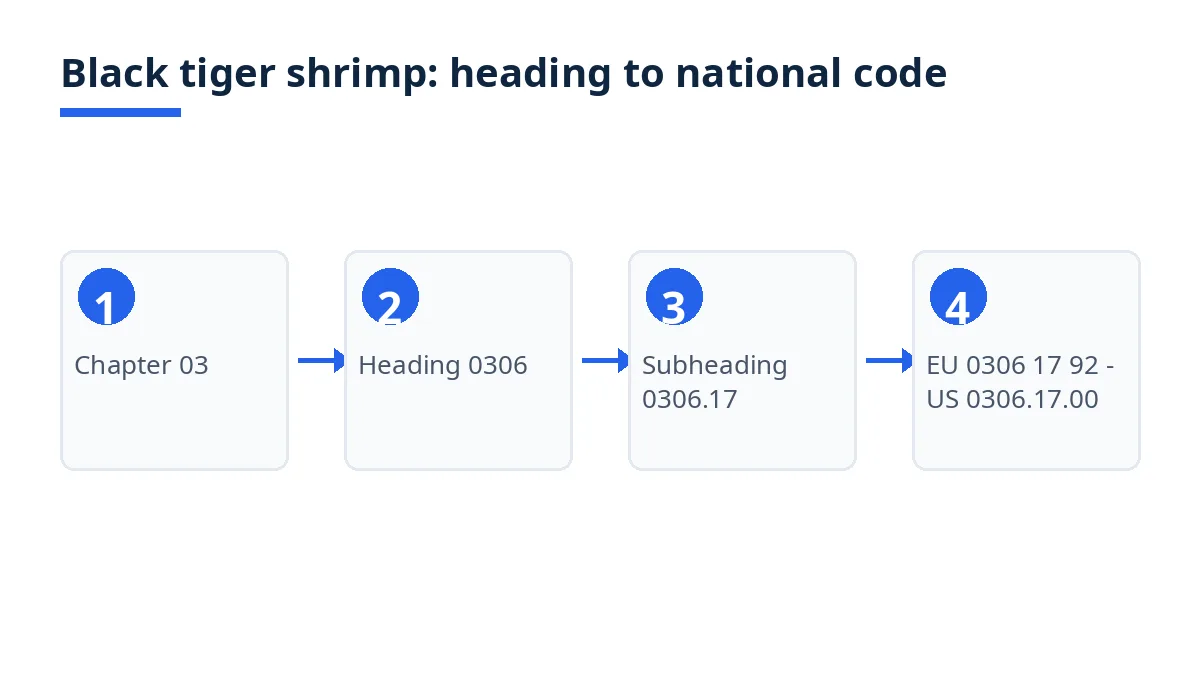
Countries subdivide the six-digit categories into national subheadings, and the current version is HS 2022.2 See the 6-digit HS code guide.
Factors that decide the code for black tiger shrimp
Species comes first: monodon is a warm-water Penaeus, not a cold-water shrimp. Subheading 0306.16 is limited to cold-water shrimps and prawns, carried in the EU at 0306 16 91 for Crangon crangon and 0306 16 99 for Pandalus spp.; every other frozen shrimp falls to 0306.17.4
Inside 0306.17, the EU splits by genus and family: 0306 17 91 deepwater rose shrimps (Parapenaeus longirostris), 0306 17 92 genus Penaeus, 0306 17 93 family Pandalidae other than genus Pandalus, 0306 17 94 genus Crangon other than Crangon crangon, and 0306 17 99 other.4 Frozen black tiger for the EU therefore reads 0306 17 92. That line covers the whole genus Penaeus, so the code alone does not separate monodon from vannamei.
TARIC goes one step further for processing trade. Under 0306 17 92, TARIC subdivision 20 covers Penaeus vannamei and Penaeus monodon, whether in shell or not, not cooked, for processing.5 The same quota entry pairs it with a fresh or chilled line, ex 0306 36 90 TARIC subdivision 30, for the same two species.5 A cooked lot, or one not for processing, does not take subdivision 20.
The United States does not split 0306.17 by genus or species at all. The US schedule keeps every other frozen shrimp at 0306.17.00, separated by statistical suffixes: farmed and not farmed, shell-on by count size bands per kilogram, and peeled, where farmed peeled takes 0306.17.0041 and not farmed peeled takes 0306.17.0042.3 None of the three suffix facts records the species.
Proving the species is the buyer's real problem, and it is a documentation problem. The EU genus line groups monodon with the rest of Penaeus, and the US line groups it with every other warm-water shrimp, so the code is only as good as the species evidence behind it. Vannamei is the substitution risk: both species sit on the same lines, so a species error can pass the code check and still misdescribe the goods. Build the evidence as a chain: keep the scientific name, Penaeus monodon, identical on the specification, invoice and packing list, and keep lot identity intact from the farm or landing record through processing and packing. In the United States, shrimp is a monitored group under the Seafood Import Monitoring Program (SIMP): compliance became effective on December 31, 2018, and the importer of record must report chain of custody data from harvest to entry into United States commerce.6 The data includes the species, recorded by its ASFIS three-alpha code, the farm or aquaculture facility name, evidence of authorization to fish or farm, the product form at landing, and records on processing, reprocessing and commingling.6 If the species cannot be evidenced lot by lot, resolve it before filing.
Freezing keeps shrimp in the frozen block, and two treatments do not move it. The EU text for 0306 17 92 reads frozen shrimps of the genus Penaeus, even smoked, whether in shell or not, including shrimps in shell cooked by steaming or by boiling in water.4 Frozen smoked black tiger, and black tiger cooked in its shell, stay in 0306.17.4
A fresh or chilled shipment leaves the frozen block. Live, fresh or chilled shrimp sits at 0306.35 for cold-water and 0306.36 for other shrimps and prawns: the US separates shell-on at 0306.36.0020 from peeled at 0306.36.0040,3 and the EU carries the other line at 0306 36 90 for fresh or chilled monodon.4 Dried, salted, in brine or smoked-only shrimp takes the third block, at 0306.95, where the US separates shell-on at 0306.95.0020 from peeled at 0306.95.0040,3 and the EU carries the other shrimps at 0306 95 90.4
Preparation beyond the heading 0306 states moves the product to heading 1605, prepared or preserved crustaceans. The US schedule names frozen breaded shrimp, not in airtight containers, at 1605.21.1020, and prepared meals at 1605.21.0500 or 1605.29.0500 by packing.3 The split follows the packing: 1605.21 not in airtight containers, at EU line 1605 21 90,5 and 1605.29 for other prepared or preserved shrimps, at EU line 1605 29 00.5 A breaded, battered, marinated or meal-ready product is never filed on a 0306 line.
National codes: US HTS, EU CN/TARIC, UK commodity code
United States: HTS, ten digits. A frozen black tiger entry starts at 0306.17.00, and the suffixes separate farmed or not farmed, shell-on count size bands, and peeled.3 There is no monodon suffix, so keep the SIMP species record beside the entry.6
European Union: CN at eight digits, TARIC for measures. The Combined Nomenclature integrates the HS and adds EU subdivisions, producing eight-digit codes.2 For frozen black tiger the eight-digit answer is 0306 17 92, genus Penaeus,4 and TARIC adds subdivisions for measures such as the for-processing line for Penaeus vannamei and Penaeus monodon.5
United Kingdom: commodity code. The UK builds its commodity code on the same first six digits, with its own extension after them.2 The UK code starts from 0306.17 when frozen and 0306.36 when fresh or chilled, but the full ten-digit code must be read in the UK Trade Tariff rather than copied from a US or EU entry.
How to confirm the code officially
Write a precise description: species with its scientific name, Penaeus monodon, state, shell-on or peeled, count size, farmed or wild-caught, and any coating.
Start from the official tariff for the destination: the USITC HTS, TARIC or the UK Trade Tariff, and read the heading text and notes.
Check published rulings for similar products: the USITC advises traders to use the Customs Rulings Online Search Service (CROSS) for the United States, because the correct classification of many items can be found there.7
For a borderline product, apply for a binding decision before you ship. In the EU, a Binding Tariff Information (BTI) application needs a separate application for each type of product and a detailed description.8 In the United Kingdom, a legally binding decision is generally valid for 3 years, through an Advance Tariff Ruling.9 In the United States, if the merchandise is not described in any ruling on CROSS, you may request a binding ruling from U.S. Customs and Border Protection.7
Give your broker the description, species evidence file and confirmed code.
Common classification mistakes
Filing black tiger on the cold-water line. Subheading 0306.16 names Pandalus spp. and Crangon crangon only.4 Every warm-water species takes 0306.17.
Treating the EU genus line as a species line. Line 0306 17 92 covers the whole genus Penaeus,4 and TARIC subdivision 20 names vannamei and monodon together.5 The species must still be evidenced lot by lot.
Copying the EU genus split into a US entry. The United States divides 0306.17.00 by farmed status, shell state and count size, with no genus lines.3 The EU divides by genus and family, with no count size lines.4
Filing breaded or marinated black tiger under 0306. Preparation moves the product to heading 1605: frozen breaded shrimp sits at 1605.21.1020 in the US schedule.3
Filing a chilled shipment on the frozen lines. The live, fresh or chilled block takes 0306.35 and 0306.36, with monodon on 0306 36 90 in the EU.3 4
Related duties and documents
This guide states no duty rates: the code decides which duty line customs applies, and a rate beside the cold-water line does not carry to the Penaeus line, a fresh shipment or a prepared product. Read the rate beside your confirmed code. Keep the regulatory file beside the classification file. NOAA lists the shrimp HTS codes, from the 0306 frozen lines through the 1605 prepared lines, in its Seafood Import Monitoring Program code list,3 and the importer of record keeps the chain of custody records it requires.6 Keep the species evidence, confirmed code, any binding decision and origin evidence with the shipment documents, and run the black tiger shrimp quality control checklist before sealing.
FAQs
What is the HS code for black tiger shrimp?
Frozen black tiger shrimp (Penaeus monodon) takes subheading 0306.17 in heading 0306, because subheading 0306.16 covers only cold-water species.4 The EU names genus Penaeus at 0306 17 92,4 and the United States carries the line at 0306.17.00 with suffixes by farmed status, shell state and count size.3
Is the HS code the same in every country?
Only the first six digits are harmonized. Beyond six digits, each country adds its own lines: eight digits in the EU Combined Nomenclature,2 and ten in the United States, split by farmed status, shell state and count size rather than species.3 Only the EU names the genus, at 0306 17 92.4
How do I confirm the correct code?
Describe the product precisely, with the species and scientific name, state, shell state, count size and any coating, read the heading text and notes in the destination tariff, and check published rulings, such as CROSS for the United States.7 For a borderline product, apply for a binding decision: a BTI in the EU,8 an Advance Tariff Ruling in the United Kingdom,9 or a CBP binding ruling in the United States.7
What happens if I use the wrong code?
Duty, licensing and quota treatment follow the code on the declaration, so a wrong code brings the wrong treatment. A binding decision taken in advance helps you calculate what will apply.9
Next steps on Exportain
Browse Bangladeshi suppliers on Exportain, a B2B marketplace where supplier profiles carry document and photo review badges, and post a free RFQ at Exportain RFQs with the confirmed code and species stated per presentation. Read HS code for frozen shrimp and the harmonized system explainer. Exportain is not a party to the goods contract and does not inspect goods, book freight or clear customs.
Sources
- What is the Harmonized System (HS)?. World Customs Organization (accessed )
- Harmonised System. European Commission (accessed )
- NMFS Trade Monitoring Program - Harmonized Tariff Schedule (HTS) Codes, Seafood Import Monitoring Program. National Oceanic and Atmospheric Administration, National Marine Fisheries Service (accessed )
- ANNEX IX - an additional ad valorem duty from September 7, 2025 (Combined Nomenclature 2025 code list). U.S. Department of Agriculture, Foreign Agricultural Service (GAIN) (accessed )
- Council Regulation opening and providing for the management of the Union autonomous tariff quotas for certain fishery products for the 2024-2026 period (15363/23). Council of the European Union (accessed )
- Seafood Import Monitoring Program Facts and Reports. National Oceanic and Atmospheric Administration, NOAA Fisheries (accessed )
- MTB 2019: Get Out Ahead of the Pack with a Binding Ruling from CBP. U.S. International Trade Commission (accessed )
- European Binding Tariff Information (EBTI). European Commission, Taxation and Customs Union, (accessed )
- Check what you'll need to get a legally binding decision on a commodity code. GOV.UK, HM Revenue and Customs (accessed )
About the author
Sourcing from Bangladesh?
Post a request for quotation and suppliers on Exportain can send you their quotes directly.
Post an RFQ