Quality Control Checklist for Black Tiger Shrimp From Bangladesh
A numbered, monodon-specific QC checklist for black tiger shrimp from Bangladesh: species and form, count and uniformity from deglazed weight, melanosis scoring, sulfite declarations, glaze and deglazing, the SEAFDEC sensory profile, documents and packing, with fixes for common failures.
Short answer
Use this black tiger shrimp quality control checklist before shipment to check species and form, count size and uniformity from deglazed weight, melanosis and blackspot, sulfite treatment records and label declarations, glaze share and net weight, and the monodon sensory profile for odor, appearance, texture and color. Agree the count basis, test methods and acceptance numbers in the purchase order.

On this page
Key takeaways
Determine the count from deglazed weight by the Codex method, then check uniformity piece by piece: in large monodon counts, a few off-size shrimp move the result for the whole carton.
Score melanosis separately from decomposition: blackspot is an appearance grade against the Codex discoloration definition, while odor and texture carry the decomposition decision.
Match the sulfite file to the lot: treatment record, laboratory result and label declaration must agree, and EU orders declare sulphur dioxide and sulphites above 10 mg/kg or 10 mg/L.
Grade thawed monodon against the published sensory profile for black tiger shrimp, which sets passable to fail levels for odor, appearance, texture and color.
Use this black tiger shrimp quality control checklist before shipment, on the monodon line only: species and form, count size and uniformity from deglazed weight, melanosis, sulfite records and declarations, glaze share, and the monodon sensory profile. If you are still setting up the order, work through how to import black tiger shrimp from Bangladesh first: for mixed-species orders, use the general frozen shrimp checklist instead.
Why this checklist matters
Black tiger shrimp, Penaeus monodon, is sold on size and appearance. A general shrimp check can pass a carton a monodon buyer would reject: it does not score uniformity inside the band, blackspot piece by piece, or odor against a monodon profile. Codex CXS 92-1981 sets the defect definitions used here.1 Codex CXC 52-2003 covers shrimp glazing, weighing and labelling.2 A published sensory profile for this species grades product from passable to fail on odor, appearance, texture and color.3
Before you start
Do not begin until the references are complete: the approved sample, the purchase order naming count basis, glaze and net weight basis, the market test list, and the packing specification.
Name the destination market first: the evidence differs by market. FDA guidance assists processors with Hazard Analysis Critical Control Point (HACCP) plans, and its allergen chapter covers sulfiting agents on shrimp.4 For EU orders, sulphur dioxide and sulphites must be declared when used as preservatives above 10 mg/kg or 10 mg/L, and crustaceans must also be declared.5
Agree the sampling plan in advance: ISO 2859-1 specifies an acceptance sampling system for inspection by attributes, indexed by acceptance quality limit (AQL).6 Draw the sample randomly across cartons, pallets and production dates.
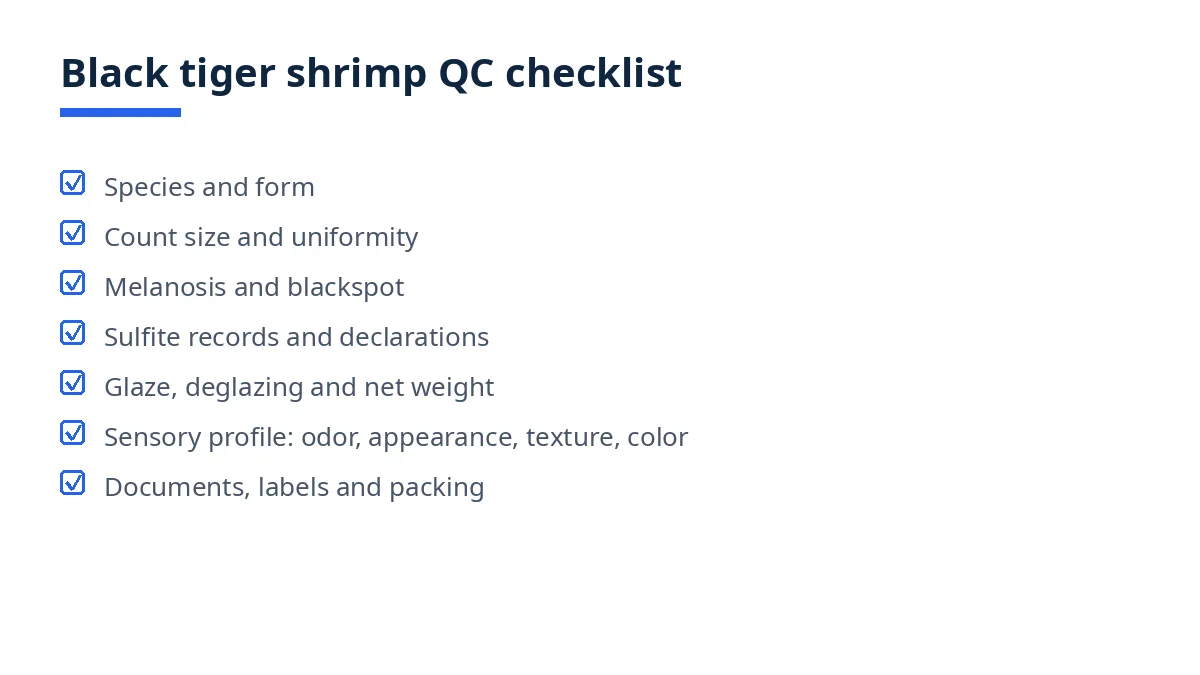
The full checklist (numbered, printable)
Species, form and presentation
Confirm the species is Penaeus monodon against the approved sample: under Codex CXS 92-1981, the pack shall not contain a mixture of genera.1
Confirm one presentation per pack, described on the label next to the name of the food: head-on shell-on, headless shell-on, peeled and deveined, peeled deveined tail-on, or the cooked form ordered.1
Check form work piece by piece: de-heading clean, peeling complete, vein removed where required, tail fan as specified, no torn flesh.
Separate broken and damaged pieces and weigh them per carton. Check the thawed sample for foreign matter.1
Count size and uniformity
Work from deglazed weight only: under Codex CXS 92-1981, declared count is the shrimp counted in the container or a representative sample, divided by the actual deglazed weight.1
Record the count basis from the purchase order first: pieces per pound or per kilogram, and its weight basis. Compare the result with the declared band.
Check uniformity: sort the deglazed sample largest to smallest, weigh the largest 10 percent and the smallest 10 percent by number as two groups, and record their weight ratio against the agreed ratio.
Count pieces outside the declared band and record their share: in large monodon counts, a few off-size pieces move the carton average.
Repeat count and uniformity across cartons, pallets and production dates, and for block-frozen product on pieces from the block center. Drift is a grading failure: re-grade that production.
Melanosis and blackspot inspection
Inspect after thawing, under the same light, piece by piece: head, shell joints and tail fan first, then the full shell.
Apply the Codex discoloration definition: a unit is defective where distinct blackening, or green or yellow discoloration, covers more than 10 percent of the surface of individual shrimp and affects more than 25 percent of the unit.1
Record melanosis separately from decomposition: the monodon profile lists black spots as a borderline fail appearance fault, not a decomposition grade.3
Photograph scored pieces next to the carton label and segregate affected dates. Above the agreed level, check raw material age and the sulfite record, then re-sort.
Sulfite treatment and declaration checks
List every treatment on this lot first: agent name and lot record. Under the Codex Code of Practice, sulphites should be used per manufacturer instructions and good manufacturing practice.2
Check the laboratory result for this lot, expressed as sulfur dioxide, method named, against the purchase order limit and your market rule, and record the value.
Check the declaration against the treatment record: where sulphites were used, the Codex Code of Practice requires care that they are properly labelled.2 For EU orders, check it against the 10 mg/kg threshold above.5
For untreated orders, hold lot evidence: a lot-by-lot supplier statement that sulfiting agents were not used, or a test result, as in the FDA screening controls for shrimp.4
Glaze, deglazing and net weight
Weigh each sampled unit frozen, packaging removed, and record the frozen weight before deglazing.
Deglaze by the Codex procedure: open the pack from cold storage, remove all glaze seen or felt, drain on a weighed sieve, and weigh again. Declared net contents exclude the glaze.1
Calculate the glaze share from the two weights and compare deglazed weight with declared net weight.
Judge the glaze itself: the Codex Code of Practice lists inadequate glaze, excessive glaze, spot welding and incorrect labelling as glaze defects.2 Check for bare patches and pieces frozen together.
Check deep dehydration against the Codex definition: white or yellow moisture loss masking the flesh color, below the surface, over more than 10 percent of the unit weight.1
If glazed with seawater, confirm the label states this, as Codex requires.1 If a result fails, re-run the test on a fresh unit before deciding the lot.
Sensory profile and thawed condition
Use a trained assessor, as Codex CXS 92-1981 requires for sensory examination, and thaw samples under controlled conditions.1 3
Grade odor first, then appearance, texture and color, against the table below, per unit. For cooked forms, repeat after cooking.
Where grading points to decomposition, confirm it with the laboratory indicator named in the purchase order: the profile notes indole is used by the US Food and Drug Administration to validate sensory evaluation, with a defect action level of 25 µg/100g.3
For raw material intake, a quality index method can benchmark freshness, combining sensory grading with chemical indicators in four levels from excellent to just acceptable.7
Quality level | Odor | Appearance | Texture | Color |
|---|---|---|---|---|
Passable | Fresh, sweet, neutral, grassy or seaweedy | Translucent | Firm | Uniform, typical of the species |
Borderline passable | Slightly stale, slightly yeasty, slightly fishy | Translucent | Slightly soft | Slightly discolored |
Borderline fail | Musty, slightly sour, fishy, old sock odor | Slightly opaque, black spots | Tough, soft, dehydrated | Bleached or faded |
Fail | Putrid, ammonia-like, fecal, chemical odors | Opaque, cooked appearance | Soft, mushy | Discolored |
Documents, labels and packing
Check this lot's health certificate and test reports: in Bangladesh, the Department of Fisheries e-certification system covers licences, health certificates and additional certificates per importing-country requirements.8 A certificate for a different plant or lot does not cover this lot.
Check the label set against Codex labelling: name of the food, presentation, designation as raw, partially cooked or cooked, the term quick frozen, and storage at -18 °C or colder.1
Check the metal detection record: under the Codex Code of Practice, final packaged products should undergo metal detection, and frozen storage is at or below -18 °C with minimal fluctuations.2
Weigh sample cartons, check pack count and count-size ratios against the packing list, and confirm markings show species, form, count size, lot and net weight. At loading, probe temperature again: quick freezing is complete only at -18 °C or colder at the thermal center.1
Common failures and how to fix them
The most frequent monodon failure is blackspot that shows only after thawing, from raw material age or a treatment gap. Hold the affected dates, check the treatment record and sulfite result together, re-sort, and re-inspect separately.
Next is count drift inside the band: the average passes while the uniformity ratio fails. Re-grade, then repeat both checks per carton. Short deglazed weight traces to excess glaze: re-run the deglazing test, correct the glaze, and re-weigh before more cartons are closed. A sulfite declaration that does not match the treatment record is a document failure: correct labels before loading, and never load on mismatched declarations.
Downloadable template and summary table
Copy the checklist into your inspection sheet, add the purchase order figures, and record the actual reading per line.
Section | Checks | Evidence |
|---|---|---|
Species and form | Species, presentation, form work | Sample comparison, photos |
Count and uniformity | Deglazed count, band, uniformity ratio | Count sheets per carton |
Melanosis | Blackspot scoring per piece | Photos, scored sample |
Sulfites | Treatment record, result, declaration | Lab report, label set |
Glaze and weight | Frozen weight, deglazing, glaze share | Deglazing test record |
Sensory | Odor, appearance, texture, color | Profile grading per unit |
Documents and packing | Certificates, labels, cartons, seal | Packing list, loading photos |
How Exportain helps
Exportain is a B2B marketplace connecting buyers with Bangladeshi suppliers of black tiger shrimp and frozen seafood, so this specification can be agreed at the enquiry stage. Browse suppliers, see the frozen seafood category and use inspection services when you plan the check. Supplier profiles show document and photo checks recorded, not factory inspections. Exportain is not a party to the goods contract and does not inspect goods.
FAQs
When should this checklist be used?
Use it at final inspection and again at loading. For first orders, also run the count, uniformity and melanosis lines during production.
Who should complete it?
The buyer, a local agent or an independent inspector, using the approved sample, the purchase order and a randomly drawn sample; sensory lines need a trained assessor.
What are the most common failures?
Blackspot after thawing, count drift inside the band, short deglazed weight from excess glaze, and a sulfite declaration that does not match the treatment record.
Can a third party do it?
Yes, if you share the approved sample, count basis, uniformity and glaze figures, test list and acceptance levels first, and the inspector records actual readings per lot.
Next steps on Exportain
Agree your count basis, uniformity ratio, glaze figure, test methods and label wording, then read the AQL acceptance quality limit explainer and the pre-shipment inspection guide, and plan the check with inspection services. Post a free RFQ via RFQs to compare quotes from Bangladeshi suppliers.
Sources
- Standard for Quick-Frozen Shrimps or Prawns (CXS 92-1981). Codex Alimentarius Commission (accessed )
- Code of Practice for Fish and Fishery Products (CXC 52-2003). FAO and WHO, Codex Alimentarius (accessed )
- Sensory Assessment of Black Tiger Shrimp (Penaeus Monodon). Southeast Asian Fisheries Development Center (accessed )
- Fish and Fishery Products Hazards and Controls Guidance. U.S. Food and Drug Administration (accessed )
- Allergies - Food Safety. European Commission (accessed )
- ISO 2859-1:1999 - Sampling procedures for inspection by attributes — Part 1: Sampling schemes indexed by acceptance quality limit (AQL) for lot-by-lot inspection. International Organization for Standardization (accessed )
- Towards improved quality benchmarking and shelf life evaluation of black tiger shrimp (Penaeus monodon). Elsevier (accessed )
- Bangladesh rolls out online certification system to simplify fish and seafood trade. International Collective in Support of Fishworkers (ICSF) (accessed )
About the author
Sourcing from Bangladesh?
Post a request for quotation and suppliers on Exportain can send you their quotes directly.
Post an RFQ