Quality Control Checklist for Home Decor Items From Bangladesh
A numbered QC checklist for home decor items from Bangladesh: vases, wall art, cushions, baskets and tableware, covering dimensions, mixed-material joins, glaze, weave, colour, labels and fragile packing, with fixes for common failures.
Short answer
Use this home decor items quality control checklist to check vases, wall art, cushions, baskets and tableware from Bangladesh before shipment. Check dimensions and sets, mixed-material joins, glaze and food-contact evidence, textile weave and colour fastness, basket weave, shade, labels and fragile packing, against the approved sample for each item type.
On this page
Key takeaways
Agree the sample, dimension chart, colour standard and acceptance numbers before inspection.
Check mixed-material joins separately, since a lid, frame or handle fails differently from its parts.
Check glaze, weave, shade and colour rub by material, not by carton, so a quiet fault is not missed.
Pack fragile pieces singly with dividers, and record every failure by item type, material and fault.
If you buy vases, wall art, cushions, baskets or tableware from Bangladesh, this home decor items quality control checklist gives you a practical way to check a mixed-material shipment before it leaves the factory. Check each material against the sample.
Why this checklist matters
A home decor order is rarely one material. One shipment can combine ceramic, glass, wood, metal, cane, jute and cotton, each showing a different fault first: crazing in vase glaze, a loose basket strand, shade drift on cushions, or an off-centre print.
Mixed-material joins add a second risk. A lid on a ceramic jar, a frame behind a wall panel, a rope basket handle and a cushion tassel each join materials that move differently. Check the join itself, by pulling and twisting each joined piece as a buyer will use it.
A written checklist stops shipment decisions turning into taste negotiations. Each point is recorded as pass, fail or not applicable, with item type, material and fault named.
Before you start
Do not begin until references are complete: an approved sample per style, colour and material, the purchase order and packing specification, a dimension chart per item type, and a colour standard per colourway. Agree the sampling plan in advance, drawing randomly across styles, colours and cartons, not from factory-selected pieces. ISO 2859-1 specifies an acceptance sampling system for inspection by attributes, indexed in terms of the acceptance quality limit (AQL), applicable to end items.1 Set acceptance numbers per defect class in the purchase order before inspection starts.
Work one item type at a time, with the approved sample beside bulk pieces.
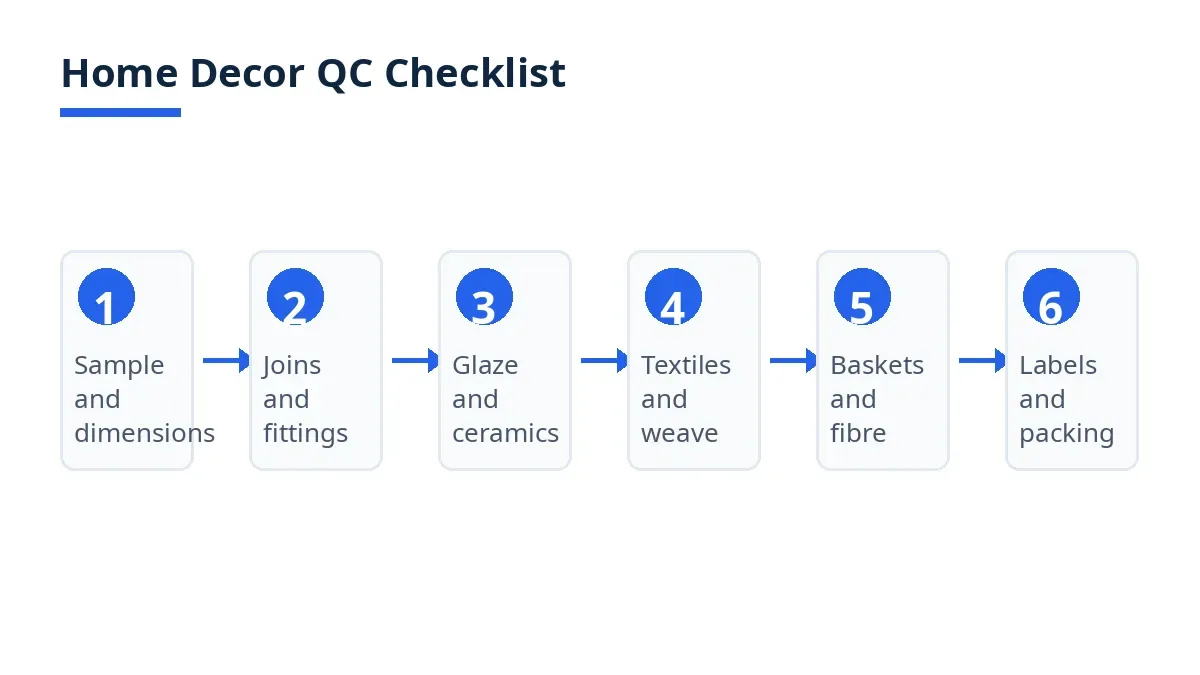
The full checklist (numbered, printable)
Dimensions, shape and sets
Measure each vase for height and rim diameter, and check it stands flat.
Measure wall art for height, width and depth, including frame, and check hanging points match on pairs.
Measure cushion covers flat, without stretching, and check fit to the named insert.
Measure baskets for rim, base and height, and check nested baskets sit together as described.
Measure tableware for diameter, height and capacity where relevant, and check lids sit flush.
Check sets as sets: dinner plates, paired vases and cushion sets must match each other, not just the chart.
Check symmetry: a leaning vase or off-centre wall panel fails even at the right height.
Mixed-material joins and fittings
Check every join where two materials meet: lid on ceramic, frame on wall panel, cane in wood.
Pull each handle, loop, tassel and fringe by hand, and check fixings hold without a gap opening.
Check rope and cane handles for even thickness, secure bindings and no sharp cut end.
Check metal fittings for burrs, sharp edges, loose screws and a matching finish.
Check glued joins for squeeze-out and gaps, and confirm the bond stays closed when lifted.
Check no fixing, staple or screw end shows on a face, or can scratch a neighbouring piece.
Ceramics, glass and glaze
Check ceramic and glass for chips and hairline cracks at rim, base, handle and spout, under good light.
Check glaze for crazing, pinholes, crawling and pooling, against the approved sample.
Check vase, bowl and plate bases sit flat, foot rings are even, and no unglazed foot scratches.
Check painted and printed surfaces for smudging, missing elements and colour outside its outline.
Check glass for bubbles, stones and waviness, and coloured glass against the sample.
For food-contact tableware, check migration test evidence and the written declaration for that glaze. The Ceramic Articles in Contact with Food (England) Regulations 2006, implementing Council Directive 84/500/EEC and Regulation (EC) No 1935/2004, set limits by category, including 4.0 mg/l lead and 0.3 mg/l cadmium for fillable articles other than cooking ware and large storage vessels.2
Check decorative-only pieces are packed and labelled that way, with no decorative glaze on food-contact surfaces without item 19 evidence.
Textile pieces: cushions, wall hangings and table linen
Check cushions, hangings and table linen for weave consistency: even spacing, no broken yarns, no thin patch.
Check seams and hems for skipped stitches, puckering and open ends, and each zip for full run and flat close.
Check cushion filling for even distribution, thin corners and shape recovery after pressing.
Check shade within pieces, between set pieces and across colours under one light, against the standard.
Review dimensional change evidence where a textile piece will be washed. ISO 5077 specifies a method for determining dimensional change in washing and drying.3
Review washing fastness evidence where required. ISO 105-C06 specifies methods for determining resistance of textile colour to domestic or commercial laundering.4
Review rubbing fastness evidence for dark and printed covers, which rub against furniture and hands. ISO 105-X12 specifies a method for determining resistance of textile colour to rubbing, with one dry and one wet test.5
Where pilling is lab tested, confirm the method and rating scale were agreed in advance. ISO 12945-2 covers pilling, fuzzing or matting by the modified Martindale method.6
Check tassels, fringes, pom-poms and embroidery for secure attachment, even length and no loose thread.
Baskets, cane and natural fibre
Check basket weave for even tension, no loose strands, no gap when lifted, and a rim that holds shape.
Check cane, seagrass, jute and rattan for splinters, sharp ends and mould, inside and outside the weave.
Check dyed natural fibre for colour rub with a white cloth, and dyed strands against the sample.
Check basket bases for flatness and strength under their intended load, at base and handles.
Check no basket, mat or wall piece sheds loose fibre onto furniture or clothing, and remove trimmings before packing.
Colour, print and finish
Check colour across the whole order, not just one carton, so no group stands apart.
Check prints and transfers for alignment, full coverage and no blurred element, with repeats joining at seams.
Check paint, lacquer and metallic finishes for even cover, drips and flaking, against the sample.
Check coatings do not change the colour underneath, and leave no tacky or strong-smelling surface.
Labels, claims and packing
Check fibre labels before bulk labels are printed. Under Regulation (EU) No 1007/2011, a textile product shall be labelled with the name and percentage by weight of all constituent fibres in descending order.7
Check care symbols against the care the piece can actually take. ISO 3758 establishes a system of graphic symbols for care labelling, based on the most severe treatments that do not cause irreversible damage.8
If a harmful-substances claim will appear on a textile piece, check the certificate scope. Under OEKO-TEX STANDARD 100, the label is awarded only if all components meet the criteria.9
Check any other pack claim, such as handmade, natural dye or food safe, against agreed evidence.
Check fragile pieces one by one: each vase, glass and ceramic piece wrapped alone, with dividers between pieces.
Check cushions, hangings and baskets cannot pick up colour, dust or moisture from neighbours, with no damp packing.
Check carton contents, ratios and markings against the packing list, and stickers scan and match the order.
Check fragile cartons are marked as required, and no carton is so full its lid presses on pieces.
Common failures and how to fix them
The most frequent failure is shade drift: one dye lot of cushions, one firing of vases or one dye batch of baskets sits apart. Group pieces by actual colour under one light, and re-sort complete sets before packing. Next is a glaze fault at rim or base, where glaze thins: re-inspect every rim and base in that firing group.
Loose basket weave usually traces to one weaver group or one batch of cane: check tension strand by strand, rework loose pieces if possible, and set the rest aside. A cushion zip that catches usually means the cover was cut to the chart but not to the insert: fit a sampled cover to the named insert before restarting cutting. A join that works loose points to the join, not the parts: re-check that join type across the order before packing more.
Above the agreed acceptance level, options are re-inspection after sorting or rework, documented partial acceptance, or rejection. Record the option taken, per item type.
Downloadable template / summary table
Copy the checklist into your inspection sheet, add dimension chart, colour standards, tolerances and acceptance numbers, and record a result per piece type.
Section | Checks | Evidence |
|---|---|---|
Dimensions and sets | Vase, wall art, cushion, basket, tableware | Measurements, set match |
Joins and fittings | Handles, lids, frames, fixings | Pull checks |
Ceramics and glaze | Chips, crazing, glaze, food-contact evidence | Visual check, declarations |
Textiles | Weave, seams, shade, wash, rub evidence | Sample comparison, reports |
Baskets and fibre | Weave tension, splinters, dye rub | Hand, rub checks |
Colour and finish | Shade, print, paint | Same-light comparison |
Labels and packing | Fibre, care, claims, packing | Label, packing checks |
How Exportain helps
Exportain is a B2B marketplace connecting buyers with Bangladeshi suppliers of home decor, so specifications behind this checklist can be agreed at enquiry stage, before production starts. Browse suppliers, see the home decor classification guide and use inspection services when you plan the check. Supplier profiles show document and photo checks recorded, not factory inspections. Exportain is not a party to the goods contract and does not inspect goods.
FAQs
When should this checklist be used?
Use it at final inspection, when goods are finished and largely packed. For larger and first orders, also use it in production, while faults can still be corrected.
Who should complete it?
The buyer, a local agent or an independent inspector can complete it, using the approved sample, dimension chart, colour standard and a random sample across item types.
What are the most common failures?
Shade drift, glaze faults at rims and bases, loose basket weave, cushion covers that do not fit inserts and joins that work loose are the failures buyers find most often.
Can a third party do it?
Yes, if you share the approved references, tolerances and acceptance levels first, and the inspector checks each item type separately.
Next steps on Exportain
Before production starts, agree your dimension chart, colour standards, test methods and label wording, then read the AQL acceptance quality limit explainer and the pre-shipment inspection guide, and plan the check with inspection services. You can also post a free RFQ via RFQs.
Sources
- ISO 2859-1:1999 - Sampling procedures for inspection by attributes — Part 1: Sampling schemes indexed by acceptance quality limit (AQL) for lot-by-lot inspection. International Organization for Standardization (accessed )
- The Ceramic Articles in Contact with Food (England) Regulations 2006. legislation.gov.uk, (accessed )
- ISO 5077:2007 - Textiles — Determination of dimensional change in washing and drying. International Organization for Standardization (accessed )
- ISO 105-C06:2010 Textiles — Tests for colour fastness — Part C06: Colour fastness to domestic and commercial laundering. International Organization for Standardization, (accessed )
- ISO 105-X12:2016 - Textiles — Tests for colour fastness — Part X12: Colour fastness to rubbing. International Organization for Standardization (accessed )
- ISO 12945-2:2020 - Textiles — Determination of fabric propensity to surface pilling, fuzzing or matting — Part 2: Modified Martindale method. International Organization for Standardization (accessed )
- Regulation (EU) No 1007/2011 on textile fibre names and related labelling and marking of the fibre composition of textile products. European Union, (accessed )
- ISO 3758:2023 - Textiles — Care labelling code using symbols. International Organization for Standardization (accessed )
- OEKO-TEX STANDARD 100 for textiles tested for harmful substances. Hohenstein (accessed )
- pre-shipment inspection
- quality control
- Bangladesh sourcing
- aql inspection
- home textiles
- Bangladesh home textiles
About the author
Sourcing from Bangladesh?
Post a request for quotation and suppliers on Exportain can send you their quotes directly.
Post an RFQ