HS Code for Home Decor Items: Classification Guide for Importers
There is no single HS code for home decor items: ceramic ornaments sit in 6913, decorative glassware in 7013, wooden ornaments in 4420 and metal ornaments in 8306, so classify each piece by material and function and confirm the full national code before filing.
Short answer
There is no single HS code for home decor items, because classification follows each piece's material and function rather than the umbrella term. Ceramic ornaments are tested against heading 6913, decorative glassware against 7013, wooden ornaments against 4420, base-metal ornaments against 8306, textile furnishing articles against 6304, and lighting fittings against 9405. Every heading here is indicative: confirm the full national code on the destination tariff before filing.
On this page
Key takeaways
There is no single HS code for home decor items: classification follows each piece's material and function, not the umbrella term, so a mixed range needs a code per piece.
The indicative family map is ceramic ornaments 6913, decorative glassware 7013, wooden ornaments 4420, base-metal ornaments 8306, textile furnishing articles 6304, glass mirrors 7009, and lighting fittings 9405.
Construction details decide the subheading: framed versus unframed mirrors, porcelain versus other ceramic, and knitted versus other textile furnishing articles all change the line.
Chapter notes can move an item out of the expected chapter: floor-standing mirrors stay in 7009 rather than chapter 94, and lighting fittings with a fixed light source leave chapter 70 for 9405.
Only the first six digits are shared worldwide: the EU extends to eight digits and the United States and United Kingdom to ten, so confirm the full national code per piece, and take a binding decision for borderline items before shipping.
If your purchase order lists "home decor items" as a single line, the hs code for home decor items is not a single code waiting to be looked up. The Harmonized System is a multipurpose international product nomenclature developed by the World Customs Organization (WCO), comprising more than 5,000 commodity groups, each identified by a six-digit code.1 "Home decor" is a shop shelf, not a tariff category: a ceramic figurine, a glass vase, a brass candle holder and a cotton cushion cover sit in different chapters. This guide sorts a mixed decor range into its families, so each piece can be filed under its own indicative heading.
Quick answer: indicative HS heading (with verify note)
All headings below are indicative only — verify the full national code on the official tariff before filing. There is no umbrella code for home decor items. Start from the item, not the range name:
Decor family | Example items | Indicative heading territory |
|---|---|---|
Textile furnishing articles | Cushion covers, bedspreads, textile wall hangings | 6304 — other furnishing articles, excluding heading 94042 |
Wooden ornaments | Carved figurine, marquetry panel, inlaid box | 4420 — wood marquetry and inlaid wood, statuettes and other ornaments of wood3 |
Ceramic ornaments | Porcelain figurine, purely decorative ceramic figure | 6913 — statuettes and other ornamental ceramic articles4 |
Decorative glassware | Glass vase, decorative glass bowl | 7013 — glassware of a kind used for indoor decoration or similar purposes5 6 |
Glass mirrors | Framed wall mirror, unframed mirror | 7009 — glass mirrors, whether or not framed5 |
Base-metal ornaments | Brass figurine, metal picture frame, metal mirror | 8306 — statuettes and other ornaments of base metal7 |
Plastic ornaments | Resin figurine, plastic decorative figure | 3926 — other articles of plastics (indicative heading only) |
Artificial flowers and foliage | Silk flower stems, plastic wreaths | 6702 — artificial flowers, foliage and fruit (indicative heading only) |
Candles | Decorative candle, taper | 3406 — candles, tapers and the like (indicative heading only) |
Lighting fittings | Table lamp, wall light fitting | 9405 — luminaires and lighting fittings8 |
Woven tapestry wall hangings | Hand-woven tapestry panel | 5805 or 6304 — test construction (indicative only) |
A glass vase and a ceramic figurine may sit on the same shelf, but each follows its own heading — and each material version of one design is classified separately.
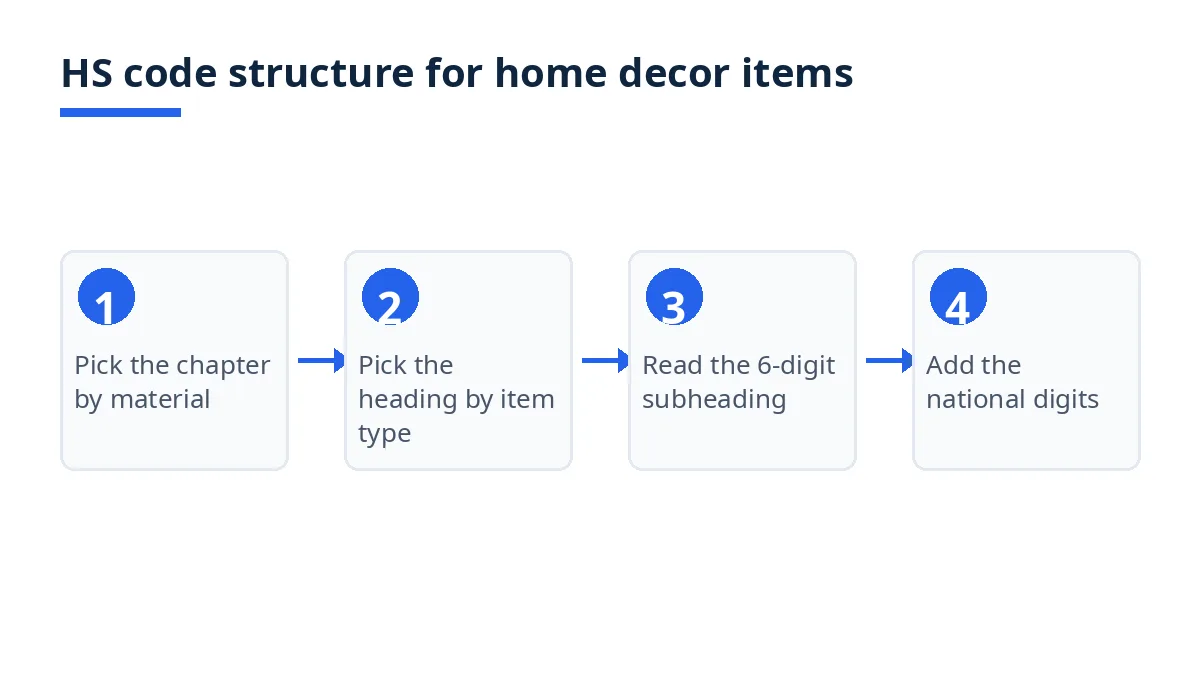
How HS codes are structured (2-4-6 digits)
The HS is organised in a hierarchical structure by sections, chapters (2 digits), headings (4 digits) and sub-headings (6 digits).9 Each pair of digits narrows the category: Take a wooden ornament: chapter 44, heading 4420 for wood marquetry, inlaid wood and wooden statuettes and ornaments,3 and a six-digit subheading split by type of wood. Take a textile furnishing article: chapter 63, heading 6304 for other furnishing articles,2 and a subheading split by construction and material.
Only the first six digits are shared worldwide: the EU Combined Nomenclature uses eight-digit codes,9 and the United States and the United Kingdom extend to ten digits. A decor item therefore has one shared six-digit core and a different full code in each destination.
Factors that decide the code for home decor items
Material first. The tariff organises goods largely by material, so the same design in different materials lands in different chapters: ceramic 69, glass 70, wood 44, base metal 83, plastics 39. Chapter 69 applies only to ceramic products fired after shaping,4 so record the constituent material for every version, not just the design name.
Ornament versus utility. A purely decorative figure follows an ornament heading, such as 6913 for ceramic statuettes.4 A piece with a use follows its use: a glass vessel used for indoor decoration follows heading 7013,5 while a ceramic plate or cup used at table follows the tableware headings, not the ornament heading. Ask what the piece does, not only what it looks like: a candle is classified as a candle, a lamp as a lighting fitting, and a shade shipped on its own as a part, not as a complete lamp.
Construction details change the subheading. Within glass mirrors, the US schedule splits framed mirrors from unframed mirrors. Within decorative glassware, the UK tariff splits lead-crystal lines from other glass and hand-gathered pieces from machine-gathered pieces.6 Within ceramic ornaments, the split runs by porcelain versus other ceramic material,4 and within textile furnishing articles by knitted versus other construction and then by material.2
Chapter notes can push an item out of the chapter you expect. Chapter 70 does not cover luminaires or lighting fittings with a permanently fixed light source, or parts thereof, of heading 9405.5 Chapter 94 does not cover floor-standing mirrors, which stay in heading 7009,8 or furniture for conjuring tricks or decorations, such as Chinese lanterns, tested under the festive heading.8 Read the notes for both the chapter you first guessed and the chapter you settle on.
Sets and mixed materials follow the essential-character test. A decor set sold together — a figurine, a candle holder and a framed print in one gift box — does not automatically take one code. Under the General Rules for Interpretation, goods put up in sets for retail sale which cannot be classified by the most-specific-description rule are classified by the material or component which gives them their essential character.3 If no component gives the set its character, classify the pieces separately; the same logic applies to a composite piece such as a wooden frame with a metal inlay.
Festive versus year-round matters. A decoration made only for a festival is tested against the festive-article heading, while the same shape sold all year follows its material ornament heading.
National codes: US HTS, EU CN/TARIC, UK commodity code
United States: HTS, ten digits. The US Harmonized Tariff Schedule starts from the same six digits and adds statistical suffixes. A glass mirror is split in the US schedule into unframed and framed lines, with the framed line split further by reflecting area.5 Read the full ten-digit line for each piece — this guide states no rates, and a rate on one glassware line does not carry to another.
European Union: CN at eight digits, TARIC for measures. The Combined Nomenclature integrates the HS and adds EU subdivisions, producing eight-digit codes.9 A textile furnishing article that is 6304.92 at six digits therefore appears in the EU at eight digits. Check the TARIC entry for the entry date and origin Bangladesh, and the origin rules behind any preference claim.
United Kingdom: commodity code, ten digits. The UK builds its commodity code on the same first six digits, with its own extension after them. The UK tariff page for heading 7013 lists full ten-digit codes under each six-digit line, including other-glassware lines at 7013.99.6 The UK page for heading 4420 lists the wooden-ornament lines, with a handmade split on some lines.3 Take the full code from the UK Trade Tariff for your item and entry date, not from an EU or US listing.
How to confirm the code officially
Write a precise description for each piece: material, item type, dimensions, framed or unframed, hand-made or machine-made, function (pure ornament, vessel, light fitting, candle), and whether it is seasonal or year-round.
Start from the official tariff for the destination: the USITC HTS, TARIC or the UK Trade Tariff, and read the heading text and chapter notes, not just the heading number.
Check the chapter-note exclusions for every chapter the piece could plausibly sit in, and published rulings for similar decor items.5 8
For a borderline piece — a composite frame, a tapestry-style wall hanging, a seasonal ornament — apply for a binding decision before you ship. In the EU, a Binding Tariff Information application needs a separate application for each type of product and a detailed description.10 In the United Kingdom, a legally binding decision is generally valid for 3 years, through an Advance Tariff Ruling.11
Give your broker the description and confirmed code for each piece, and use the same codes on the invoice, packing list and entry, with each piece as its own invoice line.
Common classification mistakes
Filing a whole decor range under one code. "Home decor items" is not a heading. A mixed shipment needs a code per piece, and a set needs an essential-character finding or separate lines.3
Filing a floor-standing mirror as furniture. Chapter 94 expressly excludes mirrors designed for placing on the floor or ground, which stay in heading 7009.8
Filing a lamp as glassware, or a glass shade as a lamp. Chapter 70 excludes lighting fittings with a permanently fixed light source, and parts thereof, of heading 9405.5 A complete lamp follows 9405; a purely decorative glass vessel follows 7013.
Filing decorative tableware as an ornament. A ceramic plate, cup or bowl used at table follows the tableware headings, while a figure with no table use follows heading 6913.4
Filing a festive item as a year-round ornament, or the reverse. Chapter 94 excludes furniture for conjuring tricks or decorations, such as Chinese lanterns, which are tested under the festive heading.8
Copying a code from another country or a supplier listing. Only the first six digits are harmonised.9 Full national lines for the same vase differ after the sixth digit, and a supplier's code may describe a different material version.
Related duties and documents
This guide states no duty rates: the code decides which duty line customs applies, and a rate on one decor line does not carry to a neighbouring line. Read the rate beside your confirmed code for your origin and entry date.
Keep the classification file with the shipment file: the per-piece description, material composition, confirmed national code per destination, any binding decision, and origin evidence, with each piece on its own invoice line.
FAQs
What is the HS code for home decor items?
There is no single code. Classification follows each item's material and function: ceramic ornaments against 6913,4 decorative glassware against 7013,5 wooden ornaments against 4420,3 base-metal ornaments against 8306,7 textile furnishing articles against 6304,2 and lighting fittings against 9405.8 All headings here are indicative — confirm the full national code per piece before filing.
Is the HS code the same in every country?
Only the first six digits are the same. The HS is organised by sections, chapters (2 digits), headings (4 digits) and sub-headings (6 digits),9 and countries subdivide further: eight digits in the EU9 and ten in the United States and the United Kingdom. The same vase therefore carries a different full code in each destination.
How do I confirm the correct code?
Describe each piece precisely, read the heading text and chapter notes in the destination tariff, and check published rulings for similar items. For a borderline piece, apply for a binding decision before shipping: a Binding Tariff Information decision in the EU, needing a separate application per product type,10 or an Advance Tariff Ruling in the United Kingdom, generally valid for 3 years.11
What happens if I use the wrong code?
Duty, licensing and quota treatment are worked out from the code on the declaration, so a wrong code brings the wrong treatment and possible delay or reassessment. A binding decision in advance helps you calculate the duties and restrictions that will apply.11 When an error is found, correct the entry through your broker promptly.
Next steps on Exportain
Start with the harmonized system guide and the guide to classifying your product, then browse Bangladeshi suppliers on Exportain. Post a free RFQ on Exportain and get quotes from verified Bangladeshi suppliers → Exportain RFQs — state the confirmed code for each decor piece in the RFQ. Exportain is not a party to the goods contract and does not clear customs, so keep your broker and any binding decision at the centre of the entry.
Sources
- What is the Harmonized System (HS)?. World Customs Organization (accessed )
- Other furnishing articles, excluding those of heading 9404 — UK Integrated Online Tariff, heading 6304. GOV.UK, HM Revenue and Customs (accessed )
- Wood marquetry and inlaid wood; statuettes and other ornaments, of wood — UK Integrated Online Tariff, heading 4420. GOV.UK, HM Revenue and Customs (accessed )
- Harmonized Tariff Schedule of the United States, Chapter 69 (2026 Revision 18). U.S. International Trade Commission (accessed )
- Harmonized Tariff Schedule of the United States, Chapter 70 (2026 Revision 18). U.S. International Trade Commission (accessed )
- Glassware of a kind used for indoor decoration — UK Integrated Online Tariff, heading 7013. GOV.UK, HM Revenue and Customs (accessed )
- Harmonized Tariff Schedule of the United States, Chapter 83 (2026 Revision 18). U.S. International Trade Commission (accessed )
- Harmonized Tariff Schedule of the United States, Chapter 94 (2026 Revision 18). U.S. International Trade Commission (accessed )
- Harmonised System. European Commission (accessed )
- European Binding Tariff Information (EBTI). European Commission, Taxation and Customs Union, (accessed )
- Check what you'll need to get a legally binding decision on a commodity code. GOV.UK, HM Revenue and Customs (accessed )
About the author
Sourcing from Bangladesh?
Post a request for quotation and suppliers on Exportain can send you their quotes directly.
Post an RFQ