

Typical MOQ for Hilsa Fish in Bangladesh (and How to Negotiate It Down)
No single hilsa MOQ in Bangladesh: how size bands, form, cartons and cold-chain lots set the minimum, and how fewer bands, one form and a consolidated shipment lower it.
Short answer
There is no single typical MOQ for hilsa fish from Bangladesh. Each supplier sets a minimum per size band, per form, and per cold-chain lot, so an order can pass on total weight and still fail on one thin band. Ask for the minimums line by line, use fewer bands and one form, consolidate the shipment, and get the binding floor, carton counts, and temperature record in writing before you confirm.
On this page
Key takeaways
There is no single typical MOQ for hilsa fish from Bangladesh, because each supplier sets a minimum per size band, per form, and per cold-chain lot.
The binding floor is usually one thin band, one cut form, or one packing run, not the order total, so the split matters more than the headline weight.
Fewer size bands, one form, one consolidated shipment, a written repeat commitment, or priced trial terms are the levers that move the minimum.
Seasonal sanctuary bans, carton counts, glaze basis, and the temperature record must be settled in writing before loading, and a badge is not a guarantee of grading, quality, or delivery.
Ask three hilsa suppliers for a minimum order and you may receive three different answers, even for the same total weight. A hilsa minimum is rarely one number for the whole order. It is built from separate floors for each size band, each form, each carton count, and each cold-chain lot, and the smallest of those floors can decide whether your order can run at all.
Hilsa shad, Tenualosa ilisha, is the national fish of Bangladesh, and the Department of Fisheries uses incentive-based management to protect its stocks, including seasonal bans in coastal sanctuary areas aimed at protecting juvenile and spawning hilsa.1 Understanding that structure lets a buyer compare quotations on the same basis.
How a hilsa MOQ is built
A workable enquiry names the product in full before it names a quantity: species, form, size band, glaze and packing, carton weight, and delivery term. Without those lines, two quotations for the same total weight may describe different fish or packing.
Size grade
Hilsa is graded by individual fish size, and each band is its own line. A supplier may have enough fish in one band and too few in another, so the minimum applies per band, not only to the order total. State the band, the count per kilogram or weight range per fish, and the tolerance around the band edges, and ask whether the band is set at landing, at grading, or after freezing.
Whole versus cut form
Form changes the work, the yield, and the minimum. Whole fish, gutted fish, steaks, and fillets pass through different preparation steps, and a cut form adds labour, trimming loss, and a separate packing line, so its minimum can be higher at the same total weight.
For fillets, state whether they are skin-on or skinless, boneless or with pin bones, and whether glaze counts in the net weight. The Codex standard for quick frozen fish fillets requires freezing to be complete when the product temperature has reached minus 18 degrees Celsius or colder at the thermal centre, and kept deep frozen during transportation, storage, and distribution.2 For glazed product, net contents shall be exclusive of the glaze.2
Seasonal availability window
A minimum agreed in a period of good availability may not hold when landings fall or a sanctuary ban is in force. The Department of Fisheries approach includes seasonal bans in sanctuary areas, aimed at protecting juvenile and spawning hilsa.1 Ask which weeks the supplier expects to grade and freeze your bands, and whether a shortfall means the order is filled, split, or deferred.
Build the enquiry around a window, not a single date, and ask the supplier to confirm grading and freezing dates inside it.
Carton and case quantity
Cartons turn a weight minimum into a packing minimum, since a supplier packs in fixed carton weights and a partial carton is often not a standard line. State the carton weight, pieces per carton, and cartons per case or pallet, and ask how a non-whole carton count is handled and priced.
Example figures: a buyer orders 480 kilograms in 10-kilogram cartons, which is 48 cartons. Split across four bands, each band is 12 cartons. If one band needs a 20-carton packing run, that band fails while the total passes. The example shows structure only, not a typical MOQ, price, or lead time.
Cold-chain lot
Fish graded and frozen together, stored together, and loaded together form one lot for inspection and temperature history. A small order that cannot fill a freezing run or container load may be held or carry a surcharge. Ask how the supplier defines a lot and what records travel with it. The Codex standard for quick frozen fish fillets requires the label to state storage at minus 18 degrees Celsius or colder.2
MOQ building block | What sets the floor | State in your enquiry |
|---|---|---|
Size band | Grading and sorting per band | Band, count or weight range, tolerance |
Form | Preparation steps and yield loss | Whole, gutted, steak, or fillet, with skin and bone terms |
Season window | Landings and sanctuary bans | Earliest and latest shipment dates |
Carton quantity | Fixed carton and case packing | Carton weight, pieces per carton, cartons per band |
Cold-chain lot | Freezing run and storage lot | Lot definition, holding temperature, temperature record |
Five levers that move the minimum
Negotiation works when you change one block, not when you ask for an exception to all of them. Use fewer size bands, use one form, consolidate the shipment into one date and lot, offer a written repeat commitment for the same bands and form, or agree priced trial terms in one band and one form with set-up, freezing, and packing shown as separate lines.
Why this matters for buyers and sellers
For the buyer, the minimum decides how much capital sits in frozen stock and whether a first order can test a band and form before a larger commitment. Ordering four bands may leave no single band at its floor, while ordering one band well may move faster.
For the seller, the minimum protects the run. Fish graded for your band, cut to your form, packed in your cartons, and frozen as your lot cannot be sold easily to another buyer if you cancel. Each step uses labour and cold-store time whether the run is short or long, so cost per kilogram rises as quantity per band falls.
Two controls keep the negotiation grounded: a written specification for every line, and one delivery term for every quotation. The Incoterms 2020 rules provide 11 rules with a clear allocation of cost, risk, and obligations.3 Compare minimums only where the term, named place, and specification match.
Step-by-step: how it works
Work through these steps in order, and do not confirm a quantity until the binding floor is named.
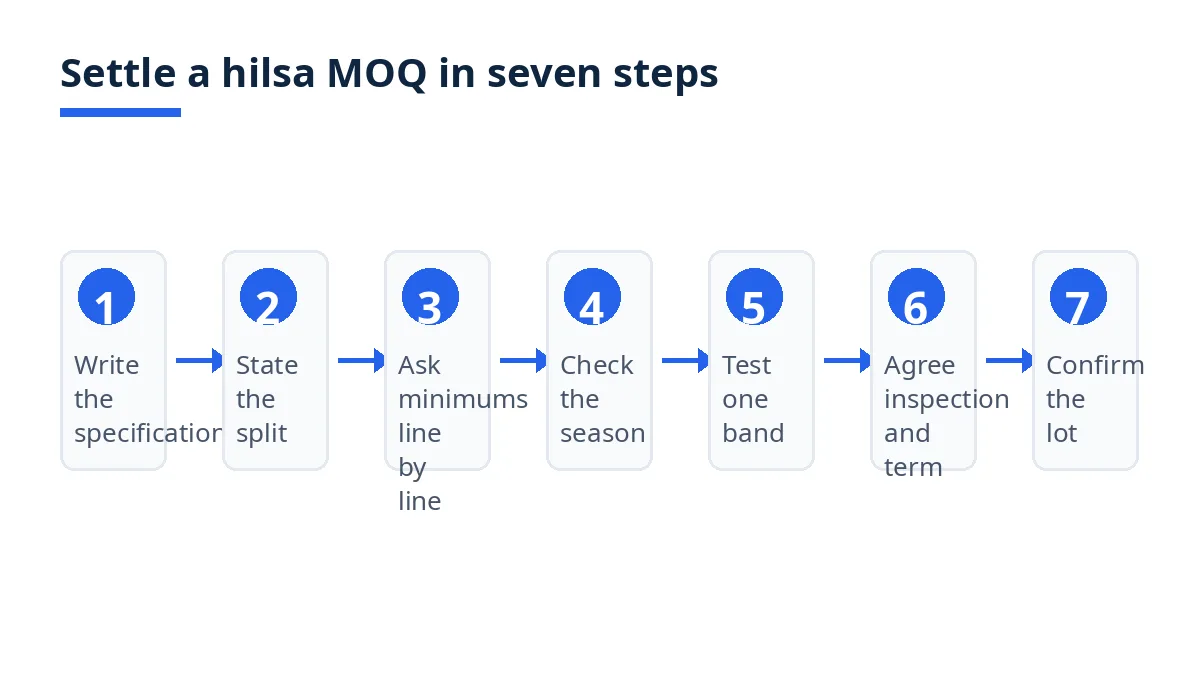
Write the full specification first. State species, form, size band, count or weight range, tolerance, glaze, carton weight, pieces per carton, and holding temperature, and attach it to the enquiry so every supplier quotes the same product.
State the split, not only the total. Give the weight per band, per form, and per shipment date. A total without a split cannot be answered with a usable minimum.
Ask for the minimums line by line. Ask for the minimum per band, per form, per carton run, and per cold-chain lot, and which line is binding for your split.
Ask what the season allows. State your shipment window and ask the supplier to confirm grading and freezing dates inside it, and what happens if landings in your band fall short.
Test one band with a sample. Order a sample in your band and form, in your carton, at your temperature, and check size count, glaze, packing, and temperature record before approving the bulk run.
Agree inspection and delivery term before you confirm. Write the inspection method, sample size, and acceptance criteria into the purchase order, and state one Incoterm and named place for every quotation.3
Confirm the lot in writing. Before loading, confirm lot numbers, carton counts per band, temperature record, and shipment date.
See the hilsa fish quality control checklist for grading, glaze, and packing points, and the HS code for hilsa fish guide for classification. In the Harmonized System, heading 0303 covers fish, frozen, excluding fish fillets and other fish meat of heading 0304.4
Costs, timelines and documents
What are the typical costs and timelines?
There are no typical costs or timelines a guide can state as fact, because each supplier prices your bands, form, glaze, carton, lot, and delivery term separately. Fish price moves with band and season, preparation cost moves with form, and freight and insurance move with the delivery term.3 Ask for each cost and each date as a separate line, not a single delivered price or shipment week.
Which documents are needed?
For export clearance in Bangladesh, goods shall not be loaded unless an export declaration, the Bill of Export or Shipping Bill, is submitted to Customs and approved.5 Enclosed documents include the export letter of credit or, where there is none, the export contract, purchase order, or export guarantee approved by the negotiating bank, the commercial invoice, the packing list, the EXP form certified by an authorized dealer, and a certificate of origin issued by the Export Promotion Bureau or a Chamber of Commerce and Industry.5
For frozen fish, Bangladesh Customs lists a Department of Fisheries quality control certificate as necessary where the destination requires it.5 Ask early whether your destination requires it, and keep one legal name across the trade licence, quotation, proforma invoice, packing list, and payment account, since the declaration names the exporter and the foreign buyer.5
Bangladesh-specific rules and tips
Check the season before you fix a date. Seasonal bans in sanctuary areas aim to protect juvenile and spawning fish.1 Ask the supplier to name the source area and applicable period in writing.
Confirm the grading point and the glaze basis. Ask whether grading happens before or after freezing, and whether net weight includes glaze. The Codex standard for fillets states that net contents for glazed product shall be exclusive of the glaze.2
Ask where each step happens. Ask where the fish is landed, graded, frozen, and stored, and whether those steps sit in one cold chain or pass through separate handlers.
Keep the destination rules in the enquiry. If your market requires a Department of Fisheries quality control certificate for frozen fish,5 state it in the first enquiry, not in the purchase order.
Mistakes and red flags
What are the most common mistakes?
Asking for a total minimum only. The binding minimum is usually per band, per form, or per lot. An order can clear the total and still fail on one thin band.
Comparing minimums on different specifications. A lower minimum on whole fish, a wide band, or a different delivery term is a different offer. Compare only replies to the same specification on the same Incoterm.3
Mixing bands and forms in a first order. A first order testing four bands and two forms tests nothing well, because each line may fall below its floor. Test one band and one form first, then widen the range.
Accepting a verbal exception. Record any agreed lower minimum, shared lot, or priced trial on the quotation and purchase order, with the split and shipment window it applies to.
Treating a profile or a badge as a grading guarantee. A profile does not test whether a supplier can grade your band, hold your temperature, or fill your lot. A badge is not a guarantee of production capacity, product quality, or delivery.6
Skipping the temperature record. A lot without a temperature record cannot be checked at loading, and a temperature break found at destination cannot be traced back to a step.
Checklist
Before you confirm, every line should be answered in writing.
Specification written: species, form, size band, count or weight range, tolerance, glaze basis.
Split stated per band, per form, and per shipment date, with carton counts per band.
Minimum confirmed per band, per form, per carton run, and per cold-chain lot, with the binding line named.
Shipment window stated, with grading and freezing dates confirmed inside it.
Sample in your band and form checked for size count, glaze, packing, and temperature record.
Inspection method, sample size, and acceptance criteria in the purchase order.
Quotations compared on the same specification and Incoterm.3
Export set agreed: Bill of Export, commercial invoice, packing list, EXP form, certificate of origin, and any Department of Fisheries certificate your destination requires.5
Lot numbers, carton counts per band, and temperature record confirmed before loading.
Repeat or trial terms recorded, with the specification they apply to.
How Exportain helps
On Exportain, browse suppliers and post a request for quotation (RFQ) on the RFQ board with your specification, split per band and form, shipment window, and delivery term, so suppliers quote against the same product. Ask each reply for its minimum per band, per form, and per lot, and for the temperature record that will travel with the lot. When you accept a quotation, Exportain creates one order and issues one proforma invoice from the accepted terms.6
Read the badges for what they record. Exportain Verified means Exportain has checked identity, phone, email, and business registration, and Export Verified means it has checked the Export Registration Certificate (ERC).6 Factory Verified means it has reviewed photos of the manufacturer factory, while Trading Company Verified means it has reviewed photos of the trading company office or warehouse.6 Verification is a document and photo review by staff, free, and never granted by membership plans.7 It is not a factory inspection,6 7 so grading, temperature, and inspection stay with you. See how supplier verification works on Exportain.
FAQs
What should I know first about hilsa fish?
Hilsa shad, Tenualosa ilisha, is the national fish of Bangladesh, managed with incentive-based measures including seasonal bans in coastal sanctuary areas aimed at protecting juvenile and spawning fish.1 For buying, the key structural fact is that the minimum is set per size band, per form, and per cold-chain lot, not as one total. Frozen fish sits under heading 0303, which covers fish, frozen, excluding fish fillets and other fish meat of heading 0304.4
What are the typical costs and timelines?
There are no typical figures a buyer can rely on, because each supplier prices your bands, form, glaze, carton, lot, and delivery term separately.3 Ask for each cost and each date as a separate line, and compare quotations only on the same specification and Incoterm.3
Which documents are needed?
The order documents are the specification, itemized quotation, and purchase order, with the minimum per band and per form on both. The export set is the Bill of Export, commercial invoice, packing list, EXP form certified by an authorized dealer, and certificate of origin issued by the Export Promotion Bureau or a Chamber of Commerce and Industry.5 Where your destination requires it, add the Department of Fisheries quality control certificate for frozen fish.5
What are the most common mistakes?
The most common mistakes are asking only for a total minimum, comparing minimums on different specifications or terms,3 mixing too many bands and forms into a first order, and accepting a lower minimum verbally. A badge is not a guarantee of capacity, quality, or delivery,6 and a lot without a temperature record cannot be checked at loading.
Next steps on Exportain
Browse suppliers, then post your specification, split per band and form, and shipment window on the RFQ board so suppliers state their minimum per band and per form. Before you confirm, read the MOQ definition guide and how to import hilsa fish from Bangladesh.
Sources
- Incentive-based hilsa fisheries management in Bangladesh. PANORAMA Solutions (accessed )
- Standard for Quick Frozen Fish Fillets (CXS 190-1995). Food and Agriculture Organization of the United Nations (accessed )
- Incoterms® 2020. International Chamber of Commerce (ICC) (accessed )
- Classification Detail — HS Code 030351. United Nations Statistics Division (accessed )
- Customs Clearance Procedures for Export. Bangladesh Customs, National Board of Revenue (accessed )
- Trust & Safety Center. Exportain (accessed )
- Supplier verification: Earn trust badges buyers can see. Exportain (accessed )
About the author
Sourcing from Bangladesh?
Post a request for quotation and suppliers on Exportain can send you their quotes directly.
Post an RFQ


