

Quality Control Checklist for Generic Medicines From Bangladesh
A numbered QC checklist for generic medicines from Bangladesh: identity and strength, dosage form, labeling, batch documents, stability, storage and packing checks, with fixes for labeling mismatches, broken tablets and certificate errors.
Short answer
Use this generic medicines quality control checklist to check identity, strength and dosage form, appearance, labeling, batch documents, stability and packing on generic medicines from Bangladesh before shipment. Agree the specification, test methods and acceptance numbers in the purchase order, and treat any identity, strength or labeling mismatch as a stop point.

On this page
Key takeaways
Agree the specification, artwork, test methods and acceptance numbers before inspection, and draw the sample randomly across batches, strengths and cartons.
Check identity, strength and dosage form first, and treat any identity, strength or labeling mismatch as a stop point rather than a sorting task.
Match the certificate of analysis and batch record to the exact lot under inspection, and do not accept a certificate for another batch or specification version.
Check shelf life against stability data for the marketed pack and destination climate, and confirm the label storage statement matches the tested conditions.
Record a result per batch and strength, and use re-inspection, documented partial acceptance or rejection when a lot sits above the agreed acceptance level.
If you buy generic medicines from Bangladesh, this checklist gives you a practical way to check a shipment before it leaves the factory. A medicine is judged on identity, strength, dosage form and labeling as much as on appearance: a wrong strength on a carton, a mixed batch in a blister run, or a certificate that does not match the lot can turn an otherwise sound order into a rejected one. Under WHO good manufacturing practices, licensed pharmaceutical products should be manufactured only by licensed manufacturers whose activities are regularly inspected by competent national authorities.1 For the United States market, an abbreviated new drug application must show that the proposed generic is the same as the reference listed drug in active ingredient, dosage form, strength and labeling, and that it is bioequivalent to that drug.2
Why this checklist matters
Medicines concentrate risk in small, identical-looking units. Tablets, capsules, syrups and injections from different strengths or batches can look alike, so a labeling or sorting error is easy to miss and hard to undo once cartons are sealed. The European Pharmacopoeia sets official quality standards for medicines and their ingredients that are legally binding in its member states, which is why the destination market, not only the factory, decides which monograph and test method applies.3
A written checklist removes interpretation. Each point is checked against the approved specification, the retained sample and the batch documents, and recorded as pass, fail or not applicable. Agree defect classes and acceptance numbers per class in the purchase order before inspection starts, and treat any identity, strength or labeling mismatch as a stop point rather than a sorting task.
Before you start
Do not begin until the references are complete: the approved specification for each product and strength, a retained sample per product, the artwork and labeling proofs for the destination market, the batch manufacturing and packing records, and the certificate of analysis for the lot under inspection. Confirm which pharmacopeia and test methods the destination market requires, because United States, United Kingdom, European Union and United Arab Emirates requirements differ in labeling, language and registration detail.
Confirm the sampling plan in advance. ISO 2859-1 specifies an acceptance sampling system for inspection by attributes, indexed in terms of the acceptance quality limit, and applicable to end items, components and materials in process.4 Draw the sample randomly across batches, strengths and cartons, never from pieces the factory selects. In Bangladesh, drug manufacturing and quality control follow good practice guidelines aligned with WHO guidance, and the regulator may inspect manufacturing premises to check good manufacturing practice.5
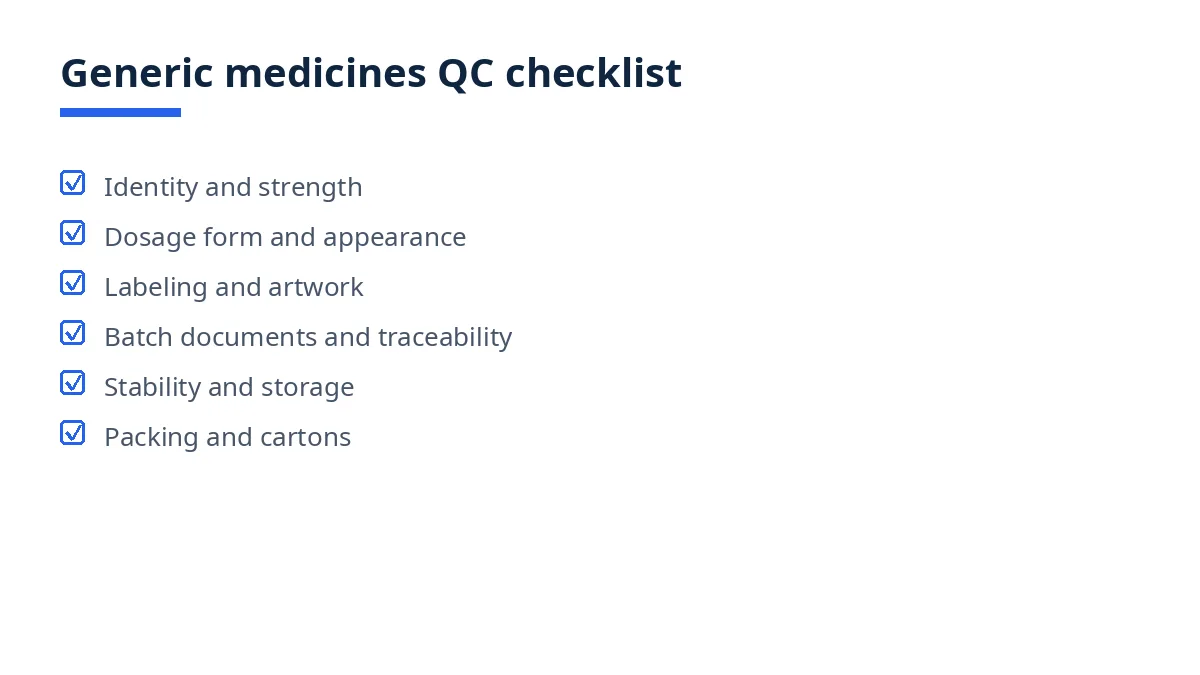
The full checklist (numbered, printable)
Identity, strength and dosage form
Confirm the product name, active ingredient name and strength on the sample, the specification and the certificate of analysis all match, character for character.
Check the dosage form against the specification: tablet, capsule, syrup, cream or injection, with the same route of administration as ordered.
Check scored tablets, capsule size and color, and syrup clarity or suspension uniformity against the retained sample, and record any change as a failure.
Check that no other strength of the same product is present in the sampled cartons, and that mixed strengths have not been packed together.
Check the batch or lot number and manufacturing date on the product, the inner pack and the carton all match the batch record.
Appearance and physical checks
Check tablets and capsules for cracks, chips, capping, sticking, discoloration and broken pieces, on both faces and edges.
Check syrups and liquids for sediment, cloudiness, leakage and off-odor against the retained sample, and check fill levels in bottles.
Check creams and ointments for separation, graininess and tube damage, and check that tubes seal cleanly without leakage.
Check blister packs for empty pockets, crushed tablets, weak seals and torn foil, and check that each pocket holds one unit.
Check injections and vials for cracks, particles, fill volume and intact seals, and set aside any unit with visible particles for laboratory review.
Labeling, artwork and patient information
Check the product name, strength, dosage form, pack size and manufacturer details on every label level: unit, inner pack and outer carton.
Check the batch number, manufacturing date and expiry date on each level, and confirm the expiry date matches the batch record and certificate.
Check storage statements, warnings and dosage directions against the approved artwork for the destination market, including language requirements.
Check barcodes and any serialization or traceability codes scan correctly and match the purchase order and packing list.
Check the patient information leaflet, where required, is the approved version for that product and market, and is present in every pack that requires one.
Batch documentation and traceability
Check that the certificate of analysis names the product, strength, batch number and the specification version used for release testing.
Check that every test result on the certificate is within the approved specification limits, and that out-of-specification results are explained in writing.
Check the batch manufacturing record covers the sampled lot only, with no pages from another batch mixed into the file.
Check raw material and active ingredient traceability for the lot, including supplier names and lot numbers recorded in the batch record.
Check that deviations, rework or rejected material linked to the lot are recorded, with the disposition signed by quality assurance.
Stability, storage and shelf life
Check that the claimed shelf life is supported by stability data for the product in its marketed pack, not only by data for another pack type.
Under ICH Q1A(R2), long-term stability testing uses 25 degrees Celsius plus or minus 2 degrees with 60 percent relative humidity plus or minus 5 percent, and accelerated testing uses 40 degrees Celsius plus or minus 2 degrees with 75 percent relative humidity plus or minus 5 percent.6
Check that the stability data cover the climatic conditions of the destination market, and that the storage statement on the label matches the tested conditions.
Check warehouse and dispatch storage for temperature control, humidity control, segregation of batches and protection from light where the label requires it.
Check that no expired, quarantined or rejected stock is stored alongside released stock for the order, and that quarantine areas are clearly marked.
Packing, cartons and shipment
Check that the inner pack, shipper carton and pallet quantities match the packing specification, and that mixed batches are not combined in one shipper unless the specification allows it.
Check carton markings for product, strength, batch number, quantity and destination, and confirm they match the packing list line by line.
Check that cartons are sealed, undamaged and dry, with no crushed corners that could have damaged blisters or bottles inside.
Check that temperature-sensitive shipments carry the monitoring or insulation the specification requires, and that monitors are placed as directed.
Check the final count of cartons, pallets and total units against the purchase order and packing list before the shipment is released.
Common failures and how to fix them
The most frequent failure is a labeling mismatch: the right product in the wrong strength carton, or an expiry date that differs between the blister foil and the outer carton. Stop packing, compare all three label levels against the batch record, and re-check every carton in the lot before packing resumes. Next is a certificate that does not match the lot, often because the certificate names a different batch or an older specification version: ask for the certificate for the exact lot and specification, and do not accept a substitute certificate.
Broken or chipped tablets usually trace to handling, compression or transport inside the factory: check the blister line and the carton packing step separately to find where the damage starts. Moisture damage in blisters points to seal or storage problems: check seal strength and warehouse humidity records for the lot. Missing batch documents are a stop point, not a paperwork delay: without a matching batch record and certificate, the lot cannot be released on this checklist.
Above the agreed acceptance level, options are re-inspection after sorting or rework where the product type allows it, documented partial acceptance, or rejection of the lot.
Downloadable template / summary table
Copy the checklist into your inspection sheet, add the specification limits, test methods and acceptance numbers, and record a result per batch and strength.
Section | Checks | Evidence |
|---|---|---|
Identity and dosage form | Name, strength, form, batch match | Specification, retained sample |
Appearance | Tablets, liquids, creams, vials | Visual check, photos |
Labeling | All label levels, dates, codes | Approved artwork |
Batch documents | Certificate, batch record, traceability | Signed documents |
Stability and storage | Shelf life, conditions, segregation | Stability data, storage records |
Packing and shipment | Quantities, markings, counts | Packing list |
How Exportain helps
Exportain is a B2B marketplace connecting buyers with Bangladeshi suppliers, so the specification, artwork and acceptance numbers behind this checklist can be agreed at the enquiry stage rather than at the loading dock. Use inspection services when you plan the check, and share the approved specification, retained sample details and destination-market labeling rules with the supplier before production starts. Supplier profiles show which document and photo checks have been recorded, not factory inspections. Exportain is not a party to the goods contract and does not inspect goods.
FAQs
When should this checklist be used?
Use it at final inspection, when goods are finished, labeled and largely packed. For larger and first orders, also use it during production, while labeling and packing errors can still be corrected.
Who should complete it?
The buyer, a local agent or an independent inspector can complete it, using the approved specification, retained sample, batch documents and a randomly drawn sample.
What are the most common failures?
Labeling and strength mismatches, broken tablets, weak blister seals, moisture damage, expiry-date differences between pack levels, and certificates that do not match the lot are the failures buyers find most often.
Can a third party do it?
Yes, if you share the approved specification, artwork, acceptance levels and batch documents first, and if the inspector can access the batch records and retained sample.
Next steps on Exportain
Before production starts, agree your specification, test methods, labeling artwork and acceptance numbers, then read the AQL acceptance quality limit explainer and the pre-shipment inspection guide, and plan the check with inspection services.
Sources
- TRS 986 - Annex 2: WHO good manufacturing practices for pharmaceutical products: Main principles. World Health Organization (accessed )
- Abbreviated New Drug Application (ANDA). U.S. Food and Drug Administration (accessed )
- European Pharmacopoeia (Ph. Eur.). European Directorate for the Quality of Medicines and HealthCare, Council of Europe (accessed )
- ISO 2859-1:1999 - Sampling procedures for inspection by attributes — Part 1: Sampling schemes indexed by acceptance quality limit (AQL) for lot-by-lot inspection. International Organization for Standardization (accessed )
- Guidelines for Reliance and Recognition on the regulatory decisions of other NRAs. Directorate General of Drug Administration, Bangladesh (accessed )
- ICH Harmonised Tripartite Guideline: Stability Testing of New Drug Substances and Products Q1A(R2). International Council for Harmonisation of Technical Requirements for Pharmaceuticals for Human Use (accessed )
- pre-shipment inspection
- quality control
- importing from Bangladesh
- Pharmaceuticals
- Pharmaceuticals Bangladesh
About the author
Sourcing from Bangladesh?
Post a request for quotation and suppliers on Exportain can send you their quotes directly.
Post an RFQ


