

Quality Control Checklist for Fruit Juices From Bangladesh
A numbered QC checklist for fruit juices from Bangladesh: product identity, Brix and acidity, pasteurization records, appearance and flavour, fill volume and seals, destination label rules, and carton and shipment checks, with fixes for common failures.
Short answer
Use this fruit juice quality control checklist before shipment from Bangladesh: confirm product identity, measure Brix and acidity against the agreed limit for each fruit, review pasteurization and laboratory reports, taste and check appearance, verify fill volume, seals and labels for each destination, then check cartons and storage. Agree acceptance numbers in the purchase order first.
On this page
Key takeaways
Start with juice identity and laboratory results: Brix and acidity limits differ by fruit, so apply the figure agreed for the actual fruit in the order.
Check the process record as well as the pack: pasteurization, aseptic filling and seal integrity decide whether the juice survives storage and transit.
Check labels per destination: juice, juice from concentrate and nectar carry different product names, concentrate wording and nectar content declarations.
Record actual readings and lot details for every check, and agree acceptance numbers per defect class in the purchase order before inspection.
If you buy fruit juice from Bangladesh, this checklist checks the juice itself, not only the carton around it. A shipment can look correct outside while the Brix level, acidity, seal or label wording is wrong, and those faults appear only after opening. Use it at final inspection, when goods are finished, filled, sealed and largely packed, recording each result against the sample and purchase order.
Why this checklist matters
Fruit juice is judged after it is opened, so a fault invisible at the carton stage still reaches the buyer. A juice that is too thin, too sharp, flat in aroma or separated reads as a different product from the sample. Codex defines fruit juice as the unfermented but fermentable liquid from the edible part of sound, appropriately mature and fresh fruit, prepared by processes that maintain its essential physical, chemical, organoleptic and nutritional characteristics.1 That definition is why the checks below start with identity and laboratory results, not with the outside of the pack.
A written checklist removes interpretation at the inspection table. Each point is checked against the approved sample and specification, and recorded as pass, fail or not applicable. Agree acceptance numbers per defect class in the purchase order before inspection, because this article sets no universal acceptance figure.
Before you start
Do not begin until the references are complete: an approved sample per juice and pack size, the purchase order and specification, the recipe, the Brix and acidity limits per fruit, the process record, the label artwork per destination, and the packing specification. Draw the sample randomly across flavours, pack sizes and cartons.
Codex sets a minimum Brix level of 13.5 for reconstituted mango juice and 16.0 for reconstituted grape juice, with a minimum juice content of 25 percent by volume for mango nectar.1 Confirm the annex figure per fruit; do not apply one fruit's figure to another.
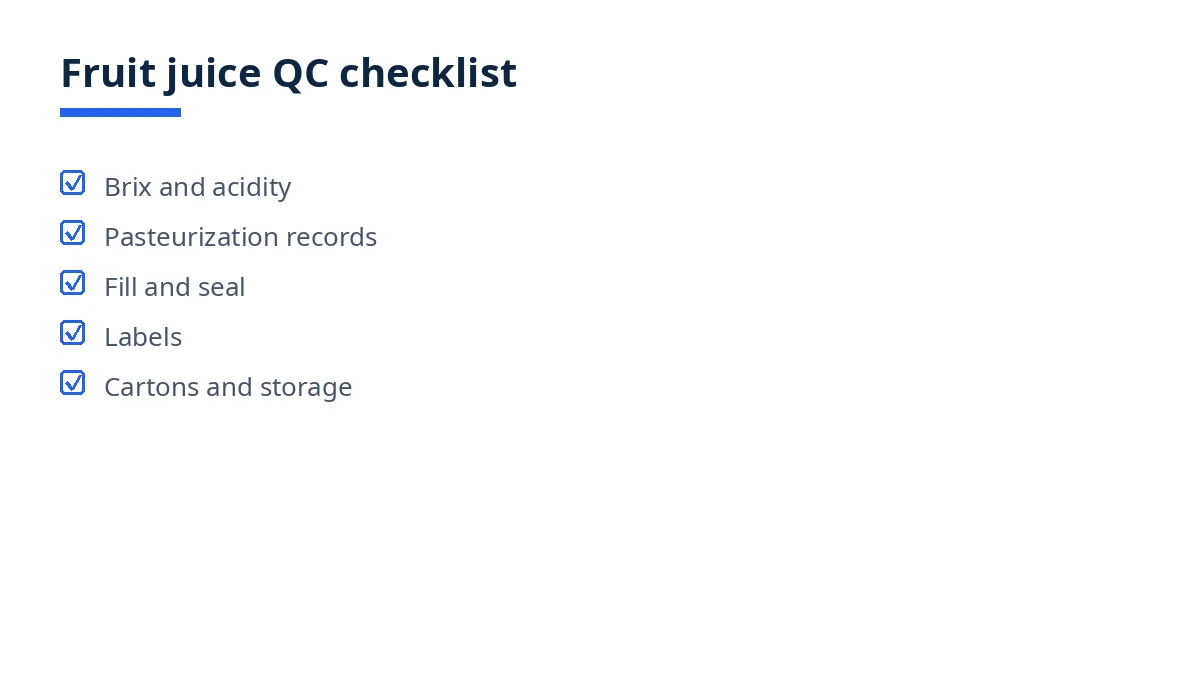
The full checklist (numbered, printable)
Identity, Brix, acidity and laboratory tests
Confirm the product name matches the definition: juice, juice from concentrate, concentrated juice or nectar, and that a mixed juice names its fruits in the order the destination rules require.
Measure Brix on each sampled flavour with a calibrated refractometer, at the temperature the method requires, and record the reading against the agreed limit for that fruit.
Compare the reading with the Codex annex figure where one applies: mango reconstituted juice at 13.5 Brix minimum and grape reconstituted juice at 16.0 Brix minimum are attributed examples, not a single rule for all juices.1
Measure titratable acidity and pH where the specification sets them, and record both values: a juice can meet its Brix level while tasting flat or sharp.
Check Brix, acidity and flavour together against the approved sample, tasting samples from the start, middle and end of the run where possible.
Review the lot laboratory report: it must name the juice, fruit, pack and lot, and use the test method agreed in the purchase order.
For apple juice, check the patulin result where the destination requires it. The United States Food and Drug Administration lists an action level of 50 parts per billion for patulin in apple juice and apple juice products.2
Check any other contaminant or residue result the destination requires, and hold any lot whose report does not cover that fruit or lot.
Pasteurization, process records and shelf life
Review the lot pasteurization record, including time and temperature, and confirm it matches the process in the specification.
For juice sold into the United States, confirm the hazard plan meets 21 CFR 120.24: measures that consistently produce at least a 5 log reduction in the pertinent microorganism, held for at least as long as the shelf life under normal and moderate abuse conditions.3
Check the aseptic filling record: pack, line and seal type must match the specification, and any pack material change during the run must be recorded.
Check the best-before or expiry date on sampled packs against the production date and agreed shelf life, and confirm remaining shelf life on arrival will meet the contract.
Check storage instructions against the product type.
Appearance, aroma, flavour and pulp
Pour a sample of each flavour and check colour against the approved sample under the same light, looking for browning, fading or uneven shade.
Check clarity or cloudiness against the sample: a clear juice should not carry unexpected sediment, and a cloudy juice should not show separation the sample does not show.
Check aroma on opening: it should match the fruit on the pack, with no fermented, cooked, metallic or chemical note the sample does not carry.
Taste for flavour balance: sweetness, acidity and any bitter or astringent note, compared with the approved sample rather than another flavour.
Check pulp and sediment where the pack promises them: pulp level should be even across sampled packs, and extra pulp or cells above the normal level must be declared as the destination rules require.1
Fill volume, seals and containers
Measure fill volume on sampled packs, and compare each result with the declared quantity and the destination tolerance, recording actual values.
Check each seal: complete, even and unbroken, with no leakage, swelling, seal-breaking dent, or sticky residue outside the pack.
Check aseptic carton seals at the top, bottom and side seams, and squeeze-test a sample where the pack type allows it, watching for air or liquid escape.
Check bottles and caps for correct closure, tamper evidence where fitted, and no cracked, chipped or deformed neck that would break the seal.
Check the container: no rust, seal-affecting dents, damaged cartons, or storage odour that could taint the juice.
Labels and destination rules
Check the product name on each destination label against the pack contents: a juice from concentrate must be described as such, close to the product name, in clearly visible characters.1
For nectars, check the juice content declaration, which Codex requires close to the product name in clearly visible characters.1
For the European Union, check the reserved product names and labelling rules in Directive 2001/112/EC as amended by Directive 2012/12/EU, including "from concentrate" or "partially from concentrate" where they apply, and the fruit content declaration for nectars.4
Check added sugars and sweeteners: where sugars are added to a juice, the sales name must carry the required statement, and a nectar made with sweeteners instead of sugars must carry its required wording.4
Check the full label set for each destination: ingredients in descending order, allergen information where required, net quantity, date marking, storage instructions, and the required name and address, all in the required language.
Cartons, pallets and shipment
Check that each carton holds the pack size, flavour and count on the packing list, and that mixed-flavour cartons, where allowed, match the agreed mix.
Check carton markings: flavour, pack size, count, lot code, production date and destination markings must match the packing list and be legible.
Check pallet build and wrapping: cartons stable, undamaged and protected from moisture, and chilled or frozen product kept in its required temperature range.
Weigh and measure sample cartons, and confirm carton count, pallet count and container load against the packing list before the container is sealed.
Common failures and how to fix them
The most frequent failure is a Brix reading that does not match the agreed limit for that fruit, usually because a concentrate was reconstituted to the wrong dilution or another fruit's limit was applied. Stop, re-check the dilution record and the annex figure, re-measure a fresh sample, and only then release the lot. Next is a label naming the product incorrectly, most often a nectar labelled as juice, or a juice from concentrate without the concentrate wording: correct the artwork before more labels are printed, and re-check every destination version.
Off flavour and separation usually trace to process or storage: a fermented note points to a failed seal or broken cold chain, and separation in a cloudy juice points to a process change during the run. Segregate that lot and re-inspect it alone. Leaking or swollen packs point to a seal or filling fault: stop the line, check seal settings on a test run, and re-check filled packs. Above the agreed acceptance level, options are re-inspection after sorting or rework, documented partial acceptance, or rejection.
Downloadable template / summary table
Copy the checklist into your inspection sheet, add the Brix and acidity limits per fruit and the acceptance numbers, and record a result per pack and per lot.
Section | Checks | Evidence |
|---|---|---|
Identity and lab tests | Product name, Brix, acidity, pH, lot reports | Readings, lab reports |
Process and shelf life | Pasteurization record, pathogen reduction, dates | Process records |
Appearance and flavour | Colour, clarity, aroma, taste, pulp | Poured samples |
Fill, seals and containers | Volume, seals, caps, container condition | Measurements, seal checks |
Labels | Product name, concentrate wording, nectar content, destination rules | Artwork check |
Cartons and shipment | Counts, markings, pallets, temperature | Packing list |
How Exportain helps
Exportain is a B2B marketplace connecting buyers with Bangladeshi suppliers of fruit juices and processed food, so the specification behind this checklist, including Brix limits, pack type and label versions, can be agreed at the enquiry stage. Supplier profiles show which document and photo checks have been recorded, not factory inspections. Exportain is not a party to the goods contract and does not inspect goods.
FAQs
When should this checklist be used?
Use it at final inspection, when juice is finished, filled, sealed and largely packed. For larger and first orders, also use it during production, while dilution, process settings and artwork can still be corrected.
Who should complete it?
The buyer, a local agent or an independent inspector can complete it, using the approved sample, the specification, the laboratory reports and a random sample across flavours and cartons.
What are the most common failures?
A wrong Brix level, an incorrect product name, missing concentrate wording, off flavour or separation, and leaking or swollen packs are the failures buyers find most often.
Can a third party do it?
Yes, if you share the approved sample, the Brix and acidity limits per fruit, the process records, the label artwork per destination and the acceptance levels first.
Next steps on Exportain
Before production, agree Brix and acidity limits per fruit, process records and label wording per destination, then read the AQL acceptance quality limit explainer and the pre-shipment inspection guide, and plan the check with inspection services.
Sources
- General Standard for Fruit Juices and Nectars, CXS 247-2005. FAO and WHO, Codex Alimentarius Commission (accessed )
- Chemical Contaminants Transparency Tool - contaminant levels for patulin and inorganic arsenic in apple juice. U.S. Food and Drug Administration (accessed )
- 21 CFR 120.24 - Process controls (Juice HACCP). Electronic Code of Federal Regulations (accessed )
- Council Directive 2001/112/EC relating to fruit juices and certain similar products intended for human consumption (as amended by Directive 2012/12/EU). European Union (accessed )
About the author
Sourcing from Bangladesh?
Post a request for quotation and suppliers on Exportain can send you their quotes directly.
Post an RFQ


