Quality Control Checklist for Frozen Vegetables From Bangladesh
Use this frozen vegetables QC checklist to check temperature evidence, IQF or block form, clumping, freezer burn, thawed texture and drip loss, defects, labels and packing before shipment.
Short answer
Use this frozen vegetables quality control checklist to check temperature evidence, IQF or block presentation, clumping and freezer burn, thawed cut, colour, blanching, texture and drip loss, defects and foreign matter, labels and packing before shipment, with acceptance numbers set in the purchase order.

On this page
Key takeaways
Start with temperature evidence, not appearance: check full cold-chain records, probe the warmest sampled bag, and record any rise warmer than -18°C as a finding.
Judge IQF goods while frozen for free movement, clumping, ice inside the bag, and freezer burn, then judge the same lot again from a controlled thawed and cooked sample.
Measure thaw loss by weight under the agreed thaw method, and judge cut, colour, blanching, and texture on the cooked sample against the approved sample.
Set defect classes and acceptance numbers in the purchase order before inspection; this checklist sets no universal acceptance figure.
Check labels, lot codes, carton ratios, and container pre-cooling at loading, and hold any lot whose storage temperature or batch code is missing.
A frozen vegetable shipment is judged twice: while it is still frozen, and again after a sample thaws. A carton that looks sound in a cold store can hide clumped pieces, freezer burn, or a sample that cooks soft and loses water. This checklist works in that order, from temperature evidence to loading.
Quick frozen food is food subjected to a quick freezing process and maintained at -18°C or colder at all points in the cold chain, subject to permitted temperature tolerances.1 The EU quick-frozen rules describe the same process: the zone of maximum crystallisation is crossed as rapidly as possible, and the product is then held, after thermal stabilisation, at -18°C or lower.2 If the temperature record does not support that chain, the rest of the inspection is checking damaged goods.
Why this checklist matters
Frozen vegetables fail in ways fresh produce and dry snacks do not. Temperature abuse shows as clumping, ice inside the bag, and soft texture after cooking. Blanching errors show as dull colour or off flavour after thawing. A pack frozen slowly, or thawed and refrozen, may look acceptable while frozen and fail only in the pan.
The Codex code for quick frozen foods states that freezing cannot improve quality and that raw materials of optimum quality are necessary, because most deterioration comes from microbial growth or enzyme activity.1 Blanching is often used to inactivate enzymes that would cause taste and colour problems in frozen storage, and its schedule should be set for the desired quality outcome.1 This checklist therefore checks process evidence as well as appearance: blanching records, temperature logs, and a cooked thawed sample.
Before you start
Do not begin until the references are complete: an approved sample per vegetable and cut, the purchase order and packing specification, the declared presentation (individually quick frozen or block frozen), the size or grade, and the defect classes and acceptance numbers agreed for this order. This article sets no universal acceptance figure. ISO 2859-1 specifies an acceptance sampling system for inspection by attributes, indexed by the acceptance quality limit (AQL), for lot-by-lot inspection.3 Draw the sample at random across vegetables, cuts, and cartons.
Keep the inspection cold. Work from a cold room or freezer-side bench where possible, keep sampled bags closed until their turn, and return unopened bags to frozen storage promptly. Record cold-store, container, and product temperatures. A checklist done at room temperature, with bags left open, creates the thawing it is meant to detect.
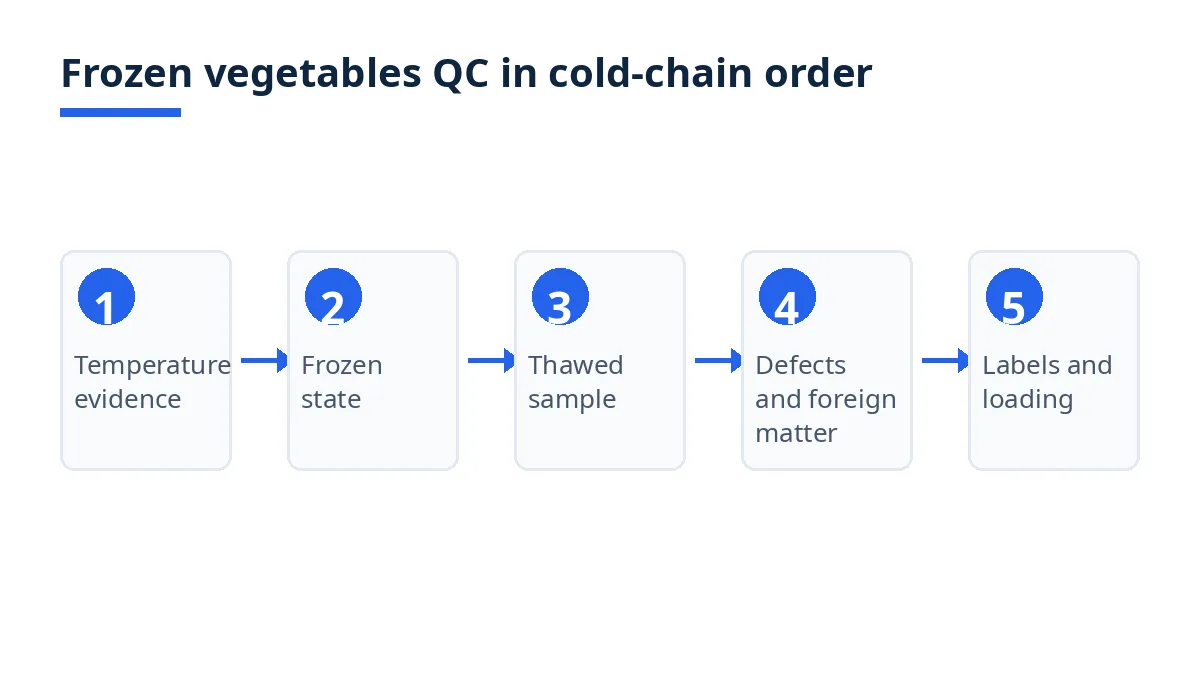
The full checklist (numbered, printable)
1. Temperature evidence before opening anything
Check cold-store and transport temperature records for the full period from freezing to inspection, and note any gap or excursion, not only the reading on the day.
Check that product temperature at the start of transport was -18°C or colder. Codex advises transport in suitably insulated equipment that ideally maintains -18°C or colder, with compartments pre-cooled before loading.1
Probe sampled bags where the purchase order allows a destructive check, and record the warmest reading, not only the average.
Treat any rise warmer than -18°C as a finding under the purchase order, not as a pass because goods still feel hard. Codex advises any rise should be kept to a minimum and should not in any case be warmer than -12°C in the warmest package.1
Check that loading was fast and door-open time short, because Codex advises loading and unloading should be as fast as practicable and minimise temperature rise.1
2. Frozen state: IQF versus block, clumping, and freezer burn
Confirm presentation matches the order: individually quick frozen (IQF) pieces that pour freely, or a block as declared. Do not accept a block where IQF was ordered.
Shake each sampled bag gently while frozen. IQF peas, corn, or diced carrots should move as separate pieces, not as one solid mass.
Open one bag per sampled lot and check for clumping: pieces frozen together, an ice bridge between pieces, or a bag frozen into a slab all point to slow freezing or a thaw and refreeze event.
Check for loose ice inside the bag and ice crystals coating the pieces. Heavy ice inside the pack, or pieces cemented by ice, is a finding.
Check for freezer burn on exposed surfaces: pale, dry, whitish or greyish patches, and a toughened surface near the top of the bag or near a damaged seal.
3. Thawed sample: cut, colour, blanching, texture, and drip
Thaw a controlled sample exactly as the purchase order or approved method directs, and keep one portion frozen for comparison. Record the thaw method, because results from different methods are not comparable.
Check cut and size against the approved sample: whole, sliced, diced, or florets as ordered, with uniform pieces within each bag. Note mixed cuts, oversized pieces, and a high share of fragments.
Check colour against the sample while thawed and again after cooking. Dull, browned, or uneven colour can point to blanching or storage problems.
Check blanching evidence where provided, and judge the cooked result: a raw-tasting or tough result may point to under-blanching, while a mushy, flavourless result may point to over-blanching. Codex notes the blanching schedule may be an essential quality provision.1
Cook a sample portion by the method the buyer will use, and check texture: pieces should hold their shape without turning to pulp, and florets or beans should not fall apart on stirring.
Measure thaw loss where the order requires it: weigh the sample before and after thawing and draining by the agreed method, and record a number, not a judgement.
Check flavour and odour after cooking against the sample, noting any sour, stale, or foreign odour. Do not taste a sample that shows signs of spoilage; record the reason instead.
4. Defects and foreign matter in the thawed sample
Spread the thawed sample on a clean tray and check piece by piece for damaged or blemished pieces, insect or disease damage, and overmature, fibrous, or woody pieces.
Check for extraneous vegetable material: leaves, stems, stalk ends, husk, or other plant matter that is not the vegetable ordered. Record it separately from damage to the vegetable itself.
Check for foreign matter of any other kind: soil, stones, plastic, or metal. Any hard foreign matter is a separate finding from a quality defect, recorded on its own line.
Check uniformity within each bag and across bags: one bag of bright, firm pieces and another of dull, broken pieces in the same carton points to mixed lots or uneven freezing.
For mixed vegetables, check the declared mix: each vegetable present in the proportion the specification gives, with none missing or dominating the bag.
5. Documents and laboratory evidence
Check that each lot can be traced from the sampled carton back to a production date and batch, and that the batch on the carton matches the batch on the documents.
Review process documents where the order requires them, including blanching and freezing records for sampled lots. Note any lot whose records are missing rather than assuming it matches the others.
Review laboratory evidence where required, and confirm every report names the vegetable, cut, lot, and test method. A report for a different vegetable or an unnamed lot does not clear the sampled lot.
6. Labels, packing, cartons, and loading
Check the label against approved artwork: vegetable name, the words quick-frozen or frozen as used in the destination market, net quantity, and storage instructions. EU quick-frozen labelling must include the sales name, the indication quick-frozen, and batch identification, with storage temperature information for the final consumer.2
Check date marking and storage instructions: the date of minimum durability and any special storage condition the date depends on should be declared.4 A missing storage temperature is a label failure, not a minor note.
Check that lot identification is present and legible on each container, so the producing factory and lot can be identified.4
Check carton contents and ratios: packs per carton, cartons per pallet, and mixed cartons only where the order allows them. Weigh sampled cartons against the packing list.
Check carton condition and markings: no crushed, wet, or softened cartons, no torn liners, and markings matching the packing list and the lot inside.
At loading, check the container was pre-cooled, pallets are stowed so air can circulate, and the final temperature reading is recorded before the doors close.
When should this checklist be used?
Use it at final inspection, when goods are frozen, packed, and ready for loading, with a thawed sample taken during the same visit. For first orders, also use it earlier, while blanching and freezing records can still be corrected.
Who should complete it?
The buyer, a local agent, or an independent inspector can complete it, using the approved sample, the purchase order, and a randomly drawn sample. They must be able to probe product temperature and cook a thawed sample, not only look at frozen bags.
What are the most common failures?
Clumped IQF pieces, heavy ice inside the bag, freezer burn, high drip loss with soft texture after cooking, and missing storage temperature or lot codes on labels are the failures buyers find most often.
Can a third party do it?
Yes, if you share the presentation, size or grade, defect classes, acceptance numbers, and thaw method first. Without the thaw method, a third party result cannot be compared with your own.
Next steps on Exportain
Before production starts, agree the presentation, size or grade, defect classes, and thaw method in writing, then read the AQL acceptance quality limit explainer and the pre-shipment inspection guide, and plan the check with inspection services.
Sources
- Code of Practice for the Processing and Handling of Quick Frozen Foods (CXC 8-1976). Codex Alimentarius Commission (accessed )
- Quick-frozen food: summary of Council Directive 89/108/EEC on quick-frozen foodstuffs for human consumption. European Union (accessed )
- SIST ISO 2859-1:2003 - Sampling procedures for inspection by attributes, Part 1: Sampling schemes indexed by acceptance quality limit (AQL). International Organization for Standardization, (accessed )
- General Standard for the Labelling of Prepackaged Foods (CXS 1-1985). Codex Alimentarius Commission (accessed )
About the author
Sourcing from Bangladesh?
Post a request for quotation and suppliers on Exportain can send you their quotes directly.
Post an RFQ