Frozen Shrimp Lead Time From Bangladesh: Production and Shipping Timeline
Plan a frozen shrimp order from Bangladesh backwards from the arrival date: sample approval, raw material, processing and freezing, inspection, export clearance and transit, with the cold chain held at -18 degrees Celsius or colder throughout.
Short answer
A frozen shrimp order from Bangladesh has no single fixed lead time. Plan backwards from the arrival date: lock the specification, approve samples, reserve raw material, produce and freeze, test and inspect, clear for export, and ship, holding the cold chain at -18 degrees Celsius or colder and a buffer before loading for any laboratory retest or document correction.

On this page
Key takeaways
There is no single fixed frozen shrimp lead time from Bangladesh: the clock runs from a locked specification to clearance at destination, so plan backwards from the arrival date.
Sample approval, raw-material reservation, production and freezing, laboratory results and inspection, and export clearance are gates: each must close before the next stage starts.
Quick-frozen shrimp must reach -18 degrees Celsius or colder at the thermal centre and stay deep frozen through transport, storage and distribution.
The Bangladesh export set, including the Bill of Export approved before loading and a Department of Fisheries certificate where the destination requires it, must be complete before loading.
Compare quotations only on the same delivery term and named place, with dated lines for every stage, and hold a buffer before loading for a retest or a document correction.
A frozen shrimp order from Bangladesh has no single lead time you can look up. The clock runs from the day your specification is locked, not from the day you first ask for a price, and it ends only when the container clears at destination. Plan it backwards: fix the arrival date, then agree a line for sampling, raw material, production, inspection, export clearance and transit, with a buffer for the gate that slips.
That sequence is where the order is won or lost. A sample approved late pushes production into a different raw-material window. A laboratory result that arrives after stuffing forces a choice between waiting and shipping without it. A document set that does not match the goods stops the container at the port.
Why this matters for buyers and sellers
For the buyer, lead time decides working capital and shelf planning. Frozen shrimp is a perishable product even when frozen, and the product must be kept deep frozen so as to maintain quality during transportation, storage and distribution.1 A delay at origin is time spent in a cold chain that must not break.
For the seller, the timeline protects the production plan. Raw shrimp must be received, graded, presented, frozen and packed in a sequence that cannot be compressed at the end without cutting a control. Quick-frozen shrimp is not regarded as completely frozen until the product temperature has reached -18 degrees Celsius or colder at the thermal centre.1
What should I know first about frozen shrimp?
Start with the specification, because it sets the timeline. The Codex standard for quick-frozen shrimps or prawns covers raw or partially or fully cooked product, peeled or unpeeled, and states that the pack shall not contain a mixture of genera.1 Species, presentation, count size, glaze basis, packing and labelling must therefore be written down before sampling starts. A change to any one of them after production has started is a new order in disguise.
Classification matters at the same early stage. Frozen shrimps and prawns other than cold-water varieties fall under subheading 030617, described as crustaceans, frozen, shrimps and prawns, excluding cold-water varieties, in shell or not.2 Confirm that code, and any national extension your destination requires, on the quotation.
Step-by-step: how it works
The steps below follow the order of the work, but the planning runs in reverse: agree the arrival date, then work backwards through destination clearance, transit, loading, inspection, production, raw material and sampling.
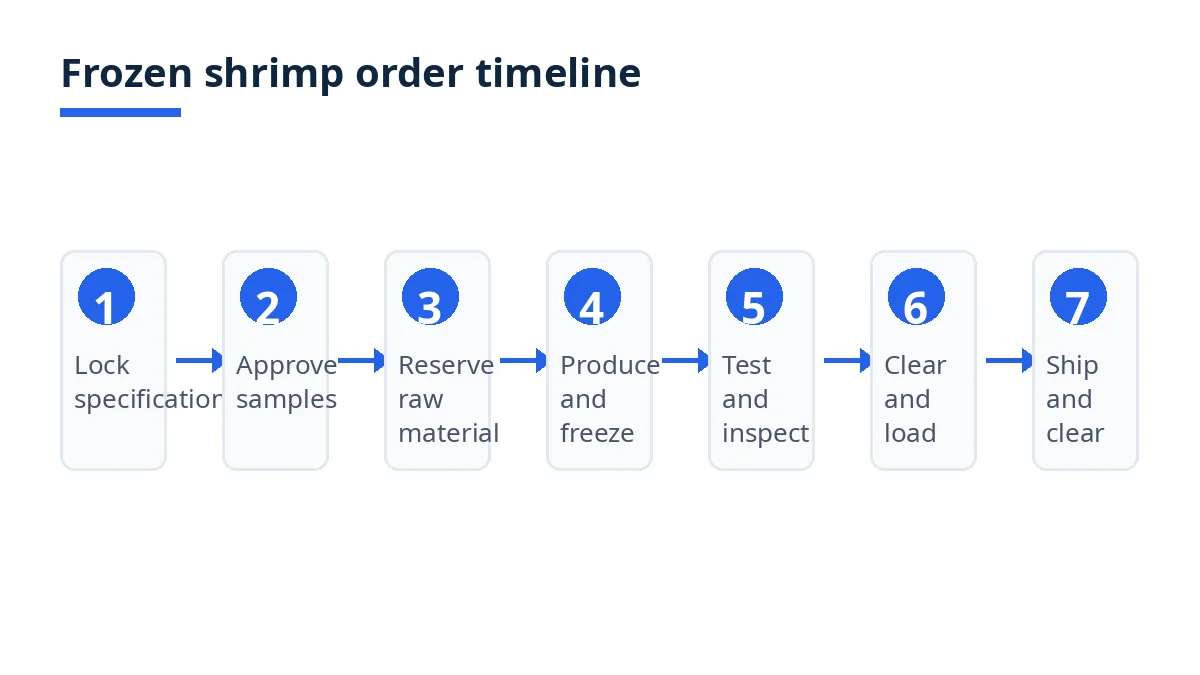
Lock the specification in writing. State species, presentation (for example headless shell-on, peeled and deveined, or cooked), count size, glaze basis, net weight basis, packing and labelling. Where the food has been glazed, the declaration of net contents must be exclusive of the glaze, and the label must state storage at -18 degrees Celsius or colder.1
Approve samples in two rounds. Order a first sample against the specification, then a pre-production sample from the production line, in the actual packing. Measure count, drained weight, glaze and appearance, and approve or list corrections in writing.
Reserve raw material against the confirmed quantity. Ask what is already held, what still has to be bought, and what happens if the next purchase lands short on your count size. Record the answer on the purchase order.
Run production, freezing and packing as one cold chain. Plan processing, freezing, glazing and packing as a continuous sequence, with cold storage between stages held at the same standard.1
Test and inspect before stuffing, not after. Agree the laboratory tests, the sampling plan and the inspector before production ends, so the result can arrive while the goods are still in cold storage. Lot sampling under the Codex standard uses a sampling plan with an AQL of 6.5.1
Complete export clearance and load only on an approved declaration. In Bangladesh, goods shall not be loaded or stuffed in containers for export unless an export declaration, known as the Bill of Export or Shipping Bill, is submitted to Customs and approved.3
Ship, track and clear at destination. Agree who books the reefer, who monitors temperature, who holds the document set during transit, and what happens if the vessel is delayed. Settle the delivery term before loading.
Plan backwards from the arrival date
Take the date the goods must be available at destination and subtract, in order, destination clearance, transit, loading and clearance, inspection and laboratory time, production, raw-material purchase and sampling. The result is the latest date you can confirm the order. If that date has already passed, the arrival date moves, the specification changes, or the order is split.
The table below shows the method with illustrative figures only. Example figures: the durations are placeholders for the dated lines you must obtain from your supplier, laboratory and carrier, not market averages.
Backward step | Dated line to obtain | Example figures |
|---|---|---|
Arrival | Goods available date | Week 12 |
Destination clearance | Clearance slot | Week 11 to 12 |
Ocean transit | Sailing and arrival dates | Week 7 to 11 |
Loading and clearance | Approved Bill of Export, stuffing date | Week 6 |
Inspection and laboratory results | Result date before stuffing | Week 5 to 6 |
Production and packing | Start and finish dates | Week 3 to 5 |
Raw-material purchase | Purchase and receipt dates | Week 2 to 3 |
Sampling and approval | Dispatch and approval dates | Week 1 to 2 |
Use the same table for every quotation. Two suppliers who quote the same total lead time but place inspection at different points are quoting different risks.
Costs, timelines and documents
What are the typical costs and timelines?
There is no typical timeline a guide can state as fact for frozen shrimp from Bangladesh, because the timeline is set by your specification, the supplier's raw-material position, the laboratory and inspection plan, and the delivery term. Read the frozen shrimp price guide alongside this guide before you compare quotations, for how glaze, count size and net weight change what a price means.
Costs that sit inside the timeline, rather than inside the unit price, are the ones buyers most often miss: sample freight, laboratory testing, cold storage while results are awaited, and destination storage if clearance slips. Ask for each as a named line, with the party who pays it under your delivery term.
The Incoterms 2020 rules set out 11 rules with a clear allocation of cost, risk and obligations.4 Under FOB, delivery and risk transfer sit at loading on board, while under CIF the seller also arranges freight and insurance to the destination port, with risk still transferring at loading. Compare timelines only on the same rule and the same named place. See the Incoterms guide for shipments from Bangladesh.
Which documents are needed?
The Bangladesh export set is fixed by Customs and must be complete before loading. The documents enclosed with the Bill of Export include the export letter of credit, or where there is no letter of credit, the export contract or purchase order or export guarantee approved by the negotiating bank; the commercial invoice; the packing list; the EXP form certified by an authorized dealer; the certificate of origin issued by the Export Promotion Bureau or a Chamber of Commerce and Industry; and VAT registration and taxpayer identification documents.3
For frozen fish, one further document can gate the whole shipment: Bangladesh Customs states that a quality control certificate by the Department of Fisheries is necessary as per the requirements of the country of destination for frozen fish.3 Ask at the start of the order whether your destination requires it.
Destination documents sit on top of the Bangladesh set. For the United States, every importer of fish or fishery products must either obtain the product from a country with an active memorandum of understanding covering the product, or have and implement written verification procedures showing the product was processed in accordance with the seafood HACCP requirements, including specifications and affirmative steps such as obtaining the processor's HACCP records for the specific lot.5 For the European Union, Commission Implementing Regulation (EU) 2021/405 lays down the lists of third countries authorised for entry of certain animals and goods intended for human consumption, and Bangladesh appears in that list for fishery products.6 Confirm the establishment and certificate model before production, because a mismatched certificate cannot be corrected after sailing.
Bangladesh-specific rules and tips
Confirm the destination gate before you confirm the order. The EU list, the US verification rule and the Department of Fisheries certificate are three different gates, for different destinations.
Keep one name, one code and one specification across every paper. The Bill of Export names the exporter and the foreign buyer and describes the goods and their value.3 The name on the trade licence, quotation, proforma invoice, EXP form and payment account should match, and the HS subheading, count size, glaze basis and net weight should read the same on the invoice, packing list, certificate and bill of lading.
Treat the cold chain as a timeline item, not a quality note. The product must be kept deep frozen during transportation, storage and distribution, and the label must state storage at -18 degrees Celsius or colder.1 Put temperature monitoring, reefer set point, pre-cooling and a response plan for a temperature excursion into the purchase order.
Ask which inputs are already in hand. Packaging, cartons, labels and glaze ingredients are small items with their own supply lines. A production slot is only real when the packing for that lot is also ready.
Plan for the laboratory, not only for the factory. Agree the laboratory, the test list and the reporting date before production starts, and hold cold-storage time for a retest.
Mistakes and red flags
What are the most common mistakes?
Accepting a single delivery week. A single week hides where inspection, laboratory work and clearance sit. Ask for the dated lines in the backward-planning table instead.
Approving a sample without measured results. Appearance alone does not confirm count size, drained weight or glaze.
Booking production before the destination gate is confirmed. If the EU establishment, the US verification file or the Department of Fisheries certificate is not settled, production is building stock that may not be shippable to your market.
Treating FOB and CIF as the same timeline. The two rules share a risk point at loading but allocate freight, insurance and the cost of delay differently.4
Letting the document set drift from the goods. A count size, glaze basis or carton count changed during production must flow into the invoice, packing list and certificate before loading.
Shipping without the laboratory result to save a sailing. A missed sailing costs days. A shipment held at destination costs the lot, the freight and the customer.
Reading a profile or a badge as a delivery promise. A badge is not a guarantee of capacity, quality or delivery. See the frozen shrimp exporters checklist for the evidence to ask for before you order.
Checklist
Before you confirm, every line should be answered in writing.
Arrival date fixed, with the backward-planning table completed from that date.
Specification locked: species, presentation, count size, glaze basis, net weight exclusive of glaze, packing and labelling.1
Sample measured and approved in writing, including a pre-production sample.
Raw-material position confirmed against the quantity and count size.
Production, freezing, glazing and packing planned as one cold chain at -18 degrees Celsius or colder.1
Laboratory, test list, sampling plan and result date agreed before production ends; inspection agreed before stuffing.
Delivery term and named place settled on every quotation, on the same rule for comparison.4
Bangladesh export set agreed: invoice, packing list, EXP form, certificate of origin, Bill of Export, and Department of Fisheries certificate where required.3
Destination gate confirmed: EU list and certificate model, or US verification file, as applicable.5 6
HS subheading 030617 confirmed, with any national extension for the destination.2
Reefer booking, temperature monitoring, a temperature-excursion plan, and a buffer before loading for a retest or a correction.
How Exportain helps
On Exportain, browse suppliers and post a request for quotation on the RFQ board with your specification, arrival date and backward-planning table, so suppliers quote against the same dates and delivery term. Ask each reply for sampling dates, raw-material position, laboratory and inspection plan, and clearance dates as separate lines.
Read the badges for what they record. Exportain Verified means Exportain has checked identity, phone, email and business registration, and Export Verified means it has checked the Export Registration Certificate (ERC).7 Factory Verified means it has reviewed photos of the manufacturer factory, while Trading Company Verified means it has reviewed photos of the trading company office or warehouse.7 Verification is a document review by staff, free, and never granted by membership plans, and it is not a factory inspection,7 8 so sample approval, laboratory results and inspection stay with you. When you accept a quotation, Exportain creates one order and one proforma invoice from the accepted terms.7
FAQs
What should I know first about frozen shrimp?
Know the specification before you ask for a timeline. Species, presentation, count size, glaze basis, packing and labelling set the production sequence, and the Codex standard covers raw or partially or fully cooked product, peeled or unpeeled.1 Frozen shrimps and prawns other than cold-water varieties fall under HS subheading 030617.2 Lock those points in writing.
What are the typical costs and timelines?
There is no single typical timeline, because sampling rounds, raw-material availability, laboratory and inspection capacity, and the delivery term all move it. Costs that sit inside the timeline include sample freight, laboratory testing, cold storage while results are awaited, and destination storage if clearance slips.4
Which documents are needed?
The Bangladesh set is the export contract or purchase order, commercial invoice, packing list, EXP form certified by an authorized dealer, certificate of origin, and the Bill of Export approved by Customs before loading.3 For frozen fish, a Department of Fisheries quality control certificate is necessary where the destination requires it.3 Added on top are the US importer verification file5 or the EU authorised-list and certificate model.6
What are the most common mistakes?
Accepting a single delivery week, approving a sample without measured results, booking production before the destination gate is confirmed, comparing FOB and CIF timelines as if they were the same,4 letting the document set drift from the goods, and shipping without a laboratory result to save a sailing. A badge is not a guarantee of delivery.7
Next steps on Exportain
Browse suppliers, then post your specification, arrival date and backward-planning table on the RFQ board so suppliers reply with dated lines for sampling, production, inspection and clearance. Before you confirm, read the Incoterms guide for shipments from Bangladesh to settle the delivery term on every quotation.
Sources
- Standard for Quick Frozen Shrimps or Prawns (CXS 92-1981). Codex Alimentarius Commission (accessed )
- Classification Detail — HS Code 030617. United Nations Statistics Division (accessed )
- Customs Clearance Procedures for Export. Bangladesh Customs, National Board of Revenue (accessed )
- Incoterms® 2020. International Chamber of Commerce (ICC) (accessed )
- 21 CFR 123.12 — Special requirements for imported products. GovRegs (accessed )
- Commission Implementing Regulation (EU) 2021/405 — list of third countries authorised for fishery products. European Union (accessed )
- Trust & Safety Center. Exportain (accessed )
- Supplier verification: Earn trust badges buyers can see. Exportain (accessed )
About the author
Sourcing from Bangladesh?
Post a request for quotation and suppliers on Exportain can send you their quotes directly.
Post an RFQ