Frozen Shrimp Exporters in Bangladesh: Verified Supplier Checklist
A pre-order verification checklist for frozen shrimp exporters in Bangladesh: identity, market listing, HACCP, traceability, cold chain, samples and inspection — what evidence to ask for, how to score it, and when to pause.
Short answer
Before you place a first order with a frozen shrimp exporter in Bangladesh, check the exporter and the processing plant behind it, not just the quotation. Confirm identity and export registration, market listing for your destination, a product- and plant-specific HACCP plan, lot traceability back to raw material, cold-chain records, and an agreed sample and inspection plan. Score each check pass, conditional, or fail, and hold the order until every fail is closed with evidence.

On this page
Use this checklist before you trust a frozen shrimp exporter in Bangladesh with a first order, not after the shrimp is already packed. It checks the exporter, the processing plant behind the quotation, and the evidence linking the two. A shipment check looks at cartons and lab results for one consignment; this list looks one step earlier, at whether the supplier can repeat that result in your market, under your specification. If a check fails here, a clean sample does not close it.
Why this checklist matters
In the European Union, specific hygiene rules apply to food of animal origin, including fishery products.1 In the United States, the seafood rule requires a hazard analysis and, where hazards are reasonably likely to occur, a written HACCP plan specific to each processing location and each kind of fishery product.2 A quotation does not name the processing plant, its market listing, its HACCP coverage for your product form, or lot traceability to raw material. Those four gaps are where most pre-order trouble sits. It also protects later orders: a later change of plant, source, pack, or provider changes the product.
Before you start
First, write a one-page specification: species, form, count, glaze, pack, marking, and markets. Frozen shrimps and prawns are shown at subheading 030613 in trade data.3
Second, name the decision rule before you see replies. Use three results: pass (evidence seen, matching, current), conditional (proceed only after a named item closes by a named date), and fail (no order until evidence is checked).
Third, the buyer, or the buyer's agent, should complete identity, listing, and document checks. For United States buyers, importer verification rules require evaluating foreign suppliers and carrying out verification activities.4 5 Keep one file per exporter, with dated evidence, the checker name, and the result for each item.
The full checklist (numbered, printable)
Print this section and work top to bottom; a strong cold chain does not cure a missing market listing, and a strong HACCP file does not cure a traceability gap.
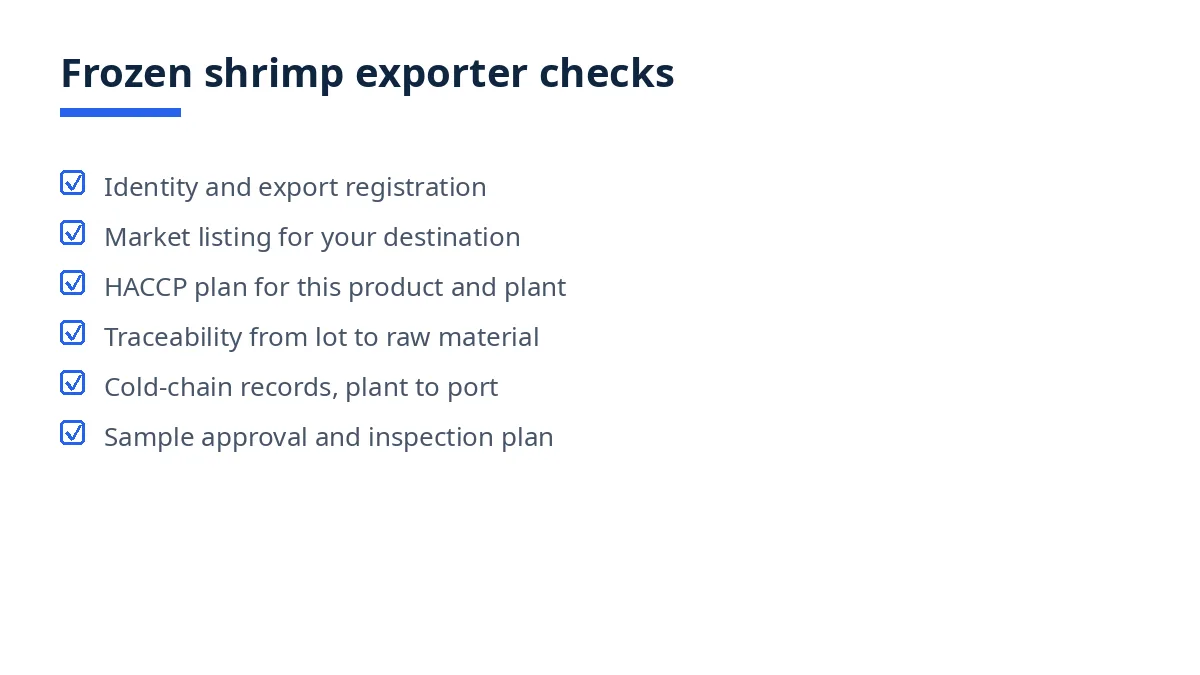
Identity: legal name, address, and trading name matching on all documents; current trade licence and Export Registration Certificate for the contracting company.
Processing plant: exporter as processor, trader buying from a named processor, or group using more than one plant; run the plant items for each plant used.
Market listing: listing covering your market, for the named plant and product; plant name, address, and approval number checked against it, under European Union import controls for food and feed.6
Bangladesh inspection route: plant coverage under Bangladesh fish inspection and quality control rules, and the authority inspecting and certifying its consignments; Bangladesh has Fisheries Inspection and Quality Control Rules dating from 1997.7
HACCP plan: plan, or controlled summary naming product, plant, and plan date, specific to your product form, not a generic seafood plan; Codex sets out seven HACCP principles for fish and fishery products.8
Hazard analysis: biological, chemical, and physical hazards identified for your shrimp, and how each is controlled; United States Food and Drug Administration hazards and controls guidance as reference.9
Prerequisite programs: personnel hygiene, cleaning and disinfection, water and ice control, pest control, and waste handling, on which the HACCP plan depends.
Traceability: raw-material source, and lot or batch coding linking a finished carton back to that source, including product and species identification, processing location, and chain of custody information.10
Traceability test: lot code from a sample carton, with raw-material, processing, and dispatch records for that lot, with dates, before bulk.
Residue controls: veterinary drugs, pesticides, and other chemical inputs controlled at farm and intake level, including withdrawal periods; recent test reports naming laboratory, sample, and date.
Species identity: species confirmed at intake and packing, with substitution between species, or between farmed and wild-caught sources, prevented.
Freezing and storage: freezing method, frozen storage arrangements, and temperature monitoring records; agreed frozen storage condition written into the specification.
Cold chain to port: handover records covering loading checks and the custody transfer point, with no unrecorded gap between plant dispatch and port loading.
Count, glaze, and net weight: count method, glaze application and declaration, and net weight excluding glaze; United States guidance has long treated including glaze ice as part of frozen seafood weight as a fraudulent practice.11
Packing and marking: pack specification and sample carton label; species, product form, count, net weight, lot code, plant identification, and origin as your market requires.
Sample approval: sample plan before bulk, covering quantity, product form, tests, payment for testing, and what counts as approval; approval recorded with sample identity and date.
Pre-shipment inspection: inspector, inspection scope, and outcome on failure: rework, re-inspection, or rejection of the affected lot.
Sampling and testing method: method agreed in writing, naming the standard or method used where one is relied on, and the laboratory running the tests.
Export documents: sample document set for your market; plant, species, quantity, and lot matching across health certificate, invoice, packing list, and certificate of origin. In Bangladesh, goods may not be loaded unless the Bill of Export is submitted to Customs and approved, with invoice, packing list, EXP form, and certificate of origin enclosed.12
Capacity: production and cold-storage capacity reserved for your order, raw-material plan for your order period, and the position if raw material is short.
Subcontracting and change control: any step subcontracted, from processing to freezing, packing, or cold storage; change of plant, source, pack, or provider requiring notice and re-approval before shipment.
Commercial terms: quotations compared only on the same delivery term, specification, and net-weight basis; Incoterms 2020 rule stated on every quotation.13
Payment and disputes: payment terms, documents triggering payment, remedy for a failed inspection or document mismatch, and law and forum for disputes, agreed before the first order.
Re-check triggers: re-check date, and triggers forcing an earlier re-check: change of plant or source, failed inspection, rejected consignment, new product form, or new destination market.
Score each item pass, conditional, or fail, with the evidence reference beside it. A fail on items 1, 3, 5, 8, or 12 should block a first order until closed.
Common failures and how to fix them
Certificate names a different plant than the quotation. Correct the set to name one plant throughout; re-run items 2 and 3 for the plant actually named.
HACCP plan is generic. A plan covering all seafood, plants, and product forms covers none of them in the sense the United States rule requires: a plan specific to each location and kind of product.2 Ask for the product-specific and plant-specific plan, or a controlled extract with hazards, critical control points, and critical limits.
Traceability stops at the trader. Run the lot-code test in item 9 on a sample before bulk; make lot-level traceability a purchase order condition.
Cold-chain records have gaps. Ask for the complete record for a sample shipment; name custody points in the contract; require a custody record with every consignment.
Sample passes but bulk differs. Hold the affected lot under item 17; require re-approval for any specification change; compare bulk against the written sample approval.
Documents disagree with each other. Return the set for correction before shipment; check it against the Bill of Export documents listed in item 19.12
Downloadable template / summary table
Copy the table below, add one row per checklist item, and file it with the evidence.
Check group | Evidence to file | Result | Owner and date |
|---|---|---|---|
Identity and legal standing | Trade licence, ERC | Pass, conditional, or fail | Buyer, date checked |
Market listing and plant identity | Market listing, named plant and product | Pass, conditional, or fail | Buyer, date checked |
HACCP and food safety system | HACCP plan, hazard analysis | Pass, conditional, or fail | Reviewer, date checked |
Raw material and traceability | Source records, lot code, traceability test | Pass, conditional, or fail | Buyer, date checked |
Cold chain, plant to port | Storage and handover records | Pass, conditional, or fail | Inspector, date checked |
Product, pack, and weight | Specification, sample approval, carton label | Pass, conditional, or fail | Buyer, date checked |
Samples and inspection | Sample plan, inspection and lab reports | Pass, conditional, or fail | Inspector, date checked |
Documents and commercial terms | Health certificate, invoice, packing list, origin certificate | Pass, conditional, or fail | Buyer, date checked |
Example figures: the scoring in this table is a working method, not a required standard.
How Exportain helps
On Exportain, browse suppliers and post your specification, markets, and delivery term on the RFQ board, so exporters quote on the same product, weight basis, and listing question. Ask each reply for plant, listing, HACCP position, traceability method, and cold-chain record, and file replies against the checklist, not by price alone. Badges record only this: Exportain Verified covers identity, phone, email, and registration; Export Verified covers the ERC; Factory and Trading Company Verified cover factory or office photos.14 Verification is a document and photo review, not a factory inspection, so this guide's checks remain with the buyer.14 15
FAQs
When should this checklist be used?
Use it before a first order with a new exporter, for a new product or market, and on any change of plant, source, or provider. It approves the supplier; shipment checks still apply per consignment.
Who should complete it?
The buyer or agent should complete identity, listing, and document items; a food safety reviewer, the HACCP items; and an inspector, the visit, sample, and pre-shipment items. The buyer should still read the raw evidence.
What are the most common failures?
A different plant on the certificate, a generic HACCP plan, traceability stopping at the trader, cold-chain gaps, bulk differing from the sample, and documents disagreeing. Each is fixed by closing the evidence gap.
Can a third party do it?
Yes, for plant visits, sample and pre-shipment inspection, and reporting on HACCP, traceability, and cold-chain records. The buyer should still set the specification, decision rule, and evidence to file, and receive the raw reports, including any importer verification certificate or facility inspection used.4
Next steps on Exportain
Browse suppliers, then post your specification, markets, and delivery term on the RFQ board so replies can be scored against this checklist on the same basis. Before confirming a supplier, read how supplier verification works on Exportain to see what a badge records and what still needs your own check.
Sources
- Regulation (EC) No 853/2004 laying down specific hygiene rules for food of animal origin. European Union (accessed )
- 21 CFR 123.6 — Hazard analysis and Hazard Analysis Critical Control Point (HACCP) plan. FindLaw (accessed )
- Frozen shrimps and prawns exports to Bangladesh. World Integrated Trade Solution (WITS) (accessed )
- Code of Federal Regulations Title 21. Food and Drugs 21 CFR § 123.12. FindLaw (accessed )
- FSMA Final Rule on Foreign Supplier Verification Programs (FSVP) for Importers of Food for Humans and Animals. U.S. Food and Drug Administration (accessed )
- Import controls of food and feed Q&As. European Commission (accessed )
- Fisheries Inspection and Quality Control Rules 1997. Department of Fisheries, Bangladesh (accessed )
- Code of Practice for Fish and Fishery Products (CXC 52-2003). FAO and WHO, Codex Alimentarius (accessed )
- Fish and Fishery Products Hazards and Controls. U.S. Food and Drug Administration (accessed )
- Seafood Exporter Toolkit. WWF-US (accessed )
- Guidance for Industry: 1991 Letter to Seafood Manufacturers Regarding the Fraudulent Practice of Including Glaze (ice) as Part of the Weight of Frozen Seafood. U.S. Food and Drug Administration, (accessed )
- Customs Clearance Procedures for Export. Bangladesh Customs, National Board of Revenue (accessed )
- Incoterms® 2020. International Chamber of Commerce (ICC) (accessed )
- Supplier verification: Earn trust badges buyers can see. Exportain (accessed )
- Trust & Safety Center. Exportain (accessed )
About the author
Sourcing from Bangladesh?
Post a request for quotation and suppliers on Exportain can send you their quotes directly.
Post an RFQ