Top Frozen Fish Fillets Manufacturers in Bangladesh: How to Find and Verify Them
Nine fillet-specific checks for shortlisting frozen fish fillets manufacturers in Bangladesh: the written fillet form, deglazed net weight, trim and yield, species evidence, size grading, cold chain, defect limits, carton labelling, and the named fillet line.
Short answer
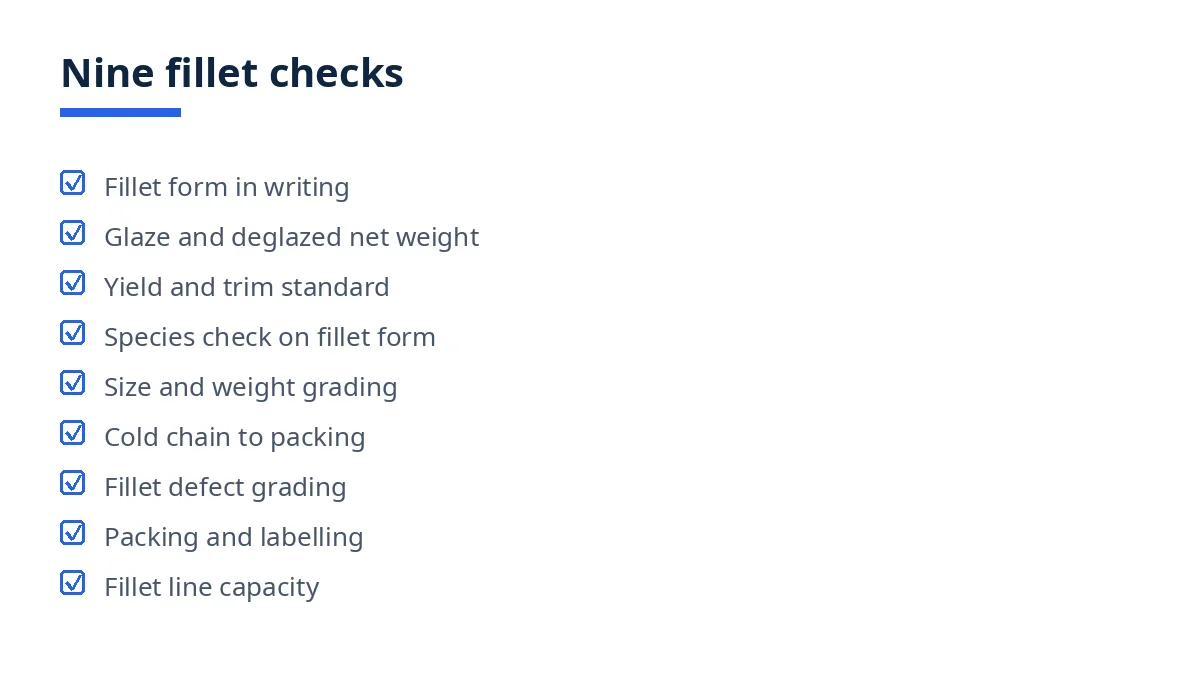
Frozen fish fillets manufacturers in Bangladesh should be shortlisted with nine fillet-specific checks, not a ranking: the written fillet form, the deglazed net-weight and glaze basis, the trim and yield standard, species evidence on fillet form, size and weight grading, the cold chain from filleting to packing, defect grading, carton and label details, and the capacity of the named fillet line.

On this page
A frozen fish fillet order fails in ways a whole-fish order does not. Once a fish has been cut, skinned, trimmed and frozen, the buyer can no longer see the whole animal, its original size, or how much of the weight is fish and how much is ice. The nine checks below name no factory.
Key takeaways
A fillet is defined by its cut, not by its species alone: skin-on or skin-off, boneless or bone-in, individually quick frozen or block frozen, and portion or whole fillet must each be stated in writing.
The weight that matters is the deglazed net weight. The Codex standard requires the declared net contents of a glazed product to exclude the glaze.1
Species substitution is harder to spot in fillet form because cutting removes the features used to identify a fish, so the check belongs in the order terms, not in visual inspection alone.2
Yield, trim, size grading and defect grading are separate specifications. A price quoted without all four is not a price for the product you intend to buy.
Bangladesh fishery export certification runs through the Department of Fisheries e-certification system, covering licences, health certificates, inspection, test reports and certificate issuance.3
The list: nine fillet checks before you shortlist a manufacturer
Each check states what to ask, why it matters for fillets, and how to fix a gap before it becomes a dispute.
1. Pin down the fillet form in writing
What to ask: Species with its scientific name, skin-on or skin-off, boneless or bone-in, whole fillet or portion, individually quick frozen (IQF) or block frozen, and the exact cut. Ask whether pinbones are removed if the fillet is sold as boneless.
Why it matters for fillets: The Codex standard defines quick frozen fillets as slices removed from the carcass of the same species by cuts parallel to the backbone, and allows a boneless presentation only when boning is complete, including pinbones.1
How to fix it: Write the form as a single line in the specification and the request for quotation (RFQ), and require the supplier to repeat it. A species name alone leaves the form undefined.
2. Set the glaze and net-weight basis before you compare prices
What to ask: The glaze percentage, whether the price is per kilogram of glazed or deglazed net weight, and the deglazing method to be used at inspection.
Why it matters for fillets: Glaze is a thin ice layer that protects a frozen fillet from dehydration, but it is not fish. The Codex standard states that where a food has been glazed, the declaration of net contents shall be exclusive of the glaze, and it gives a deglazing method for weighing after glaze removal.1 For quick frozen blocks, the companion standard derives glaze weight as gross weight minus deglazed net weight.4 A lower price per glazed kilogram can therefore be a higher price per kilogram of fish.
How to fix it: Price every quotation on deglazed net weight, state the maximum glaze percentage in the order, and agree that inspection weighs a deglazed sample. In research on 111 retail prepackaged frozen fillets, 10 samples (9 per cent) were short-weighted, average glaze was 5 per cent, and seven samples exceeded 10 per cent.2
3. Agree the fillet yield and trim standard
What to ask: What is trimmed, and what stays: belly flap, bloodline, tail end, belly fat, and dark muscle. Ask whether yield is measured from whole fish or gutted weight, and over how many fillets it is averaged.
Why it matters for fillets: Two plants cutting the same species can produce fillets of different weight and appearance from the same fish, simply because one trims harder than the other. Yield without a trim definition has no meaning.
How to fix it: Attach a trim description and a photograph of the approved sample fillet, front and back, to the specification, and state the yield basis in the same paragraph. Example figures: a skin-off, boneless fillet with belly flap and bloodline removed, with yield as fillet weight divided by gutted weight. These figures illustrate a format, not any supplier's yield.
4. Run a species substitution check suited to fillet form
What to ask: The species name on the label, the acceptable market name for your destination market, and the supplier's evidence for species identity: raw-material records, lot traceability from intake to packing, and, where risk justifies it, a laboratory test on the sample.
Why it matters for fillets: Cutting removes the features used to recognise a species, and the research cited above notes that this makes intentional mislabelling hard to detect from appearance alone.2 In that study, substitution was found in two of the 111 samples and three further samples carried unacceptable market names.2
How to fix it: Require the scientific name and the market name on every document, from quotation to carton label, and keep the lot code on the sample. Where a market publishes a seafood list of acceptable market names, check the name against it before approving label artwork.
5. Grade fillets by size and weight, not by a single average
What to ask: The size grade as a weight band per fillet or a count per kilogram, its tolerance, and how mixed sizes inside a carton are handled.
Why it matters for fillets: Fillets from one batch vary in size because fish vary in size. An average hides that spread: a carton averaging 150 grams per fillet can contain fillets from 100 to 200 grams, which cook and pack unevenly.
How to fix it: State the grade as a band with a tolerance, and inspect by counting and weighing individual fillets rather than weighing the carton alone. Example figures: 120 to 160 grams per fillet, with no more than 10 per cent outside the band in any inspected carton. Set the band from your own needs and the approved sample.
6. Trace the cold chain from filleting to packing
What to ask: The time from filleting to freezing, the freezing method, the core temperature, the storage temperature, and whether temperature is logged from filleting through loading.
Why it matters for fillets: A fillet has far more exposed surface than a whole fish, so it dehydrates and oxidises faster when temperature control slips. The Codex standard requires quick freezing to minus 18 degrees Celsius or colder at the thermal centre, and deep-frozen keeping during transportation, storage and distribution.1 A gap between filleting and freezing, or a thaw and refreeze, shows up later as dehydration, off flavour and short shelf life.
How to fix it: Ask for the plant's time-and-temperature record for a recent fillet run, and write the storage temperature into the order and the carton label.
7. Apply fillet defect grading, not a general fish inspection
What to ask: How the supplier grades fillet-specific defects: dehydration area, bones in a boneless pack, parasites in skinless fillets, foreign matter, and flesh abnormalities.
Why it matters for fillets: The Codex standard treats these as defined defectives with measurable limits. Dehydration over 10 per cent of the sample surface counts as a defect, and in a boneless pack, more than one bone per kilogram at or above 10 millimetres long, or 1 millimetre in diameter, counts as a defect.1 For skinless fillets, the parasite check examines the thawed sample by candling on a translucent sheet.1
How to fix it: Copy the defect limits for your product into the inspection instruction, and sample lots under a stated plan: the Codex standard samples lots under a plan with an acceptance quality limit (AQL) of 6.5, with a sample unit of at least 1 kilogram for individually quick frozen product.1 The frozen fish fillets quality control checklist turns these limits into an inspection sheet.
8. Check packing and labelling as a fillet specification
What to ask: Inner bag and master carton, carton net weight and glaze declaration, lot code, species and form on the carton, storage instruction, and the heading 0304 classification.
Why it matters for fillets: The label is where checks 1, 2 and 5 either hold or collapse. The Codex standard requires the label to state the form of presentation near the name of the food, to carry the term "quick frozen" (or "frozen" where customary), and to state storage at minus 18 degrees Celsius or colder.1 Heading 0304 covers fish fillets and other fish meat, and the United Nations registry gives subheading 030483 for frozen fillets of flat fish as one example.5
How to fix it: Approve the carton artwork before production, and check the first cartons against it: species, form, skin and bone state, IQF or block, net weight basis, lot code and storage instruction. Confirm the full classification code with the supplier's customs broker. The HS code guide for frozen fish fillets explains how the heading breaks down by species and state.
9. Match the plant to fillet work, not to frozen fish in general
What to ask: Whether the plant runs a fillet line or buys in fillets for packing, the line's daily output, the minimum economic order, and the export documents the plant itself holds.
Why it matters for fillets: A plant set up for whole frozen fish may have no fillet line at all, and a plant that packs bought-in fillets cannot control checks 3, 5 and 6. Capacity in tonnes of frozen fish per month says nothing about fillet output, because filleting is limited by cutting tables and skilled trimmers, not cold-store volume.
How to fix it: Ask which line will cut your order, what it produced in its last full fillet run, and what the smallest run it can schedule is. The Department of Fisheries e-certification system gives traders online access to licences, health certificates, inspection, test reports and certificate issuance.3 Ask for a recent certificate for a fillet shipment to a market like yours, and check that its plant name matches the cutting plant.
Summary table
Check | Question to ask | Evidence that passes it |
|---|---|---|
1. Fillet form | Skin, bones, IQF or block, portion | Written form line in the quotation |
2. Glaze and net weight | Glazed or deglazed basis | Deglazed net weight agreed |
3. Yield and trim | What is trimmed, yield basis | Trim description, sample photograph |
4. Species identity | Scientific name, market name, traceability | Intake-to-packing lot record |
5. Size and weight grade | Weight band, count per kilogram | Band with tolerance, fillets weighed |
6. Cold chain | Filleting-to-freezing time | Time-and-temperature record from filleting |
7. Defect grading | Dehydration, bones, parasites | Codex defect limits in the instruction |
8. Packing and labelling | Carton, lot code, HS code | Approved carton artwork matched |
9. Fillet line capacity | Own fillet line, smallest run | Named line, run record, certificate |
Where fillet factories sit, and what sets capacity, MOQ and price
Do not shortlist by region. A fillet supplier is one plant with one cutting line, and the plant name on the certificate, quotation and carton must match.
Capacity for fillets is set by the cutting line: the number of trimmers, the species, and the trim standard in check 3. A heavier trim lowers saleable fillet weight from the same intake, so it lowers capacity and raises unit price. MOQ follows the same logic: the smallest run the line can cut, freeze and pack without changing over.
Price drivers for fillets are species and raw-material cost, trim and yield, size grade, glaze and net-weight basis, packing, and documentation. Compare quotations only after checks 1, 2, 3 and 5 match. One context figure, used with care: in fiscal year 2022-23, Bangladesh exported frozen and live fish worth 422 million dollars, down from 532 million dollars the previous fiscal year.3 That figure covers frozen and live fish together, not fillets alone.
How Exportain helps
Exportain is a B2B marketplace for sourcing from Bangladesh. Buyers search published products by keyword and category, and can filter to suppliers holding the Exportain Verified badge, sample availability and OEM or ODM capability.6 Each supplier profile shows its verification level, location, main products and the certifications the supplier has declared.6
Use the badges as a starting filter, not a conclusion. Verification on Exportain is a document and photo review by the Exportain team, not a factory inspection, and membership never grants a badge.7 Run the nine checks above on your shortlist, and keep the exchange in the RFQ thread so the agreed terms are recorded in one place. The guide to how supplier verification works on Exportain sets out what each badge covers and what it does not.
FAQs
What is the biggest mistake?
Buying fillets on a species name and a price, without a written form, glaze basis, trim standard and size grade. Once those four are missing, supplier and buyer are pricing different products.
How can I avoid it?
Write the nine checks into a one-page specification before contacting any supplier: form, glaze basis, trim, species evidence, size grade, cold-chain record, defect limits, carton and label, and the named fillet line. Send the identical page to every candidate, approve a sample against it, and inspect the shipment against it.
Who is responsible?
The supplier is responsible for cutting, freezing and packing fillets to the agreed specification and the approved sample. The buyer is responsible for making that specification complete and checkable. In a dispute, the side with the specification, the sealed sample and the inspection report is the side whose version counts.
Where can I get help?
Start with the records that exist: the Codex fillet standard, the Department of Fisheries e-certification system, and the registry for heading 0304.1 3 5 On Exportain, read what each profile badge covers before relying on it, and message the supplier through its profile.7 For the steps that follow shortlisting, read the guide to importing frozen fish fillets from Bangladesh.
Next steps on Exportain
Browse Bangladeshi suppliers and open each profile's verification checklist before you shortlist a fillet plant. Read how supplier verification works on Exportain so you know what each badge records and what it does not. Then post your fillet specification through Exportain RFQs, with form, glaze basis, trim and grade stated.
Sources
- Standard for Quick Frozen Fish Fillets (CXS 190-1995). Food and Agriculture Organization of the United Nations (accessed )
- An investigation into country of origin labeling, species authentication and short weighting of commercially sold frozen fish fillets. Chapman University / Food Control (via PubMed Central) (accessed )
- Bangladesh rolls out online certification system to simplify fish and seafood trade. International Collective in Support of Fishworkers (ICSF) (accessed )
- Codex Standard for Quick Frozen Blocks of Fish Fillet, Minced Fish Flesh and Mixtures of Fillets and Minced Fish Flesh (CODEX STAN 165-1989). Codex Alimentarius Commission (FAO/WHO) (accessed )
- HS Classification Detail: 030483 - Fish fillets; frozen, flat fish. United Nations Statistics Division (accessed )
- How to source and buy from Bangladesh. Exportain (accessed )
- Supplier verification: Earn trust badges buyers can see. Exportain (accessed )
About the author
Sourcing from Bangladesh?
Post a request for quotation and suppliers on Exportain can send you their quotes directly.
Post an RFQ