Quality Control Checklist for Frozen Fish Fillets From Bangladesh
A numbered QC checklist for frozen fish fillets from Bangladesh: fillet identity, pin-bones and trim, size grading, candling, sensory defects, deglazed net weight, labels and packing, with fixes for common failures.
Short answer
Use this frozen fish fillets quality control checklist before shipment to check fillet identity and presentation, pin-bone removal and trim against the approved sample, size grading on the purchase order basis, candling of skinless fillets for parasites, sensory and dehydration defects, and net weight after deglazing on fillets from Bangladesh. Agree every criterion and test method in the purchase order first.

On this page
Key takeaways
Check the cut, not just the carton: Codex CXS 190-1995 defines a fillet as slices from the same species cut parallel to the backbone, and a boneless presentation requires pin-bone removal to be completed.
Score boneless packs by CXS 190-1995 Section 8.4: more than one bone per kilogram at or over 10 mm long or 1 mm in diameter makes a sample unit defective; trim itself has no Codex figure, so the written trim standard carries it.
Candle skinless fillets under CXS 190-1995 Section 7.4 and score parasites under Section 8.3, and check dehydration under Section 8.1, where more than 10 percent of the surface showing deep moisture loss makes a unit defective.
Weigh fillets deglazed: net contents are declared exclusive of glaze under CXS 190-1995 Section 6.2, found by spraying off all glaze that can be seen or felt under Section 7.3.1, and size grades are read on the purchase order basis.
Use this checklist before shipment to check the cut: identity, pin-bones, trim, skin, grade and deglazed weight. Under Codex CXS 190-1995 Section 2.1, fillets are slices removed from the carcass of the same species by cuts parallel to the backbone.1 For whole fish, use the frozen fish quality control checklist; for the buying process, see how to import frozen fish fillets from Bangladesh.
Why this checklist matters
Pin-bones in a boneless pack, trim drift, skin on a skinless line and glaze counted as fish all hide inside a frozen pack. Check each point against the sample, trim standard and purchase order, recording a reading or count. Temperature is the floor: under Regulation (EC) No 853/2004, frozen fishery products must be kept at not more than -18 °C in all parts.2
Before you start
Do not begin until the references are complete: approved sample per species and presentation, purchase order, written trim standard with a photograph, grade and its basis, glaze and net weight basis, test list and packing specification. Agree every criterion first; sample randomly across cartons and dates.
Prepare a calibrated probe and scales, a tared pan and paper towels for the Section 7.3.1 deglazing test, and candling equipment for skinless fillets.1 Codex CXC 52-2003 Section 9.3.1 directs that accurate freezing records should be kept and core temperature monitored regularly, so request those records first.3 FDA guidance assists processors in developing HACCP plans, with chapters on parasites, scombrotoxin, contaminants, aquaculture drugs, allergens and metal inclusion.4
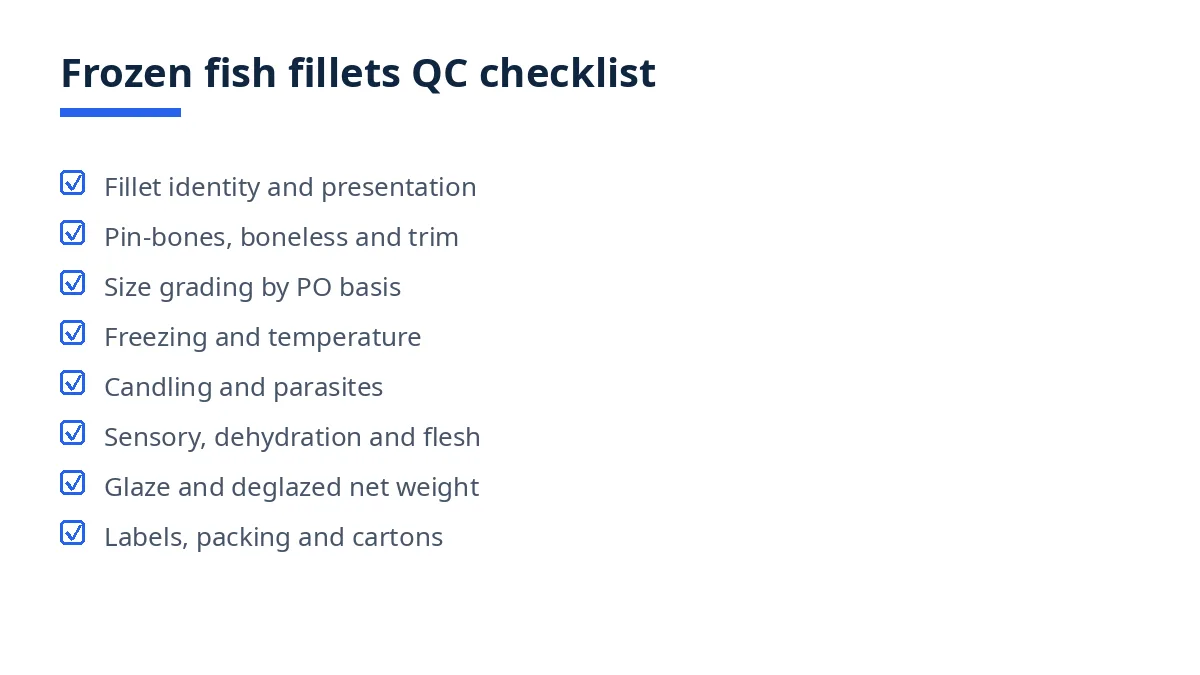
The full checklist (numbered, printable)
Fillet identity, species and presentation
Match lot identity: species, presentation, trim, grade, date and lot code across carton, packing list and test records.
Check identity pack by pack: under Section 2.1, a fillet comes from the same species, cut parallel to the backbone, so one pack holds one species, not mixed species or other fish meat.1
Check one presentation per pack, as ordered: skin-on or skinless, pin-bone in or removed, and the purchase order freezing format.
On skin-on fillets, check skin finish and remaining scales against the sample. On skinless fillets, check both faces for skin remnants and torn flesh.
Pin-bone, boneless and trim checks
Run a hand check along the pin-bone line of every sampled boneless fillet, then confirm on a thawed, cooked portion if the purchase order requires it.
Score bones by Section 8.4: a unit is defective with more than one bone per kilogram at or over 10 mm long, or at or over 1 mm in diameter.1
Apply the Section 8.4 small-bone limits: a bone at or under 5 mm long is not a defect if its diameter is not more than 2 mm; disregard a bone foot at or under 2 mm wide, or that strips off with a fingernail.1
Check the claim: under Section 2.3, fillets may be presented as boneless only where boning is complete, including pin-bone removal.1
Check trim against the written standard and photographed sample: belly flap, tail piece, dark meat and bloodline, collar trim. Codex sets no trim figure, so the written standard carries this check.
Count torn, gaping and undersized fillets by the purchase order method, per carton and across dates.
Size grading by purchase order basis
State the grading basis before weighing: weight per fillet, fillets per pack, or another purchase order basis.
Weigh sampled fillets individually and record how many fall outside the grade.
Repeat across cartons and dates; re-grade any run where out-of-grade fillets cluster in one date. Keep them separate.
Freezing and temperature for fillets
Review the freezing record: under Section 2.2, quick freezing is not complete until the product reaches -18 °C or colder at the thermal centre after thermal stabilization.1
Probe cartons from different pallet positions, recording each reading: Regulation (EC) No 853/2004 requires not more than -18 °C in all parts in storage, and in transport an even not more than -18 °C, with short upward fluctuations of not more than 3 °C.2
Check the label: under Section 6.3, it shall indicate storage at -18 °C or colder.1
Candling, parasites and foreign matter on fillets
Candle skinless fillets under Section 7.4: the whole unit is examined non-destructively, thawed portions on a 5 mm acryl sheet with 45% translucency, lit at 1500 lux 30 cm above the sheet.1
Score parasites under Section 8.3: a unit is defective with two or more parasites per kilogram by the Section 7.4 method, capsular diameter greater than 3 mm, or a parasite not encapsulated and greater than 10 mm long.1
For EU orders, confirm the visual parasite examination: Regulation (EC) No 853/2004 requires it before placing on the market, and obviously contaminated products must not be placed on the market for human consumption.2
Check foreign matter after thawing: under Section 8.2, any matter not derived from fish, excluding packaging, readily recognized without magnification.1
Check the metal detection record: under Codex CXC 52-2003 Section 9.2.4, detectors, if used, should be periodically calibrated with a known standard, and rejected product investigated.3
Sensory, dehydration and flesh checks
Use trained examiners, each fillet examined individually after thawing under Annex A, for foreign matter, parasites, bone, odour and flesh abnormalities.1
Check dehydration by area: under Section 8.1, a unit is defective where greater than 10% of its surface shows excessive moisture loss, as white or yellow abnormality masking the flesh colour, penetrating below the surface, not easily removed by scraping with a knife.1
Check odour and flavour: under Section 8.5, persistent, distinct objectionable odours or flavours of decomposition, rancidity or feed make a unit defective.1 If in doubt, confirm by a Section 7.6 cooking method, heating to 65-70 °C internally.1
Check flesh under Section 8.6: excessive gelatinous condition with greater than 86% moisture in any fillet, or pasty texture from parasitic infestation over more than 5% of the unit by weight, makes a unit defective.1
Test histamine only for the named families: under Section 3.4, not more than 10 mg/100 g on average per unit, only for Clupeidae, Scombridae, Scombresocidae, Pomatomidae and Coryphaenedae.1 Under Section 5, no unit shall exceed 20 mg/100 g for the same families.1
Confirm every other purchase order test was run on this lot, species and presentation on each report.4
Glaze and deglazed net weight
Weigh each unit frozen, packaging removed: under Section 7.3, net weight, exclusive of packaging, is determined frozen.1
Check glaze cover first: under Codex CXC 52-2003 Section 9.3.2, glazing is complete when the entire surface is covered with ice, free of exposed areas where dehydration can occur.3
Deglaze by Section 7.3.1: open straight from low temperature storage, spray gently with cold water until all glaze seen or felt is removed, remove adhering water with a paper towel, and weigh in a tared pan.1
Compare deglazed with declared weight: under Section 6.2, net contents are declared exclusive of glaze.1 Calculate and keep the glaze share, as Codex CXC 52-2003 Section 9.3.2 directs it be kept for determining net weight, exclusive of glaze.3
For the United States, FDA policy states net weight may not include glazing, and overstating net quantity misbrands the product.5
Labels, packing and cartons
Check the label under Section 6.1: name as fillets or fillets of the named fish, presentation close to the name, the term quick frozen, and a statement if glazed with sea-water.1
Check packs and cartons against the packing list: pack count, grade ratio, lot and date markings, species, grade and deglazed basis, and no carton holding a different presentation from its label.
Weigh sample cartons, confirm carton count, and photograph the loaded container, logger position and seal.
Common failures and how to fix them
The most damaging failure is pin-bones in a boneless pack. Stop the line, re-run the hand check, score under Section 8.4, and hold same-run cartons until re-checked.1
Next is short deglazed weight. Stop loading, re-run the Section 7.3.1 test on a fresh sample, and hold the lot until a re-test passes. Trim drift traces to the cutting table, usually after a species or shift change: re-brief against the photographed counter-sample and re-check cartons packed since then.
Dehydration over the Section 8.1 area points to exposed glaze or storage history: check glaze cover under Codex CXC 52-2003 Section 9.3.2 and the temperature record.3 Decide a candling finding on the Section 8.3 count and your market rule.1 Mixed species or presentations cannot be fixed by relabelling: segregate them as a separate lot.
Downloadable template and summary table
Copy this table into your inspection sheet, add species, presentation, trim, grade basis and glaze level, and record a result per line.
Section | Checks | Evidence |
|---|---|---|
Identity | Species, parallel cut, skin presentation | Pack check, photos |
Pin-bones and trim | Hand check, bone count, trim vs sample | Bone record, photo |
Size grading | Fillet weights, purchase order basis | Grade sheet |
Freezing | Freezing record, probe, storage label | Records |
Candling | Skinless candling, parasites, foreign matter | Candling record |
Sensory | Dehydration, odour, flesh, histamine | Reports |
Weight and glaze | Frozen weight, deglazing, glaze share | Record |
Packing | Labels, presentation, seal | Packing list |
How Exportain helps
Exportain is a B2B marketplace connecting buyers with Bangladeshi suppliers of frozen fish fillets and frozen seafood, so species, presentation, trim and grade can be agreed at enquiry stage. Browse suppliers, read the frozen seafood sourcing guide and use inspection services. Profiles show document and photo checks, not factory inspections. Exportain is not a party to the goods contract and does not inspect goods.
FAQs
When should this checklist be used?
At final inspection, when fillets are frozen, glazed and packed, and again at loading. Use pin-bone, trim and candling lines during production too.
Who should complete it?
The buyer, a local agent or an independent inspector, using the approved sample and a random sample. Sensory and candling lines need a trained examiner.
What are the most common failures?
Pin-bones in boneless packs, short deglazed weight, trim and grading drift, dehydration, mixed presentations.
Can a third party do it?
Yes, if you share the sample, trim photograph, grade basis, glaze level and test list first.
Next steps on Exportain
Agree species, presentation, trim, grade and glaze in writing, then read the frozen fish quality control checklist for whole fish and how to import frozen fish fillets from Bangladesh, and plan the check with inspection services.
Sources
- Standard for Quick Frozen Fish Fillets (CXS 190-1995). Food and Agriculture Organization of the United Nations (accessed )
- Regulation (EC) No 853/2004 laying down specific hygiene rules for food of animal origin. European Union (accessed )
- Code of Practice for Fish and Fishery Products (CXC 52-2003). FAO and WHO, Codex Alimentarius (accessed )
- Fish and Fishery Products Hazards and Controls Guidance. U.S. Food and Drug Administration (accessed )
- Guidance for Industry: 1991 Letter to Seafood Manufacturers Regarding the Fraudulent Practice of Including Glaze (ice) as Part of the Weight of Frozen Seafood. U.S. Food and Drug Administration, (accessed )
About the author
Sourcing from Bangladesh?
Post a request for quotation and suppliers on Exportain can send you their quotes directly.
Post an RFQ