Frozen Fish Fillets Lead Time From Bangladesh: Production and Shipping Timeline
Frozen fish fillets lead time from Bangladesh is set inside the filleting line: yield, trim, pin-bone work, grading, glaze and freezing form, not by a single standard week count.
Short answer
There is no single typical lead time for frozen fish fillets from Bangladesh. The timeline is set inside the filleting line: the whole-fish tonnage the yield requires, skin-on or skin-off, pin-bone removal, portioning and grading, the glaze percentage, and IQF or block freezing. Confirm the fillet specification, the deglazed sample, the -18 degree cold chain, and the destination certificate in writing, and treat any single week count without those lines as an incomplete quotation.
On this page
Key takeaways
There is no single typical frozen fish fillets lead time from Bangladesh: the timeline is set inside the filleting line, by yield, skin, pin-bone work, portioning and grading, glaze percentage, and IQF or block freezing.
Yield decides the supply line: FAO cod figures show skinned fillets at 36 percent of ungutted weight and 43 percent of gutted weight, so a fillet order needs far more whole fish than the fillet weight ordered.
Boneless means boning is complete including pin-bone removal, and the sample must be weighed after the glaze is removed, because glazed net contents are declared exclusive of the glaze.
IQF fillets freeze as single units while block fillets are cut into portions later, so the two forms are different production jobs with different timelines; both must reach -18 degrees Celsius or colder at the thermal centre.
Load only on an approved Bill of Export with the Department of Fisheries certificate where the destination requires it, plus the EU certificate model or the US verification file, and treat a badge as a document review, not a delivery promise.
A frozen fish fillets order from Bangladesh does not run on the same clock as a whole-fish order. Between raw fish and carton sits a filleting line: heading, gutting, skinning, trimming, pin-bone removal, portioning, grading, glazing and freezing. Each step can add days, change the yield, or force a rework, so a supplier who quotes one week count without naming the fillet specification has not quoted a timeline at all.
There is no single typical lead time for frozen fish fillets from Bangladesh. The timeline is set inside the filleting line: how much whole fish must be bought to yield the fillet weight ordered, whether the fillet is skin-on or skin-off, whether pin bones are removed, how the fillets are portioned and graded, what glaze percentage is applied, and whether the fillets freeze as single units or in blocks. Fix those lines first, and the delivery date follows from them.
Why this matters for buyers and sellers
For the buyer, the specification decides what arrives in the carton: the edible weight after deglazing, the piece size in each pack, and whether every fillet in a grade band cooks the same way. For the seller, it decides raw-fish intake and freezer time. A change to skin, bones, trim or grade after freezing starts is a new production job, not a correction.
What should I know first about frozen fish fillets?
Quick frozen fillets are slices removed from the carcass by cuts made parallel to the backbone, for direct consumption without further processing.1
Skin-on or skin-off. Fillets are presented with or without the skin, and the choice changes both yield and line time. Skinning is a separate pass, and a skin-off order needs more whole fish per kilogram of fillet than the same order skin-on. State the skin line in the enquiry.
Pin-bone removal. Fillets may be presented as boneless, provided that boning has been completed including the removal of pinbones.1 Pin-bone removal is slow, skilled hand work, and the step most often underestimated in a quotation. In packs designated boneless, more than one bone per kilogram of product at or above 10 mm in length counts as a defect under the standard.1 Write the pin-bone check into the sample approval.
Trim and yield. The fillet is what remains after the head, guts, backbone, fins, belly flaps and skin are removed. FAO yield figures for cod show the scale of that loss: skinned fillets are 36 percent of ungutted weight and 43 percent of gutted weight, with the head alone taking 21 percent of ungutted weight.2 Figures differ by species, season and processing method, so treat the cod figures as a guide to the arithmetic, not as a rate for your species.2 The practical point stands for every species: an order for 10 tonnes of fillets needs far more than 10 tonnes of whole fish, and the plant must hold or buy that tonnage before the line can start. Ask for the yield basis in writing.
Portioning and grading. Portioning turns a fillet into pieces of a stated size or weight, and grading sorts those pieces into bands. A single-grade order runs faster than a multi-grade order, because each band is a separate sort, pack and carton count. State the grade bands and piece weight range.
IQF or block. Individually quick frozen (IQF) products are frozen as single units which need not be thawed for sub-division, and IQF single fillets are named as a product of this type.3 A block order freezes fillets together into a mass later cut into portions.3 IQF suits piece-by-piece sale; blocks suit further processing. Never compare an IQF timeline with a block timeline as if they were the same job, because the block order carries a second cutting step after storage.
Glaze percentage. Glazing is carried out after freezing by brushing, spraying or dipping in chilled water.3 Glaze protects against dehydration and oxidation, but it is ice, not fish: where food is glazed, the declaration of net contents must be exclusive of the glaze.1 State the glaze percentage in every quotation, with weight and price on a deglazed net basis.
The cold-chain gate. Quick freezing is not complete unless the product reaches -18 degrees Celsius or colder at the thermal centre, and it must stay deep frozen during transport, storage and distribution.1 FAO data show lean fish such as cod and haddock holding about 8 months at -18 degrees Celsius, against 18 months at -25 degrees and 24 months at -30 degrees.3 Fluctuating cold-store temperatures are a major cause of dehydration, and glaze evaporates over time, so reglazing is a common need.3
In the Harmonized System, heading 0304 covers fish fillets and other fish meat, whether or not minced, fresh, chilled or frozen.4 See the HS code guide for frozen fish fillets.
Step-by-step: how it works
Each step closes one fillet line; the next step should not start until that line is closed in writing.
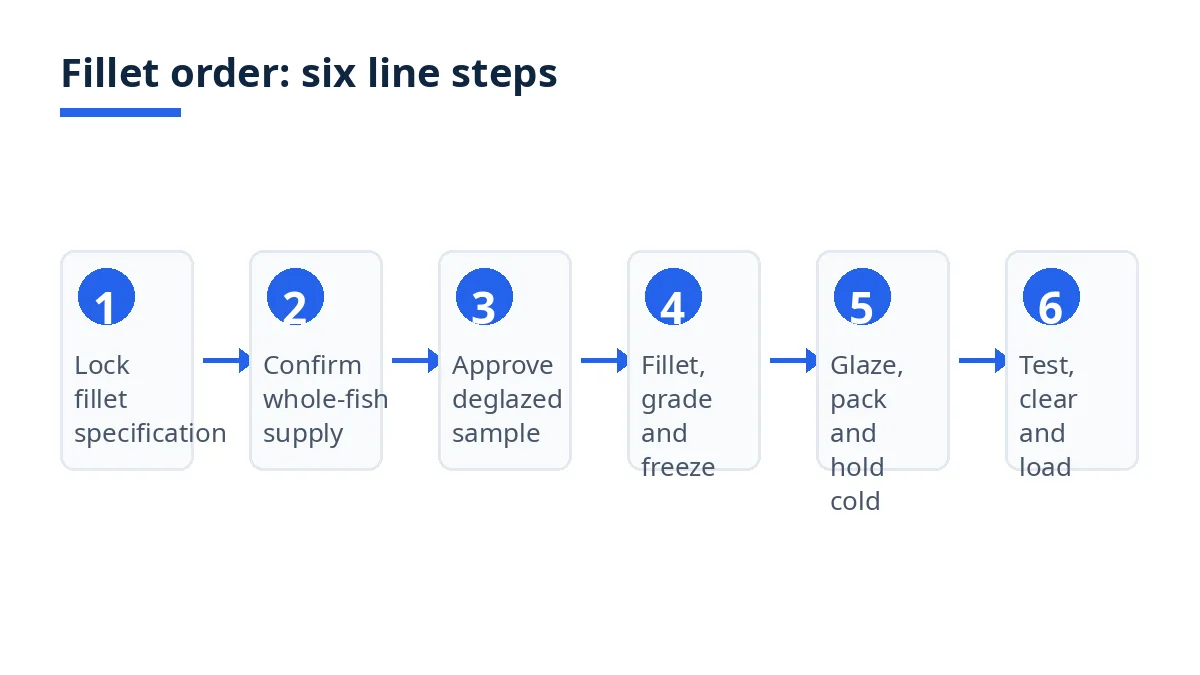
Lock the fillet specification in full. State species, skin-on or skin-off, boneless with pin-bone removal, trim standard, portion size or weight, grade bands, freezing form, glaze percentage, and whether weight and price are on a deglazed net basis.1
Confirm the whole-fish supply and the yield maths. Ask what tonnage of whole fish the plant holds or will buy for your fillet tonnage, on the agreed yield basis, and by what date it is in hand. FAO yield figures are a guide only,2 so the plant's own yield for your species and trim is the figure that matters.
Approve a sample measured after deglazing. Order a sample in the actual skin, bone, trim, portion, grade and pack. Remove the glaze as the standard directs, by spraying until all ice glaze that can be seen or felt is removed, then weigh the product.1 Check skin, pin bones, trim, piece size and grade band, and approve or list corrections in writing. Lot sampling follows a plan with an AQL of 6.5.1
Fillet, trim, portion, grade and freeze as one chilled run. Confirm that the fish is kept chilled before freezing, that filleting, trimming and grading run without warm waiting, and that freezing passes the range of maximum crystallization quickly.1 3 If fillets are cut before or during rigor, they can shrink and acquire a rubbery texture, so chilling before filleting is part of the timeline.3 State plainly whether any fillets will be cut from previously frozen fish: double freezing means freezing, thawing or partly thawing, and refreezing, and it results in further quality changes, so only fish that were initially very fresh are suitable for it.3
Glaze, pack and hold at -18 degrees Celsius or colder. Confirm glaze, packing and hold temperature. Quick frozen fillets must reach -18 degrees Celsius or colder at the thermal centre and stay deep frozen through transport, storage and distribution.1
Test, inspect, clear and load the reefer. Agree laboratory tests, sampling plan and inspector before production ends, so results arrive while goods are still in cold storage. Confirm the destination certificate model at the same time, load only on an approved export declaration, and verify the reefer temperature record and the deglazed weight of a sample carton on arrival.
Costs, timelines and documents
What are the typical costs and timelines?
There is no typical timeline a guide can state as fact for frozen fish fillets from Bangladesh, because the skin, bone, trim, grade, glaze, freezing form, raw-fish position, destination gate and delivery term all move it. Read the frozen fish fillets price guide before you compare quotations.
Example figures: a buyer ordering one grade of skinless, boneless IQF portions from graded stock, with an approved deglazed sample, can move from order to loading faster than a buyer ordering several grades of skin-on fillets in blocks, where the plant must first secure the whole-fish tonnage, run the full trim and sort, freeze in blocks, and cut portions later.
Costs inside the timeline, rather than inside the unit price, are the ones buyers most often miss: sample freight, laboratory testing, cold storage while results are awaited, re-glazing or re-packing after a failed check, and destination storage if clearance slips. Ask for each as a named line, with the party who pays it under your delivery term. The Incoterms 2020 rules set out 11 rules with a clear allocation of cost, risk and obligations.5 Compare timelines only on the same rule and named place. See the Incoterms guide for shipments from Bangladesh.
Which documents are needed?
The Bangladesh export set must be complete before loading. Goods shall not be loaded or stuffed in containers for export unless an export declaration, known as the Bill of Export or Shipping Bill, is submitted to Customs and approved.6 Enclosed documents include the export letter of credit, or where there is no letter of credit, the export contract or purchase order or export guarantee approved by the negotiating bank, the commercial invoice, the packing list, the EXP form certified by an authorized dealer, the certificate of origin, and VAT registration and taxpayer identification documents.6
For frozen fish, Bangladesh Customs states that a quality control certificate by the Department of Fisheries is necessary as per the requirements of the country of destination.6 Ask at the start whether your destination requires it.
Destination documents sit on top of the Bangladesh set. For the European Union, Commission Implementing Regulation (EU) 2021/405 lists third countries authorised for entry of certain animals and goods for human consumption, and Bangladesh appears in that list for fishery products.7 For the United States, every importer must either obtain the product from a country with an active memorandum of understanding covering the product, or have written verification procedures showing the product was processed under the seafood HACCP requirements, including the processor's HACCP records for the specific lot.8
Bangladesh-specific rules and tips
Order fillet kilograms, but check whole-fish tonnes. The plant buys whole fish and sells fillets, so the binding supply line is the whole-fish tonnage on your yield basis. Ask for the tonnage held, the yield applied, and the date the balance arrives, before you fix a production date.
Keep the fish chilled from landing to line. Freezing does not improve product quality: the final quality depends on the quality of the fish at the time of freezing and on handling during freezing, cold storage and distribution.3
Mistakes and red flags
What are the most common mistakes?
Ordering fillet weight without yield maths. The plant cannot start until the whole-fish tonnage is in hand. Ask for the yield basis and the tonnage held.
Comparing glazed and deglazed prices as if they were the same. Where food is glazed, net contents are declared exclusive of the glaze.1 Compare only on the same weight basis, and weigh the sample after deglazing.
Approving a sample without checking pin bones and grade.
**Changing skin, bone, trim or grade after freezing starts restarts production: a skin-off boneless IQF line and a skin-on block line are different jobs.
Booking production before the destination gate is confirmed. If the EU model, US verification file, or Department of Fisheries certificate is not settled, production builds stock that may not be shippable to your market.6 7 8
Reading a profile or a badge as a delivery promise. See the frozen fish fillets quality control checklist for the evidence to ask for before you order.
Checklist
Before you confirm, every line should be answered in writing.
Species, skin, boneless with pin-bone removal, and trim standard locked.1
Portion size or weight and grade bands stated.
Freezing form stated: IQF single units or block with later portion cutting.3
Glaze percentage stated, with weight and price on a deglazed net basis.1
Yield basis and whole-fish tonnage held confirmed, with the balance arrival date.2
Sample measured after deglazing and approved in writing, including pin-bone and grade checks.1
Chilling before filleting and quick freezing agreed; double freezing stated where it applies.3
Freezing to -18 degrees Celsius or colder at the thermal centre, monitored at every handover.1
Laboratory, test list and result date agreed before production ends.
Destination gate confirmed: EU model or US verification file.7 8
Bangladesh export set agreed, including the Bill of Export and Department of Fisheries certificate where required.6
HS heading 0304 confirmed; delivery term and named place settled on every quotation.4 5
Reefer booking and temperature logging.
How Exportain helps
On Exportain, browse suppliers and post a request for quotation on the RFQ board with your species, skin and bone lines, trim standard, grade bands, freezing form, glaze percentage and destination market, so suppliers quote against the same fillet line. Ask each reply for tonnage, yield basis, sample terms and clearance dates. Compare this guide with the frozen fish lead time guide, which plans from cut, glaze and freezing form rather than from inside the filleting line.
Read the badges for what they record. Exportain Verified means Exportain has checked identity, phone, email and business registration, and Export Verified means it has checked the Export Registration Certificate (ERC).9 Factory Verified means it has reviewed photos of the factory, while Trading Company Verified means it has reviewed photos of the office or warehouse.9 A badge is not a guarantee of capacity, quality or delivery. Verification is a document and photo review, not a factory inspection.9 10
FAQs
What should I know first about frozen fish fillets?
Know the fillet line before you ask for a timeline: skin, bones, trim, portion and grade, glaze, and IQF or block freezing. Fillets are slices removed from the carcass by cuts parallel to the backbone,1 and boneless means boning is complete including pin-bone removal.1 Heading 0304 covers fish fillets and other fish meat, fresh, chilled or frozen.4
What are the typical costs and timelines?
There is no single typical timeline, because the skin, bone, trim, grade, glaze, freezing form, raw-fish position, destination gate and delivery term all move it. Timeline costs include sample freight, testing, cold storage while results are awaited, and destination storage.5
Which documents are needed?
The Bangladesh set is the export contract or purchase order, commercial invoice, packing list, EXP form, certificate of origin, and the Bill of Export approved before loading.6 For frozen fish, a Department of Fisheries certificate is necessary where the destination requires it.6 Added on top are the EU model7 or the US verification file.8
What are the most common mistakes?
Ordering fillet weight without yield maths, comparing glazed and deglazed prices, approving a sample without pin-bone and grade checks, changing the specification after freezing starts, and booking production before the destination gate is confirmed.1 3
Next steps on Exportain
Browse suppliers, then post your species, skin and bone lines, trim, grade bands, freezing form, glaze percentage and destination market on the RFQ board Before you confirm, read the frozen fish fillets quality control checklist and the Incoterms guide for shipments from Bangladesh.
Sources
- Standard for Quick Frozen Fish Fillets (CXS 190-1995). Food and Agriculture Organization of the United Nations (accessed )
- Freezing and refrigerated storage in fisheries - Some related facts and figures. Food and Agriculture Organization of the United Nations (accessed )
- Freezing and refrigerated storage in fisheries - Influence of temperature. Food and Agriculture Organization of the United Nations (accessed )
- Classification Detail - HS Code 030474. United Nations Statistics Division (accessed )
- Incoterms® 2020. International Chamber of Commerce (ICC) (accessed )
- Customs Clearance Procedures for Export. Bangladesh Customs, National Board of Revenue (accessed )
- Commission Implementing Regulation (EU) 2021/405 — list of third countries authorised for fishery products. European Union (accessed )
- 21 CFR 123.12 — Special requirements for imported products. GovRegs (accessed )
- Trust & Safety Center. Exportain (accessed )
- Supplier verification: Earn trust badges buyers can see. Exportain (accessed )
About the author
Sourcing from Bangladesh?
Post a request for quotation and suppliers on Exportain can send you their quotes directly.
Post an RFQ