Frozen Fish Fillets Price in Bangladesh: FOB Cost Breakdown for Buyers
A fillet quote is only comparable when trim, glaze, freezing form and weight basis match. This guide shows how to read an FOB quotation for frozen fish fillets from Bangladesh, convert headline prices to net-weight prices, and check a supplier before ordering.
Short answer
The frozen fish fillets price in Bangladesh has no single FOB figure, because a fillet quotation prices a specific trim, glaze level, freezing form and weight basis. Compare quotes only after converting each headline price to a price per kilogram of net fillet weight, with skin, pin bones, belly trim and glaze stated. A lower headline price can be the higher net price once glaze and trim are removed from the comparison.
On this page
Key takeaways
A fillet quotation prices one exact fillet, not fish in general: species, trim, glaze level, freezing form and weight basis all change the price per kilogram.
Deeper trimming yields fewer kilograms of fillet from the same fish, so the raw-fish cost per kilogram rises before extra trimming labour is added.
Convert every headline price to a price per kilogram of net fillet weight excluding glaze before ranking suppliers, because the cheapest headline can be the most expensive fillet.
A fillet presented as boneless must have pin bones removed, and a glaze percentage is meaningless without a stated gross or net weight basis.
Exportain verification is a document and photo review, not a factory inspection, and a badge is not a guarantee of quality or delivery.
A quotation for frozen fish fillets is not a price for fish in general. It is a price for one exact fillet: a stated species, trim, glaze level, freezing form and weight basis. Change any one of those lines and the price per kilogram changes, even when the fish is the same. That is why two fillet quotations from Bangladesh can sit far apart without either supplier being wrong, and why a headline price alone cannot settle a buying decision.
Read a fillet quotation as a specification sheet. Confirm what part of the fish you are buying, how much of the quoted kilogram is fillet rather than ice, and what freezing and packing work sits inside the price, before comparing numbers. Worked examples here are labelled Example figures throughout, because they illustrate arithmetic, not a market price.
Why this matters for buyers and sellers
For a buyer, the main risk is paying fillet money for weight that is not fillet. A skin-on fillet, a fillet with pin bones left in, a fillet with the belly line untrimmed and a fillet carrying a heavy glaze are four different products, each carrying a different amount of saleable fish per kilogram. A buyer who orders on headline price and receives a lighter trim or heavier glaze has bought less fish, or a different cut, at a price that only looked lower.
For a seller, the risk runs the other way, A buyer who compares only price per kilogram will push suppliers toward the cheapest-looking line: lightest trim, heaviest glaze, cheapest freezing form. A quotation spelling out trim, glaze, freezing form and weight basis turns that argument into a product discussion into a product discussion.
The Codex standard for quick frozen fish fillets gives buyers a useful anchor. It defines quick frozen fillets as slices removed from the carcass by cuts parallel to the backbone, and states that a fillet may be presented as boneless only when boning is complete, including removal of pin bones.1 It also states that glazed products must declare net contents exclusive of glaze.1 Those sentences settle what "boneless" must mean, and whether glaze counts as product weight. It does not.
Step-by-step: how it works
Work through a fillet quotation in this order, fixing one variable at each step, and do not compare prices until every step is fixed.
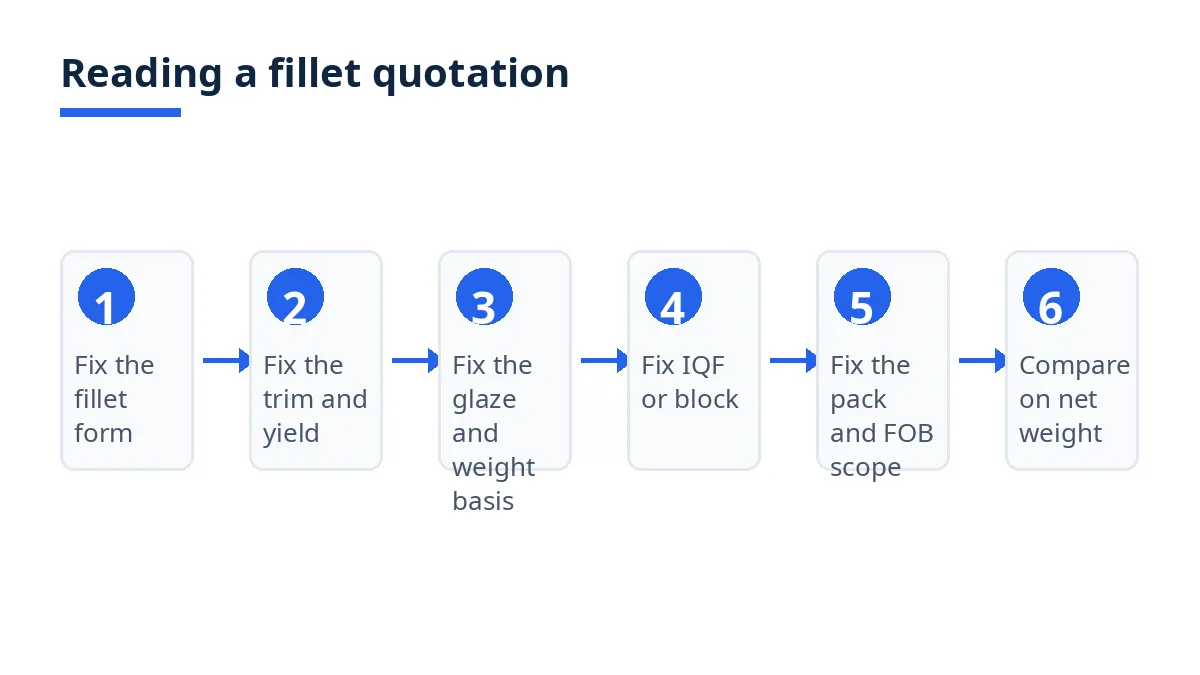
Fix the fillet form. State the species, skin-on or skinless, pin-bone removal, belly-line and bloodline trim, and whether the fillet is whole, portioned or cut into loins. Portioning adds labour and trim loss.
Fix the trim and the yield. Ask what proportion of incoming fish becomes saleable fillet at the stated trim. Deeper trimming removes more weight, so each kilogram carries more raw-fish cost. Ask for the trim definition in words, not only a grade name.
Fix the glaze and the weight basis. State the glaze percentage and whether the price is per kilogram of gross weight including glaze or per kilogram of net fillet weight excluding glaze. The Codex method for glazed products removes the glaze with a cold-water spray and weighs the product itself, the same principle a buyer should apply when comparing quotations.1
Fix the freezing form. State whether the fillets are individually quick frozen (IQF) or block frozen. IQF fillets freeze separately and can be taken from a bag a few at a time, while a block freezes as one mass that must be thawed as a unit.
Fix the pack and the carton. State the inner bag weight, bags per carton, carton net weight and whether the carton weight is gross or net. A quotation priced per carton cannot be compared with one priced per kilogram until both are converted to the same unit.
Fix the FOB scope and the validity. State the named load port, what is included up to loading on board, and the date the quotation expires. Incoterms 2020 allocates cost, risk and obligations between seller and buyer for each rule, so the three letters after the price change what the price includes.2
Costs, timelines and documents
What an FOB fillet price is built from
An FOB fillet price is a stack of separate costs, each moving for a different reason. Ask a supplier to itemize the layers below, at least in broad terms, before accepting a headline figure.
Cost layer | What it covers | What moves it |
|---|---|---|
Raw fish | Whole fish delivered to the plant | Species, size and availability |
Filleting and trimming labour | Cutting, skinning, pin-bone removal, belly trim | Trim depth and portioning |
Yield loss | Fish weight that does not become saleable fillet | Trim depth and fish size |
Freezing | IQF or block freezing to minus 18 degrees Celsius or colder | Freezing form |
Glazing and packing | Glaze water, inner bags, cartons, labels | Glaze level and pack size |
Cold storage and port handling | Holding frozen stock, transport to the named port and loading inside the FOB scope | Storage time, plant-to-port distance and port charges |
Export documentation | Invoice, packing list, origin and destination certificates | Destination market requirements |
Example figures: how trim changes the price per kilogram
Example figures. At a light trim, 100 kilograms of incoming fish yields 40 kilograms of fillet. At a deep trim, with skin removed, pin bones removed and the belly line trimmed away, the same 100 kilograms yields 33 kilograms. The raw-fish cost per kilogram of fillet is therefore about 21 percent higher at the deep trim before extra trimming labour, because 40 divided by 33 is 1.21.
Example figures: how glaze changes the price per kilogram
Example figures. Three quotations for the same species and nominal fillet show why the weight basis matters more than the headline price.
Quotation | Headline price | Weight basis | Price per kilogram of net fillet |
|---|---|---|---|
A | 4.20 per kilogram | Gross weight including 10 percent glaze | 4.67 |
B | 4.55 per kilogram | Net fillet weight, no glaze counted | 4.55 |
C | 4.35 per kilogram | Gross weight including 20 percent glaze | 5.44 |
Quotation A converts by dividing 4.20 by 0.90, giving 4.67 per kilogram of actual fillet. Quotation C converts by dividing 4.35 by 0.80, giving 5.44. The cheapest headline is not the cheapest fillet, and the highest headline, quotation B, is the lowest net price. Any comparison that skips this conversion compares different quantities and calls it a price difference.
Example figures: IQF compared with block
Example figures. IQF fillets generally carry higher freezing and packing costs than block-frozen fillets, because each fillet is frozen separately and packed so it stays separate. Block freezing is cheaper at the plant, but the buyer must thaw the whole block before use, which suits a processing line that consumes a full block at once and suits a retail or catering buyer poorly. Ask the supplier to quote both forms for the same trim and glaze level if the end use could accept either, so the cost difference is measured on identical fish.
Timelines
No standard timeline covers every fillet order, because production depends on raw-fish availability, order size, trim and packing format. Ask for three dates in writing instead of a single lead time: the date production can start, the date the goods will be ready for shipment, and the last date the quotation price holds. Confirm also who books the reefer container and who bears cold-storage cost if the vessel date moves, since those points sit inside or outside the FOB scope depending on the agreed rule.2
Documents
Bangladesh Customs requires an export declaration, known as a Bill of Export or shipping bill, before goods may be loaded for export, with a commercial invoice, a packing list, an EXP form certified by an authorized dealer, a certificate of origin and tax documents enclosed.3 For frozen fish, the same guidance lists a Department of Fisheries quality control certificate as necessary where the destination requires it.3 Ask the supplier which destination certificates it will provide, and get that list in writing.
Market rules differ at the destination end. In the European Union, Regulation (EC) No 853/2004 lays down specific hygiene rules for food of animal origin, including registration or approval of establishments handling such products and identification marking.4 In the United States, processors of fish and fishery products must conduct a hazard analysis and implement a written HACCP plan where hazards reasonably likely to occur are identified.5
Bangladesh-specific rules and tips
Start from the export declaration, not from the price. Confirm that the supplier will issue a commercial invoice and packing list describing the fillet exactly as quoted: species, trim, glaze level, freezing form, bag and carton weights and net weight exclusive of glaze. If the invoice describes a different fillet, customs, the buyer and any later claim will each work from a different product description.
Use the harmonized classification carefully. Heading 0304 covers fish fillets and other fish meat, fresh, chilled or frozen, and the frozen fillet subheadings vary by species.6 Confirm the six-digit subheading for your species with the supplier and your customs broker before shipment, because a fillet, a portion and minced fish meat can sit under different lines.
Mistakes and red flags
Comparing headline prices without converting to net weight. This is the most expensive mistake in fillet buying, as the worked example above shows. Convert every quotation to a price per kilogram of net fillet at the same trim before ranking suppliers.
Accepting "boneless" without a pin-bone statement. Under the Codex standard, a fillet presented as boneless must have boning completed, including removal of pin bones.1 Ask for the words "pin bones removed" in the specification.
Accepting a glaze level without a weight basis. A glaze percentage alone does not settle the price. A 10 percent glaze on a gross-weight price and on a net-weight price are different offers. The quotation must state both the glaze level and whether the price is gross or net.
Ordering portions without a portion specification. Portion weight, count per bag, weight tolerance and whether portions are cut from whole fillets or trimmings all change the product. An order without those lines invites a delivery that meets the weight but not the use.
Treating IQF and block as interchangeable. A buyer who needs single fillets and receives a block, or a processor who needs a block and receives loose IQF fillets, has a handling problem that no price saving repairs.
Skipping the destination documents. A shipment that clears export customs in Bangladesh can still fail at destination if the health certificate, establishment listing or labelling for that market is missing. Confirm the list before production, not after loading.
Paying for a badge that does not mean what you think. On Exportain, supplier verification is a document and photo review, not a factory inspection, and a badge is not a guarantee of quality or delivery.7 Treat a badge as one input among others, not as a substitute for the specification, sample and contract.
Checklist
Species, skin, pin bones, belly trim and portioning stated
Trim definition and expected yield stated
Glaze percentage and gross or net weight basis stated on every quotation
Freezing form stated as IQF or block, matching the end use
Inner bag weight, bags per carton and carton net weight stated
Every quotation converted to price per kilogram of net fillet before comparison
Named load port, FOB inclusions and quotation validity date stated
Production start and ready-for-shipment dates stated in writing
Invoice and packing list wording checked against the quotation
Six-digit classification confirmed with the supplier and broker
Destination certificates and establishment requirements confirmed
Sample checked for trim, glaze, portion size and labelling before a bulk order
Supplier documents checked on Exportain before contracting
How Exportain helps
Exportain lists suppliers and lets buyers send a request for quotation carrying the specification in the enquiry itself, the practical place to fix trim, glaze, freezing form and weight basis before prices arrive. A buyer who writes the fillet specification into the enquiry receives quotations that can be compared line by line. Supplier pages also show verification badges, which reflect a document and photo review, not a factory inspection.7 Use badges to shortlist, then confirm the plant, specification and documents before ordering.
For a fillet order, the most useful Exportain step is the comparison step. Keep every quotation in the same format, convert each one to net fillet weight using the method in this guide, and record the trim, glaze and freezing form beside each converted price. That record becomes the order specification and the invoice check on arrival.
FAQs
What should I know first about frozen fish fillets?
Know first that a fillet quotation prices one exact fillet, not fish in general. Species, skin, pin bones, belly trim, glaze level, freezing form and weight basis all change the price per kilogram, so fix those lines before comparing prices. The Codex standard defines quick frozen fillets as slices cut parallel to the backbone, and requires glazed products to declare net contents exclusive of glaze.1
What are the typical costs and timelines?
There is no single typical FOB price for frozen fish fillets from Bangladesh, because it depends on species, trim, yield, glaze, freezing form, packing and the named port. Cost layers are raw fish, trimming labour, yield loss, freezing, glazing and packing, cold storage, inland movement, port handling and documentation. Timelines vary with raw-fish availability and order size, so ask for a production start date, a ready-for-shipment date and a quotation validity date in writing.
Which documents are needed?
The export set in Bangladesh includes the Bill of Export, a commercial invoice, a packing list, an EXP form certified by an authorized dealer, a certificate of origin and tax documents, with a Department of Fisheries quality control certificate for frozen fish where the destination requires it.3 Destination markets add EU hygiene and establishment rules and US HACCP requirements for fish processors.4 5 Confirm the full destination list before production.
What are the most common mistakes?
The most common mistakes are comparing headline prices without converting to net fillet weight, accepting "boneless" without a pin-bone statement, accepting a glaze level without a weight basis, ordering portions without a portion specification, treating IQF and block as interchangeable, and skipping destination documents. Each is avoidable by writing the specification in full before ordering and converting every quotation to the same net-weight basis.
Next steps on Exportain
Browse suppliers to shortlist fillet suppliers, post a specification-led enquiry through RFQs, and read how supplier verification works on Exportain before shortlisting. Send every supplier the same specification, ask for a net-weight price, and compare converted prices before contracting.
Sources
- Standard for Quick Frozen Fish Fillets (CXS 190-1995). Food and Agriculture Organization of the United Nations (accessed )
- Incoterms® 2020. International Chamber of Commerce (ICC) (accessed )
- Customs Clearance Procedures for Export. Bangladesh Customs, National Board of Revenue (accessed )
- Regulation (EC) No 853/2004 laying down specific hygiene rules for food of animal origin. European Union (accessed )
- 21 CFR Part 123 — Fish and Fishery Products. United States Food and Drug Administration (accessed )
- HS Classification Detail: 030483 - Fish fillets; frozen, flat fish. United Nations Statistics Division (accessed )
- Supplier verification: Earn trust badges buyers can see. Exportain (accessed )
About the author
Sourcing from Bangladesh?
Post a request for quotation and suppliers on Exportain can send you their quotes directly.
Post an RFQ