FOB Freight Cost: Who Pays Main Carriage, Origin and Destination
Under FOB, the freight bill splits at loading: the seller pays to loading and the buyer pays main carriage and every destination charge. This guide follows each charge, how it is calculated, and how to reconcile the final invoice.
Short answer
Under FOB, the seller delivers the goods loaded on board the vessel nominated by the buyer at the named port of shipment, having cleared them for export. The buyer contracts the carrier, pays ocean freight and its surcharges, and pays destination handling, import clearance, duties and inland transport. FOB applies only to sea and inland waterway transport.
On this page
Key takeaways
Under FOB the seller pays to loading on board, and the buyer pays main carriage, fuel and currency surcharges, destination handling, import clearance, duties and inland transport.
Each charge family has its own unit: FCL is priced per container, LCL per weight-or-measurement unit, fuel surcharges per twenty-foot equivalent unit, and time charges per day after free time.
The bunker adjustment factor is listed separately from the base freight rate and is reviewed monthly or quarterly, so a quotation must state whether it is floating or fixed.
Origin terminal handling sits with the seller and destination handling with the buyer, while demurrage and detention follow whichever side caused the delay.
No freight figure in this guide is a current rate: every number is labelled as example figures, and duty must be confirmed with the import broker.
Free On Board (FOB) looks simple on a quotation: one price, one port, one loading moment. The freight bill that follows is separate charges, raised by different parties, fixed at different times, and split where the goods are loaded on board the vessel.
This guide works through that bill line by line: who pays each charge, how each charge is built, and how to read a quotation. FOB applies only to sea and inland waterway transport.1 For air freight, or a container handed to a carrier well before loading, FCA fits the handover. The FOB meaning guide explains the term itself.
The FOB charge ledger: who pays each line
The Incoterms 2020 rules give a clear allocation of cost, risk and obligations for each rule.2 Under FOB, the seller delivers the goods loaded on board the vessel nominated by the buyer at the named port of shipment, having cleared them for export, and risk transfers to the buyer at that loading point.1 The buyer must contract the carrier, pay the port-to-port costs, and handle import formalities.1
The ledger uses the usual allocation; only a written agreement moves a line.
Charge | Seller pays | Buyer pays |
|---|---|---|
Export packing | Yes | No |
Inland transport to the origin port | Yes | No |
Export customs clearance | Yes | No |
Origin terminal handling | Yes | No |
Loading on board | Yes | No |
Ocean freight, main carriage | No | Yes |
Fuel and currency surcharges | No | Yes |
Marine insurance | No, unless agreed separately | Yes, if cover is wanted |
Destination terminal handling | No | Yes |
Unloading at destination | No | Yes |
Import clearance, duties and taxes | No | Yes |
Inland transport at destination | No | Yes |
Demurrage and detention after free time | Seller delay only | Buyer delay only |
The seller pays export packing, export clearance, inland transport, origin handling and loading, while the buyer pays ocean freight, marine insurance, import clearance, duties and destination inland transport.3 Marine insurance is a buyer choice: neither party must buy cover under FOB. Time charges follow the delay: a late vessel nomination can leave storage costs with the buyer even before loading.1
Why the freight split changes the price you compare
Two quotations for the same goods can differ by thousands of dollars without either supplier misquoting, because they count different lines as included. An FOB quotation ends at loading, so comparing it with a CFR quotation, where the seller pays freight to destination, compares two different scopes. Compare quotations only when they state the same rule, named port, load basis and inclusions. The Incoterms guide sets the rules side by side.
The split also decides who controls the ocean leg: under FOB the buyer chooses the carrier and negotiates the freight, and owns every line after loading. Budget the buyer side as a range, because several buyer lines are not fixed at signing.
How each charge is calculated
Each charge family has its own unit: per container, per weight-or-measurement unit, per twenty-foot equivalent unit, per day, or as a percentage. Check the unit before the amount.
Main carriage, fuel and currency surcharges
Main carriage is priced on the load basis. A full container load (FCL) carries a fixed rate per container, while a less-than-container load (LCL) is charged per cubic meter (CBM) or per ton, whichever is greater.4 LCL freight uses the weight-or-measurement rule: 1 CBM or 1,000 kg counts as one revenue ton, and the higher decides the charge.4 LCL shipments also carry container freight station charges at both ends, which do not apply to FCL.4
Example figures: cartons totalling 8.4 CBM and 500 kg give 8.4 weight-or-measurement units, and at an example rate of 120 per unit the LCL freight is 1,008. These are example figures only; the carrier or forwarder quote decides the real rate.
Fuel is charged apart from the base rate. The bunker adjustment factor (BAF) is a surcharge for variation in bunker fuel costs, always listed separately from the base freight rate.5 It combines a reference fuel price, from average bunker fuel costs at major bunkering ports, with a trade factor for average fuel use on the route. The result is typically applied per container using the twenty-foot equivalent unit, with rates reviewed monthly or quarterly.5 Carriers may use a floating or fixed BAF, and the currency adjustment factor (CAF) and environmental surcharges are separate lines.5
Terminal handling at each end
Terminal handling charges (THC) cover the terminal work around the vessel: storage and positioning, loading and unloading, documentation, labor and cargo security.6 Origin terminal handling (OTHC) covers port services before departure, and destination terminal handling (DTHC) covers unloading, storage, monitoring and use of port facilities at arrival.6 Under FOB the seller pays origin handling and the buyer pays destination handling.3 The amount varies by carrier, route and container type: hazardous goods need special storage, and reefer containers need constant temperature monitoring.6
Time charges: demurrage, detention and storage
Time charges are charged per day after free time expires. Detention is charged for extended use of intermodal equipment, and demurrage accrues when a container exceeds free time on a marine terminal.7 Ask the carrier or forwarder, before booking, for the free days, the clock start and stop points, and the tiered rates after free time. Under FOB, time before loading follows the seller delay, and time after the buyer takes control follows the buyer.
Clearance, duty and inland transport at destination
At destination the buyer pays import clearance, duties and taxes, unloading and inland transport.3 The clearance fee follows the broker the buyer appoints, so ask for it as a separate line. Duty comes from the destination tariff for the classification, on the customs value the destination rules prescribe: confirm the rate and valuation basis with the import broker. Where the destination port and the final delivery point differ, state both in the quotation request.
Step-by-step: from quotation to the final invoice
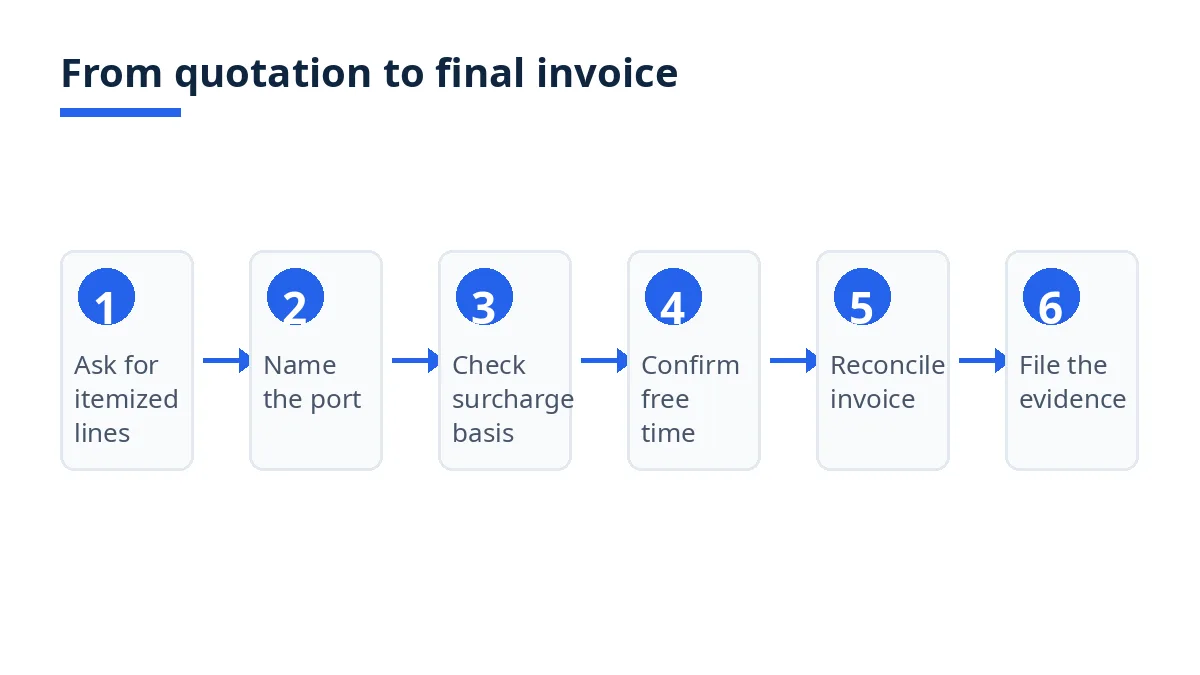
Ask for itemized lines. Request the FOB price, freight, each surcharge with its basis, handling, clearance, duty estimate, insurance and inland transport as separate lines, with the unit for each.
Name the port, the vessel and the loading point. Write the rule, the named port of shipment and Incoterms 2020 on the contract, quotation and invoice, and give the seller the vessel name and loading point in time.1
Check the surcharge basis. Record whether the fuel surcharge is floating or fixed, which index it tracks, the review date, and whether currency and environmental surcharges are included or separate.5
Confirm free time in writing. Record the free days at each end, the clock start and stop points, and the tiered rates after free time, from the carrier or forwarder terms.7
Reconcile the invoice line by line. Match each invoice line to the quotation line with the same unit, and query any line without a quotation basis before paying it.
File the charge evidence. Keep the quotation, carrier invoice, handling receipts and duty assessment together, with one name for each party across every document.
Costs, timelines and documents
When is each charge fixed?
The seller lines are fixed when the contract is signed, because they sit inside the FOB price. The buyer lines are fixed at different moments: freight at booking, fuel surcharges at the carrier review date, destination handling at discharge, and duty at the destination declaration. For container maritime cargo entering the EU, the entry summary declaration must be lodged at least 24 hours before loading commences in the foreign port.8
Example figures: the table below builds a buyer-side total for one 40-foot container. Every figure is an example only, and no figure here is a current rate.
Buyer-side line | Example figures |
|---|---|
Ocean freight, one 40-foot container | 1,900 |
Fuel surcharge (BAF) | 260 |
Destination terminal handling | 320 |
Import clearance fee | 180 |
Inland transport at destination | 240 |
Subtotal before duty | 2,900 |
Import duty at an assumed 6 percent on an example customs value of 30,160 | 1,810 |
Buyer-side total, excluding the goods price | 4,710 |
The example customs value of 30,160 is 28,000 plus the freight and fuel lines of 2,160; duty at 6 percent is 1,809.60, rounded to 1,810. For the full journey, see the landed cost guide.
Which documents prove each charge?
Each charge needs its own paper: the quotation, carrier invoice, terminal receipts, and import declaration and duty assessment. A proof of origin is declared with the customs declaration for EU customs clearance, and certificates of preferential origin allow reduced or nil duties where an agreement applies.8 Keep the on-board bill of lading with the file.
Bangladesh-specific rules and tips
Bangladesh-origin FOB shipments load most often at Chattogram or Mongla. Goods cannot be loaded for export until a Bill of Export, or Shipping Bill, is submitted and approved through ASYCUDA World.9 The standard export documents include the export letter of credit or contract, the commercial invoice, the packing list, the EXP form certified by an Authorized Dealer bank, the certificate of origin, VAT registration and Taxpayer Identification Number.9
Use a licensed clearing and forwarding agent unless the seller has in-house clearance capacity. A C and F agent is a government-authorized customs broker, licensed by Bangladesh Customs.9 Certificates, licences and permits now move through the Bangladesh Single Window: from July 1, 2025, submissions from 19 designated organizations must be done through that system for import and export customs clearance.9 Confirm which certificates the product needs before the vessel is nominated.
Mistakes and red flags
What are the most common mistakes?
Comparing an FOB price with a CFR or CIF price as if they were the same scope. The FOB price ends at loading; CFR includes freight to destination and CIF includes freight and insurance.3 Compare only quotations that state the same rule and inclusions.
Accepting an all-in freight figure with no unit and no surcharge basis. An all-in figure hides whether the fuel surcharge is floating and whether the rate is per container or per weight-or-measurement unit.4 5 Ask for the lines.
Reading "FOB Origin" or "FOB Destination" as an Incoterm. Those phrases appear in US purchase agreements and are not Incoterms.3 Write the rule and named port in full.
Using FOB for air freight or a factory-handover container move. FOB applies only to sea and inland waterway transport.1 Where a container is handed to a terminal days before loading, FCA fits the handover.
Leaving free time and the vessel nomination until sailing week. A late nomination can shift risk and storage costs to the buyer,1 and free time is consumed by customs holds.
Treating the duty estimate as the duty. Duty comes from the destination tariff for the classification, on the customs value the destination rules prescribe. Confirm it with the import broker.
Checklist
Answer every line below in writing before the vessel is nominated.
Rule, named port of shipment and Incoterms 2020 stated on the contract, quotation and invoice.
FOB price separated from freight, surcharges, handling, clearance, duty estimate, insurance and inland transport, each with its unit.
Fuel surcharge basis recorded: floating or fixed, index, review date, and whether currency and environmental lines are separate.5
Origin handling on the seller side and destination handling on the buyer side confirmed in writing.3 6
Free days, clock points and tiered rates after free time confirmed with the carrier or forwarder.7
Vessel name and loading point given to the seller in time, with the deadline in the contract.1
Import broker instructed, duty rate and valuation basis confirmed, and proof of origin ready where claimed.8
Advance-declaration data with the lodging party before the loading deadline for EU-bound cargo.8
Invoice reconciled against the quotation before payment, with the bill of lading and duty assessment filed.
How Exportain helps
On Exportain, post a request for quotation (RFQ) stating the quantity and unit, target price, destination, Incoterm, required certifications and deadline, so suppliers quote against the same requirement.10 State FOB and the named port, and ask each reply to separate the FOB price from any freight service offered as an extra. Look up freight rates published by forwarders on Exportain and request quotes from listed freight, customs and inspection providers.10
Read the badges for what they record. Supplier verification is a document review by Exportain staff, not a factory inspection, and a badge is not a guarantee of production capacity, product quality or delivery.11 Verification is free and never purchased, and membership plans never grant a trust badge.11 When a quotation is accepted, Exportain creates one order and issues one proforma invoice from the accepted terms, including the Incoterm as quoted.11
FAQs
What should I know first about FOB?
FOB is a sea and inland waterway rule: the seller delivers the goods loaded on board the vessel nominated by the buyer at the named port of shipment, having cleared them for export, and risk transfers to the buyer at that point.1 The buyer contracts the carrier and pays main carriage, surcharges, destination handling, clearance, duties and inland transport. The FOB price ends at loading.
What are the typical costs and timelines?
There are no typical freight figures a guide can state as fact, because freight, surcharges, handling and duty depend on the route, load basis, carrier tariff and destination rules. What is fixed is the split and the order: seller lines inside the FOB price, buyer lines fixed at booking, at the surcharge review date, at discharge and at the destination declaration.8
Which documents are needed?
The quotation, carrier invoice, terminal receipts, and import declaration prove the agreed lines, freight, handling and duty. For Bangladesh-origin goods the export set is the Bill of Export with the contract or letter of credit, invoice, packing list, EXP form, certificate of origin, VAT registration and Taxpayer Identification Number.9
What are the most common mistakes?
The most common mistakes are comparing FOB and CFR or CIF prices as if they were the same scope, accepting an all-in freight figure with no unit or surcharge basis, reading a US domestic FOB phrase as an Incoterm, using FOB for air freight, and treating a duty estimate as the duty. Write the rule and inclusions into the contract, and reconcile the invoice before paying it.
Next steps on Exportain
Browse suppliers, then post your FOB requirement, named port and charge inclusions on the RFQ board so suppliers quote the FOB price and any freight service on separate lines. Before you confirm, read the landed cost guide and how to buy.
Sources
- FOB & FAS Incoterms® 2020 explained: Key differences. ICC Academy (accessed )
- Incoterms® 2020. International Chamber of Commerce (ICC) (accessed )
- FOB Incoterms Explained: A Complete Guide for Importers and Freight Forwarders 2026. GoFreight (accessed )
- FCL vs LCL Meaning: Differences, Costs + Calculator. Drip Capital, (accessed )
- What Is Bunker Adjustment Factor?. Climb the Ladder (accessed )
- What are Terminal Handling Charges (THC): How to mitigate shipping charges 2025. Container xChange, (accessed )
- Detention and Demurrage. Federal Maritime Commission (accessed )
- Customs clearance documents and procedures. European Commission (accessed )
- Custom Clearance in Bangladesh: Port Procedures and C and F Agent Guide. Bizmend (accessed )
- How to source and buy from Bangladesh. Exportain (accessed )
- Trust & Safety Center. Exportain (accessed )
About the author
Sourcing from Bangladesh?
Post a request for quotation and suppliers on Exportain can send you their quotes directly.
Post an RFQ