FOB Shipping From Bangladesh to UAE: Costs, Steps and Timeline
FOB shipping from Bangladesh to UAE: the Chattogram to Jebel Ali sea leg, mainland or free-zone entry, Dubai duty and import VAT treatment, example buyer-side costs, documents, and a checklist for a Dubai or Abu Dhabi delivery.
Short answer
Under FOB Chattogram, Incoterms 2020, a Bangladeshi seller delivers goods on board the vessel nominated by the buyer, clears them for export, and passes risk at loading. The buyer then pays ocean freight, arranges insurance, appoints a UAE customs broker, decides mainland or free-zone entry, clears the Jebel Ali import entry, settles duty and import VAT as the broker advises, and arranges inland delivery to Dubai or Abu Dhabi.
On this page
Key takeaways
Under FOB Chattogram, Incoterms 2020, the seller delivers goods on board the vessel nominated by the buyer at Chattogram and clears them for export, while risk passes to the buyer on board, not on arrival at Jebel Ali.
Before ordering, decide whether the goods will enter the UAE mainland or stay under a free-zone or suspension regime, since that choice changes the customs entry, the duty and VAT treatment, and the documents the broker asks for.
After the FOB price, the buyer pays ocean freight, cargo insurance it arranges, Jebel Ali port and terminal charges, a customs broker fee, import duty, import VAT as the broker advises, and inland delivery to Dubai or Abu Dhabi.
The core document set is the commercial invoice, packing list, bill of lading, origin proof where a preference claim is intended, and an insurance certificate for the CIF value at entry, plus the UAE customs declaration data the broker needs.
A buyer ordering from Bangladesh to the UAE on FOB terms faces one decision before any other: whether the goods will enter the mainland or stay inside a free zone. That choice changes the customs entry, the duty and VAT treatment, and the documents the broker asks for at Jebel Ali, so it should be settled before ordering. This guide follows the mainland route throughout, flagging the free-zone difference where it changes the plan, from loading in Bangladesh to a warehouse in Dubai or Abu Dhabi.
Under Incoterms 2020, FOB (Free On Board) is a rule for sea and inland waterway transport only. The seller delivers the goods on board the vessel nominated by the buyer at the named port of shipment, and risk passes from seller to buyer when the goods are on board that vessel.1 The seller clears the goods for export. The buyer bears main carriage, import clearance, and duties from that point onward. On this lane, risk moves at Chattogram, not at Jebel Ali.
Why this matters for buyers and sellers
An FOB price ends at loading, so a buyer who budgets only that price has covered only the first part of the journey. Ocean freight, buyer-arranged insurance, Jebel Ali port and terminal charges, a customs broker fee, import duty, import VAT treatment, and inland delivery all sit after the FOB price. A seller who quotes FOB without a named port leaves the delivery point open to dispute. Writing the term in full, for example "FOB Chattogram, Incoterms 2020", fixes the port, the rule, and the edition.
FCA is an any-mode rule under which delivery is made to the carrier nominated by the buyer.1 CFR is a sea rule under which the seller pays freight to the named destination port while risk still passes on board at origin.1 CIF is CFR plus minimum insurance bought by the seller for the buyer, with risk still passing on board at origin.1 A buyer who wants to choose the carrier, sailing, and insurance level will often prefer FOB, while a buyer who wants the seller to arrange freight will look at CFR or CIF instead.
The UAE entry adds a split absent from a mainland-only European lane. Goods released into the mainland pass through a customs entry with duty and VAT settled as the broker advises, while goods under a duty-suspension or free-zone regime follow separate rules and need a financial guarantee or a zone permit.2 A buyer who plans a mainland delivery but books a zone routing, or the reverse, will find the entry file does not match the cargo on arrival.
Step-by-step: how it works
The lane in this guide is Chattogram to Jebel Ali throughout. Keep that pair fixed, because a different UAE arrival port changes the entry and the inland leg.
Decide mainland or zone entry and appoint the UAE customs broker early. Record whether the goods will be released into the mainland or held under a zone or suspension regime, and appoint the broker who will handle the Jebel Ali entry. Agree in writing what the broker needs, including trade licence and tax registration details.2
Write the term and confirm who nominates the vessel. Record "FOB Chattogram, Incoterms 2020", the goods, quantity, price, payment method, and inspection terms in the sales contract or purchase order. Confirm that the buyer, or its forwarder, nominates the vessel and gives the seller the loading window in good time, and confirm who insures the voyage.
Prepare, pack, and check the goods for the UAE market. The seller packs and marks the goods for sea carriage. The buyer confirms the packing, marking, and labeling the order requires before dispatch, and checks whether the goods need UAE marking, certification, or a permit.2
Move the goods to Chattogram and clear them for export. The seller arranges inland transport to the port and clears the goods for export. The buyer, or its forwarder, confirms the vessel nomination and loading window.
Load on board and issue the bill of lading. Once the goods are on board the buyer's nominated vessel, delivery under FOB is complete and risk passes to the buyer.1 The carrier issues the bill of lading, which is the contract of carriage, the carrier receipt, and the document of title for claiming the cargo.3
Sail the Gulf leg and finish the entry file at sea. The buyer, through its carrier or forwarder, has already contracted the main carriage from Chattogram. While the vessel is sailing, the buyer and the broker reconcile the bill of lading, invoice, and packing list, so the Jebel Ali entry can be filed promptly on arrival. The 2023 service report describes a routing via Colombo and Mundra before Jebel Ali.4
Clear at Jebel Ali and deliver inland. On arrival, the buyer's broker files the UAE customs entry, duty and import VAT are settled as the broker advises, and the buyer arranges release and transport onward. The inland leg to an Abu Dhabi or Dubai warehouse is a forwarder-confirmed option only: confirm the route, vehicle, receiving hours, and price in writing before release.
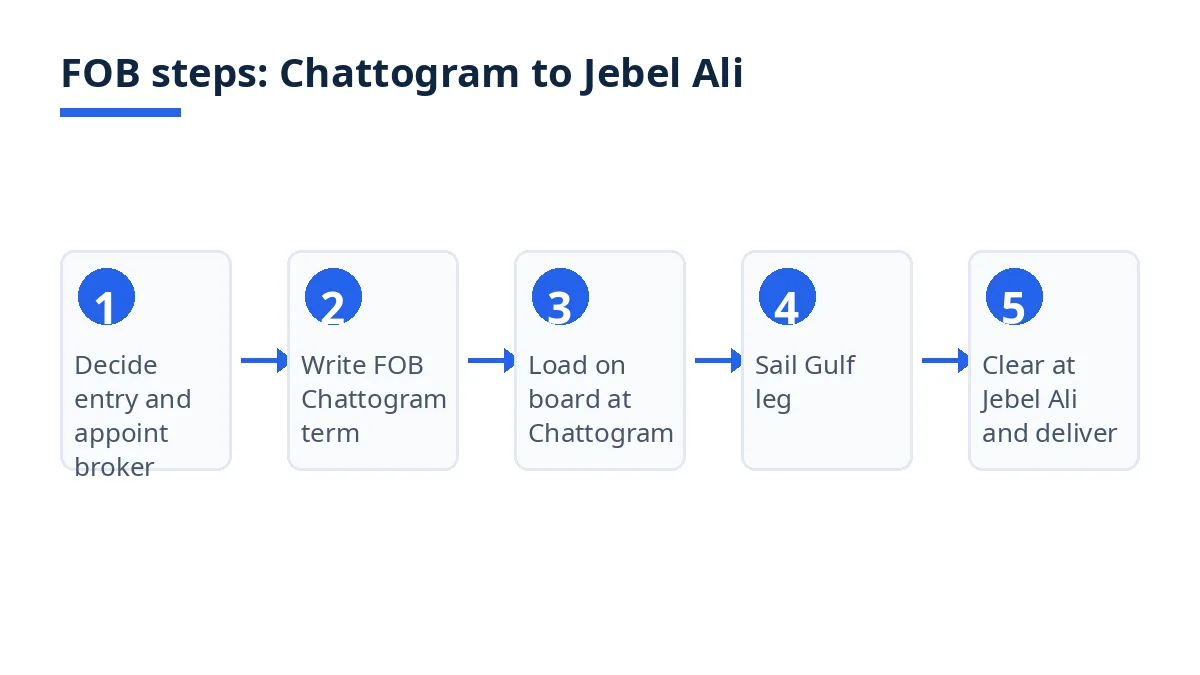
The order matters more than any single step. If the mainland-or-zone decision, the broker appointment, or the insurance decision is still open when loading starts, the shipment is already behind.
Costs, timelines and documents
No single freight rate, port charge, or fee describes an FOB shipment from Bangladesh to the UAE, because each one moves with the carrier, the season, the cargo, and the contract. The table below uses labelled example figures only, for one container to a warehouse in Dubai. Replace every figure with a written quotation for the actual order before committing.
Buyer-side line after the FOB price | Example figure (USD) | Note |
|---|---|---|
Ocean freight, Chattogram to Jebel Ali | 980 | Example only |
Cargo insurance, buyer-arranged | 85 | Example only |
Customs broker fee | 130 | Example only |
Jebel Ali port and terminal charges | 240 | Example only |
Inland delivery to Dubai warehouse | 210 | Example only |
Subtotal of buyer-side lines in this example | 1,645 | Before duty and import VAT |
Duty and import VAT are left out of that subtotal on purpose. Import duties are the buyer's responsibility under FOB, and the rate for the goods concerned must be confirmed by the broker for the actual classification, origin, and destination entry. This guide states no product duty rate, because a rate copied from another product or entry would misprice the order. Ask the broker to confirm classification, duty, and import VAT treatment before pricing for resale.
For Dubai in general, the official UAE government platform states that the customs tariff in Dubai is 5 per cent of the CIF value, except for alcohol and cigarettes, for which higher rates are stated on that page.5 That general statement is not a product rate for a particular order: the broker must still confirm the tariff treatment for the goods concerned, including any exemption, relief, or higher rate.
For import VAT, use only a conditional reading. A guide describing Federal Tax Authority practice states that VAT at 5 per cent applies to the sum of the CIF value and the customs duty payable for non-exempt imports entering mainland UAE.2 This guide uses that description only as a conditional illustration, attributed to that guide: it illustrates a CIF value of AED 100,000 with 5 per cent duty giving AED 5,000 duty, a VAT base of AED 105,000, and VAT of AED 5,250.2 If the broker confirms that treatment for the goods concerned, treat VAT as a cash-flow item where it can be reclaimed, and as a full landed cost where it cannot. The broker must confirm how import VAT is calculated for the actual order.
For transit time, read only dated estimates for the exact route and port pair. A news report dated 9 May 2023 on the launch of a Chattogram to Dubai service said exports from Chattogram to Dubai would take 15 days on the new service, and quoted the carrier group as saying shipments would reach Jebel Ali and Abu Dhabi in 14 and 15 days respectively.4 Treat those figures as a dated service-launch report, not as a carrier promise for a current booking, and confirm the booked sailing, its port calls, and its arrival plan.
The document set for this lane matches the set the opened VAT guide lists for customs and tax compliance:
Document | Job on this lane |
|---|---|
Commercial invoice | States seller, buyer, goods, value, and origin for the sale and customs |
Packing list | Breaks the shipment down by carton, quantity, weight, and marks |
Bill of lading | Contract of carriage, carrier receipt, and document of title for claiming the cargo3 |
Origin proof | Supports any preference claim, in the form the broker confirms |
Insurance certificate | Supports the insurance element of the CIF value used at entry2 |
UAE customs declaration data | HS code, CIF value, duty and VAT inputs, trade licence and tax registration details, given to the broker2 |
Keep the entry data, bill of lading, invoice, and packing list consistent, because freight and insurance amounts are checked against the bill of lading and insurance certificate, and a discrepancy can halt release.2
Bangladesh-specific rules and tips
This guide uses Chattogram throughout because the 2023 service report describes a Chattogram departure for Jebel Ali, with Colombo as the first transshipment port and Mundra as a further call before Jebel Ali.4 Use the current spelling, Chattogram, in the contract term.
Three points deserve attention before booking. First, ask whether the booked service calls at Colombo, Mundra, or another hub, and how those calls affect the arrival date.4 Second, confirm where the container is stuffed and who hands it to the carrier, because that handover decides whether FOB or FCA fits the facts.1 Third, confirm the receiving arrangements at the Dubai or Abu Dhabi warehouse before release, since a container held at Jebel Ali while the warehouse is unready will build storage charges.
One caution applies to containers. The ICC Academy notes that for goods in containers, FCA is a better choice than FOB, even for maritime transport, because containers are handed to the carrier at a terminal before they are loaded on board.1 If handover is at a depot or terminal rather than on board, discuss FCA before signing FOB.
Mistakes and red flags
Writing a bare "FOB Bangladesh" with no named port and no Incoterms edition, so the delivery point can be argued later.
Using FOB for air, road, or rail cargo, when FOB is a sea and inland waterway rule only.1
Treating arrival at Jebel Ali as the risk transfer point, when risk already passed on board at Chattogram.1
Comparing an FOB price directly with a CFR or CIF price, when the three prices contain different legs of the journey.
Leaving insurance undecided until the vessel has sailed, when the buyer already bears the voyage risk from loading.
Appointing the UAE customs broker late, or without the entry data ready for the filing.
Planning a mainland entry while booking a zone routing, or the reverse, without broker confirmation.
Copying a duty rate or an import VAT treatment from another product, entry, or order without broker confirmation for the goods concerned.
Checklist
[ ] Term written in full: "FOB Chattogram, Incoterms 2020".
[ ] Mainland or zone entry decided and recorded before ordering.
[ ] UAE customs broker appointed, with entry data agreed.
[ ] Insurance decision recorded: buyer-arranged cover and level.
[ ] Bill of lading checked on issue: parties, quantities, weights, and marks.
[ ] Ocean service confirmed: port calls, sailing date, and Jebel Ali arrival plan.
[ ] Origin proof ready if a preference claim is intended, in the form the broker confirms.
[ ] Inland delivery confirmed as a forwarder-confirmed option.
How Exportain helps
Exportain connects buyers with Bangladeshi suppliers and trade-service providers. Before ordering, a buyer can compare supplier profiles and discuss the FOB term, the named port, and inspection in writing. During preparation, the buyer can line up forwarder and broker contacts for this lane. After loading, the buyer can check the invoice, packing list, and bill of lading against the checklist above. Exportain does not set freight rates, duty rates, or sailing dates; those figures come from the carrier, the broker, and the official tariff for the order.
FAQs
What should I know first about FOB?
Know the dividing line before the price. Under FOB, the seller delivers on board the vessel nominated by the buyer at the named port of shipment, and risk passes on board, not on arrival.1 The seller clears the goods for export, while the buyer bears main carriage, import clearance, and duties. Write the term as "FOB Chattogram, Incoterms 2020", decide mainland or zone entry early, appoint the broker, and decide insurance at the same time.
What are the typical costs and timelines?
After the FOB price, the buyer pays ocean freight, cargo insurance it arranges, Jebel Ali port and terminal charges, a customs broker fee, import duty, import VAT as the broker advises, and inland delivery. The example table adds those lines to 1,645, with duty and import VAT left for the broker to confirm. For transit, a news report dated 9 May 2023 said a new Chattogram to Dubai service would take 15 days, with Jebel Ali at 14 days and Abu Dhabi at 15 days.4 Confirm the booked sailing.
Which documents are needed?
The core set is the commercial invoice, the packing list, the bill of lading, and origin proof where a preference claim is intended, plus an insurance certificate for the CIF value at entry.2 The bill of lading combines the contract of carriage, the carrier receipt, and the document of title.3 Add the UAE customs declaration data the broker needs, including HS code, CIF value, trade licence, and tax registration details.2
What are the most common mistakes?
The most common mistakes are a bare "FOB" term with no named port, using FOB for a non-sea leg, treating Jebel Ali arrival as the risk point, comparing an FOB price with a CFR or CIF price as if they contained the same journey, and leaving insurance or the UAE entry file until loading has begun. Planning a mainland entry on a zone routing is another.
Next steps on Exportain
Read the FOB definition in full: FOB (Free On Board) Meaning.
Compare all 11 rules for a Bangladesh shipment: Incoterms for Shipments From Bangladesh.
Price the buyer-side lines to your warehouse: Landed Cost for Imports From Bangladesh.
Sources
- Place of delivery & risk transfer in trade contracts. ICC Academy (accessed )
- VAT on Customs Duty in the UAE: Documents and Payment Process. Global Trade Plaza (accessed )
- Bill of Lading (B/L) Explained: Types, Functions, and How Freight Forwarders Use It in 2026. GoFreight (accessed )
- Shipping on Ctg-Dubai route begins. The Business Standard (accessed )
- Customs duty and tariff. UAE Government (accessed )
About the author
Sourcing from Bangladesh?
Post a request for quotation and suppliers on Exportain can send you their quotes directly.
Post an RFQ