FOB Shipping From Bangladesh to Australia: Costs, Steps and Timeline
FOB shipping from Bangladesh to Australia: the Chattogram to Sydney sea leg, ABF entry through a licensed customs broker at Port Botany, example buyer-side costs in AUD, biosecurity packaging checks, documents, and a checklist for a Sydney delivery with an inland leg as a forwarder-confirmed option.
Short answer
Under FOB Chattogram, Incoterms 2020, a Bangladeshi seller delivers goods on board the vessel nominated by the buyer, clears them for export, and passes risk at loading. The buyer then pays ocean freight, arranges insurance, appoints a licensed Australian customs broker, clears the ABF Import Declaration at Sydney, settles duty and GST on a broker-confirmed base, and moves goods inland only on a forwarder-confirmed leg to a Sydney warehouse.
On this page
Key takeaways
Under FOB Chattogram, Incoterms 2020, the seller delivers goods on board the vessel nominated by the buyer at Chattogram and clears them for export, while risk passes to the buyer on board, not on arrival at Sydney.
Before ordering, appoint the licensed Australian customs broker and ask the broker to confirm classification, duty position, origin proof, and the GST base for the goods concerned, since an entry file started at arrival wastes the Port Botany terminal window.
After the FOB price, the buyer pays ocean freight, cargo insurance it arranges, Sydney port and terminal charges, a customs broker fee, import duty, GST on a broker-confirmed base, and inland delivery only where a forwarder confirms it.
The core document set is the commercial invoice, packing list, bill of lading, origin proof where a tariff treatment is relied on, and the buyer's insurance certificate, sent to the broker before arrival at Sydney, with entry documents kept for five years.
A Sydney buyer planning a first container from Bangladesh should start at the Sydney end of the journey, not at the factory gate. The container loads at Chattogram, the Australian entry is made through a customs broker for release at Port Botany, and any movement onward to a warehouse is a separate leg, priced only once the forwarder confirms it for the actual delivery address. This guide follows that order.
Under Incoterms 2020, FOB (Free On Board) is a rule for sea and inland waterway transport only. The seller delivers the goods on board the vessel nominated by the buyer at the named port of shipment, and risk passes from seller to buyer when the goods are on board that vessel.1 The seller clears the goods for export. The buyer bears main carriage, import clearance, and duties from that point onward. On this lane, risk moves at Chattogram, not at Sydney.
Why this matters for buyers and sellers
An FOB price ends at loading, so a buyer who budgets only that price has paid for the first part of the journey only. Ocean freight, buyer-arranged insurance, Port Botany and terminal charges, a broker fee, import duty confirmed by the broker for the goods concerned, GST on a broker-confirmed base, and inland delivery all sit after the FOB price. Writing the term in full, for example "FOB Chattogram, Incoterms 2020", fixes the port, the rule, and the edition in one line.
FCA is an any-mode rule under which the seller delivers the goods to the carrier nominated by the buyer.1 CFR is a sea rule under which the seller pays freight to the named destination port while risk still passes on board at origin.1 CIF is CFR plus minimum insurance bought by the seller for the buyer, with risk still passing on board at origin.1 A buyer who wants to choose the carrier, the sailing, and the insurance level will often prefer FOB, while a buyer who wants the seller to arrange freight will look at CFR or CIF instead.
The Sydney entry adds a biosecurity point to settle before production finishes. All solid wood packaging, including pallets, crates, and dunnage, must meet ISPM-15 treatment and marking rules, and non-compliant packaging may be treated, re-exported, or destroyed at the importer's expense.2 Confirm the packaging plan with the broker, rather than discovering a packaging problem at Port Botany.
Step-by-step: how it works
The lane in this guide is Chattogram to Sydney throughout.
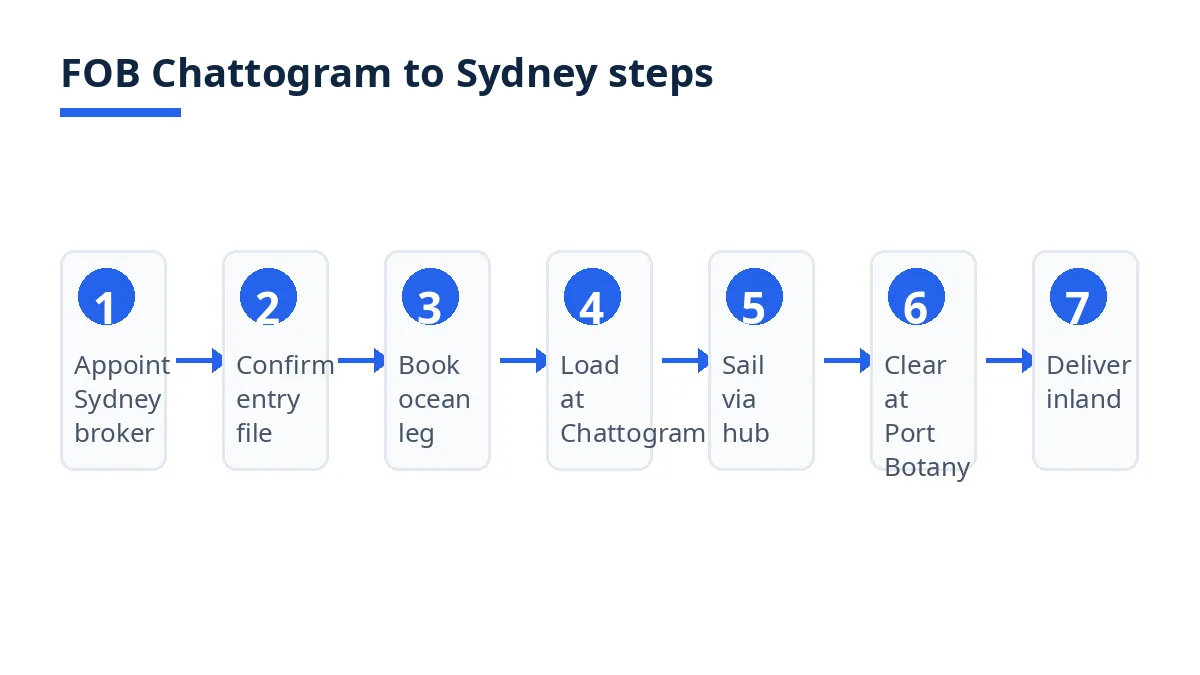
Write the term and appoint the Australian customs broker early. Record "FOB Chattogram, Incoterms 2020", the goods, quantity, price, payment method, and inspection terms in the sales contract or purchase order. At the same time, appoint a licensed customs broker to act as agent for the import entry. The Australian Border Force encourages first-time or infrequent importers to use a licensed customs broker to clear their goods.3
Confirm the broker's entry file before production finishes. The broker needs the goods description, the importer details, the transport details, and the tariff classification and customs value for the Import Declaration.3 Ask the broker what the duty position is for the goods concerned, what base GST will be calculated on, and what origin proof is needed if any preference claim is to be made. Do not price the order until those answers are in writing.
Book the ocean leg through the buyer's forwarder. The buyer contracts the carrier and pays freight to Sydney.1 Give the seller timely notice of the vessel name and the loading place and point within the port, because late notice can shift risk and added costs to the buyer even before loading.1 Direct services from Chattogram to Australia are limited, and most cargo transships via Singapore, Port Klang, or Colombo.2
Load at Chattogram and collect the on-board evidence. The seller delivers the goods on board, clears them for export, and gives notice of delivery.1 Check that the bill of lading shows the goods as loaded on board, that the port pair reads Chattogram to Sydney, and that the marks and numbers match the packing list.
Sail, track, and prepare the Sydney release. Send the broker the commercial invoice, packing list, bill of lading, and any origin proof before arrival, so the entry file is ready when the vessel berths at Port Botany. For goods valued over AUD 1,000 and cleared into home consumption, an Import Declaration (N10) is required, and all applicable duties, taxes, and charges must be paid before release.3
Clear the Sydney entry at Port Botany. The broker lodges the declaration in the Integrated Cargo System, and the importer remains responsible for completing and submitting the Import Declaration, which the Australian Border Force will not complete on the importer's behalf.3 Standard clearance at Port Botany takes 1 to 3 days for compliant shipments with proper documentation, while a biosecurity tailgate inspection, if triggered, may add 1 to 2 days.2
Move inland only on a forwarder-confirmed leg. Port Botany has a dedicated freight rail line to intermodal terminals at Moorebank and Enfield, supporting distribution to western Sydney and beyond.2 An onward leg to the buyer's warehouse is added only when the forwarder confirms it for the actual address, vehicle size, and delivery window. Do not add a guessed inland figure to the landed cost.
Costs, timelines and documents
No figure in this section is a quoted rate. Ocean freight, port charges, broker fees, and inland delivery change by sailing, carrier, volume, and season, so every money figure below is labelled as an example figure for one order, and every time figure is a dated guide estimate or a planning allowance to confirm with the forwarder.
A guide updated on November 24, 2024 puts standard FCL ocean transit from Bangladesh to Sydney at 18 to 24 days, with transshipment through Singapore, Port Klang, or Colombo, and puts LCL transit at 22 to 30 days once consolidation and deconsolidation are added.2 Treat those ranges as planning inputs from that date, not as promises for a named sailing. Add separate allowances, confirmed by the forwarder and the broker, for loading at Chattogram, Port Botany handling and release, any biosecurity inspection, and the inland leg where one is confirmed. Monsoon conditions from June to September can affect Chattogram port work, peak volumes from August to October can tighten vessel space, and the September to November retail peak can affect berth availability at Port Botany.2
Line | Example figures (AUD) |
|---|---|
Product cost: 6,000 units, FOB Chattogram | 18,630.00 |
Ocean freight, Chattogram to Sydney | 2,340.00 |
Cargo insurance, buyer-arranged | 165.00 |
Sydney port and terminal charges | 385.00 |
Customs broker fee | 230.00 |
Inland delivery, Sydney to warehouse (forwarder-confirmed option) | 380.00 |
Pre-shipment inspection | 275.00 |
Bank and currency costs | 95.00 |
Subtotal before duty and GST | 22,500.00 |
Landed cost per unit before duty and GST | 3.75 |
Example figures only: every figure here is illustrative for a single order, not a quoted price, freight rate, or charge for any supplier, route, or shipment. The lines sum to 22,500.00, or 3.75 AUD per unit over 6,000 units before duty and GST. Import duty is not in this subtotal: the broker confirms it from the tariff classification and origin of the goods concerned, and no product-specific Australian duty rate is stated in this guide.
GST is shown separately from the subtotal because its base is broker-confirmed for each entry. As a conditional example only, a broker-confirmed GST amount of 2,250.00 AUD for this order would give 24,750.00 AUD including that conditional GST figure, or 4.13 AUD per unit. That amount is an example assumption for arithmetic, not a statement about the duty position, the tax base, or the tax treatment of any real shipment, and this guide states no GST rate and no conclusion about GST recovery. Both points are for the broker and the buyer's tax adviser.
The core document set is the commercial invoice, packing list, bill of lading, origin proof where a preference claim or tariff treatment is relied on, and the insurance certificate for the buyer's own cover. To lodge a declaration in person, the Australian Border Force lists the bill of lading or air waybill, commercial documents such as invoices, evidence of identity, permits or approvals, and any other relevant documents.3 After the declaration is made, all relevant documents must be kept for five years.3 Ask the seller for origin proof before loading, since a certificate requested after sailing can arrive too late for the entry as planned.
Bangladesh-specific rules and tips
Start with the named port, not the country name. The contract should name Chattogram together with the edition: "FOB Chattogram, Incoterms 2020". A quote reading only "FOB Bangladesh" leaves the delivery point open, and one omitting the edition leaves the rule version open.
Check the container handover against the rule. The ICC Academy notes that containerised goods are often delivered to a container terminal and may stay there for days before loading, in which case FCA is the more appropriate rule.1 If the seller will hand containers to a terminal rather than load them directly on board, discuss FCA with the forwarder before signing FOB.
Confirm Australian labelling and packaging before production. Garment exports require compliance with Australian Consumer Law on labelling, safety standards, and fibre content declarations, and natural fibre products may face biosecurity inspection.2 Send the label text and packaging specification with the purchase order and check a production sample against both.
Plan around the seasonal pressures on this lane. Book 3 to 4 weeks ahead during normal periods and 6 or more weeks ahead during peak season from August to October, and allow a 2 to 3 day buffer for a missed connection at a transshipment hub.2
Mistakes and red flags
Accepting "FOB Bangladesh" with no named port and no edition.
Budgeting only the FOB price, leaving freight, insurance, Sydney charges, broker fees, duty, GST, and inland delivery unbudgeted.
Appointing the broker after the vessel sails, wasting the Port Botany terminal window.
Copying a duty rate from another product or an earlier order instead of getting the broker's figure for the goods concerned.
Treating the dated 18 to 24 day guide range as a sailing promise.
Adding an inland delivery figure that no forwarder has confirmed.
Assuming a GST amount from the FOB price instead of the broker-confirmed base.
Signing FOB for containers handed over at a terminal without discussing FCA.
Ignoring the ISPM-15 wood packaging check before production.
Paying in full before the on-board bill of lading, marks, and packing list are checked against each other.
Checklist
[ ] Contract states "FOB Chattogram, Incoterms 2020" with goods, quantity, price, payment method, and inspection terms.
[ ] Licensed Australian customs broker appointed before production finishes.
[ ] Broker confirms in writing: classification, duty position, origin proof needed, and the GST base.
[ ] Vessel name and loading point notified to the seller in time for loading.
[ ] Bill of lading checked: on-board notation, Chattogram to Sydney port pair, marks matching the packing list.
[ ] Invoice, packing list, bill of lading, origin proof, and insurance certificate sent to the broker before arrival.
[ ] Port Botany handling, release timing, and any biosecurity examination allowance confirmed with the forwarder.
[ ] Inland leg confirmed for the actual warehouse address, or delivery planned from Sydney without assuming it.
[ ] Label content and ISPM-15 packaging approved before production, with a sample checked against both.
[ ] Landed cost recalculated from actual charges after release, with the entry file kept for five years.
How Exportain helps
Exportain connects international buyers with Bangladeshi suppliers and trade service providers. Use this guide's checklist: ask for the named port and edition in the quote, ask what origin documents the seller will supply and by when, and ask the broker to confirm the Sydney entry file before production finishes. Exportain does not book freight, clear customs, or act as a party to the goods contract, so the ocean booking, broker appointment, and inland leg remain the buyer's arrangements with its forwarder and broker.
FAQs
What should I know first about FOB?
Know the dividing line before you know the price. Under FOB Chattogram, Incoterms 2020, the seller delivers on board at Chattogram and clears the goods for export, and risk passes to you at that loading moment.1 Everything after loading, freight, insurance, Sydney charges, broker fees, duty, GST treatment, and inland delivery, is yours to arrange and pay for.
What are the typical costs and timelines?
The cost lines after the FOB price are ocean freight, buyer-arranged insurance, Sydney port and terminal charges, a customs broker fee, import duty confirmed by the broker for the goods concerned, GST on a broker-confirmed base, and inland delivery where a forwarder confirms it. The example table totals 22,500.00 AUD before duty and GST for one 6,000-unit order, or 3.75 AUD per unit, with a conditional GST figure of 2,250.00 AUD on the example base stated there. For time, use the November 2024 guide range of 18 to 24 days for standard FCL ocean transit from Bangladesh to Sydney as a planning input, then add forwarder-confirmed allowances for loading, Port Botany release, any biosecurity inspection, and any inland leg.2
Which documents are needed?
The core set is the commercial invoice, packing list, bill of lading, origin proof where a tariff treatment is relied on, and the buyer's insurance certificate. The broker also needs the full goods description, importer details, transport details, and tariff classification and customs value for the Import Declaration, and the importer remains responsible for the declaration.3 Request origin proof and packing details in the purchase order, with dates, so they arrive before loading.
What are the most common mistakes?
The most common mistakes are accepting an unnamed port, budgeting only the FOB price, appointing the broker too late, copying a duty rate from another product, treating a guide transit range as a sailing promise, pricing an unconfirmed inland leg, and signing FOB for a terminal handover where FCA fits better.1 Each one is avoidable at contract stage: name the port and edition, appoint the broker early, get the duty and GST positions in writing, confirm the packaging plan, and confirm every leg with the forwarder who will run it.
Next steps on Exportain
Read the FOB meaning guide for the full FOB obligation lists, then the Incoterms guide for shipments from Bangladesh to compare FOB with FCA, CFR, and CIF on one table, and the landed cost guide for imports from Bangladesh to rebuild the example table from your own forwarder quotes and broker-confirmed duty figure.
Sources
- FOB & FAS Incoterms® 2020 explained: Key differences. ICC Academy (accessed )
- Shipping from Bangladesh to Sydney. GoCubic (accessed )
- Import declarations. Australian Border Force (accessed )
About the author
Sourcing from Bangladesh?
Post a request for quotation and suppliers on Exportain can send you their quotes directly.
Post an RFQ