Typical MOQ for Finished Leather in Bangladesh (and How to Negotiate It Down)
Finished leather MOQs are counted per dye lot, grade, shade band and thickness, not per order total. This guide works the lot split, the Savar evidence and six negotiation levers, with every number labelled as an example figure.
Short answer
There is no single typical MOQ for finished leather from Bangladesh. Each supplier counts the minimum per dye lot, per grade, per shade band, and per thickness, through five splits: the tannery lot, grade and usable area, shade, thickness and form, and packing. State the lot split first, find the binding count, and negotiate by changing the split or using stocked leather.
On this page
Key takeaways
There is no single typical MOQ for finished leather from Bangladesh, because each supplier counts the minimum per dye lot, per grade, per shade band, and per thickness.
The lot split binds first: one failing shade band or grade can stop a run whose label area looks large enough.
Five splits set a finished leather minimum: the tannery lot, grade and usable area, shade, thickness and form, and packing.
Negotiate in lot order: consolidate shade bands, share one dye lot, use stocked leather, widen grade acceptance, standardize thickness, and phase the bands.
A tannery audit covers the tannery, not a single lot: ask for the lot lab report by named method and agree the validity in writing.
A finished leather order fails on shade, not on area: the total is large enough and the price is agreed, yet one shade band falls short of its minimum and the run cannot start as specified. There is no single typical finished leather MOQ in Bangladesh that a buyer can plan around, because each supplier counts the minimum against a different split of the same lot.
This guide is for buyers ordering finished leather from Bangladesh to cut into shoes, bags, belts, or upholstery for the USA, UK, EU, or UAE. It works the lot split first, then the negotiation.
The finished-leather lot: five splits that each set a minimum
Finished leather means leather further prepared after tanning or crusting. Heading 4107 covers that leather, of bovine (including buffalo) or equine animals, without hair on, whether or not split, other than leather of heading 4114.1 A wet-blue or crust hide is not finished leather in tariff terms, even if a supplier describes it as finished.2 Sheep or lamb leather falls under heading 4112, other animals under 4113, and chamois, patent, patent laminated, and metallized leather under heading 4114 even when the animal is bovine.2 Record the animal first: there is no single code for all finished leather.
A minimum order quantity is the smallest quantity a supplier will accept on its normal terms, counted per order, per style, or per color, and sometimes combined with a minimum order value.3 For finished leather, add the counting bases that come with the material: per dye lot, per grade, per shade band, and per thickness.
Split | What multiplies it | Ask for it as |
|---|---|---|
Tannery and dye lot | Animal, tannage, dye batch, finish | Minimum per lot, color, and finish |
Grade and usable area | Hide area, defect position and size | Minimum per grade, in usable area |
Shade band | Shade drift hide to hide | Minimum per shade band, under one light |
Thickness and form | Thickness, whole hides or sides, grain split | Minimum per thickness and form |
Packing | Rolls, shade-band labels, lot marks | Minimum per roll and packing type |
See the MOQ meaning guide.3
Start with the tannery lot: dye, finish, and shade consistency
A dye lot is one batch of leather dyed and finished together. Hides from the same lot can drift in shade; hides from two lots rarely match. Ask whether the quotation covers one dye lot or several, and whether the shade standard is a sealed sample hide held under an agreed light.
Tannery evidence rides with the lot, not with the trader who sells it. The Leather Working Group (LWG) audit, first launched in 2005, assesses a tannery's manufacturing operations across 17 sections, with thresholds of 85 percent for Gold, 75 percent for Silver, 65 percent for Bronze, and 50 percent for Audited, and the final medal is set by the lowest-scoring section.4 Certification is valid for 24 months for leather manufacturing facilities, and does not guarantee no restricted substance failures in a final product.4 The standards also cover traders of finished leather, but a trader rating is not a tannery medal, and neither one certifies a single lot.4
Chromium VI must stay lot-specific. For Gold and Silver, chromium VI must be below 3 mg/kg, and any level above that results in automatic failure.4 ISO 17075-1:2017 specifies a colorimetric method for determining chromium(VI) in solutions leached from leather, quantifying the content down to 3 mg/kg, reported in milligrams per kilogram of dry mass.5 Ask for the lab report for the lot you are buying, naming the method. A tannery audit covers the tannery, not the finished product.
Grade splits: usable area is not hide area
Finished leather is graded, not passed or failed as a perfect sheet: natural marks are inherent, and grading turns on position and size. Corner damage may mean a grade drop; main-area damage may scrap the hide.6
Leather is commonly sold by the square foot, with hides measured at the tannery and the square footage marked on each piece, and no two pieces are exactly the same area.7 The label area is the hide area. The usable area is what remains after the grade map is applied: prime areas kept, secondary areas downgraded or cut around, damaged areas excluded. State the area unit, how usable area is measured, and which grade bands the order accepts. A lot can clear the total minimum and still fail the usable-area need.
Agree the grade rules before the price, from the buyer's acceptance specification, with a map of prime and secondary areas and a rule for how a defect in each area affects the grade.6 See the quality control checklist for finished leather for the hide-by-hide checks behind a grade rule.6
Thickness splits: one hide, several minimums
Thickness is gauged under a specified load, for whole leather and test samples, with readings at agreed points including the spine and the belly, because one hide can be thicker at the spine than at the belly.6 Thickness still varies across a cut, so it is indicated as a range, in ounces, irons, or millimeters.7 State the thickness, its tolerance, the reading points, and the gauge method in the specification.
A thickness change is a new split: a thicker leather for upholstery and a thinner leather for small goods, in the same animal, color, and finish, are two finishing and sorting runs. A change of form, whole hides to sides, has the same effect.2 Ask for the minimum per thickness and per form, apart from the lot minimum.
Hides are rolled, never folded, with paper between rolls and no weight on the finish, because folding leaves marks that can stay permanently, and rolling runs neck to butt because the butt is the stiffest part.6 A roll that mixes shade bands or grades under one label destroys the sorting the grade rule just created. Ask for rolls labeled by lot, shade band, and grade.
Savar and the lot: why the tannery address matters
Most Bangladeshi tanneries sit at the Savar Tannery Industrial Estate, outside Dhaka, after the move from Hazaribagh in 2017.8 Effluent treatment at the estate sets the ceiling on what many tanneries can evidence. A gap-assessment workshop in May 2026 reported that an audit of 20 Savar tanneries found only three scoring above 50 percent against the LWG protocol, with the highest at 51 percent, and that the Central Effluent Treatment Plant (CETP) was only partially functional.9 The workshop noted that only eight Bangladeshi institutions had secured LWG certification, while around 140 of the 162 allocated tanneries in Savar were operational.9
The workshop reported that most Savar tanneries could not directly export to European and US markets due to a lack of certification, and sold raw leather to China at lower prices.9 A Business Promotion Council director told the workshop that local firms were receiving only one-third of the potential global leather prices due to a lack of LWG certification.9 Ask for the tannery name, audit status and expiry, effluent evidence, and the lab report for the lot. According to the Export Promotion Bureau (EPB), leather exports reached $1,145.07 million in FY2024-25.9
Work the lot split on paper: one order, five counts
Work the split before you accept a quotation. Example figures only: one order of 1,200 square feet, one color and finish, minimum 300 per shade band and 500 per thickness, usable-area need 1,000 square feet.
Split | Example figures | Against the stated minimum |
|---|---|---|
Total area | 1,200 square feet | Passes a 1,000 square foot total minimum |
Per shade band, 6 bands | 200 square feet per band | Fails a 300 square foot band minimum |
Per shade band, 4 bands | 300 square feet per band | Passes a 300 square foot band minimum |
Usable area after grading | 900 square feet | Fails a 1,000 square foot usable need |
Per thickness, 2 thicknesses | 600 square feet each | Passes a 500 square foot thickness minimum |
Sharing one dye lot clears the lot minimum, but six shade bands restart the shade agreement six times, and grading the lot down to 900 usable square feet leaves the order short even though the label area passes.
Work in this order:
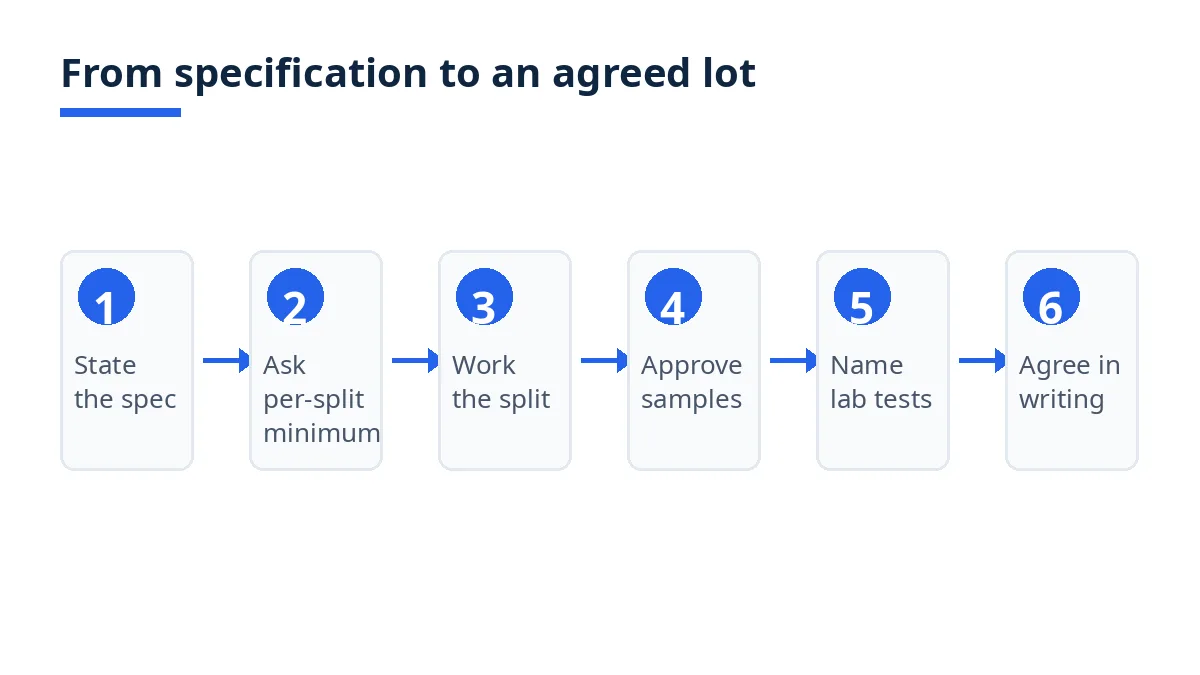
Negotiate in lot order: six levers
Record each agreed change on a new quotation version. An MOQ can often be discussed, but a smaller order usually costs more per unit, and none of these options is guaranteed: raise them as questions and expect a trade-off.3
Consolidate the shade bands. Ask whether four bands, each at the full band minimum, can serve the range that six thin bands cannot.
Share one dye and finish lot across end uses. Ask whether the same lot can serve two cutting programs, with the grade split recorded per program.
Use stocked leather and a running color. Stocked leather in a running color may carry a lower minimum than a color dyed to order.
Widen grade acceptance in writing, by area. Ask whether secondary-area hides can serve secondary parts under an agreed grade band, with the usable-area map attached.
Standardize thickness and roll packing. One thickness, one form, and one roll specification remove the thickness and packing splits.
Split the shipment and phase the bands, with the repeat in writing. A first shipment of core bands, with a written repeat price and MOQ for the rest on the same lot, can succeed where a small order covering every band fails.
Do not trade away testing for a lower minimum. ISO 2859-1:2026 defines acceptance sampling plans indexed by AQL, the maximum average percentage of defective items considered acceptable during random sampling, with switching rules that tighten inspection when defects increase.10 Name the inspection level and AQL values in the purchase order.
What a lower minimum costs, and when it stops holding
All figures here are example figures; a supplier may state an upcharge for an order below the quoted quantity.3
Example figures: a buyer needs 720 square feet in one shade band against a 900 square foot band minimum. A surcharge of 6 units per square foot costs 4,320 units, with no extra stock. Ordering up to 900 square feet at 18 units for the 180 extra square feet costs 3,240 units and leaves 180 square feet in stock. At index prices of 100 units below 900 square feet and 96 from 900, the totals are 72,000 units for 720 square feet and 86,400 for 900. Compare the total at each tier, not only the unit price.
An agreed MOQ is tied to a dye lot, shade bands, grade map, thickness, price validity, and production slot, and stops applying when any of them changes.4 Agree the validity in writing at the first order. Classification under the indicative heading for the animal, 4107 for bovine or equine, 4112 for sheep or lamb, or 4113 for other animals, is confirmed by the broker before pricing is fixed.2
Finished-leather mistakes that cost a second lot
Agreeing a total area without a lot split. The binding minimum is usually per dye lot, grade, shade band, or thickness, not per order total.
Adding a thickness, finish, or shade band late. A late thickness change restarts finishing and sorting; a late finish change restarts the dye lot; a late shade band restarts the shade agreement.
Treating a tannery certificate as a lot certificate. An audit covers the tannery, not a single dye lot, and LWG certification does not guarantee no restricted substance failures in a final product.4 Ask for the lot lab report by named method.
Judging capacity from a listing or a badge. Verification on Exportain is a review of documents and photos by Exportain staff, not a factory visit, and a badge is not a guarantee of production capacity, product quality, or delivery.11 Read each badge for the check behind it, using the supplier verification guide.11
Filing every finished leather under 4107. The animal test comes first: sheep and lamb under 4112, other animals under 4113, and patent, chamois, and metallized leather under 4114.2
Agree these eight lines before you pay
Animal, tannage, dye lot, finish, and tannery, per lot.
Shade bands and shade standard, with sealed samples and the agreed light named.
Grade rules and usable-area method, with the area unit and prime and secondary map attached.
Thickness, tolerance, reading points, gauge method.
Form and grain per line, whole hides or sides, against the approved sample.2
Lab tests by named method: chromium(VI) under ISO 17075-1; sampling under ISO 2859-1 with AQL values.5 10
Roll packing and labels per lot, shade band, and grade, with hides rolled, never folded.6
Price tier basis and validity dates confirmed, with repeat-order terms, and classification to be confirmed by the broker.2
What should I know first about finished leather?
Know the order as five splits, not one number. The tannery and dye lot, the grade and usable area, the shade band, the thickness and form, and the packing each set a minimum, and the first one that fails decides the order. Finished leather is leather further prepared after tanning or crusting, and the animal decides the heading.1 2 State the lot split first and test every line before you discuss price.
What are the typical costs and timelines?
There are no typical costs or timelines a guide can state as fact, because each supplier prices your animal, tannage, dye lot, grade mix, shade bands, thickness, split, and delivery term. A smaller order usually costs more per square foot, through a surcharge or a setup charged apart from the unit price, and timelines follow the dye lots, sample approval, and lab reports in that order.3
Which documents are needed?
The order documents are the specification, the accepted quotation stating the minimum per lot, grade, shade band, and thickness, and the purchase order carrying the same split, the inspection standard, and the validity dates. Keep the lot lab report, the sealed sample record, and the classification file with the shipment documents. Classification is confirmed by the broker before filing.2
What are the most common mistakes?
The most common mistakes are agreeing a total area without a lot split, asking for the lowest minimum and the lowest tier price together, accepting a lower minimum verbally, adding a thickness, finish, or shade band late, reading a tannery certificate as a lot certificate, filing every leather under 4107, and paying before the split is written.
Next steps on Exportain
Browse suppliers, then read the supplier verification guide and the HS code guide for finished leather. When the specification is fixed, post a free RFQ on Exportain with the split per dye lot, grade, shade band, and thickness.
Sources
- Classification Detail: HS, 2017, Code 4107. United Nations Statistics Division (accessed )
- HS Code for Finished Leather: Classification Guide for Importers. Exportain, (accessed )
- MOQ Meaning (Minimum Order Quantity). Exportain (accessed )
- Certification - Leather Working Group. Leather Working Group (accessed )
- EN ISO 17075-1:2017 - Leather - Chemical determination of chromium(VI) content in leather - Part 1: Colorimetric method. International Organization for Standardization (accessed )
- Quality Control Checklist for Finished Leather. Exportain, (accessed )
- Selecting Leather. MTR Custom Leather (accessed )
- Bangladesh's leather exports drop 64% in 10 yrs as CETP not complete. Fibre2Fashion, (accessed )
- Poor compliance in Savar tanneries forcing leather industry out of global markets. The Business Standard, (accessed )
- ISO 2859-1:2026 - Sampling procedures for inspection by attributes — Part 1: Sampling schemes indexed by acceptance quality limit (AQL) for lot-by-lot inspection. ISO (accessed )
- How Supplier Verification Works on Exportain. Exportain, (accessed )
About the author
Sourcing from Bangladesh?
Post a request for quotation and suppliers on Exportain can send you their quotes directly.
Post an RFQ