Finished Leather Exporters in Bangladesh: Supplier Checklist
Fifteen tests in five groups for finished leather exporters in Bangladesh: identity and site, specification, sample and laboratory evidence, quotation fields, and the shipment file, each with the evidence to file before a deposit.
Short answer
Use this checklist to compare finished leather exporters in Bangladesh before a deposit: file identity and site evidence, the specification sheet and classification, sealed samples and laboratory reports, quotation fields on one unit, and the shipment file, and stop the file on any contradiction.
On this page
Key takeaways
Work the checklist in two passes: groups A and B decide the shortlist, and groups C, D, and E decide the deposit; pay no deposit while any test is open.
Read each Exportain badge for the checks its name records: verification is a document and photo review, not a factory inspection or a guarantee.
Example figures: a minimum of 400 square feet per color across four colors in one finish means a smallest order of 1,600 square feet, not 400.
A contradiction between any two documents stops the file; the supplier supplies evidence and the sample but does not close its own file.
A finished leather exporter can pass every test for the leather and still fail as an exporter. The sample can match the specification while the quotation prices a different unit, the producing site stays unnamed, or the shipment file describes leather the buyer did not order. This checklist is for buyers comparing finished leather exporters in Bangladesh: it answers who is selling the leather, on what written terms, and with what file behind it.
It names no companies and ranks no exporter. Fifteen tests in five groups follow the order a buyer meets them: identity and site, leather and specification, sample and lot evidence, commercial fields, and the shipment file. Each test names the evidence to file and how to check it. Example figures are labeled as such.
Why this checklist matters
A quotation is comparable only when every exporter answers the same requirement in the same fields. One exporter quotes per square foot, another per hide, and the lowest number can be the bigger order once the unit is fixed. Run this checklist first, while the shortlist is still open.
It separates two questions: whether the sample leather is the leather described, and whether the company answering made it, at the site named, under the terms written. A badge, a photograph, or a sample answers part of the first question. None answers the second alone. No deposit moves while a test is open, and a contradiction between documents stops the file.
Before you start
Send every exporter the same requirement pack: specification sheet reference and version, quantity and unit per finish and color, delivery term with the named place, and destination. Ask for the same quotation fields from each: unit price, minimum with its counting basis, lead time, delivery term, payment terms, and validity dates.
Keep one file per exporter, in the same field order, with the date and sender beside each entry. Keep both versions when an answer changes. Groups A and B decide the shortlist; groups C, D, and E decide the deposit. Reopen the file when the leather, tannery, finish, color, or delivery term changes.
The full checklist for finished leather exporters in Bangladesh
Work the groups in order. Pay no deposit until all five groups are filed.
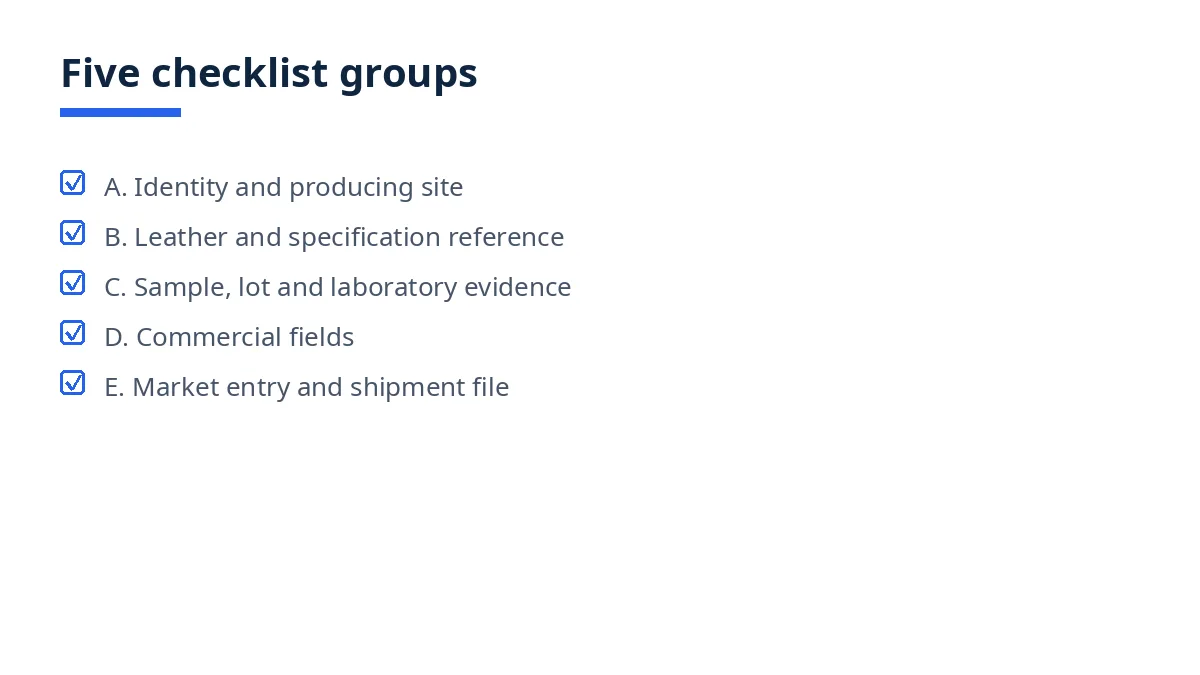
Group A: identity and producing site
Company name and address match across documents. Ask the exporter for copies of the trade licence and Export Registration Certificate (ERC) yourself, and check the name and address against the quotation and the invoice.1 Any difference is a stop.
Each badge is read for the checks its name records, with its limits. Exportain Verified records identity, phone, email, and business registration; Export Verified records the ERC; Factory Verified records reviewed factory photos; Trading Company Verified records reviewed office or warehouse photos; Trusted Trader records completed orders on Exportain with no disputes.1 Verification is a document and photo review, not a factory inspection or a guarantee of capacity, quality, or delivery.1 A missing badge means a check has not been approved, not that it failed; membership never grants a badge.1
The producing site is named for each stage. Record who tanned the sample leather, who finished it, at which site each stage happened, and which stages were bought in. For a trading company, record the tannery and finisher per finish before any deposit, and name them in the order terms.
Group B: leather and specification reference
Preparation state and the five material facts are stated in writing. Finished leather means leather further prepared after tanning or crusting; a wet-blue or crust hide is not finished leather in tariff terms.2 Record species, preparation state, form, grain, and finish behind any trade name.2
Classification is confirmed for the exact leather. The indicative heading for bovine, including buffalo, or equine finished leather is 4107; sheep or lamb leather falls under 4112, other animals under 4113, and chamois, patent, patent laminated, and metallized leather under 4114.2 Confirm the full national code in the destination tariff, and re-check it if the specification changes.2
One version-numbered specification sheet is referenced in the quotation. File one sheet covering animal and tannage, finish type, thickness and where it is read, grade rules, shade standard and light source, area and its unit, and packing. The quotation must cite the sheet version it prices. Thickness is gauged under a specified load, at the spine and the belly.3
Group C: sample, lot, and laboratory evidence
One sealed sample per finish and color is approved and kept. Approve one sealed sample per finish and color, showing grain, shade, softness, and finish, kept flat, away from light, and apart from other colors.3 Judge each sample hide unrolled, never folded, and record the light used for shade.3
Lot capacity is tested through a trial lot, not a claimed number. Ask for the lot size normally finished in one run, and whether the order will be finished in one run or several; each run needs its own sample approval. Judge the trial lot on the same hide-by-hide record as the bulk lot. A tannery change restarts sample and laboratory evidence.
Laboratory reports name the leather and the method. Where the buyer specification requires it, require reports naming the product, the leather, and the method for each market limit, judged against the buyer specification. Colorfastness to rubbing is tested under ISO 17075 and flex resistance under ISO 5402-1, with no universal grade or pass mark stated.3 Confirm any certificate with the body that issued it.1 Treat a tannery audit as evidence about the tannery, never as a certificate for the leather in the lot.
Group D: commercial fields
The minimum and the price sit on one stated unit. Ask whether the minimum is counted per hide, per side, per square foot or square metre, per finish, per color, per lot, or by order value, and whether more than one minimum applies at once. Get the basis in writing. Example figures: 400 square feet per color across four colors in one finish means a smallest order of 1,600 square feet, not 400.
Every quotation field is present, dated, and written in full. Each quotation must state unit price, minimum with its basis, lead time, delivery term with the named place, payment terms, and validity dates. Agree the delivery term, payment schedule, inspection, and shipment terms in writing before paying.1 A missing field is an open item.
Payment and inspection terms are agreed before money moves. Record the payment schedule, triggering documents, and inspection condition. Cash in advance is the least attractive option for a buyer, while a letter of credit protects both sides because payment depends on documents showing the goods were shipped as agreed.1 Exportain is not a party to the trade, and holds money only when both parties agree to a funds hold.1 A late change to bank details is a stop until confirmed in writing through the same channel as the quotation.
Group E: market entry and shipment file
Packing is agreed for the material, hide by hide. Confirm roll packing before shipment: hides rolled, never folded, paper between rolls, no weight on the finish, rolling neck to butt, because the butt is the stiffest part and does not take a sharp bend well.3 Check hide count, area total, and roll labels against the packing list and the order.
The shipment file is listed before loading. File the specification sheet, the confirmed code for each leather type, any binding decision, and the origin evidence with the shipment documents, with each leather type as a separate invoice line.2 Ask the exporter to confirm that the invoice and packing list describe the leather in the same terms used for classification.2
The whole file is re-read for contradictions. Before the deposit, names, sites, codes, units, and dates must agree across the licence, quotation, specification sheet, sample record, and shipment file. Any unexplained change or expired certificate is a stop. The supplier supplies documents and the sample; it does not close its own file. Report suspected fraud or misrepresentation through the Trust Center.1
Common failures and how to fix them
Repair means the exporter supplies the missing or corrected evidence and the group is re-checked. A second contradictory correction closes the file.
Failure | Test | Fix, or stop when |
|---|---|---|
Trade name only, no material facts | 4 | All five facts in writing; stop if only the name arrives |
Price compared on different units | 10 | Quotations restated on one unit; stop if pricing rests on a headline number |
One sample applied to another finish or color | 7 | Sealed sample per finish and color; stop if a finish has no sample |
Badge read as a guarantee | 2 | Badge read for its named checks only; stop if offered instead of sample evidence |
Code copied from another leather or country | 5 | Broker-confirmed code for the exact leather; stop if copied from a made article |
Bank details changed late | 12 | Confirmed in writing through the same channel; stop if confirmation does not arrive |
Summary table: one exporter, one file
One row per exporter, one decision per file. The table is a decision record, not a ranking.
Exporter | Groups filed | Open items | Decision |
|---|---|---|---|
Exporter A | A, B, C, D, E | None | Proceed to order terms |
Exporter B | A, B, C | D: counting basis unstated; E: shipment file unlisted | Repair or walk away |
Exporter C | A | B: preparation state unstated; C: no sealed sample | Walk away |
Where two files are both complete, compare identical quotation fields and the sample and laboratory record, not the number of badges held. A badge shortens the desk check; it does not replace the sample, the inspection, or the payment terms.1
When should this checklist be used?
At three decision points: shortlisting, before quotations are compared; sample approval, before bulk production; and before a deposit, before money moves. A single pass at the end leaves no room to change the shortlist, and a single pass at the start cannot test the lot. Reopen the file whenever the leather, tannery, finish, color, or delivery term changes.
Who should complete it?
The buyer owns the file and the decision. A customs broker can complete the classification parts, an inspector the sample and inspection parts, and a laboratory the chemical and physical test parts, each working to the buyer specification. The supplier supplies documents, names sites and stages, and produces the sample; it does not complete its own file. Name the person responsible for each group.
What are the most common failures?
A trade name offered instead of the five material facts; a minimum and price compared on different units; one sample applied to several finishes or colors; a badge read as a guarantee; a code copied from another leather or country; and bank details changed late without written confirmation. Each is a file failure before it is a goods failure: the evidence was missing, contradictory, or late, and the order went ahead without it.
Can a third party do it?
Yes, for parts of it. A third-party inspector can carry out the sample, during-production, and pre-shipment checks against the buyer specification and sampling plan. A broker can confirm classification, and a laboratory can report on named methods. Require a written report for each part, recording the lot, sample size, defects with photographs, measurements, and packing. The decision stays with the buyer: no third party can close a group on evidence it has not seen, and none can turn a badge into an inspection.
Next steps on Exportain
Browse Bangladeshi suppliers and open each profile trust and verification checklist before shortlisting, then read how supplier verification works on Exportain and the MOQ guide. When the specification sheet, quantity and unit, and delivery term are fixed, post an RFQ stating all three in full, and compare quotations on the same fields. Exportain is a B2B marketplace where buyers find Bangladeshi suppliers and post requests for quotation. It is not a party to the contract for the goods, and it does not inspect goods, book freight, or clear customs.1
Sources
- How Supplier Verification Works on Exportain. Exportain, (accessed )
- HS Code for Finished Leather: Classification Guide for Importers. Exportain, (accessed )
- Quality Control Checklist for Finished Leather. Exportain, (accessed )
About the author
Sourcing from Bangladesh?
Post a request for quotation and suppliers on Exportain can send you their quotes directly.
Post an RFQ