Can You Use FAS for Air Freight? Rules, Alternatives and Examples
No, FAS cannot be used for air freight. FAS is a sea and inland waterway rule, so it has no delivery point at an airport. Use FCA for buyer-arranged air freight, or CPT or CIP where the seller arranges the flight.
Short answer
No, FAS cannot be used for air freight. FAS (Free Alongside Ship) is a sea and inland waterway rule only, so delivery happens alongside a vessel at a named port, and no such delivery point exists at an airport. For buyer-arranged air freight, use FCA (Free Carrier) with a named cargo terminal instead, and for seller-arranged air freight use CPT or CIP, with the rule and named place written in full as Incoterms 2020.
On this page
Key takeaways
FAS cannot be used for air freight or courier shipments, because FAS delivery happens alongside a vessel at a named port.
A term written as FAS at an airport is not a valid FAS term and leaves the risk transfer point unclear.
For buyer-arranged air freight, use FCA with a named cargo terminal or other named place, under Incoterms 2020.
If the seller arranges the flight, CPT or CIP are the any-mode alternatives, with CIP adding a seller insurance obligation.
Fix the term before you pay or ship, and name the place, the carrier handover point, and the edition in writing.
No, you cannot use FAS for air freight. FAS (Free Alongside Ship) is a sea and inland waterway rule only, so it has no delivery point at an airport. This guide explains why the rule fails for air cargo and courier shipments, what to write instead, and how to fix a quotation that already says FAS.
Under Incoterms 2020, FAS means the seller delivers by placing the goods alongside the vessel nominated by the buyer at the named port of shipment, and risk passes to the buyer at that point.1 An aircraft is not a vessel in that sense, and a cargo terminal is not a port of shipment, so the delivery event the rule depends on never happens. The replacement in most buyer-arranged air shipments is FCA (Free Carrier), which works for any mode of transport.2
Why this matters for buyers and sellers
The Incoterms 2020 rules divide into two groups. Seven rules work for any mode of transport: EXW, FCA, CPT, CIP, DAP, DPU and DDP. Four rules work for sea and inland waterway transport only: FAS, FOB, CFR and CIF.3 Air freight belongs in the first group, so every air shipment must use one of those seven rules. The United States Export-Import Bank guide lists the same split, placing FAS in the sea and waterway group and FCA in the any-mode group.4
Incoterms rules allocate delivery, cost and risk, not just a price label. Under FAS, the seller clears the goods for export, delivers them alongside the vessel, and the buyer then pays for loading, main carriage, import clearance and onward delivery.1 FAS also does not require either party to obtain cargo insurance, so each party should arrange cover for its own risk period.1 None of that allocation can be read across to an airport, where there is no vessel to stand alongside and no loading on board a ship to mark the handover.
The same problem appears with the other sea-only rules. A sea-only term written on an air contract leaves the risk transfer point undefined, because the condition that triggers the handover never occurs, and a dispute then has to be settled from the rest of the contract rather than from the Incoterms rule.3 The goods may already be in transit while neither side can point to the moment responsibility changed hands.
Unlike the other FAS guides in the Exportain series, which explain FAS for genuine sea shipments, this guide answers only the air question, and its answer is a correction: do not stretch FAS to cover a flight.
The short answer, in full
Can FAS be used for air freight or courier shipments?
No. FAS applies only to goods transported by sea or inland waterways, and the seller delivers when the goods are placed alongside the ship at the named port of shipment.1 Air cargo has no ship, no quay and no alongside delivery, so FAS cannot describe the handover. Courier shipments fail for the same reason: a courier collection, a courier hub and a courier waybill are not a vessel, a port and a sea delivery, even when the courier moves the parcel by air for part of the journey. If any leg of the movement is by air and the parties want an Incoterms rule, choose an any-mode rule for the whole contract and name the handover place for that rule.
A common misunderstanding is that adding an airport name repairs the term. It does not. Writing "FAS Dhaka airport" or "FAS airport terminal" keeps the word FAS, which still means alongside a vessel, and attaches it to a place where no vessel delivery can occur. The result is not a new, valid term. It is a sea term used outside its scope, with no agreed delivery event. The same applies to a courier booking note that copies a sea term from an earlier ocean quotation: acceptance by a booking system does not make the Incoterms rule apply.
Agreement between the parties does not give FAS a delivery point at an airport. For the FAS commercial split, with the buyer arranging main carriage, write FCA; where the seller arranges the flight, write CPT or CIP.
Step-by-step: how it works
Use this sequence when a quotation, proforma invoice or draft contract arrives with FAS on an air shipment.
Stop at the term, not at the price. If the shipment travels by air, in whole or in part, FAS is out, whatever the price looks like.
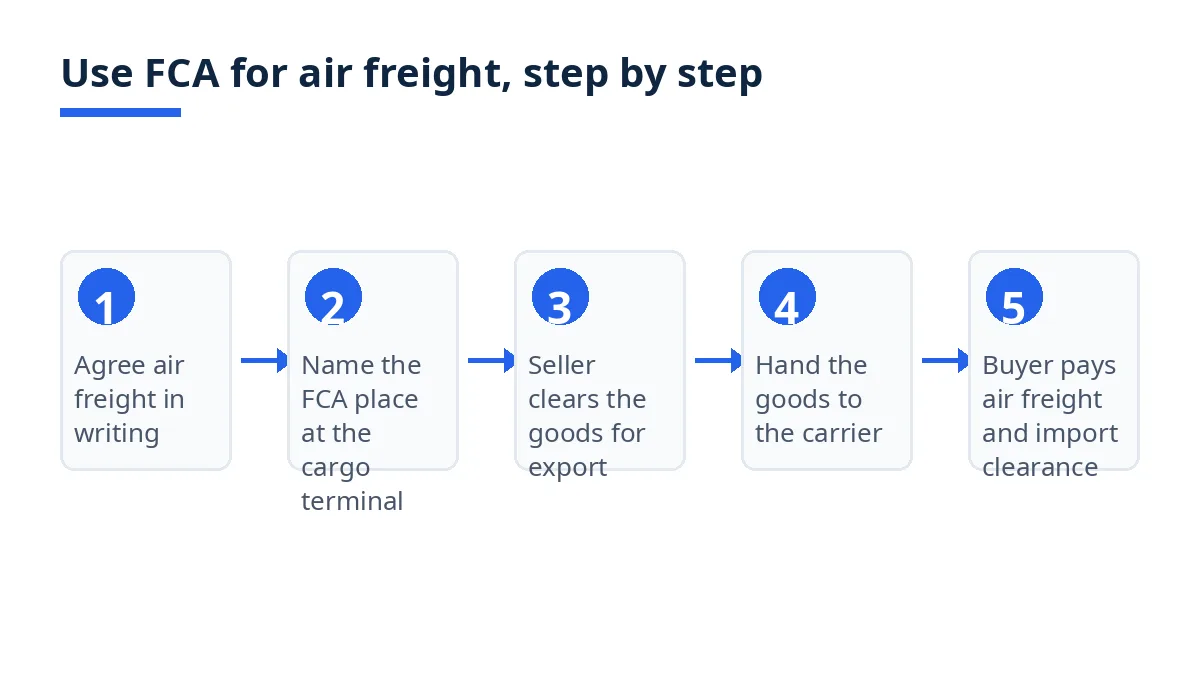
Decide who arranges the flight. Buyer-arranged air carriage means FCA; seller-arranged air carriage means CPT, or CIP where the seller must also provide insurance.
Name the FCA place precisely. For buyer-arranged air freight, the named place is typically the cargo terminal at the export airport, where the seller hands the goods to the carrier.3 Name the terminal, not just the city or the airport, and confirm it with the forwarder first.3
Write the full term. Use the form "FCA [named place], Incoterms 2020". The named place fixes where delivery happens and where risk passes.3
Reallocate cost, risk and documents on the new term. Under FCA, the seller handles export clearance and delivers to the carrier nominated by the buyer at the named place, and risk passes at that handover.2 The buyer then arranges main carriage, pays for it, and handles import clearance and duties.2 Neither party must insure under FCA, so the buyer should arrange cargo insurance from the handover point.2
Reissue every document that carried the old term. Correct the quotation, purchase order, proforma invoice and forwarder instruction that said FAS, so no paper in the set still points to a vessel delivery.
Costs, timelines and documents
What are the typical costs and timelines?
There are no typical air freight costs or timelines that a guide can state as fact, because the rate depends on the route, the chargeable weight, the carrier, the season and the forwarder quote for that shipment. What the term change does fix is who pays for each leg, and that split is what you should compare across quotations.
Under the corrected FCA term, the seller bears export clearance and delivery to the named place, and the buyer bears main carriage, import clearance, duties and onward delivery.2 Under CPT, the seller pays main carriage to the named destination, but risk still passes at handover to the first carrier. Under CIP, the seller pays main carriage and must provide insurance at the wider Institute Cargo Clauses (A) level.3 Compare quotations only after each one is restated on the same term with the same named place; a FAS price and an FCA price for the same flight are not comparable, because the FAS price describes a sea handover that will not happen.
For timelines, the seller must have export clearance complete and the goods ready at the named terminal within the agreed window, and the buyer must nominate the carrier in time.2 If nomination is late, risk can still pass from the agreed delivery date.2
Example figures: a buyer orders knitwear by air at a goods price of USD 12,000. The corrected FCA quotation keeps that price, adds seller delivery to the cargo terminal at the seller's cost, and leaves air freight of USD 2,400, import clearance of USD 350 and onward delivery of USD 180 to the buyer, for USD 14,930 before duty. Risk passes at the terminal handover, not at any point described as alongside a vessel. These are example figures only, not a market rate for any route.
Which documents are needed?
The document set follows the corrected term. The seller provides the goods and a commercial invoice, completes export clearance, and delivers to the carrier at the named place with notice of delivery.2 The buyer contracts the carrier, and the air transport document is the air waybill, not a bill of lading.3 A bill of lading assumes a vessel shipment, while air freight runs on an air waybill under different rules.3
Bangladesh-specific rules and tips
Bangladesh air exports move through airport cargo terminals, not through seaports, so the handover place in the contract should be a cargo terminal or a named carrier facility, never a port of shipment. The Exportain Incoterms guide makes the same point for Bangladesh shipments: for air freight from Dhaka, use only the any-mode rules.5 That guide also records that FAS suits bulk and break-bulk cargo at Chattogram or Mongla, where goods can genuinely be delivered alongside a vessel.5 Sea ports for FAS, cargo terminals for FCA, and no crossing between them.
Three practical tips follow. First, when a Bangladeshi seller quotes FAS from habit, because an earlier ocean order used it, ask for the quotation to be reissued as FCA with the cargo terminal named, rather than accepting a note that says FAS "for air". Second, confirm the named place with the forwarder handling the airport handover, because the forwarder knows which terminal the carrier accepts goods at and what cutoff applies. Third, keep export clearance with the seller under FCA,2 rather than falling back to EXW, where the buyer would carry export formalities in a country where it is not established.
If the shipment changes mode to a sea sailing from Chattogram, FAS can be used for the sea leg only if the goods will in fact be delivered alongside the nominated vessel, and the contract should be amended to say so.
Mistakes and red flags
What are the most common mistakes?
Copying a sea term from an ocean quotation onto an air order. A supplier or buyer copies FAS, FOB or CIF from a previous sea shipment into a new air quotation without checking the mode group. Check the mode group before the price, every time.4
Naming an airport and keeping the sea term. Adding an airport name to FAS does not create an air version of FAS. The delivery point is still defined by a vessel, so the risk point stays undefined.3
Reading a courier booking as an Incoterms term. A courier label or tracking number does not convert a sea term into an air term. If the contract adopts an Incoterms rule, that rule must fit the mode; otherwise the courier's own carriage terms will decide what happens in practice.
Comparing a FAS price with an FCA price. The two prices contain different handovers. Restate both on the same any-mode term with the same named place before comparing.
Assuming insurance follows the freight invoice. Under FAS, neither party must insure, and under FCA, neither party must insure either.1 2 Whoever bears risk from the handover point should hold cover from that point.
Leaving the old term on one document. A corrected purchase order beside an uncorrected invoice or forwarder instruction keeps the dispute alive. Reissue the full set.
Checklist
Before you confirm an air shipment, every line should be answered in writing.
Mode confirmed as air, so no sea-only rule appears anywhere in the set.
Buyer-arranged flight: FCA written with the cargo terminal or carrier facility named.
Seller-arranged flight: CPT or CIP written with the named destination, and insurance stated for CIP.
Edition written as Incoterms 2020 alongside the rule and the named place.
Export clearance assigned to the seller under FCA, CPT or CIP.
Cargo insurance assigned from the handover point, with the policy holder named.
Air waybill, not a bill of lading, expected as the transport document.
Quotation, purchase order, invoice and forwarder instruction all carry the same corrected term.
How Exportain helps
On Exportain, browse suppliers and post a request for quotation (RFQ) on the RFQ board stating the mode, the Incoterm and the named place, so suppliers quote against the same term. A request that states "FCA cargo terminal, Incoterms 2020" receives comparable replies, while a request that states FAS for an air shipment invites replies priced on a handover that cannot happen. Check the term line before the price line, and ask any supplier quoting a sea term for air freight to reissue on FCA, CPT or CIP as appropriate. See how to buy on Exportain for the steps from search to shipment.6
FAQs
Can FAS be used for air freight or courier shipments?
No. FAS is a sea and inland waterway rule under which the seller delivers alongside the vessel at the named port of shipment.1 Air and courier shipments have no vessel delivery, so use FCA for buyer-arranged carriage, or CPT or CIP where the seller arranges carriage.3
What should I know first about FAS?
FAS means Free Alongside Ship. The seller clears the goods for export and places them alongside the buyer-nominated vessel at the named port of shipment, and risk passes to the buyer at that point, with loading and main carriage then for the buyer.1 It is one of the four sea and inland waterway rules in Incoterms 2020.4
What are the typical costs and timelines?
There are no typical air freight costs or timelines to quote as fact, because rates and schedules vary by route, weight, carrier and season. Under FCA the buyer pays main carriage, import clearance and onward delivery after the terminal handover,2 while under CPT or CIP the seller pays main carriage to destination but risk still passes at origin handover.3 Get a forwarder quote for the named route before comparing prices.
Which documents are needed?
The seller provides the commercial invoice, completes export clearance and delivers to the carrier at the named place.2 Air freight runs on an air waybill, not a bill of lading,3 so the document set should name the air waybill and carry the corrected term on every paper.
What are the most common mistakes?
The most common mistakes are copying a sea term from an ocean quotation onto an air order, naming an airport while keeping FAS, comparing prices across different terms, and leaving the old term on one document. Each one is fixed the same way: restate the shipment on FCA, CPT or CIP with the named place and Incoterms 2020 in full.
Next steps on Exportain
Read the Incoterms guide for shipments from Bangladesh to compare all 11 rules, then follow how to buy on Exportain and post on the RFQ board stating the mode, the Incoterm and the named place, so suppliers quote on FCA, CPT or CIP for air freight.
Sources
- FAS Incoterms (Free Alongside Ship): Meaning and Use. iContainers (accessed )
- What Does FCA Mean in Incoterms? Free Carrier Explained. LegalClarity (accessed )
- Air Freight Incoterms: Use FCA, Not FOB. Ovrseas (accessed )
- Incoterms - What to Know When Shipping Your Exports. Export-Import Bank of the United States, (accessed )
- Incoterms for Shipments From Bangladesh. Exportain (accessed )
- How to source and buy from Bangladesh. Exportain (accessed )
About the author
Sourcing from Bangladesh?
Post a request for quotation and suppliers on Exportain can send you their quotes directly.
Post an RFQ