Documents Required for FAS Shipments: Complete Checklist
FAS shipment document checklist for buyers: the seller's export set and proof of delivery, the buyer's carriage, transport and import papers, and the joint consistency check before loading.
Short answer
Under FAS, the seller delivers the goods alongside the buyer's nominated vessel at the named port, cleared for export, and owns the export papers and proof of delivery, while the buyer owns the carriage contract, transport document, insurance and import papers. Check the full set against the invoice before the Bill of Export is filed, so a mismatch cannot hold the goods at the quayside.
On this page
Key takeaways
Split the set by owner: the seller owns export papers and proof of delivery, while the buyer owns the carriage contract, transport document, insurance and import papers.
For Bangladesh, the shipping bill set needs the signed invoice, packing list, EXP form certified by an authorized dealer, certificate of origin, VAT registration, taxpayer identification and Export Registration Certificate.
Under FAS the seller's delivery document is proof of delivery alongside the vessel, not a bill of lading, which is normally the buyer's document because the buyer contracts the carriage.
Check the full set against the invoice before filing: identical names, quantities, weights, marks, ports, vessel and goods description on every document.
Arrange insurance from delivery alongside the vessel, not from loading, since the buyer's risk begins when the goods are placed alongside the vessel.
Under FAS, short for Free Alongside Ship, the seller delivers the goods alongside the vessel nominated by the buyer at the named port of shipment, cleared for export, and the buyer takes over loading and main carriage from that point. The document set therefore splits in a way buyers often miss: the seller owns the export papers and proof of delivery, while the buyer owns the carriage contract, the transport document and the import papers.
The key point is that FAS does not make the seller the shipper on the bill of lading. The seller has no obligation to make a contract of carriage, while the buyer contracts the carriage from the place of delivery.1 The seller must still deliver the goods, the commercial invoice and evidence of conformity, and must give proof of delivery at the seller's cost.1 A buyer that waits for the seller to produce a bill of lading as a matter of course is waiting for a document the seller was never required to produce.
Why this checklist matters
Most FAS document problems are not missing papers. They are mismatched papers: the invoice says one quantity, the packing list says another, and the carrier refuses to load or destination customs holds the goods until the set agrees. Under FAS that mismatch is costly because the goods are already at the quayside, so storage charges and a missed sailing follow quickly. A second reason is the hand-off itself. FAS applies only to sea and inland waterway transport, and delivery is complete when the goods are placed alongside the vessel nominated by the buyer.2 The proof of that delivery closes the seller's main obligation, so agree its form in advance: a mate's receipt, a dock receipt or a signed delivery note. Use this checklist before the goods leave the factory, not at the port.
Before you start
Agree four things in writing before any document is drafted: the exact FAS term with the named port of shipment and, where the port has more than one berth, the loading point within it, since the FAS rule recommends determining the loading point as clearly as possible because handling charges and the move from quay or barge to ship can vary with port practice;2 the vessel name, delivery date or period, and who notifies whom if the vessel is delayed, since the buyer must notify the seller of the vessel name, loading point and delivery date within the agreed period;2 the document list itself, including product-specific certificates the destination requires and whether the sale is under a letter of credit; and one format rule for the whole set, identical names, quantities, weights, marks and numbers on every document.
The full checklist (numbered, printable)
Items 1 to 9 are normally the seller's side, items 10 to 15 the buyer's side, and items 16 and 17 are joint checks.
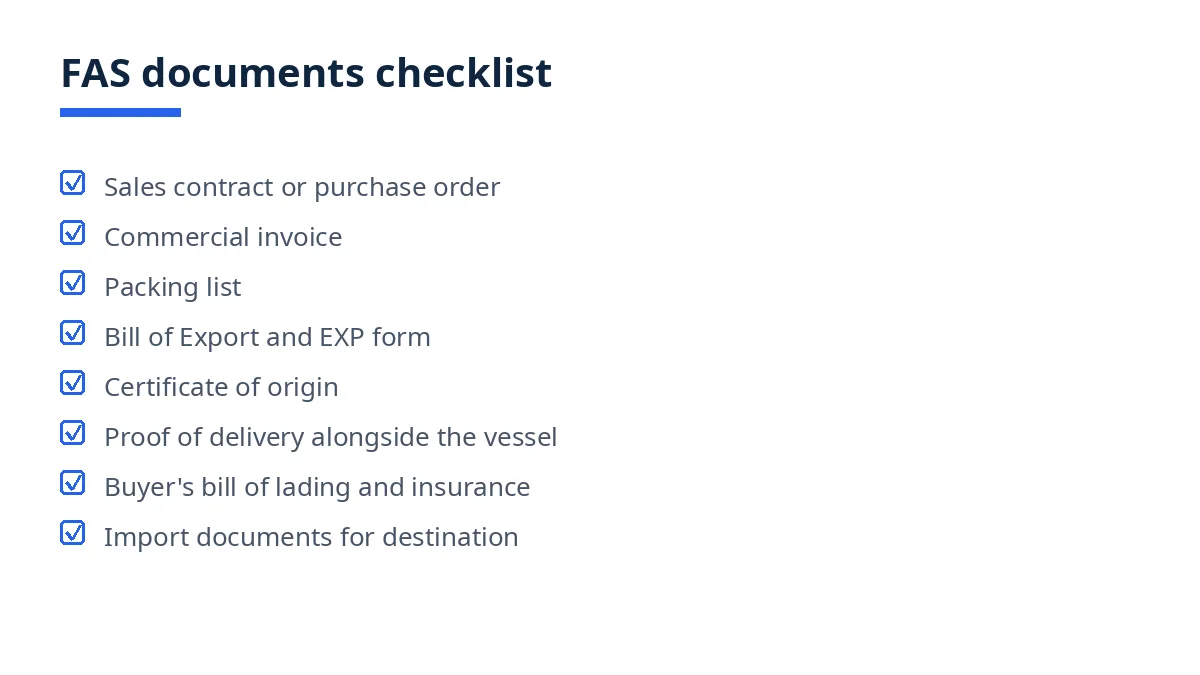
Sales contract or purchase order. Proves a sale exists, on what terms, and under which named port. Where there is no export letter of credit, an export contract or purchase order or export guarantee approved by the negotiating bank is needed for the shipping bill set.3
Commercial invoice. Proves the transaction value and goods description on which customs will assess the shipment. It must be signed by the exporter and agree with the contract, packing list and shipping bill on quantity, value and marks.3
Packing list. Proves how the goods are packed, and the quantity, weight and packing information for each package.3 Check counts, weights and marks against the shipment and the invoice.
Bill of Export, also called the shipping bill, with its supporting set. Proves Bangladesh Customs has accepted the export declaration and the goods may be loaded. The shipping bill is the mandatory document to complete customs clearance, load the goods and claim duty drawbacks.3 Its set includes the export letter of credit or purchase order, signed invoice, packing list, EXP form certified by authorized dealers, certificate of origin, VAT registration certificate, taxpayer identification number and Export Registration Certificate.3
EXP form, certified by an authorized dealer bank. Proves export proceeds will be realized through the banking channel. Keep the certified copy with the shipping bill set.3
Certificate of origin. Proves the country of origin of the goods, which the destination may use to decide duties and preferential treatment. In Bangladesh it is issued by the Export Promotion Bureau or a Chamber of Commerce and Industry.3
Export licence and product-specific certificates, where required. Prove goods subject to control, or a product subject to a destination rule, may lawfully leave and enter. List every certificate at order stage, not at the port, including phytosanitary certificates for plant products, issued by the Plant Quarantine Wing.3
Proof of delivery alongside the vessel. Proves the seller delivered the goods at the agreed point alongside the vessel nominated by the buyer, discharging the delivery obligation. The seller must provide the buyer at the seller's expense with the usual proof of delivery.2 Agree the form in advance: mate's receipt, dock receipt, terminal receipt or signed delivery note.
Seller's checking and marking record. Proves the goods were checked, counted, weighed, marked and packed as the contract requires, since the seller must check, count, weigh, mark and package the goods under the FAS rule.1
Contract of carriage and booking confirmation. Proves the buyer has arranged carriage from the named port onward. The buyer must contract the carriage from the place of delivery, unless the seller has agreed to contract it at the buyer's risk and cost.1
Bill of lading or sea waybill. Proves the carrier received the goods for transport, and on what terms they will be delivered at destination. A bill of lading is a legal document issued to a shipper by a carrier that includes the description, quantity and destination of the goods.3 Under FAS this is normally the buyer's document, and if the seller holds proof of delivery rather than a transport document, the seller must assist the buyer at the buyer's request, risk and expense in obtaining one.2
Insurance certificate or cover note, arranged by the buyer. Proves the goods are insured from the point the buyer's risk begins. Under FAS neither side is obliged to insure, and the seller must provide the buyer, on request, with the information needed to procure insurance.1 Cover should therefore start at delivery alongside the vessel, not at loading.
Import licence and import documents for the destination. Prove the buyer may lawfully import the goods and clear them at destination. The buyer must carry out and pay for all formalities required by the country of transit and the country of import, including licences, permits, import clearance and security clearance.1
Payment documents. Prove payment will be made, or has been made, on the agreed terms. Where a letter of credit is used, the set must match the credit exactly, including delivery term, port, goods description and any transport document requirement.
Delivery and receipt notices. Prove each side knew what the other was doing, and when. The buyer notifies the vessel name, loading point and delivery period, and the seller gives notice that the goods have been delivered or that the vessel failed to collect them.1
Joint consistency check. Before filing, one person on each side checks the full set against the invoice: names, quantities, weights, marks, ports, vessel and goods description identical on every document.
Final copy file. After loading, assemble one complete copy set, including proof of delivery, bill of lading or waybill, shipping bill, invoice, packing list, certificate of origin and insurance document, and share it with the carrier, destination customs broker and insurer.
Common failures and how to fix them
What are the most common failures?
The bill of lading names the wrong shipper. Under FAS the buyer contracts the carriage, so the shipper should normally be the buyer or its agent. State the shipper name in the booking instruction.
The seller is expected to produce a bill of lading it never agreed to produce. The seller's FAS obligation is proof of delivery, with assistance in obtaining a transport document only at the buyer's request, risk and expense.2 Name the proof of delivery document in the contract.
The vessel nomination arrives late or changes without notice. If the buyer fails to nominate a carrier, or the carrier does not arrive, risk can fall on the buyer under the FAS rule.1 Confirm vessel name and loading period before delivery, with any change notified in writing at once.
The shipping bill set is filed with a missing EXP form, certificate of origin or registration document. The Bangladesh set requires the EXP form certified by authorized dealers, the certificate of origin, VAT registration, taxpayer identification and Export Registration Certificate alongside the invoice and packing list.3 Run a pre-filing checklist owned by the seller's customs broker.
Names, quantities or marks differ across documents. Fix it with the joint consistency check in item 16, done by one named person on each side before filing.
Product-specific certificates are discovered at the port. A phytosanitary, health or inspection certificate cannot always be issued after loading. List every certificate at order stage, with issuing authority and lead time.
Insurance starts at loading, not at delivery alongside the vessel. Under FAS the buyer's risk begins when the goods are placed alongside the vessel.1 Write the cover start point into the insurance instruction: from delivery alongside the vessel.
Downloadable template / summary table
Copy the table below into the order file, assign an owner and a due date to each row, and mark each document as draft, checked or final.
Document | Owner | Proves |
|---|---|---|
Sales contract or purchase order | Both | Sale terms, FAS port |
Commercial invoice | Seller | Value, description |
Packing list | Seller | Packing, weight |
Bill of Export, shipping bill set | Seller | Customs acceptance |
EXP form, dealer certified | Seller | Proceeds route |
Certificate of origin | Seller | Origin |
Export licence, product certificates | Seller | Lawful export |
Proof of delivery alongside vessel | Seller | Delivery discharged |
Checking and marking record | Seller | Count, marking |
Carriage contract, booking | Buyer | Onward carriage |
Bill of lading or sea waybill | Buyer | Carrier receipt |
Insurance certificate or cover note | Buyer | Cover from delivery |
Import licence, import documents | Buyer | Lawful import |
Payment documents | Both | Payment terms |
Delivery and receipt notices | Both | Notice given |
Joint consistency check | Both | No contradictions |
Final copy file | Both | Complete record |
How Exportain helps
Post the FAS document list with the enquiry on Exportain, so suppliers quote against the same named port, goods description and document expectations rather than a generic price. Ask each reply to confirm, in writing, the proof of delivery it will provide, the shipping bill set it will file, and the product certificates it holds for the destination. Post a free RFQ on Exportain and get quotes from Bangladeshi suppliers through the RFQ board.
FAQs
When should this checklist be used?
Use it at order stage, and again as a pre-filing check before the Bill of Export is submitted and as a pre-loading check before delivery alongside the vessel.
Who should complete it?
Both sides, each owning its own documents and jointly owning the consistency check. The seller owns the export set and proof of delivery, the buyer owns the carriage contract, transport document, insurance and import papers.
What are the most common failures?
The most common failures are the wrong shipper on the bill of lading, an expected transport document the seller never agreed to produce, a late or changed vessel nomination, a missing EXP form or certificate of origin in the shipping bill set, inconsistent names or quantities across documents, product certificates discovered at the port, and insurance that starts at loading rather than at delivery alongside the vessel.
Can a third party do it?
Yes. A customs broker or freight forwarder can prepare, file and check the set, and a bank can check the documents against a letter of credit. The seller and buyer still own the underlying obligations, so a third party's work should be checked against this list before filing and before loading.
Next steps on Exportain
Browse suppliers, then post the FAS named port, goods description and document list on the RFQ board so replies confirm their proof of delivery and shipping bill set in writing. Before you confirm, read the guide to Incoterms for shipments from Bangladesh, the CIF cost, insurance and freight guide and the FAS price guide.
Sources
- FAS | Incoterms Guru. Incoterms Guru (accessed )
- Incoterms 2020 FAS. ShipHub (accessed )
- Bangladesh Trade Portal FAQ: Export Registration Certificate (ERC). Bangladesh Trade Portal (accessed )
About the author
Sourcing from Bangladesh?
Post a request for quotation and suppliers on Exportain can send you their quotes directly.
Post an RFQ