

Quality Control Checklist for Face Masks From Bangladesh
A numbered QC checklist for face masks from Bangladesh: mask type and claimed standard, layers and meltblown, dimensions and fit, ear loops and nose wire, lab evidence, packaging, labeling and batch traceability, with fixes for common failures.
Short answer
Use this face masks quality control checklist to check mask type and claimed standard, layer build and meltblown filter, dimensions and fit, ear loops and nose wire, seams and visual defects, lab evidence for the claimed EN 14683 type or ASTM F2100 level, and packaging, labeling and batch traceability for face masks from Bangladesh before shipment. Agree the governing standard, test methods and acceptance numbers in the purchase order.

On this page
Key takeaways
Agree the governing standard, test methods and acceptance numbers in the purchase order, and record the standard next to every figure, because figures do not transfer between standards.
Open sample masks and check the meltblown layer directly: a missing, short or patchy middle layer is the failure a sealed box hides.
Check ear loop pull strength and nose wire length, position and hold on both sides, because fit failures show only when the mask is worn.
Match the lab report to the lot: every value must meet the claimed EN 14683 type or ASTM F2100 level, and a report for another lot is no evidence for this shipment.
Match lot and batch codes across mask pack, inner box, carton and lab report, and never let one carton mix mask types, levels, colors or lots unless the packing specification allows it in writing.
If you buy face masks from Bangladesh, use this checklist to check the mask type and claimed standard, layer build and meltblown filter, dimensions and fit, ear loops and nose wire, lab evidence for the claimed type or level, and packaging, labeling and batch traceability before shipment. A mask can look correct and still fail, because the filtration layer, weld quality and lab result are not visible in a sealed box. This is a quality control and process checklist for buyers, not medical advice, and it does not replace the destination market rules for the mask type you are buying.
Why this checklist matters
Face masks are judged in use: a mask with a missing middle layer, a short nose wire or a weak ear loop fails when worn, not when counted. The most expensive failure is a shipment whose label claims one standard and whose lab report proves another, because the whole lot is in doubt.
A written checklist removes interpretation. Each point is checked against the approved sample, the purchase order and the pack, and recorded as pass, fail or not applicable. Agree the governing standard, test methods and acceptance numbers in the purchase order, and record the standard next to every figure.
Before you start
Do not begin until the references are complete: an approved sample per mask type, size and color, the purchase order naming the governing standard, the size chart with tolerances, the packing specification, and the lab report plan. Agree the sampling plan in advance and draw the sample randomly across sizes, colors and cartons. ISO 2859-1 specifies an acceptance sampling system for inspection by attributes, indexed in terms of the acceptance quality limit (AQL), applicable to end items.1
Confirm the mask category first. The US Food and Drug Administration regulates face masks as medical devices when they are intended for a medical purpose, and states that surgical masks are Class II medical devices, not respiratory protective devices such as respirators.2 A respirator is checked under its own rules, not this checklist.
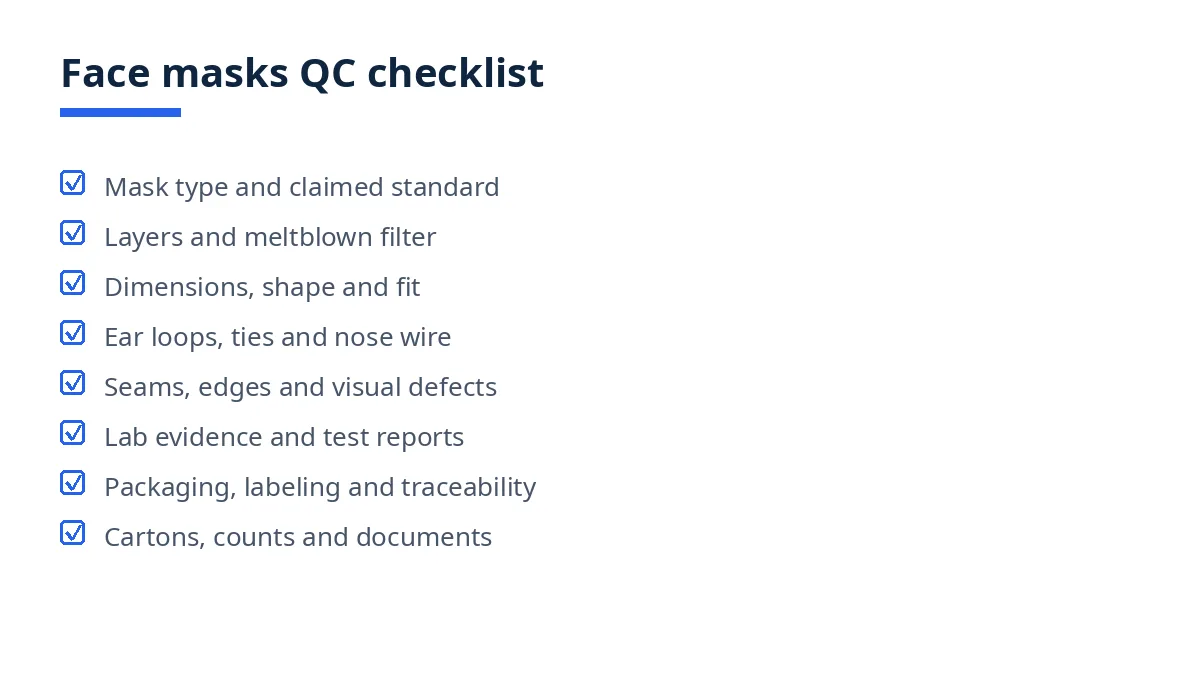
The full checklist (numbered, printable)
Mask type and claimed standard
Confirm the mask category in the purchase order (medical mask, barrier face covering, or general-use mask) and check that the pack category matches it.
Confirm the governing standard named in the purchase order (EN 14683 type for Europe, ASTM F2100 level for the US, or the destination market standard agreed in writing) and confirm the destination market recognizes the claimed type or level.
Check that the type or level claimed on the pack matches the lab report, character for character, with no mixed claims and no claim above the report.
Layers and meltblown filter
Open sample masks for destructive checking and compare layer count, order and materials with the sample.
Confirm the middle meltblown layer is present in every sampled mask, runs the full width of the mask body, and has no gaps, thin patches or missing edge sections.
Check the meltblown layer against the purchase order specification, including any weight or thickness figure named there, and record actual values.
Check the outer and inner layers for the material and color in the sample, and record any bulk substitution as a failure.
Dimensions, shape and fit
Measure mask body length and width on unfolded sampled masks, laid flat without stretching, against the size chart.
Measure the expanded height with pleats open and check nose-to-chin coverage on the approved sample form, per size where sizes are offered.
Check shape symmetry: both sides match, pleats open fully and evenly, and the mask does not skew. Measure every size, and confirm pack size markings match the measured size.
Ear loops, ties and nose wire
Measure ear loop length on sampled masks and check both loops match each other and the sample.
Pull each ear loop by hand with firm, even force and check the weld or stitch holds on both sides, with no fraying or detachment.
Where ties are specified, measure tie length and check both ties are present, secure and free of frayed ends.
Measure nose wire length, check it sits centered across the top edge, and confirm it is fully enclosed with no sharp end exposed.
Bend the nose wire on sampled masks and check it holds its shape without breaking or slipping out of its channel.
Seams, edges and visual defects
Check ultrasonic welds and edge seals around the full mask perimeter for complete bonding, with no open sections, lifted edges or burns.
Check the face and back of each sampled mask for holes, tears, stains, loose fibers, welding burns and foreign material.
Check printed or embossed markings for legibility and placement, and confirm no print ink transfers to the inner layer.
Lab evidence and test reports
Collect the lab report for the claimed standard and confirm it names the test methods, laboratory, date and lot or batch tested.
Under EN 14683, check the claimed type against the standard performance table: bacterial filtration efficiency of at least 95 percent for Type I and at least 98 percent for Type II and Type IIR; differential pressure of less than 40 Pa/cm2 for Type I and Type II and less than 60 Pa/cm2 for Type IIR; splash resistance pressure of at least 16.0 kPa for Type IIR only; and microbial cleanliness of no more than 30 cfu/g.3
Under ASTM F2100, check that the material is designated Level 1, Level 2 or Level 3 barrier, based on bacterial filtration efficiency, differential pressure, sub-micron particulate filtration efficiency, resistance to penetration by synthetic blood, and flammability,4 and check the level figures in the report: bacterial and particulate filtration efficiency of at least 95 percent for Level 1 and at least 98 percent for Levels 2 and 3, fluid resistance of 80, 120 and 160 mmHg for Levels 1, 2 and 3, and differential pressure of less than 5.0 mmH2O/cm2 for Level 1 and less than 6.0 mmH2O/cm2 for Levels 2 and 3.5
Confirm every report value meets the claimed type or level, and treat a report for a different lot or mask type as no evidence for this shipment.
For splash-resistant claims, confirm the test method in the report: EN 14683 refers to ISO 22609 and ASTM F2100 to ASTM F1862 for resistance to penetration by synthetic blood.6
Packaging, labeling and batch traceability
Check inner box count, mask count per box, and box seals against the packing specification, and check every label carries the mask type or level, governing standard, manufacturer name, lot or batch code, and country of origin, plus any expiry date ordered.
Check the lot or batch code matches across mask pack, inner box, carton and lab report, barcodes scan and match the purchase order, and no carton mixes two mask types, levels, colors or lots unless the packing specification allows it in writing.
Cartons, counts and documents
Weigh and measure sample cartons, check carton markings and count against the packing list, and confirm the packing list, invoice and reports all describe the same mask type, quantity and lot.
Common failures and how to fix them
The most frequent failure is a missing, short or patchy meltblown layer, usually because the filter roll ran out or was cut short. Stop, open sample masks from more than one carton, compare the layer build with the retained sample before packing restarts. Next is a weak ear loop weld, from welding temperature or pressure drift: re-check loop pull strength on a fresh sample before more masks are boxed.
A short or off-center nose wire usually starts at cutting or insertion: re-measure wire length and position on a test batch first. Mixed lots in one carton point to packing discipline: re-sort cartons by lot. A label claiming a higher type or level than the report proves is the most serious failure: stop, segregate the affected lot, and correct the claim only with new lab evidence, or reject the lot.
Above the agreed acceptance level, options are re-inspection after sorting or rework, partial acceptance, or rejection.
Downloadable template / summary table
Copy the checklist into your inspection sheet, add the size chart, tolerances and acceptance numbers, and record a result per mask type and lot.
Section | Checks | Evidence |
|---|---|---|
Type and standard | Category, type or level, pack claim | Purchase order, report |
Layers and filter | Layer count, meltblown, pleats | Opened samples, photos |
Dimensions and fit | Length, width, expanded height | Measurements |
Loops and nose wire | Loop pull, wire length and hold | Pull and bend checks |
Seams and visual | Welds, holes, stains, print | Visual check |
Lab evidence | Filtration, pressure, splash, flammability | Reports per lot |
Packing and labels | Counts, seals, lot codes | Packing list, scans |
Cartons and documents | Markings, counts, invoice match | Packing list |
How Exportain helps
Exportain is a B2B marketplace connecting buyers with Bangladeshi suppliers of face masks and medical supplies, so the mask type, governing standard and tolerances behind this checklist can be agreed at enquiry. Plan the check with inspection services and read the AQL acceptance quality limit explainer before final inspection. Supplier profiles show which document and photo checks have been recorded, not factory inspections. Exportain is not a party to the goods contract and does not inspect goods.
FAQs
When should this checklist be used?
Use it at final inspection, when goods are finished and packed. For larger and first orders, also use it in production, while layer build, welds and nose wire can still be corrected.
Who should complete it?
The buyer, a local agent or an independent inspector can complete it, using the approved sample, size chart, packing specification, a random sample, and the lab reports for the lot.
What are the most common failures?
A missing or patchy meltblown layer, weak ear loop welds, a short or off-center nose wire, mixed lots in one carton, and a label claiming a higher type or level than the lab report proves are the failures found most often.
Can a third party do it?
Yes, if you share the approved references, governing standard, tolerances and acceptance levels first, and require lab reports to name the lot tested.
Next steps on Exportain
Before production, agree mask type, governing standard, layer specification, tolerances and label wording, then read the AQL acceptance quality limit explainer and the pre-shipment inspection guide, and plan the check with inspection services.
Sources
- ISO 2859-1:1999 - Sampling procedures for inspection by attributes — Part 1: Sampling schemes indexed by acceptance quality limit (AQL) for lot-by-lot inspection. International Organization for Standardization (accessed )
- Face Masks, Barrier Face Coverings, Surgical Masks, and Respirators. U.S. Food and Drug Administration (accessed )
- EN 14683:2019 - Medical face masks - Requirements and test methods. European Committee for Standardization (CEN) (accessed )
- Standard for Medical Face Masks, ASTM F2100-23. American National Standards Institute (ANSI) (accessed )
- Barrier Performance Classification of Face Masks. I3CGlobal (accessed )
- Medical Face Masks. Centexbel (accessed )
About the author
Sourcing from Bangladesh?
Post a request for quotation and suppliers on Exportain can send you their quotes directly.
Post an RFQ


