How to Choose the Named Place for EXW Correctly
How to choose the EXW named place: what it legally is under Incoterms 2020, how factory, warehouse, depot and port places differ, and how to write it into the contract.
Short answer
The named place in an EXW contract is the exact point where the seller delivers by placing the goods at your disposal, and risk passes to you there. It must be a precise address, not a city: a factory gate, warehouse, inland depot, or port or airport location, written as EXW plus the full place plus Incoterms 2020. The seller does not load the collecting vehicle or clear the goods for export under the default rule.
On this page
Key takeaways
The named place is the EXW delivery point: the seller delivers by placing the goods at your disposal there, and risk passes to you at that point.
Name a precise address, never a city: factory gate, warehouse, inland depot, or port or airport location, written as EXW plus the full place plus Incoterms 2020.
The place type changes how much of the origin journey is done before delivery, but it never moves loading or export clearance to the seller under the default rule.
Agree loading, access, exporter of record, readiness notice, and collection window in writing before signature, and copy the clause unchanged into every document.
In Bangladesh, a Gazipur factory gate, a Dhaka warehouse, Dhaka ICD Kamalapur, and a Chattogram port or Dhaka airport place each need different access and handover checks.
Under EXW, the named place is the delivery point, and everything in the contract turns on it. The seller delivers when the goods are placed at your disposal at that named place, not when they leave the factory, not when a truck is booked, and not when they reach a port.
The named place can be the seller's factory, a warehouse, an inland depot, or a port or airport location. What changes with each choice is who moves the goods to that point, when risk passes to you, and what your forwarder must still arrange after delivery. This guide covers that choice only: what a named place legally is under Incoterms 2020, how the four place types used in Bangladesh differ, and how to write the place into a contract and a proforma invoice so that it cannot be read two ways. The Incoterms 2020 rules set out 11 rules with a clear allocation of cost, risk and obligations.1 For the wider meaning of EXW and what an EXW price includes, read the EXW meaning guide.
Why this matters for buyers and sellers
For the buyer, the named place fixes the first leg of the journey, the point from which insurance must run, and the address a carrier must be able to reach. A factory in Gazipur and a depot in Dhaka need different vehicles, access arrangements, and amounts of time.
For the seller, the named place fixes when delivery is complete and when the goods stop being the seller's risk. A seller who names a place it does not control, such as a third-party depot with restricted entry, may be unable to place the goods at your disposal there at all. Under EXW the seller does not need to load the goods on a collecting vehicle, nor does it need to clear the goods for export, where such clearance is applicable.2 Naming a port does not change that.
Step-by-step: how it works
The table below compares the four place types a buyer of Bangladeshi goods is most likely to meet. Read it before you accept a quotation, because changing the place type after signature means changing the delivery point, and that is a contract change, not a logistics detail.
Named place type | Where delivery happens | Risk passes to you | What you still arrange after delivery |
|---|---|---|---|
Seller's factory gate, for example Gazipur | At the factory, goods at your disposal, not loaded | When goods are placed at your disposal at the factory | Loading, inland transport, export clearance, main carriage, insurance, import clearance |
Seller's warehouse, for example Dhaka | At the named warehouse, goods at your disposal, not loaded | When goods are placed at your disposal at that warehouse | Loading, inland transport, export clearance, main carriage, insurance, import clearance |
Inland depot, for example Dhaka ICD Kamalapur | At the depot, goods at your disposal, not loaded | When goods are placed at your disposal at the depot | Loading, onward transport to port or airport, export clearance, main carriage, insurance, import clearance |
Port or airport location, for example Chattogram port or Dhaka airport | At the named place inside the port or airport area, goods at your disposal, not loaded | When goods are placed at your disposal at that place | Loading, export clearance, main carriage, insurance, import clearance |
What does not change across the rows is that the seller does not load the collecting vehicle and does not clear the goods for export under the default rule.2 What changes is how far the seller must get the goods before delivery is complete.
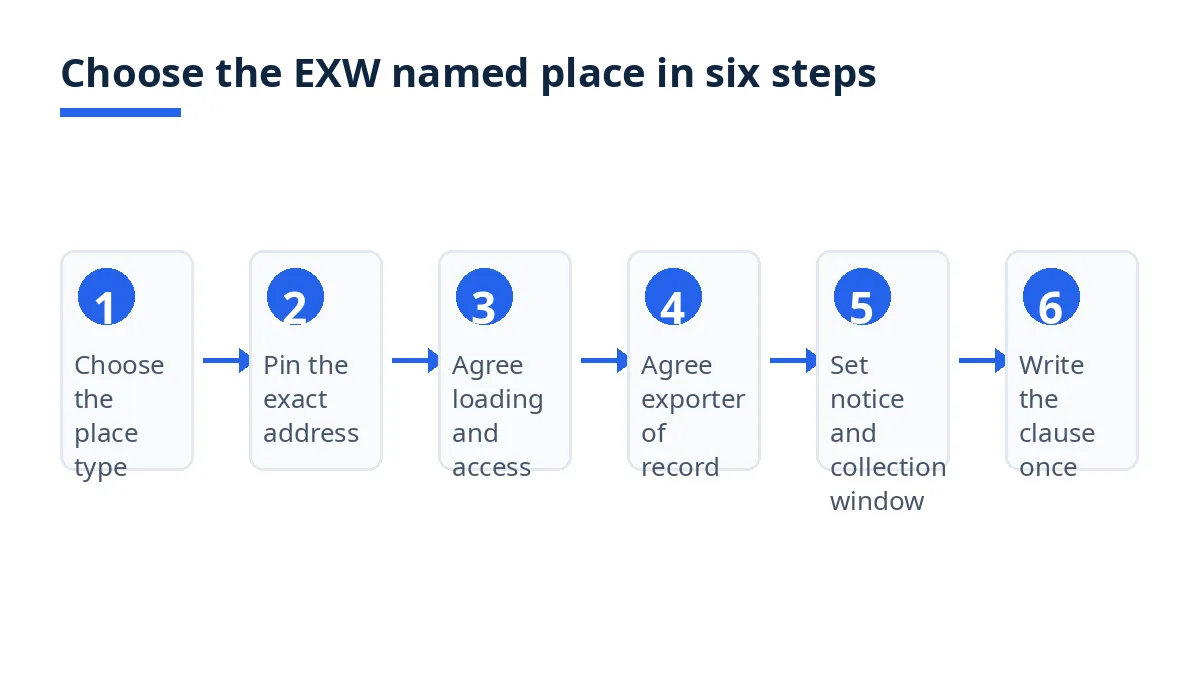
Choose the place type first, before you compare prices. A factory-gate place gives you control of the whole origin leg and the earliest risk transfer. A depot or port place shortens your origin leg but depends on a third party getting the goods to that place on time.
Pin the exact address: building or warehouse name and number, street, area, district, and postcode, plus the gate or bay where the vehicle must report. "EXW Dhaka" names a city and no delivery point; "EXW Factory Gate 2, Plot 14, Gazipur, Bangladesh" names a point a driver can reach.
Agree loading and access in writing: who loads, who supplies labour and equipment, what vehicle sizes the site accepts, and what hours the gate operates. Under the default rule the seller does not load,2 so if the seller will load, write that as an added contract term.
Agree who acts as exporter of record. Under EXW the buyer clears the goods for export, and the seller's duty is limited assistance at the buyer's risk and expense. In Bangladesh, goods may not be loaded for export unless an export declaration, the Bill of Export or Shipping Bill, is submitted to Customs and approved, naming the exporter and the foreign buyer.3 Confirm before signature whether your forwarder can act in that role.
Set the readiness notice and the collection window: notice period, notice contents, free holding period, and storage charges after the window. Without a window, a late vehicle and a ready warehouse produce a dispute about whether risk passed on the agreed date.
Write the clause once, then copy it unchanged into every document: sales contract, proforma invoice, purchase order, and forwarder instruction, for example: "EXW Factory Gate 2, Plot 14, Gazipur, Bangladesh, Incoterms 2020." A proforma that shortens the place to a city, or drops the edition, reopens the ambiguity the contract closed.
Costs, timelines and documents
What are the typical costs and timelines?
There is no typical cost or timeline for a named place, because the origin leg depends on the distance from the seller's premises to the named place, the vehicle, the handling at that place, and the forwarder you appoint. What can be stated exactly is which cost lines the named place moves: a factory-gate place puts the whole origin leg on you, a depot place moves the factory-to-depot leg to the seller's side of delivery, and a port or airport place moves more of the origin journey before delivery, but none of them moves export clearance or loading to the seller.
Example figures: the figures in this paragraph show structure only and are not a price, rate, or charge for any route. A buyer comparing two quotations for the same order sees an origin leg of USD 400 from a Gazipur factory gate and USD 150 from Dhaka ICD Kamalapur, because the depot quotation already includes the factory-to-depot movement before delivery. The buyer must still pay loading, export clearance, onward carriage, insurance, and import costs from the depot, and must check depot handling and storage charges. Compare quotations only after adding every cost the named place leaves with you, using the method in the landed cost guide.
For timelines, ask for separate dates rather than a single delivery week: goods-ready date, collection window, depot or port cut-off, and vessel or flight departure.
Which documents are needed?
The documents that fix the named place are the sales contract, the proforma invoice, and the purchase order, all carrying the same EXW clause. The documents that operate the shipment are the commercial invoice, the packing list, the forwarder instruction naming the place and the collection window, and the export set for Bangladesh. For export clearance in Bangladesh, the documents enclosed with the Bill of Export include the export contract or purchase order where there is no export letter of credit, the commercial invoice, the packing list, the EXP form certified by an authorized dealer, and a certificate of origin issued by the EPB or a Chamber of Commerce and Industry.3 Keep the seller name and address identical across the contract, the invoice, and the Bill of Export.3
Bangladesh-specific rules and tips
Gazipur factory. Much garment and knitwear production sits in the Gazipur and Dhaka industrial belt, so a factory-gate place is the most common EXW place in Bangladesh. Confirm the factory address against the trade licence and the proforma invoice, confirm which gate accepts container vehicles, and confirm whether the factory can load a container at its own premises. Where goods are loaded into containers at private premises, a customs gate officer may check the goods before they proceed to the port area.3
Dhaka warehouse. A seller may hold stock in a Dhaka warehouse separate from its factory. If the named place is the warehouse, the contract must name the warehouse, not the factory. Ask who controls entry, and whether the goods are already there or must be moved from the factory before the collection window.
Dhaka ICD Kamalapur. Kamalapur ICD, established in 1987, moves containers between Chattogram port and Dhaka by rail, and export goods are consolidated at the ICD and shipped to the port for onward transportation.4 As a named place, the ICD suits a buyer whose forwarder works from Dhaka and wants the factory-to-Dhaka leg done at delivery. Confirm the operator, handling charges, onward booking, and storage terms before you name it. The ICD handles only a small share of Chattogram port throughput: in the 2024-25 fiscal year Chattogram Port handled 3,296,066 TEUs, of which 72,998 TEUs were processed at Kamalapur.4
Chattogram port and Dhaka airport. Naming a place inside a port or airport area is possible under EXW, but it is the place type most likely to be misread. It does not make the term FOB or FCA, it does not oblige the seller to clear the goods for export, and it does not give your vehicle automatic access to a restricted zone. Before naming a port or airport place, confirm who brings the goods to that place, where exactly inside the zone delivery happens, and what access pass the collecting vehicle needs. If the seller cannot guarantee access or handover inside the zone, name the factory or the depot instead.
One address rule covers all four place types: use the same full address, with the same spelling, in the contract, the proforma invoice, the packing list, and the forwarder instruction.
Mistakes and red flags
What are the most common mistakes?
Naming a city instead of a place. "EXW Dhaka" and "EXW Bangladesh" name a market, not a delivery point, and leave the risk transfer date open to argument.
Naming a place the seller does not control. A depot, port zone, or third-party warehouse that the seller cannot enter freely is a delivery point the seller may fail to meet.
Assuming the seller loads. Under the default rule the seller does not load the collecting vehicle.2 A buyer who sends a vehicle with no loading labour faces a refused loading or a wasted vehicle booking.
Assuming export clearance follows the place. Moving the named place to a port or an airport does not move export clearance to the seller. Under EXW the buyer clears the goods for export in every place type, unless the contract adds a different arrangement.
Starting insurance at the port. Risk passes when the goods are placed at your disposal at the named place, which may be days before they reach a port.2 Insurance that starts at loading on board leaves the factory-to-port leg uncovered.
Letting documents drift apart. A contract naming the factory, a proforma naming the warehouse, and a forwarder instruction naming a depot describe three different deliveries.
Checklist
Before you confirm an EXW order, every line below should be answered in writing.
Place type chosen: factory gate, warehouse, inland depot, or port or airport location.
Full address written: building or warehouse name and number, street, area, district, postcode, and gate or bay.
Clause written in full: "EXW" plus the full place plus "Incoterms 2020", identical in the contract, proforma invoice, purchase order, and forwarder instruction.
Loading agreed: who loads, with what equipment, at whose cost, and with what risk allocation.
Access agreed: vehicle sizes accepted, gate hours, and appointment or pass requirements.
Exporter of record agreed: who clears export formalities and what cooperation the seller will give.
Readiness notice agreed: notice period, contents, collection window, and storage charges after the window.
Insurance instructed from the named place, not from the port of loading.
Export set checked: contract or purchase order, commercial invoice, packing list, EXP form, and certificate of origin.3
Forwarder priced from the named place onward, including loading, inland transport, export clearance, main carriage, and insurance.
How Exportain helps
On Exportain, post a request for quotation that states the Incoterm and the named place in full, so suppliers quote against the same delivery point. The buying steps on Exportain include stating quantity, destination, Incoterm, required certifications, and deadline in the request, and comparing quotations that record Incoterm, payment terms, and validity.5 Ask each reply to confirm the named place address, the gate or bay, the loading arrangement, and the exporter-of-record plan in writing before you accept. Exportain badges record document and photo checks, not a factory inspection, so the named place, loading, and export arrangements stay terms you confirm with the supplier and your forwarder.
FAQs
What should I know first about EXW?
EXW is a delivery rule under Incoterms 2020, not a price or a payment term. The seller delivers by placing the goods at your disposal at the named place, without loading the collecting vehicle and without clearing the goods for export under the default rule.2
What are the typical costs and timelines?
There is no typical cost or timeline for a named place, because the origin leg depends on the place type, the distance, the vehicle, and the forwarder. Example figures in this guide show structure only. Price every quotation from the named place onward.
Which documents are needed?
The contract, proforma invoice, and purchase order must all carry the identical EXW clause with the full named place. For Bangladesh export clearance, the Bill of Export set includes the export contract or purchase order where there is no export letter of credit, the commercial invoice, the packing list, the EXP form certified by an authorized dealer, and a certificate of origin issued by the EPB or a Chamber of Commerce and Industry.3
What are the most common mistakes?
The most common mistakes are naming a city instead of a place, naming a place the seller does not control, assuming the seller loads, assuming a port place moves export clearance to the seller, starting insurance at the port, and letting the contract, proforma invoice, and forwarder instruction carry different places.
Next steps on Exportain
Read the EXW meaning guide for what an EXW price includes and how EXW compares with FCA and FOB, then read the Incoterms for shipments from Bangladesh guide before you choose between rules. When you are ready to buy, follow the steps on how to buy from Bangladesh and state the full EXW named place in your request for quotation.
Sources
- Incoterms® 2020. International Chamber of Commerce (ICC) (accessed )
- Incoterms. DHL (accessed )
- Customs Clearance Procedures for Export. Bangladesh Customs, National Board of Revenue (accessed )
- Kamalapur ICD tender stalled for three years. The Business Post (accessed )
- How to source and buy from Bangladesh. Exportain (accessed )
About the author
Sourcing from Bangladesh?
Post a request for quotation and suppliers on Exportain can send you their quotes directly.
Post an RFQ