EXW Freight Cost: Who Pays and How It Is Calculated
Under EXW the buyer pays every freight leg: origin charges, main carriage and destination charges. This guide shows who pays each charge, how FCL, LCL and air freight are calculated, and works through a labelled example cost build-up.
Short answer
Under EXW, the buyer pays all freight costs: loading and inland transport at origin, origin terminal charges, main carriage by sea or air, destination terminal charges, and onward delivery to the warehouse. The seller price covers only the goods made available at the named place. Each leg is priced differently: full containers per container, consolidated sea freight per revenue ton, and air freight per chargeable kilogram. Ask for all three legs in writing before comparing quotes.
On this page
Key takeaways
Under EXW the buyer pays all three freight legs: origin charges, main carriage, and destination charges, while the seller price covers only the goods at the named place.
Full container sea freight is priced per container, consolidated sea freight per revenue ton, and air freight per chargeable kilogram, so each leg must be quoted on its own basis.
Terminal handling is charged at both ends under EXW, once at origin and once at destination, and must be checked against the freight invoice to avoid paying it twice.
Example figures in this guide build one container to a freight-related total of 3,285, or 0.33 per unit across 10,000 units, showing the method only, not current rates.
Exportain badges record document and photo reviews, not factory inspections, and a badge is not a guarantee of capacity, quality or delivery.
An EXW price looks low because the journey is not in it. Under Ex Works, the seller makes the goods available at a named place, and the buyer arranges and pays for everything after that point: collection, origin charges, main carriage, destination charges and final delivery. This guide separates that freight bill into its three legs, shows how each leg is calculated, and works through a labelled example build-up so you can price an EXW quotation against any other term on the same finish line.
Incoterms 2020 is the set of 11 rules published by the International Chamber of Commerce (ICC) that allocates cost, risk and obligations between seller and buyer, with all costs for a given rule gathered in that rule's costs article.1 EXW is the rule with the least seller obligation: the seller must make the goods available at the agreed place and time, and is not required to load the goods onto the buyer's vehicle or to clear them for export.2
Why this matters for buyers and sellers
For the buyer, the freight bill is where an EXW bargain is won or lost. A quotation stating only the goods price leaves three invoices still to arrive: one at origin, one for main carriage, and one at destination. Landed cost is the supplier price plus every charge it does not cover, divided by the units received, so a quote can only be compared with another once both are priced to the same finish line.3
For the seller, the same split protects the price: the seller is not asked to fund transport it never quoted, and help with export paperwork is given at the buyer's risk and expense unless the contract says otherwise.2 Both sides benefit when the contract names the place precisely and states who loads the goods. The EXW meaning guide explains delivery and risk transfer in full; this guide stays on the freight bill itself.
Step-by-step: how it works
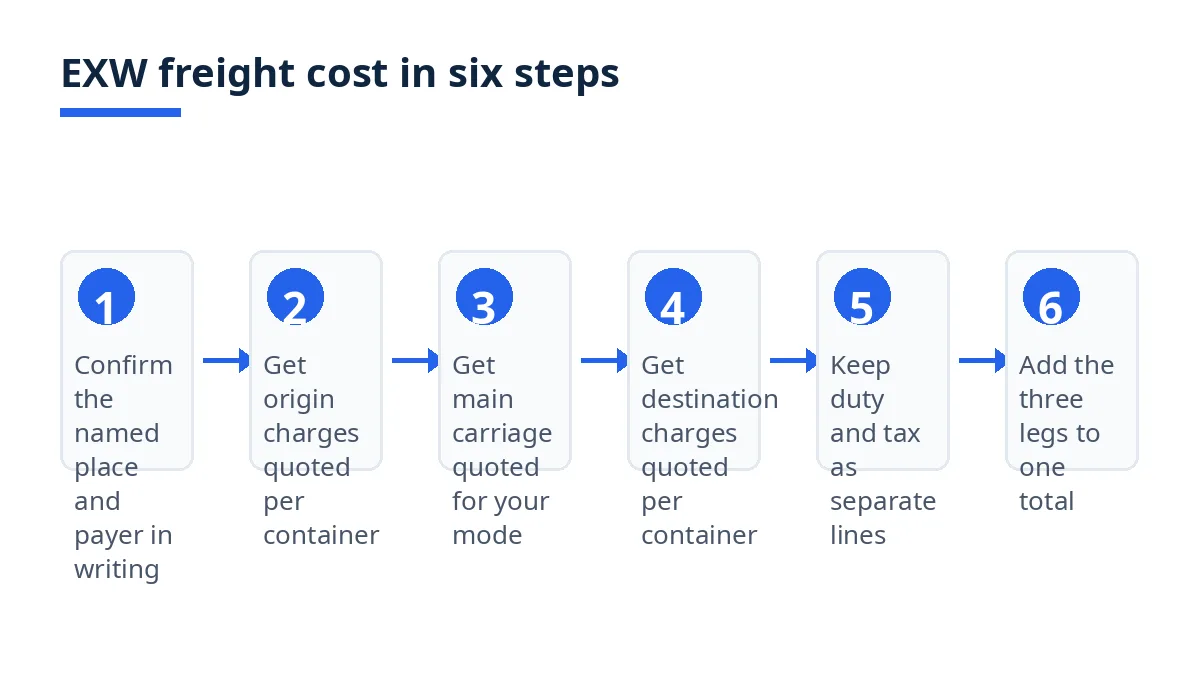
Confirm the named place and the payer in writing. Write the factory or warehouse address, the rule and the edition, for example "EXW [factory address, Gazipur, Bangladesh], Incoterms 2020". State who loads the collecting vehicle, because the default EXW rule does not require the seller to load it.2
Ask your forwarder for the origin leg as one quoted block. This covers loading at the factory, inland transport to the port or airport, and origin terminal and documentation charges.
Ask for main carriage on your actual mode and volume. Sea freight, air freight and consolidated sea freight are each calculated differently, as shown below.
Ask for the destination leg as one quoted block. This covers destination terminal charges, the delivery order fee, import broker fees and inland delivery to your warehouse.
Keep duty, import tax and insurance on separate lines. They are real costs, but they are not freight, and folding them into a freight quote hides which leg changed when a price moves.
Add the three freight legs to the goods price and compare that total with every other quotation priced to the same warehouse. Never compare an EXW goods price with an FOB or CIF price directly.3
Costs, timelines and documents
What are the typical costs and timelines?
There are no typical freight costs a guide can state as fact, because every leg is priced for a specific route, volume, mode and date. What can be stated is who pays each leg and how each leg is calculated. Under EXW, the buyer pays all three legs. The table below uses the charge names a forwarder quotation will show.
Freight leg | What it covers | Paid by | How it is calculated |
|---|---|---|---|
Origin charges | Loading at the factory, inland transport to the port or airport, origin terminal handling, export documentation | Buyer | Per shipment, per container or per vehicle, as quoted |
Main carriage, sea FCL | Ocean transport from origin port to destination port, plus carrier surcharges | Buyer | Per container, by container size and route |
Main carriage, sea LCL | Ocean transport for consolidated cargo | Buyer | Per revenue ton, the greater of volume and weight |
Main carriage, air | Air transport from origin airport to destination airport | Buyer | Per chargeable kilogram |
Destination charges | Destination terminal handling, delivery order fee, import broker fee, inland delivery to the warehouse | Buyer | Per container or per shipment, as quoted |
Terminal handling charges are a package charge for the services a container receives while it is at the terminal, including lifting, stacking, equipment use and document handling, charged by the terminal to the carrier and collected by the carrier from the cargo owner.4 At origin, that charge is normally borne by the shipper, and at destination by the consignee, and most ports charge it by container size.4 Under EXW, the buyer is the payer at both ends, so the same charge appears twice in the build-up.
Main carriage is calculated by mode. A full container load is priced per container, so neither volume nor weight is billed directly; the shipment must stay inside the container's cubic capacity and payload limit.5 Consolidated sea freight is billed in revenue tons, written W/M, which is the greater of the shipment's volume in cubic metres and its weight in metric tons.5 Air freight is billed on chargeable weight, the greater of actual gross weight and volumetric weight, where volumetric weight in kilograms is length times width times height in centimetres divided by 6000, the IATA divisor for general cargo, rounded up to the carrier's billing increment.5
A worked chargeable-weight calculation shows why carton size matters for air freight. Example figures: ten cartons, each 60 by 50 by 40 centimetres, gross weight 12 kilograms each. Volumetric weight per carton is 120,000 divided by 6000, which is 20 kilograms. Total volumetric weight is 200 kilograms against total gross weight of 120 kilograms, so the chargeable weight is 200 kilograms. At an example rate of 4.50 per kilogram, the air freight is 900. The rate and carton figures are example figures only, not current rates.
Example figures: one container, three freight legs
Example figures throughout this build-up. They show the method only and are not current rates for any route, carrier or port. The shipment is one 20-foot container of garments collected from a factory in Gazipur, shipped by sea to a UK port, and delivered to the buyer's warehouse. The same three legs apply in the USA, EU, UAE.
Leg | Example figures (USD) |
|---|---|
Origin: factory loading | 120 |
Origin: inland haulage, Gazipur to Chattogram | 380 |
Origin: origin terminal handling charge | 260 |
Origin: export documentation and broker fee | 150 |
Origin: bill of lading fee | 60 |
Origin subtotal | 970 |
Main carriage: base ocean freight | 1,250 |
Main carriage: bunker surcharge | 150 |
Main carriage subtotal | 1,400 |
Destination: destination terminal handling charge | 320 |
Destination: delivery order fee | 75 |
Destination: import broker fee | 180 |
Destination: inland haulage, port to warehouse | 340 |
Destination subtotal | 915 |
Total freight-related cost, excluding goods, duty, import tax and insurance | 3,285 |
Divided across 10,000 units in the container, the freight-related cost is 0.33 per unit. Change any leg and the per-unit figure moves with it, which is why a quotation showing only one combined freight figure cannot be checked. Ask for the three legs separately, and check whether destination terminal handling is included in the ocean freight quotation or billed again on arrival.
Timelines follow the same split: collection and export approval at origin, the carrier schedule for main carriage, and broker and delivery booking at destination. Ask for each leg's dates separately rather than accepting a single delivery week.
Which documents are needed?
The freight quotation itself needs only your cargo details: named place of collection, destination warehouse, mode, container or carton count, dimensions, gross weight, and commodity. The shipment needs the export set. Under Bangladesh customs rules, goods may not be loaded for export unless an export declaration, the Bill of Export or Shipping Bill, is submitted to Customs and approved.6 Documents enclosed with the Bill of Export include the export contract or purchase order where there is no export letter of credit, the commercial invoice, the packing list, the EXP form certified by an authorized dealer, and a certificate of origin issued by the Export Promotion Bureau or a Chamber of Commerce and Industry.6
For the freight invoice, keep the bill of lading or air waybill, the forwarder's itemized invoice showing the three legs, and the destination delivery order. If a destination charge appears on both the ocean freight invoice and the arrival invoice, ask the carrier which document already includes it before paying twice.
Bangladesh-specific rules and tips
The Bangladesh leg of an EXW shipment has one structural point to settle early: export clearance is the buyer's responsibility under EXW, and the seller's help with documents is given at the buyer's risk and expense.2 A foreign buyer usually cannot file the declaration alone, so agree in writing who acts as exporter of record and what documents the seller will provide, with deadlines. Route choice changes the calculation: sea freight from Chattogram is quoted per container for full loads and per revenue ton for consolidated loads, while air freight from Dhaka is quoted per chargeable kilogram. Measure packed carton dimensions including pallets, because carriers bill on packed dimensions. Keep one legal name across all papers: the declaration names the exporter and the foreign buyer,6 and a mismatch can delay the shipment at the origin terminal, where storage charges then fall on the buyer. The Incoterms guide for shipments from Bangladesh compares all 11 rules on this point.
Mistakes and red flags
What are the most common mistakes?
Treating the EXW goods price as the freight-inclusive price. The goods price ends at the named place, and every leg after it is an additional invoice.
Comparing quotations that show different legs. One forwarder may include destination terminal handling in its ocean freight figure while another bills it on arrival. Compare only quotations that itemize the same three legs.
Assuming the destination charge is already paid. Under EXW it is not, unless a separate written agreement says so. Confirm in writing whether destination terminal handling is included in the freight quotation or billed at arrival.
Forgetting the origin leg on a factory far from the port. Inland haulage from a factory outside the port city is a separate quoted line, and it is the buyer's line under EXW.
Measuring product size instead of packed size. Air freight bills on chargeable weight, so a bulky carton can cost more than a heavier compact one.5
Paying a destination charge twice. Check the ocean freight invoice against the arrival invoice for the same terminal charge before paying.
Leaving insurance out of the budget. Insurance is not freight, but risk passes to the buyer at the named place, so cover should start there rather than at the port of loading.
Checklist
Before you confirm an EXW order, every line should be answered in writing.
Named place written in full, with rule and edition, and loading agreed: who loads the collecting vehicle.
Origin leg quoted: loading, haulage, terminal handling, documents.
Main carriage quoted: mode, container or chargeable weight basis, surcharges listed.
Destination leg quoted: destination terminal handling, delivery order fee, broker fee, inland delivery.
Duty, import tax and insurance kept on separate lines, not folded into freight.
Exporter of record agreed, with document deadlines from the seller.
Export set agreed: Bill of Export, commercial invoice, packing list, EXP form, certificate of origin.6
Free time at both terminals confirmed, with storage rates after free time.
Quotations compared on the same three legs, priced to the same warehouse.3
How Exportain helps
On Exportain, browse suppliers and post a request for quotation on the RFQ board stating the Incoterm, the named place, the destination warehouse, the mode and the carton or container count, so suppliers and freight providers quote against the same specification. Ask each reply to itemize the three freight legs separately, and to state whether destination terminal handling is included in the ocean freight figure or billed on arrival.
Read badges for what they record. Exportain badges record document and photo reviews, not factory inspections, and a badge is not a guarantee of capacity, quality or delivery. See the landed cost guide to convert the itemized build-up into a landed cost per unit before you confirm.
FAQs
What should I know first about EXW?
Under EXW, the seller's obligation ends when the goods are made available at the named place, not loaded and not cleared for export.2 The buyer pays loading, inland transport, origin terminal charges, main carriage, destination terminal charges, import formalities and final delivery. The 11 Incoterms 2020 rules allocate cost, risk and obligations for each term,1 and EXW places the largest share on the buyer.
What are the typical costs and timelines?
There are no typical freight costs or timelines a guide can state as fact, because each leg is priced for a specific route, volume, mode and date. Origin charges are quoted per shipment or per container, full container sea freight per container, consolidated sea freight per revenue ton, and air freight per chargeable kilogram.5
Which documents are needed?
The freight quotation needs cargo details: collection place, destination warehouse, mode, container or carton count, dimensions, gross weight and commodity. The shipment needs the export set: Bill of Export approved by Customs, commercial invoice, packing list, EXP form certified by an authorized dealer, and certificate of origin issued by the Export Promotion Bureau or a Chamber of Commerce and Industry.6 Keep the bill of lading or air waybill, the itemized forwarder invoice and the destination delivery order for the freight account.
What are the most common mistakes?
The most common mistakes are treating the EXW goods price as freight-inclusive, comparing quotations that itemize different legs, assuming destination terminal handling is already paid, measuring product size instead of packed size for air freight,5 and paying a destination charge twice. Ask for the three legs itemized and compare every quotation priced to the same warehouse.3
Next steps on Exportain
Start with the EXW meaning guide to confirm the delivery point and risk transfer, then use the landed cost guide to turn your itemized freight build-up into a landed cost per unit. When you are ready to buy, follow how to buy from Bangladesh and ask each supplier to quote EXW with the three freight legs itemized.
Sources
- Incoterms® 2020. International Chamber of Commerce (ICC) (accessed )
- Incoterms 2020: EX Works rule explained. Export Development Canada (accessed )
- Landed Cost for Imports from Bangladesh. Exportain (accessed )
- What Are the Fees Covered by Terminal Handling Charges?. Chinadivision (accessed )
- Chargeable Weight Calculator. Pioneer Express (accessed )
- Customs Clearance Procedures for Export. Bangladesh Customs, National Board of Revenue (accessed )
About the author
Sourcing from Bangladesh?
Post a request for quotation and suppliers on Exportain can send you their quotes directly.
Post an RFQ