

EXW Shipping From Bangladesh to Saudi Arabia: Costs, Steps and Timeline
EXW shipping from Bangladesh to Saudi Arabia, read port-first: Jeddah or Dammam, the SABER file, the export filer at the factory gate, and the full buyer-paid cost chain to a Saudi warehouse.
Short answer
Under EXW, a Saudi buyer takes goods at a named place in Bangladesh and pays for loading, export clearance, freight, insurance, Saudi duty and 15 percent import VAT, and inland delivery. Jeddah serves the western region and Dammam serves the Eastern Province and Riyadh, and SABER conformity must be confirmed before sailing.
On this page
Key takeaways
Under EXW, the buyer takes goods at a named place in Bangladesh and pays for loading, export clearance, freight, insurance, Saudi duty and import VAT, and inland delivery.
Choose the Saudi port from the delivery address: Jeddah for the western region, Dammam for the Eastern Province and the Riyadh leg.
Confirm the SABER position before production finishes: a shipment without the required SABER documentation faces re-export, not a delay.
Name the Bangladesh export filer in the contract, since the seller has no export-clearance obligation under EXW.
A buyer in Riyadh and a buyer in Jeddah do not buy the same journey when they sign an EXW purchase from Bangladesh. The Riyadh buyer needs a Gulf entry through Dammam and an inland leg to the capital, while the Jeddah buyer needs a Red Sea entry to the western region. That port decision, made before the price is locked, shapes the freight quote, the broker and the inland cost. This guide works in that order: port first, Saudi entry second, factory-gate handover third.
Under EXW (Ex Works), Incoterms 2020, the seller delivers by making the goods available at a named place, usually its own premises in Bangladesh, and the buyer takes over from that point. The Incoterms 2020 rules set out 11 rules with a clear allocation of cost, risk and obligations.1 Under EXW, that allocation is at its most one-sided: the seller is not required to load the goods or clear them for export. The buyer arranges and pays for loading, Bangladesh inland transport, export clearance, the sea leg, Saudi clearance, duty and tax, and inland delivery. The low EXW price is therefore not a delivered price. It is the price of goods standing at a named place, ready for collection.
Why this matters for buyers and sellers
For a Saudi buyer, EXW gives control over the carrier, the route and the Saudi broker, and keeps the seller's price free of freight and insurance margins the buyer did not choose. That control is worth something only when the buyer, or a forwarder acting for the buyer, can run the Bangladesh side of the chain: a party in Bangladesh to collect, file the export declaration and load, and a party in Saudi Arabia to file the import entry and pay duty and tax. Without both appointments in writing, an EXW purchase can stall at the factory gate.
For a Bangladeshi seller, EXW keeps the sale simple: make the goods available, packed for transport, at the agreed place and date, and hand over the commercial invoice and packing list. The seller takes on no freight or Saudi customs risk, and has no obligation to re-route a shipment or absorb a demurrage charge.
The Saudi-specific reason to plan early is conformity. For regulated products, a Product Certificate of Conformity (PCoC) is issued through the SABER platform, and a Shipment Certificate of Conformity (SCoC) is issued for each shipment.2 A shipment that reaches Saudi customs without the required documentation registered in SABER faces re-export rather than a delay.2 That consequence falls on the buyer under EXW, so the SABER question belongs in the enquiry, not in the week the container sails.
Step-by-step: how it works
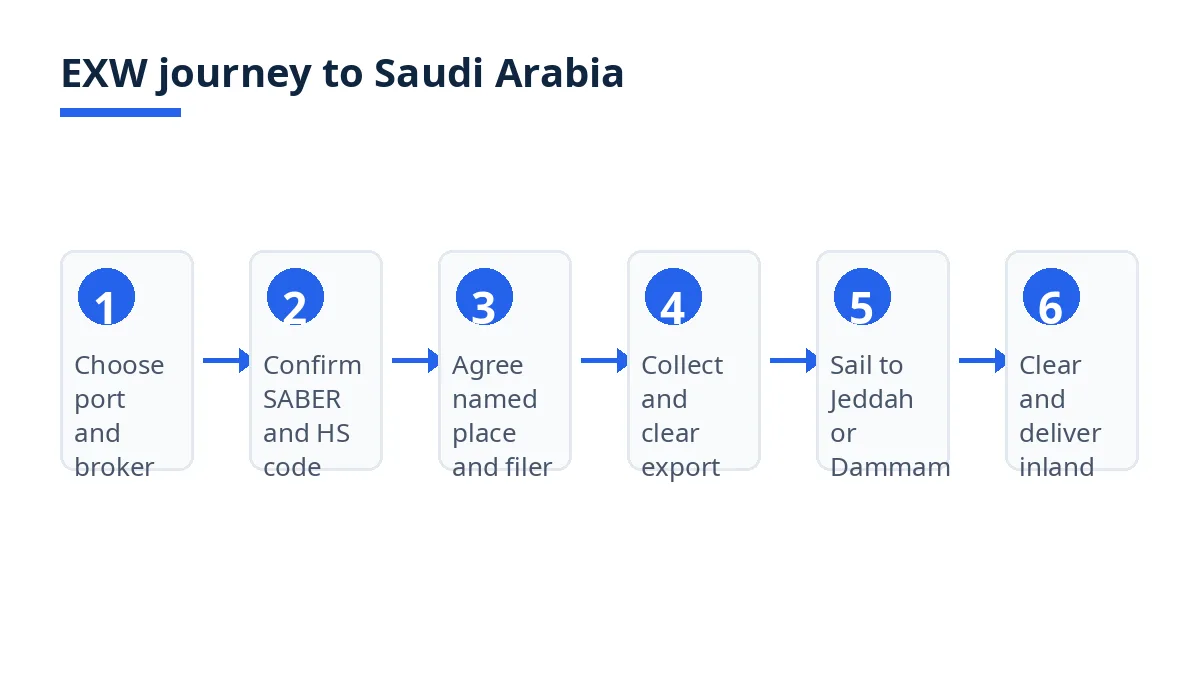
Choose the Saudi port and appoint the Saudi broker. Decide between Jeddah Islamic Port on the Red Sea, serving the western region, and King Abdulaziz Port in Dammam on the Arabian Gulf, serving the Eastern Province and Riyadh.3 Ask the broker to confirm the Harmonized System (HS) classification, duty position and SABER position before any price is agreed.
Appoint the Bangladesh forwarder and confirm the SABER path. Ask the Saudi broker and a Bangladesh forwarder to confirm whether the goods are regulated, whether a PCoC is needed, and what test reports the manufacturer must supply.2 For regulated products, the PCoC is valid for 12 months, while an SCoC is issued per shipment.2 Start before production finishes.
Agree the named place, the loading and the export filing in writing. Name the exact factory or warehouse, the collection date, who loads the goods, and who files the Bangladesh export declaration. Under EXW the export filing is the buyer's task, so the contract should name the agent who will file it, at the buyer's cost. If no party is named, do not sign.
Inspect at the named place before collection. Check quantity, marking, packing and labelling against the purchase order while the goods are still at the seller's premises. Under EXW, risk passes when the goods are placed at the buyer's disposal.
Collect, move to Chattogram and clear for export. The buyer's carrier collects the goods, moves them to the port of loading, usually Chattogram, and the appointed agent files the export declaration. Goods may not be loaded for export unless an export declaration, the Bill of Export or Shipping Bill, is submitted to Customs and approved.4 The enclosed set includes the export contract or purchase order where there is no export letter of credit, the commercial invoice, the packing list, the EXP form certified by an authorized dealer, and a certificate of origin issued by the Export Promotion Bureau (EPB) or a Chamber of Commerce and Industry.4
Sail to Jeddah or Dammam and file the Saudi entry. The forwarder books the sea leg to the chosen port and sends the documents to the Saudi broker in advance. The SCoC is verified through the Saudi single-window system.2 Ask for the sailing schedule, arrival window and free time in writing, and treat any single transit figure as a planning estimate.
Pay duty and tax, clear and deliver inland. The buyer pays the duty and import VAT assessed, collects the release, and arranges inland delivery from Jeddah or Dammam to the final warehouse. Dammam to Riyadh is a separate leg, quoted separately from ocean freight.
Costs, timelines and documents
What are the typical costs and timelines?
There is no single typical EXW cost or transit time for this lane, because the port, the goods, the container size, the sailing and the duty position all change the total. The buyer carries, in order: loading, Bangladesh inland transport, export clearance and terminal charges at Chattogram, ocean freight, insurance, Saudi port charges, the broker fee, import duty, import VAT, SABER assessment costs where they apply, and inland delivery. See the EXW price guide and the Incoterms guide.
Import VAT is the largest single tax line for most buyers on this lane, calculated on the duty-inclusive value at 15 percent of the customs value plus any applicable customs duty.5 The customs value is the cost, insurance and freight (CIF) value, so the freight and insurance the buyer pays under EXW still enter the VAT base.5 A VAT-registered Saudi business may recover import VAT as input tax where the goods are used for taxable business activities, while a non-registered buyer bears it as a final cost.5
Example figures: a CIF value of 10,000 US dollars with an illustrative duty figure of 500 dollars gives a VAT base of 10,500 dollars. At 15 percent, import VAT is 1,575 dollars. The duty figure is illustrative only; the broker confirms the actual rate.
For timelines, work in stages: SABER assessment and testing, collection and export clearance, the sailing to Jeddah or Dammam, Saudi clearance, and inland delivery. SABER assessment is most often underestimated, because testing or a factory audit can extend it, while a non-regulated product follows a self-declaration path.2 Keep a buffer between the factory-ready date and the sailing date.
Cost or tax line | Who pays under EXW | How to confirm it |
|---|---|---|
Goods at named place | Buyer | Purchase order |
Loading and Bangladesh transport | Buyer | Forwarder quote |
Export clearance | Buyer | Agent quote4 |
Freight and insurance | Buyer | Forwarder quote |
Saudi port and broker | Buyer | Broker quote |
Import duty | Buyer | Broker classification |
Import VAT 15 percent | Buyer | Duty-inclusive CIF base5 |
SABER costs | Buyer, where applicable | Quote before production2 |
Inland delivery | Buyer | Separate port-to-warehouse quote |
Which documents are needed?
The document set splits into three groups. The Bangladesh export group is the Bill of Export, the commercial invoice, the packing list, the EXP form certified by an authorized dealer, and the certificate of origin issued by the EPB or a Chamber of Commerce and Industry, with the export contract or purchase order where there is no export letter of credit.4 The transport group is the bill of lading and the insurance document where the buyer has arranged cover. The Saudi import group is the customs declaration, the detailed invoice, the bill of lading, origin proof where claimed, and the SABER certificates.2 5
ZATCA lists original detailed receipts and the bill of lading among the documents provided with a customs declaration, and a broker delegated through the Fasah platform may submit documents on the importer's behalf.6 For a commercial EXW shipment, the practical equivalent is a licensed Saudi broker holding the full set before the vessel arrives. Keep one name, HS code and set of values consistent across all documents.
Bangladesh-specific rules and tips
Name the export filer, not just the forwarder. A forwarder who books freight is not automatically the agent who files the Bill of Export. Ask, in writing, which named agent files it and which documents the seller must hand over. The declaration names the exporter and the foreign buyer,4 so the seller's legal name should match exactly across the licence, invoice and declaration.
Check the certificate of origin route early. The certificate is issued by the EPB or a Chamber of Commerce and Industry.4 Ask the Saudi broker whether origin proof changes the duty position, and if so, agree who obtains it and by when.
Agree the packing and marking for the sailing. State the carton marking, pallet arrangement and labelling the Saudi market requires, including any Arabic labelling for retail goods, in the purchase order.
Keep the SABER file with the shipment file. The PCoC, SCoC, test reports and product information should travel as one file with the invoice and packing list, even though the SCoC is verified electronically.2
Mistakes and red flags
What are the most common mistakes?
Signing EXW with no export filer named. Under EXW the seller has no export-clearance obligation, so a buyer who assumes the seller or carrier will file can find goods ready at the factory with no filing arranged. Name the filer in the contract.
Pricing the EXW price as a delivered price. An EXW quotation that looks cheaper usually is not cheaper once loading, inland transport, freight, insurance, Saudi port charges, duty, 15 percent import VAT and inland delivery are added.5 Compare on the landed-cost basis in the landed cost guide.
Choosing the port after booking the freight. Jeddah and Dammam serve different regions and inland legs.3 A container booked to the wrong port adds an inland leg that was never quoted. Choose the port from the delivery address, then book freight.
Treating SABER as a port formality. The PCoC must exist before the SCoC can be issued, and a shipment without the required SABER documentation faces re-export.2 Start before production finishes.
Using different names, codes or values across documents. The invoice, packing list, bill of lading, SABER certificates and customs declaration should agree on names, HS code, quantities and values. A mismatch invites a query and costs terminal time.
Checklist
Before you confirm an EXW order from Bangladesh to Saudi Arabia, every line should be answered in writing.
Saudi port chosen from the delivery address: Jeddah for the west, Dammam for the east and Riyadh.3
Saudi broker appointed, with HS classification, duty and SABER positions confirmed.
SABER path confirmed: PCoC position, SCoC before sailing.2
Bangladesh forwarder and named export filer appointed, at the buyer's cost.
Named place, collection date, loading party and marking agreed in the purchase order.
Inspection at the named place agreed before collection.
Freight, insurance, port charges and inland delivery quoted separately.
Duty and 15 percent import VAT estimated on the duty-inclusive CIF base by the broker.5
Full document set agreed: Bill of Export set, invoice, packing list, bill of lading, origin proof, SABER certificates.4 2
Quotations compared on landed cost, not the EXW headline price.
How Exportain helps
On Exportain, browse suppliers and post a request for quotation (RFQ) on the RFQ board stating the EXW named place, the chosen Saudi port and the delivery address, so replies quote against the same journey. Ask each reply to state the EXW price, the collection terms and the documents the seller will hand over, and ask a forwarder or broker reply to quote the three legs separately. When you accept a quotation, Exportain creates one order and issues one proforma invoice from the accepted terms.
Read the badges for what they record. Exportain Verified means Exportain has checked identity, phone, email and business registration, and Export Verified means it has checked the Export Registration Certificate (ERC). Factory Verified means it has reviewed photos of the manufacturer factory, while Trading Company Verified means it has reviewed photos of the trading company office or warehouse. Verification is a document review by staff, free, and never granted by membership plans. It is not a factory inspection, so inspection at the named place and SABER assessment stay with you and your appointed broker and forwarder.
FAQs
What should I know first about EXW?
Under EXW, the seller delivers by making the goods available at a named place in Bangladesh, and the buyer arranges and pays for everything after that point, including loading, export clearance, freight, insurance, Saudi clearance, duty and tax, and inland delivery.1 The first task is appointing a Bangladesh export filer and a Saudi broker, and confirming the SABER position.
What are the typical costs and timelines?
There are no typical figures that hold across products and ports on this lane. The buyer pays loading, inland transport, export clearance, freight, insurance, Saudi port and broker charges, duty, import VAT at 15 percent on the duty-inclusive CIF value, SABER costs where they apply, and inland delivery.5 Timelines should be quoted stage by stage.
Which documents are needed?
The Bangladesh export set is the Bill of Export, commercial invoice, packing list, EXP form certified by an authorized dealer, and certificate of origin issued by the EPB or a Chamber of Commerce and Industry, with the export contract or purchase order where there is no export letter of credit.4 The Saudi import set adds the customs declaration, detailed invoice, bill of lading, origin proof where claimed, and SABER certificates.2 6
What are the most common mistakes?
The most common mistakes are signing EXW with no export filer named, pricing the EXW headline as a delivered price, choosing the port after booking freight, treating SABER as a port formality, and using different names, codes or values across documents. Each is avoidable: name the filer, choose the port from the delivery address, confirm SABER before production finishes, and keep one consistent document set.
Next steps on Exportain
Browse suppliers, then post the EXW named place, the chosen Saudi port and the final delivery address on the RFQ board so replies quote the full journey, not only the factory-gate price. Before you confirm, read the EXW price guide and the landed cost guide.
Sources
- Incoterms® 2020. International Chamber of Commerce (ICC) (accessed )
- Certificate of Conformity for Exports to Saudi Arabia. QIMA (accessed )
- Top Ports in Saudi Arabia - Ranking. ShipHub (accessed )
- Customs Clearance Procedures for Export. Bangladesh Customs, National Board of Revenue (accessed )
- Guide to Import VAT in Saudi Arabia for Foreign Companies. Commenda (accessed )
- Personal Importation. Zakat, Tax and Customs Authority (ZATCA) (accessed )
About the author
Sourcing from Bangladesh?
Post a request for quotation and suppliers on Exportain can send you their quotes directly.
Post an RFQ


