EXW Shipping From Bangladesh to Netherlands: Costs, Steps and Timeline
An EXW shipment from Bangladesh to the Netherlands starts at the Dutch entry: Rotterdam, EORI and Article 23 first, then factory collection, Bangladesh clearance and delivery.
Short answer
Under EXW, the seller places goods at your disposal at a named place in Bangladesh, and you arrange and pay for loading, export clearance, freight, insurance, Dutch duty and import VAT, and delivery. Settle the Rotterdam entry, your EORI number and your Article 23 position before collection, because the Dutch declaration cannot be filed well without them.
On this page
Key takeaways
Under EXW, the seller places goods at your disposal at a named place in Bangladesh, and you arrange and pay for loading, export clearance, freight, insurance, Dutch duty and import VAT, and delivery.
Settle the Dutch entry first: Rotterdam as entry port, a valid EORI number for the importer of record, and the Article 23 position, which changes when import VAT is paid, not whether duty is paid.
A foreign entrepreneur cannot apply for an Article 23 permit alone; a tax representative can apply for the permit and declare the import VAT on the VAT return.
Duty depends on the TARIC code and origin, so the broker must confirm the duty outcome and any proof of origin for the exact goods; no rate in this guide is a promise.
Example figures show the build-up: an example customs value of 46,500 euros, example duty of 2,325 euros at 5 percent, and example import VAT of 10,253 euros at 21 percent.
Start at the Dutch entry, not at the factory gate. An EXW shipment from Bangladesh to the Netherlands is decided before collection: whether you enter through Rotterdam, who holds the EORI number, whether an Article 23 permit changes how import VAT is paid, and which broker files the Dutch declaration. Settle those four items first, and the factory collection becomes a pickup with a plan behind it.
This guide is for a buyer in the Netherlands, or a buyer using the Netherlands as the EU entry point, comparing an EXW quotation or running one already accepted. It works in entry-first order: Dutch entry, broker brief, collection, Bangladesh clearance, carriage, Rotterdam clearance, and delivery. The EXW meaning guide sets out the same split in general terms, and the Incoterms guide for shipments from Bangladesh places EXW among the other terms.
Why this matters for buyers and sellers
What should I know first about EXW?
Under EXW (Ex Works), the seller delivers by placing the goods at the buyer's disposal at the named place, usually the seller's factory or warehouse in Bangladesh. From that point the buyer arranges and pays for loading, export clearance, carriage to Chattogram, ocean freight, insurance, Dutch import clearance, duty and import VAT, and delivery. The Incoterms 2020 rules, published by the International Chamber of Commerce (ICC), set out 11 rules with a clear allocation of cost, risk and obligations.1 Under EXW, the seller carries the minimum obligation and the buyer the maximum.
That split is why the Dutch entry matters more than the headline EXW price. The EXW price covers the goods at the named place only. Everything after that point is a separate line the buyer must arrange, and the Dutch lines cannot be arranged at the last minute. For the seller, EXW keeps the sale simple at the factory gate. For the buyer, it gives control over the carrier, the route and the broker, with every risk after the named place.
Step-by-step: how it works
The steps run in entry-first order.
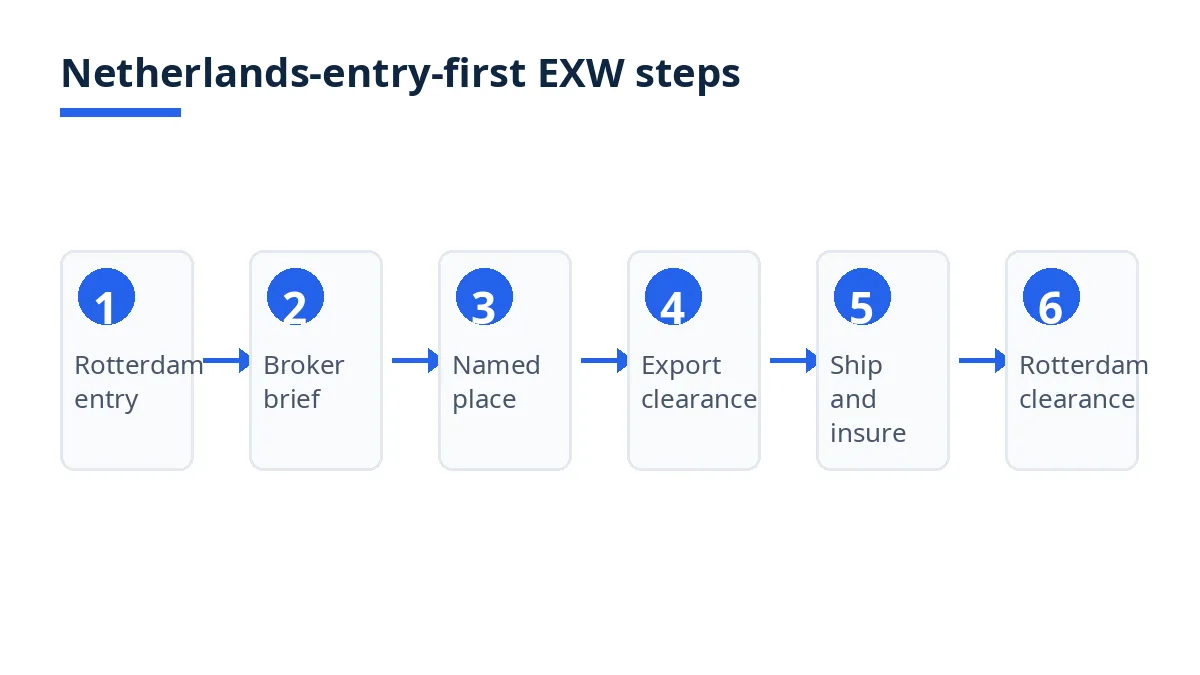
Settle the Dutch entry. Confirm the entry port, normally Rotterdam, and whether the goods will stay in the Netherlands or move onward to another EU country. The Port of Rotterdam describes an intermodal network of rail, inland shipping, road, short sea and pipelines providing connections to the rest of Europe.2 Record that choice before you book freight.
Confirm the EORI number and the importer of record. An Economic Operators Registration and Identification (EORI) number is mandatory for the clearance of all types of customs operations in the customs territory of the EU, such as import, export and transit, and at any point in time a person can be assigned only one valid EORI number.3 Confirm in writing who the importer is and that the importer holds a valid EORI number.
Decide the Article 23 position. The reverse-charge mechanism on import means you are not required to pay the VAT on import immediately, and the VAT can then be paid when you file your VAT return, but you need an Article 23 permit to do this.4 As a foreign entrepreneur, you cannot apply for an Article 23 permit yourself, but you can engage a tax representative for this purpose.4 Record whether Article 23 applies and who holds the permit. It changes the timing of import VAT; it does not remove customs duty.
Brief the Dutch broker before collection. Give the broker the TARIC code, the goods description, the value, the origin, the arrival port and the Article 23 position. In the case of import, the commodity code is called the TARIC code, which customs uses to check import levies and the VAT rate.5 Ask the broker to confirm, in writing, the duty outcome for the exact goods and any proof of origin needed.
Name the place and the collection in the contract. Write the EXW named place in full, with the factory address, the collection window, who loads the goods, and who pays for loading equipment. Under EXW the seller is not obliged to load, so if the seller will load as a favour, write that down as a separate agreement.
Arrange Bangladesh export clearance through your filer. Goods may not be loaded for export unless an export declaration, the Bill of Export or Shipping Bill, is submitted to customs and approved.6 The enclosed documents include the export contract or purchase order where there is no export letter of credit, the commercial invoice, the packing list, the EXP form certified by an authorized dealer, and a certificate of origin issued by the Export Promotion Bureau (EPB) or a Chamber of Commerce and Industry.6 Under EXW that filer works for you, not for the seller.
Book carriage and insurance as the buyer. Book inland transport from the named place to Chattogram, ocean freight to Rotterdam, and cargo insurance that covers the goods from the named place, not only from the port.
Clear the goods at Rotterdam and deliver. The Dutch declaration is submitted digitally, and a transporter or customs broker can do this for you if you do not have much experience with declarations.5 Pay the duty assessed, and pay import VAT at the border unless Article 23 applies. If you sell goods to a client in another EU country, you do not need to declare goods with customs and you do not need to pay import duties for that intra-EU movement.5
Costs, timelines and documents
What are the typical costs and timelines?
There is no typical EXW landed cost for a Bangladesh to Netherlands shipment, because the duty depends on the TARIC code and origin, the freight depends on the route and the container, and the VAT treatment depends on the Article 23 position. The amount of duty depends on the product's TARIC code, and a trade advantage from an agreement or special arrangement can reduce duty, with proof of country of origin required.7 Ask the broker for the duty outcome for the exact goods.
Buyer-side line | What decides the amount |
|---|---|
EXW goods price | Quotation at the named place |
Loading at the named place | Labour and equipment agreed in writing |
Inland transport to Chattogram | Distance, vehicle and container |
Bangladesh export clearance and filing | Agent or forwarder fee |
Ocean freight Chattogram to Rotterdam | Carrier quote and sailing |
Cargo insurance | Value, route and cover |
Dutch import duty | TARIC code and origin, broker-confirmed |
Dutch import VAT | Customs value plus duty, Article 23 position |
Broker, terminal and delivery charges | Broker and carrier quotes |
Example figures: an EXW goods value of 40,000 euros plus example inland transport, freight and insurance of 6,500 euros gives an example customs value of 46,500 euros. At an example duty rate of 5 percent, the example duty is 2,325 euros, giving an example VAT base of 48,825 euros. At an example VAT rate of 21 percent, the example import VAT is 10,253 euros. With Article 23, that example VAT amount is reported on the VAT return rather than paid at the border. Without Article 23, the same amount is paid at the border and reclaimed through the return. Every figure in this paragraph is an example figure only; the broker must confirm the duty rate, the customs value and the VAT treatment for the exact goods.
For timelines, do not plan from a single sailing date. Ask the carrier for the sailing schedule, the transhipment port if any, the free time at Rotterdam, and the delivery window, as separate lines.
Which documents are needed?
Document | Purpose |
|---|---|
Commercial invoice | Value and goods description |
Packing list | Quantity, weight and packing |
Bill of Export or Shipping Bill | Bangladesh export declaration6 |
EXP form, certified by an authorized dealer | Export proceeds control6 |
Certificate of origin | Origin evidence, from the EPB or a Chamber of Commerce and Industry6 |
Bill of lading | Carriage document |
Cargo insurance certificate | Cover from the named place |
Dutch import declaration | |
Article 23 permit details | VAT timing on the declaration4 |
Product conformity documents | Product-specific EU rules, per the goods |
The broker should list any product-specific conformity, labelling or safety papers for the exact goods before collection.
Bangladesh-specific rules and tips
Confirm the filer before you sign. Under EXW the Bangladesh export declaration is the buyer's job in practical terms, even though the seller holds the goods and many of the papers. Name the filer in the purchase order, with the Bill of Export, invoice, packing list, EXP form and certificate of origin attached.6
Keep one legal name across every paper. The export declaration specifies the exporter, the foreign buyer and the transport operator.6 The name on the trade licence, quotation, proforma invoice, payment account, bill of lading and Dutch declaration should match, or the broker will ask for corrections at Rotterdam.
Check the loading point, not only the factory town. A factory in Dhaka and a factory near Chattogram do not carry the same inland leg, and a factory without a forklift or loading dock changes who supplies equipment. Confirm the loading method, the vehicle type and the container stuffing point in writing, and ask the broker whether the certificate of origin, issued by the EPB or a Chamber of Commerce and Industry,6 supports any duty outcome claimed at Rotterdam.
Mistakes and red flags
What are the most common mistakes?
Signing EXW with no export filer. The most common EXW failure on this lane is a contract that names the place but names no one to file the Bangladesh export declaration. Confirm the filer, the fee and the document list before you sign.
Assuming the seller loads. Under EXW the seller places the goods at the buyer's disposal. If your collection plan assumes the seller's staff and forklift, loading becomes your problem on the day. Write loading into the contract or hire it yourself.
Treating Article 23 as a duty exemption. Article 23 changes when import VAT is paid, not whether duty is paid. Duty is still assessed on the customs value, and the broker still needs the TARIC code and origin evidence.7 5
Using the EXW price as the landed cost. The EXW price excludes loading, export clearance, freight, insurance, duty, import VAT, broker fees and delivery. The landed cost guide for imports from Bangladesh shows how those lines add up.
Filing the Dutch declaration with the wrong TARIC code. The amount of duty depends on the TARIC code,7 and the code also drives the VAT rate check and any product-specific measure.5 Ask the broker to confirm the code for the exact goods.
Leaving insurance to start at the port. Risk under EXW passes at the named place, before loading and before the port. Insurance that starts at Chattogram leaves the inland leg uncovered. Check the cover start point in the policy.
Accepting a verbal Article 23 promise. If a forwarder says Article 23 applies, ask for the permit holder, the representative and the declaration code in writing.
Checklist
Every line should be answered in writing.
Rotterdam entry confirmed, with the final destination and any onward EU movement recorded.
Importer of record named, with a valid EORI number confirmed.3
Article 23 position recorded: permit holder, tax representative if any, and declaration treatment.4
Dutch broker briefed with TARIC code, value, origin, arrival port and Article 23 position.5
EXW named place, collection window, loading method and loading payer written into the contract.
Bangladesh export filer named, with the Bill of Export document list confirmed.6
Freight and insurance booked from the named place, with cover start point checked.
Duty outcome broker-confirmed for the exact goods, with proof of origin listed.7
Import VAT treatment confirmed: paid at the border or reported under Article 23.4
Delivery from Rotterdam booked, with free time confirmed.
Names matched across invoice, packing list, bill of lading and Dutch declaration.
How Exportain helps
On Exportain, browse suppliers and post a request for quotation (RFQ) on the RFQ board with the EXW named place, the Rotterdam entry and the broker brief stated, so suppliers quote against the same delivery term. When you accept a quotation, Exportain creates one order and issues one proforma invoice from the accepted terms.8
Read the badges for what they record. Exportain Verified means Exportain has checked identity, phone, email and business registration, and Export Verified means it has checked the Export Registration Certificate (ERC).8 Factory Verified means it has reviewed photos of the manufacturer factory, while Trading Company Verified means it has reviewed photos of the trading company office or warehouse.8 Verification is a document review by staff, free, and never granted by membership plans.8 It is not a factory inspection.8
FAQs
What should I know first about EXW?
Under EXW, the seller places the goods at your disposal at the named place in Bangladesh, and you arrange and pay for everything after that point: loading, export clearance, freight, insurance, Dutch duty and import VAT, and delivery. The Incoterms 2020 rules allocate cost, risk and obligations between seller and buyer,1 and under EXW the buyer carries the maximum share.
What are the typical costs and timelines?
There is no typical landed cost, because duty depends on the TARIC code and origin, freight depends on the carrier quote, and import VAT depends on the Article 23 position.7 5 The example figures in this guide show how an example customs value, example duty and example import VAT add up, and how Article 23 changes only the timing of the VAT amount.4
Which documents are needed?
The Bangladesh export set is the Bill of Export, commercial invoice, packing list, EXP form certified by an authorized dealer, and certificate of origin issued by the EPB or a Chamber of Commerce and Industry.6 The Dutch entry needs the import declaration with a valid EORI number,3 the TARIC code,5 the bill of lading, the insurance certificate and the Article 23 details where they apply.4
What are the most common mistakes?
The most common mistakes are signing EXW with no export filer, assuming the seller loads, treating Article 23 as a duty exemption, using the EXW price as the landed cost, and filing with the wrong TARIC code.7
Next steps on Exportain
Browse suppliers, then post your EXW named place, Rotterdam entry and Article 23 position on the RFQ board so suppliers quote against the same terms. Before you confirm, read the EXW meaning guide and the landed cost guide for imports from Bangladesh.
Sources
- Incoterms® 2020. International Chamber of Commerce (ICC) (accessed )
- The port that will take you ahead. Port of Rotterdam (accessed )
- Economic Operators Registration and Identification number (EORI). European Commission, Taxation and Customs Union (accessed )
- Reverse-charge mechanism on import: Article 23. Belastingdienst (accessed )
- Customs Administration of the Netherlands. Business.gov.nl (accessed )
- Customs Clearance Procedures for Export. Bangladesh Customs, National Board of Revenue (accessed )
- Rules for importing products into the Netherlands: a checklist. Business.gov.nl (accessed )
- Trust & Safety Center. Exportain (accessed )
About the author
Sourcing from Bangladesh?
Post a request for quotation and suppliers on Exportain can send you their quotes directly.
Post an RFQ