EXW Shipping From Bangladesh to Australia: Costs, Steps and Timeline
EXW from Bangladesh to Australia, Australia-entry first: buyer responsibilities, example costs, GST, biosecurity and the documents for factory-gate collection.
Short answer
Under EXW, the seller places goods at the buyer's disposal at the named factory or warehouse in Bangladesh, and the buyer arranges and pays for loading, export clearance, freight, insurance, Australian import clearance, GST and delivery. Settle the ABN, GST and deferred GST position, name the Bangladesh export filer, and check DAFF biosecurity and packing before collection.
On this page
Key takeaways
Start with the Australian entry, not the factory gate: ABN and GST setup, a broker brief, DAFF biosecurity and packing checks, and the gateway choice decide whether an EXW shipment clears smoothly.
Under EXW the seller only places the goods at the buyer's disposal at the named place in Bangladesh; the buyer arranges and pays for loading, export clearance, freight, insurance and Australian import clearance.
GST on a taxable importation is 10 percent of the customs value plus duty and international transport and insurance; eligible importers can defer GST through the monthly BAS instead of paying it at clearance.
Over AUD1,000 means an Import Declaration (N10); at or under AUD1,000 for air or sea cargo means a Self-Assessed Clearance declaration, and DAFF may inspect, treat, export or destroy cargo where biosecurity risks are found.
In Bangladesh, goods may not be loaded for export until the Bill of Export is approved, and timber packing and dunnage must meet ISPM 15 treatment rules before the cartons are sealed.
Start with the Australian entry, not the factory gate. An EXW shipment from Bangladesh to Australia puts almost every step after the factory door in the buyer's hands, so the work that decides whether it clears smoothly is done before collection: the Australian Business Number (ABN) and Goods and Services Tax (GST) setup, the customs broker brief, the biosecurity check for the goods and their packing, and the choice of Australian gateway. Settle those four items first, and the factory collection becomes a pickup with a plan behind it.
Under EXW, short for Ex Works, the seller's job is to place the goods at the buyer's disposal at the named place, usually the seller's factory or warehouse. The Incoterms 2020 rules are published by the International Chamber of Commerce (ICC) and give a clear allocation of cost, risk and obligations for each rule.1 From the named place onward, the buyer arranges and pays for loading, inland transport, export clearance, main carriage, insurance, Australian import clearance and final delivery, and carries the risk from the moment the goods are made available.
Why this matters for buyers and sellers
For the buyer, EXW offers control and price transparency. The factory price carries no freight, insurance or destination charges chosen by someone else, so the buyer can compare carriers, choose the Australian gateway nearest the warehouse, and decide the insurance cover. That control is also the cost: the buyer must solve the export filing in Bangladesh, a step a foreign buyer cannot always file alone, and must answer for the Australian declaration, duty, GST and biosecurity outcome.
For the seller, EXW is the lightest delivery obligation in the Incoterms 2020 set: the seller does not have to load the goods or clear them for export unless the contract adds those duties. That lightness is why a seller may prefer EXW, and why a buyer should not accept it on price alone: if no one on the buyer's side can file the Bangladesh export declaration, the shipment can sit at the factory. The EXW definition guide sets out the rule in full, and the Incoterms guide for shipments from Bangladesh compares EXW with terms that move more work to the seller.
Step-by-step: how it works
Work in Australia-entry order: factory collection is step three, not step one.
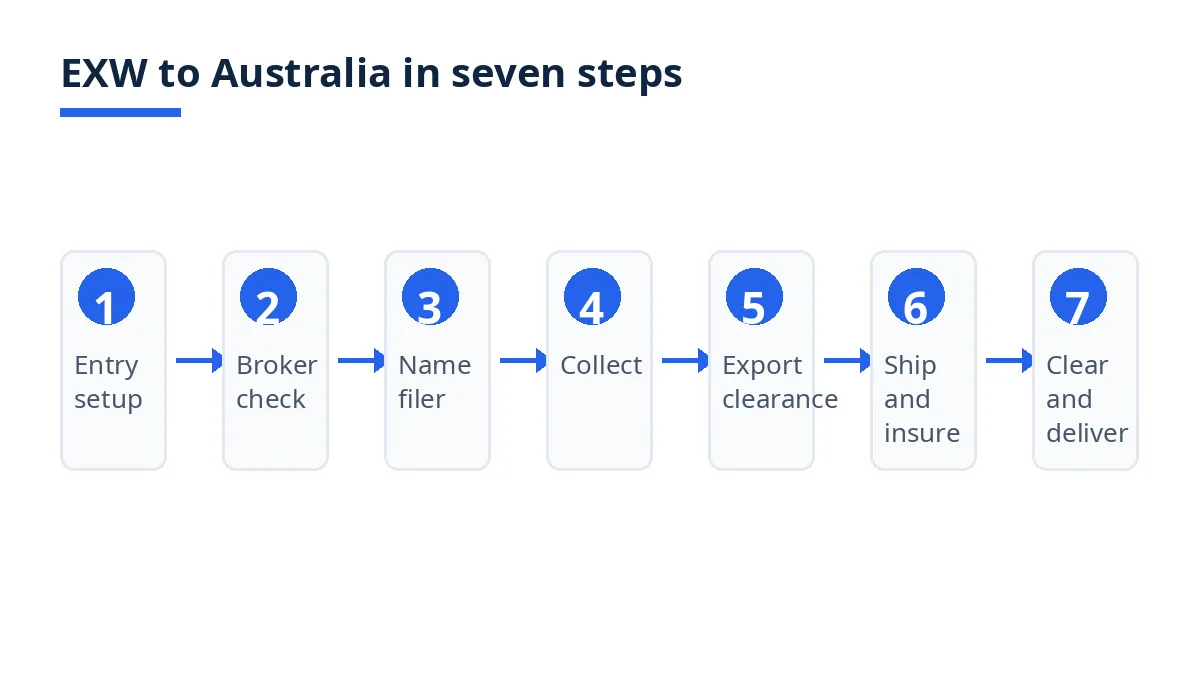
Settle the Australian entry setup. Confirm your ABN, GST registration, and deferred GST scheme approval. The deferred GST scheme lets an eligible importer pay GST on taxable imports through the monthly Business Activity Statement (BAS) rather than to the Australian Border Force (ABF) at importation, and eligibility requires an ABN, GST registration, monthly BAS lodgment online and electronic payment.2 Outside the scheme, GST is payable at clearance, so budget for it before the goods sail.
Brief a licensed customs broker and check biosecurity. Give the broker the product description, tariff classification, value, origin and packing details before shipment. The ABF encourages first-time or infrequent importers to use a licensed customs broker.3 Ask the broker to confirm the DAFF import conditions for the exact goods and packing.
Name the place precisely and agree the export filer. Write the contract as EXW followed by the full factory address in Bangladesh and Incoterms 2020, and name in writing who will file the export declaration and who will load the goods. Under EXW the seller has no duty to load or to clear the goods for export unless the contract says otherwise.
Collect, load and move to the port. The buyer's carrier collects at the named place, loads the goods and carries them to the Bangladesh load port, usually Chattogram. Confirm vehicle access, loading equipment and who signs the collection receipt, and photograph the loaded cartons before the vehicle leaves.
Complete Bangladesh export clearance. Goods may not be loaded or stuffed for export until an export declaration, the Bill of Export or Shipping Bill, is submitted to Customs and approved.4 The export set enclosed with it includes the export letter of credit or, where there is none, the export contract or purchase order, the commercial invoice, the packing list, the EXP form certified by an authorized dealer, a certificate of origin and the VAT and taxpayer documents.4
Ship and insure. Book main carriage to the chosen gateway and arrange cargo insurance for the full route. EXW includes no insurance from the seller.
Clear in Australia and deliver. Lodge the Australian declaration, pay duty, GST and charges or defer GST where approved, answer any DAFF biosecurity direction, and move the goods to the warehouse. Keep every document for five years after the import declaration, as the ABF requires.3
Costs, timelines and documents
Costs and timelines in practice
There is no single EXW cost for a Bangladesh to Australia shipment, because the factory price, route, gateway, packing and Australian duty and GST outcome all change with the order. The table below separates the cost lines so a buyer can compare quotations line by line, not as two totals built on different inclusions.
The buyer-side lines are the EXW goods price, loading and inland transport, export filing and port charges, main carriage, cargo insurance, Australian duty, Australian GST, broker and processing charges, biosecurity charges, and Australian inland delivery.
GST on a taxable importation is 10 percent of the value of the taxable importation: the customs value, any duty payable, the amount paid or payable to transport the goods to Australia and to insure them for that transport, and any wine tax payable where applicable.5 Goods entered for warehousing are not liable for GST until cleared for home consumption.5
Example figures: a customs value of A$20,000, duty of A$0 in this example, and transport and insurance of A$3,000 gives a taxable importation value of A$23,000 and GST of A$2,300. The duty figure is an assumption for arithmetic only; the broker must confirm the actual duty, which depends on classification and origin, before the goods sail.
For timelines, plan in phases rather than a single door-to-door promise. Example planning allowances, not quoted transit times: factory collection and Bangladesh export filing, main carriage to the chosen gateway, Australian border clearance including any biosecurity inspection, and inland delivery. Each phase can lengthen if documents are incomplete, if a biosecurity inspection or treatment is directed, or if the sailing service tranships. Ask the carrier for the sailing schedule, transhipment points and terminal free time, and keep a buffer before any customer commitment.
Documents for the shipment
The Bangladesh export set is listed in step five above.4 For Australia, have ready the bill of lading or air waybill, commercial documents such as invoices, evidence of identity, permits or approvals, and any other relevant documents.3 A sea freight packing declaration states the packing material used, which matters for biosecurity.6
For the declaration itself, the line is value. An Import Declaration (N10) is required where goods have a combined value over AUD1,000 and are being cleared into home consumption, and all duties, taxes and charges must be paid before release.3 A Self-Assessed Clearance (SAC) declaration applies where goods arrive by air or sea cargo and have a value equal to or less than AUD1,000, and it cannot be used for goods arriving through international mail or under a carnet.3 Where goods need a permit, the importer must use either an Import Declaration or a long format SAC declaration.3 For low-value cargo, DAFF uses the SAC information to assess biosecurity risk, and may refer a consignment for inspection, with treatment, export or destruction where risks are found.7
Bangladesh-specific rules and tips
File the export declaration before loading, not after. Goods shall not be loaded or stuffed for export unless the Bill of Export is submitted and approved.4 Name the C and F agent and check the export set before booking the vehicle.
Treat the EXP form and the certificate of origin as order documents, not afterthoughts. The EXP form, certified by an authorized dealer, supports realization of export proceeds, and the certificate of origin is issued by the Export Promotion Bureau (EPB) or a Chamber of Commerce and Industry.4 If the buyer plans to claim any duty concession, the origin documents and the broker's classification check must match the invoice before shipment.
Check the current Australian duty treatment for the specific goods. Australia has extended duty-free quota-free access to least developed countries, including Bangladesh, since 2003, and has assured that the treatment will continue after Bangladesh's graduation from least developed country status in 2026.8 That history does not make every product duty-free: origin rules, classification and the current tariff still decide the outcome, so ask the broker to confirm the rate for the exact product.
Ask about packing before the factory packs. Freight entering Australia must be free of biosecurity risk materials such as soil, plant material, pests and insects, and timber, bamboo and dunnage carry higher risk and require mandatory treatment under ISPM 15.6 A sea freight packaging declaration informs customs of the packing material used.6 Confirm whether timber pallets or dunnage will be used, whether they are treated and marked, and whether clean new packaging is required, before the cartons are sealed.
Keep one name and one address across every paper. The Bill of Export names the exporter, the foreign buyer and the transport operator.4 A mismatch across the invoice, packing list and declarations creates questions at both borders, and under EXW the buyer pays for the delay.
Mistakes and red flags
Accepting EXW without naming the export filer. If the contract says EXW and nothing about export clearance, the buyer owns a step it may not be able to file. Name the filer, the fee and the documents the seller must supply, in the contract.
Comparing an EXW price with a CIF or FOB price as if they were the same offer. An EXW price excludes loading, export clearance, freight, insurance and Australian charges. Compare only after adding the buyer-side lines in the cost table, or on the same Incoterm. See the landed cost guide for imports from Bangladesh for how the lines add up.
Budgeting GST on the goods value alone. GST is charged on the taxable importation value, which adds duty and international transport and insurance to the customs value.5 A budget built on the factory price understates the border payment, and a buyer outside the deferred GST scheme must pay it at clearance.
Leaving biosecurity to arrival. DAFF may inspect, treat, export or destroy cargo where biosecurity risks are found.7 Timber packing, soil, plant material or pest evidence found at the Australian border costs far more than a packing check at the factory.
Checklist
Before the goods leave the factory, every line should be answered in writing.
Australian entry setup confirmed: ABN, GST registration, and deferred GST approval or a border GST budget.2
Broker briefed with product, classification, value, origin and packing details.3
DAFF conditions checked for the exact goods and packing, including timber and dunnage treatment.6
Contract names the EXW place in full, the export filer, and who loads the goods.
Bangladesh export set checked: contract or letter of credit, invoice, packing list, EXP form, certificate of origin, VAT and taxpayer documents.4
Main carriage booked to the gateway nearest the warehouse, with sailing schedule and transhipment points confirmed.
Cargo insurance placed for the full route from the factory gate.
Declaration type confirmed: Import Declaration over AUD1,000 or SAC at or under AUD1,000, with permits handled.3
Border payment ready: duty, GST at 10 percent of the taxable importation value, processing and biosecurity charges, or GST deferred through the BAS.5 2
Delivery and warehouse receiving booked, with documents kept for five years.3
How Exportain helps
On Exportain, browse suppliers and post a request for quotation (RFQ) on the RFQ board with the product specification, the EXW named place and the Australian gateway, so suppliers quote on the same factory-gate basis. State the export filer question in the RFQ itself, and ask each reply to confirm which export documents the seller will supply. When a quotation is accepted, Exportain creates one order and issues one proforma invoice from the accepted terms.9
Read the badges for what they record. Exportain Verified means Exportain has checked identity, phone, email and business registration, and Export Verified means it has checked the Export Registration Certificate (ERC).9 Factory Verified means it has reviewed photos of the manufacturer's factory, while Trading Company Verified means it has reviewed photos of the trading company office or warehouse.9 Verification is a document review by staff, free, never granted by membership plans, and not a factory inspection.9
FAQs
What should I know first about EXW?
Under EXW, the seller places the goods at your disposal at the named place in Bangladesh, and you arrange and pay for everything after that point, including loading, export clearance, freight, insurance and Australian import clearance. The Incoterms 2020 rules give the allocation of cost, risk and obligations for each rule.1 Before accepting EXW, settle the Australian entry setup, name the export filer, and confirm packing and biosecurity.
What are the typical costs and timelines?
There are no typical costs a guide can state as fact, because the factory price, route, gateway, packing and Australian duty and GST outcome change with each order. The buyer-side lines are loading and inland transport, export filing, main carriage, insurance, Australian duty, GST at 10 percent of the taxable importation value, broker and processing charges, and inland delivery.5 For timelines, plan in phases and confirm the sailing schedule with the carrier.
Which documents are needed?
The Bangladesh export set is the export contract or letter of credit, commercial invoice, packing list, EXP form certified by an authorized dealer, certificate of origin, and VAT and taxpayer documents, enclosed with the Bill of Export.4 For Australia, have the bill of lading or air waybill, commercial documents, evidence of identity, permits or approvals, and a sea freight packing declaration ready.3 6 The declaration is an Import Declaration over AUD1,000 or a SAC declaration at or under AUD1,000 for air or sea cargo.3
What are the most common mistakes?
The most common mistakes are accepting EXW without naming the export filer, comparing an EXW price with a CIF or FOB price, budgeting GST on the goods value alone, and leaving biosecurity checks until arrival. GST is charged on the customs value plus duty and international transport and insurance,5 and DAFF may inspect, treat, export or destroy cargo where biosecurity risks are found.7 Name the filer, build the full buyer-side cost table, and check packing before the factory seals the cartons.
Next steps on Exportain
Browse suppliers, then post the product specification, the EXW named place and the Australian gateway on the RFQ board so suppliers quote on the same factory-gate basis. Before you confirm, read the EXW definition guide and the landed cost guide for imports from Bangladesh to build the full buyer-side cost table.
Sources
- Incoterms® 2020. International Chamber of Commerce (ICC) (accessed )
- Deferred GST scheme. Australian Taxation Office (accessed )
- Import declarations. Australian Border Force (accessed )
- Customs Clearance Procedures for Export. Bangladesh Customs, National Board of Revenue (accessed )
- GST and other taxes when importing. Australian Border Force (accessed )
- Biosecurity Measures: Import Regulations Australia. Mainfreight (accessed )
- Self-assessed clearance cargo (SAC) process. Department of Agriculture, Fisheries and Forestry (accessed )
- A guide to exporting to Australia from Bangladesh. DHL (accessed )
- Trust & Safety Center. Exportain (accessed )
About the author
Sourcing from Bangladesh?
Post a request for quotation and suppliers on Exportain can send you their quotes directly.
Post an RFQ