

Top Electrical Cables Manufacturers in Bangladesh: How to Find and Verify Them
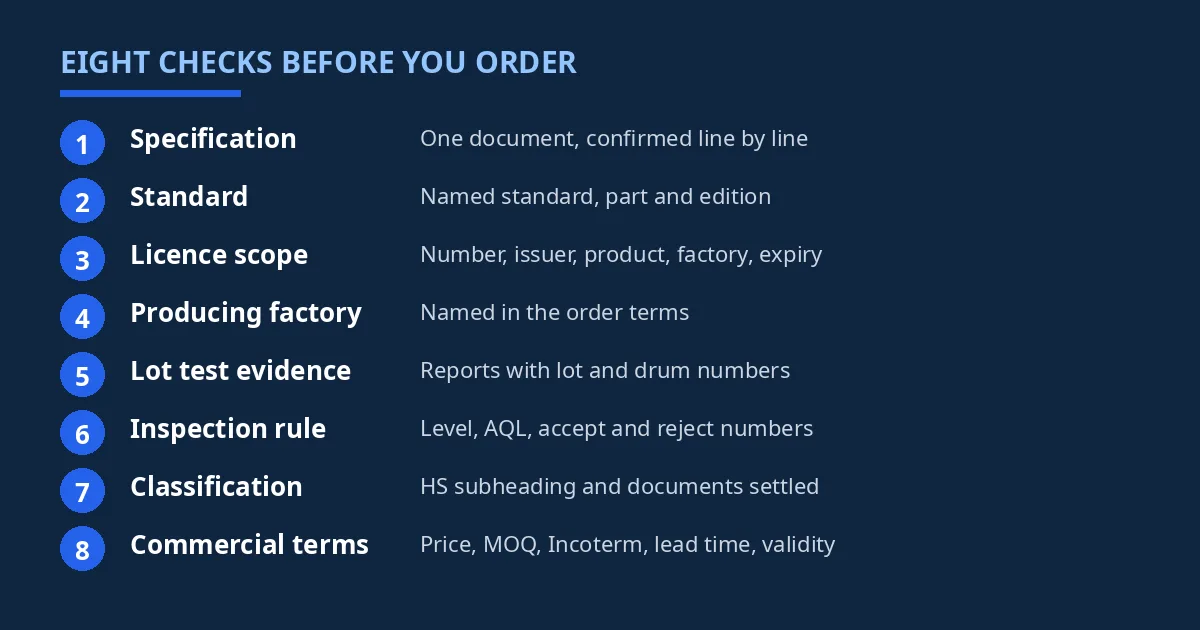
Eight find-and-verify checks for sourcing electrical cables from Bangladesh: specification, standard, licence scope, producing factory, lot tests, inspection rule, classification, and comparable commercial terms.
Short answer
Finding an electrical cable supplier in Bangladesh is a document and evidence problem. A cable that looks identical on a profile page can differ in conductor, insulation, voltage rating, and test history. Compare suppliers with one specification, the same questions, and only answers backed by a named standard, a licence or certificate in scope, and a test report tied to your lot.
On this page
Finding an electrical cable supplier in Bangladesh is a document and evidence problem. A cable that looks identical on a profile page can differ in conductor, insulation, voltage rating, and test history. Compare suppliers with one specification, the same questions, and only answers backed by a named standard, a licence or certificate in scope, and a test report tied to your lot.
Cables are classified for customs under heading 8544, which covers insulated wire, cable, and other insulated electric conductors, including optical fiber cables made of individually sheathed fibers.1 Settle the subheading, which changes with voltage and construction, with the supplier and your customs broker before you order.
Key takeaways
Write the cable down before you ask for a price: conductor, insulation, construction, voltage rating, length, and the standard it must meet. A quote without that specification cannot be compared with another quote.
Ask the supplier to name the standard and edition for your exact cable, and to show the licence, certificate, or test report that covers it. A standard named on a profile page is only a claim until checked.
Confirm who makes the cable and where the producing factory is, in writing, before you pay a deposit. A trader quoting another factory's capacity is a different offer.
Agree the inspection rule before production, including what happens to a rejected lot.
Compare quotations line by line on the same specification, quantity, Incoterm, and packing. A lower unit price usually reflects a different cable, quantity, or delivery term.
The list: eight find-and-verify checks for electrical cable suppliers
Each check states what to check, why it matters, and how to verify it before you commit money.
1. One written specification, sent to every supplier
What to check. A single document describing the cable: conductor material and cross-section, insulation and sheath compounds, cores, armouring or screening where required, rated voltage, drum or coil length, marking, packing, and the standard it must meet.
Why it matters. Prices and lead times move with conductor size, insulation compound, and construction, so suppliers quoting from different assumptions are not competing on the same product. A specification also gives an inspector something to measure against: without it, a quality dispute becomes one person's word against another's.
How to verify or fix it. Send the identical specification to every shortlisted supplier and ask each one to confirm it line by line, noting any deviation in writing. Keep the confirmed specification as an annex to the order, with any later change recorded as a written amendment.
2. The standard named for your exact cable, with its edition
What to check. The standard and edition governing the cable, stated in the quotation and the order. For power cables with extruded insulation, IEC 60502 covers rated voltages from 1 kV up to 30 kV, with Part 1 covering 1 kV and 3 kV cables and Part 2 covering 6 kV to 30 kV cables for fixed installations such as distribution networks or industrial installations.2 The Bangladesh Standards list records the national adoptions BDS IEC 60502-1, BDS IEC 60502-2, and BDS IEC 60502-4, alongside BDS 899 for insulated flexible cords.3
Why it matters. A standard defines construction, dimensions, and tests, so the wrong one means the tests do not match the installation. Cables above 30 kV fall under IEC 60840, which covers extruded-insulation power cables above 30 kV and up to 150 kV, so quoting IEC 60502 for a high-voltage cable quotes the wrong rule.4 Special installations such as overhead networks, mining, nuclear, submarine, and shipboard use are also outside IEC 60502-2 and need their own specification.2
How to verify or fix it. Ask the supplier to name the standard, part, and edition for your cable type and voltage. If only a family of standards is named, or the named standard does not cover your voltage range, ask for the correct one before approving a sample. Where your market requires its own national standard, ask for written confirmation of compliance with it.
3. The licence or certificate, checked inside its scope
What to check. The licence, certificate, or test report behind any conformity claim: number, issuer, product and standard, factory address, and expiry date. A BSTI Certification Mark licence confirms that a product complies with the relevant Bangladesh Standard, and the scheme involves factory inspection and periodic product testing.5 BSTI has also issued ISO 9001 and ISO 14001 certificates to a Bangladeshi cable maker alongside a Bangladesh Standard for optical fiber cables.6
Why it matters. A certificate is only useful inside its scope. A quality-management certificate shows a management system was assessed; it does not prove that a particular cable type passed its product tests. A product licence for one cable type does not cover another type, and a certificate naming a different factory address does not cover the factory making your order.
How to verify or fix it. Ask for a copy and confirm product, standard, factory address, expiry date, and issuer match your order. If a claim has no document in scope behind it, ask the supplier to obtain the right document or remove the claim from the quotation, and record the outcome.
4. The producing factory, named before any deposit
What to check. The factory that will draw, insulate, and sheath your cable: its name and address and which stages run in-house or are subcontracted. Ask the same question of every supplier, whether it presents itself as a manufacturer, exporter, or trading company.
Why it matters. Cable quality is set on the production line, so the record of the selling company tells you little about the line making it. A supplier buying finished cable from another factory cannot control conductor quality or routine testing the way a producing factory can.
How to verify or fix it. Ask for the producing factory to be named in the order terms, with stages stated in writing. If the supplier will not name the factory, treat that as a reason to pause, not a detail to accept on trust. Where the order justifies it, arrange a visit or independent inspection at the producing site.
5. Test evidence tied to your lot, not to a catalogue
What to check. Test reports for the cable you are buying: routine tests on the production lot, the test facility, the standard and edition, and the lot or drum numbers covered. Ask what is tested on every lot and what documentation ships with the goods.
Why it matters. A catalogue page and a sample from an earlier run describe what a supplier can make, not what it made for you. Faults that matter in service, such as insulation weakness or conductor resistance outside tolerance, are lot-level facts, so evidence must be lot-level too. A report that cannot be tied to your drums is not quality evidence.
How to verify or fix it. Require the test report in the order terms, with lot numbers and results stated. Ask what happens if a routine test fails: remake, retest, or reject. If only a generic certificate of conformity with no lot reference is offered, ask for lot-tied reports before shipment and hold the final payment step until they arrive and match the packing list.
6. A pre-shipment inspection rule agreed before production
What to check. The inspection plan for the finished lot: inspector, timing, specification and sample, and acceptance rule. ISO 2859-1 provides sampling schemes indexed by acceptable quality limit (AQL), where lot size, inspection level, and AQL together determine the sample size and the acceptance and rejection numbers.7 A lot is accepted when defectives in the sample are at or below the acceptance number, and rejected when they reach the rejection number.7
Why it matters. Without an agreed rule, buyer and supplier will disagree after the fact about how many defects are too many. With a rule agreed in advance, both sides know the sample size and the accepting and rejecting counts before a drum is opened.
How to verify or fix it. Write the inspection level, AQL, and acceptance and rejection numbers into the order, and name the inspector and timing: before packing, before loading, or both. Keep a sealed reference sample for the inspector to measure against. State in writing what happens on rejection: replacement, rework and re-inspection, or cancellation, and who pays for each step.
7. Customs classification and export documents settled early
What to check. The HS classification for your cable, the export documents the supplier will provide, and the marking and packing your market requires. Heading 8544 separates conductors by voltage and connector fitting: 8544.49 covers other conductors not exceeding 1,000 volts and not fitted with connectors, 8544.60 covers conductors exceeding 1,000 volts, and 8544.70 covers optical fiber cables.1 The guide to the HS code for electrical cables explains how that classification is applied to cable shipments.
Why it matters. Classification drives duty, documentation, and clearance, and a correction at the border costs time and storage while goods wait. Marking matters too: a drum that cannot be identified against its test report and packing list slows inspection and receipt.
How to verify or fix it. Ask the supplier to state the proposed HS subheading and the documents it will issue, and confirm both with your customs broker before production. Check that drum marking carries cable identification, length, lot reference, and standard, and that the packing list matches the test reports. Resolve any broker-supplier classification difference before shipment.
8. Commercial terms compared on identical lines
What to check. The commercial lines of each quotation on the same basis: unit price, minimum order quantity (MOQ), lead time, Incoterm, payment terms, packing, and validity. On Exportain, a quotation is versioned and states unit price, MOQ, lead time, Incoterm, payment terms, and validity for each version, so two suppliers can be compared on the same fields.8 The guide to MOQ in the supply chain explains how quantity, setup, and packing shape MOQ.
Why it matters. Quotations differ legitimately: conductor content, drum lengths, packing, and delivery terms all move the price. Comparing only unit price hides those differences, so the cheapest quote often means a shorter length, lighter construction, or a delivery term leaving freight and risk with the buyer. A supplier's MOQ reflects its production setup, so a quantity below it either cannot be made or will be priced as a special run.
How to verify or fix it. Ask every supplier to quote the same specification, quantity, Incoterm, and packing. Put the agreed Incoterm, lead time, payment terms, and validity in the order, and confirm what happens if production slips: notice period, revised date, and the buyer's options. Ask for any blank commercial line to be completed before you compare.
Summary table
Check | Ask for | Gap it exposes |
|---|---|---|
Written specification | One document, confirmed line by line | Quotes for different cables |
Named standard and edition | Standard and edition | Wrong standard for the cable |
Licence or certificate in scope | Licence details | Claim with no document behind it |
Producing factory named | Factory and stages | Seller quoting another factory's lines |
Lot-tied test evidence | Reports with lot and drum numbers | Catalogue claims, not lot facts |
Agreed inspection rule | Level, AQL, accept/reject numbers | Dispute with no decision rule |
Classification and documents | HS code, documents, marking | Border delays, mismatched lots |
Comparable commercial terms | Price, MOQ, Incoterm, lead time, validity | Cheap price hiding a different offer |
How Exportain helps
Exportain is a B2B marketplace for sourcing from Bangladesh. Buyers search products by keyword and category, filter by badge, sample availability, and OEM or ODM capability, and sort by MOQ or lead time.9 Each supplier profile shows its verification level, location, main products, and the certifications the supplier has declared.9 Buyers post a request for quotation (RFQ) stating quantity, target price, destination, Incoterm, required certifications, and deadline.9
Use the badges as a starting filter, not a conclusion: verification on Exportain is a document and photo review, not a factory inspection, as the guide to how supplier verification works sets out.9 Run the eight checks above on your shortlist and keep the exchange in the RFQ thread.
FAQs
What is the biggest mistake buyers make when sourcing electrical cables from Bangladesh?
Choosing a supplier by unit price before writing a specification. A cable quoted without a named standard, voltage rating, and confirmed construction cannot be compared with another cable. Write the specification first and compare only quotations that confirm the same document.
How can I avoid it?
Send one specification to every supplier, require the standard and edition, producing factory, and lot-tied test evidence, and agree inspection and commercial terms before production. Approve a sample to that specification, keep a sealed reference sample, and inspect against it under the agreed plan.
Who is responsible for quality, the factory or the buyer?
Both, at different points. The factory is responsible for making cable to the agreed specification and the approved sample, and for the test evidence that proves it. The buyer is responsible for making that specification complete and checkable, confirming the licence and certificate scope, and inspecting against the agreed rule before shipment. In a dispute, the written specification, sealed sample, and inspection report decide whose version counts.
Where can I get help verifying a supplier?
Start with the records that exist: the BSTI licence or certificate for the product standard, the issuing body for any management-system claim, and an inspection provider for the pre-shipment check. On Exportain, read what each profile badge covers before relying on it, and message the supplier through its profile so questions and answers stay in one thread.9
Next steps on Exportain
Browse Bangladeshi suppliers and filter by badge, MOQ, and sample availability. Before you order, read how supplier verification works on Exportain so you know what each badge covers. Then post a free RFQ with your specification, quantity, destination, and Incoterm, and compare the quotations.
Sources
- Classification Detail — HS 2017 Code 8544: Insulated wire, cable and other electric conductors. United Nations Statistics Division (UNSD) (accessed )
- IEC 60502-2:2014 RLV — Power cables with extruded insulation and their accessories for rated voltages from 1 kV up to 30 kV. International Electrotechnical Commission (IEC) (accessed )
- BSTI product list: products brought under the mandatory certification marks scheme. Bangladesh Standards and Testing Institution (BSTI) (accessed )
- IEC 60502 vs IEC 60840: Power Cable Standards Compared. My Cable Engineering (accessed )
- Guide to Obtain BSTI License in Bangladesh. TNP Legal (accessed )
- ABS Cables receives ISO certificates. The Financial Express (accessed )
- AQL Sampling Explained: Tables, Levels, Examples. MetricMech (accessed )
- MOQ Meaning (Minimum Order Quantity). Exportain (accessed )
- How Supplier Verification Works on Exportain. Exportain, (accessed )
About the author
Sourcing from Bangladesh?
Post a request for quotation and suppliers on Exportain can send you their quotes directly.
Post an RFQ


