

How Much Does During Production Inspection Cost in Bangladesh?
A mid-run inspection is priced on the completed portion, not the full order. What sets the day count for Bangladesh orders, how to compare totals, and how to read the report while correction is still possible.
Short answer
During production inspection cost in Bangladesh has no single market rate. Firms price by workload on the completed portion: a man-day rate multiplied by the man-days the sample needs, plus travel, tests, and any follow-up visit. The day count moves with completed units sampled, variants, checks per unit, sites, and reporting depth. Compare written totals for identical scope, and agree the correction and recheck payer before production starts.
On this page
Key takeaways
A during production inspection is priced on the completed portion, not the full order quantity: man-days for the sample actually checked, plus travel, tests, and any follow-up visit.
There is no single Bangladesh market rate; one firm's 2026 guide puts South Asia at 240 to 320 dollars per man-day, with Bangladesh higher for non-textile products.
The day count moves with completed units sampled, variants, checks per unit, sites, reporting depth, booking notice, and any recheck.
The sample must be drawn by the inspector from completed units on the line, and the result covers that portion only, never units not yet made.
A mid-run pass is not shipment approval: agree the correction, owner, deadline, and recheck payer in writing, and still run a final inspection of the finished, packed lot.
A during production inspection is the one inspection visit that can still change the outcome of an order. It takes place while manufacturing is still running, typically once 20 to 80 percent of production is complete, so defects found on the day can be corrected before the rest of the run is made.1
Take a visit at about 40 percent completion on a shirt order: the inspector samples units already made and finds a seam fault that repeats across the sample. At 40 percent, the factory can change the setting and run the rest correctly. Found at final inspection, the same fault would mean sorting a packed lot.
Why this matters for buyers and sellers
For the buyer, a mid-run report protects the balance payment, usually the last leverage left once goods are made, and tests the supplier's progress claim: produced, semi-finished, and packed quantities are recorded as observed.1
For the seller, it guards against a larger failure later: a fault corrected mid-run costs a rework of part of the order, while a fault found after packing costs a rework of the whole lot. One limit applies to both sides: this is an interim check on the portion already made, not shipment approval.2
Step-by-step: how it works
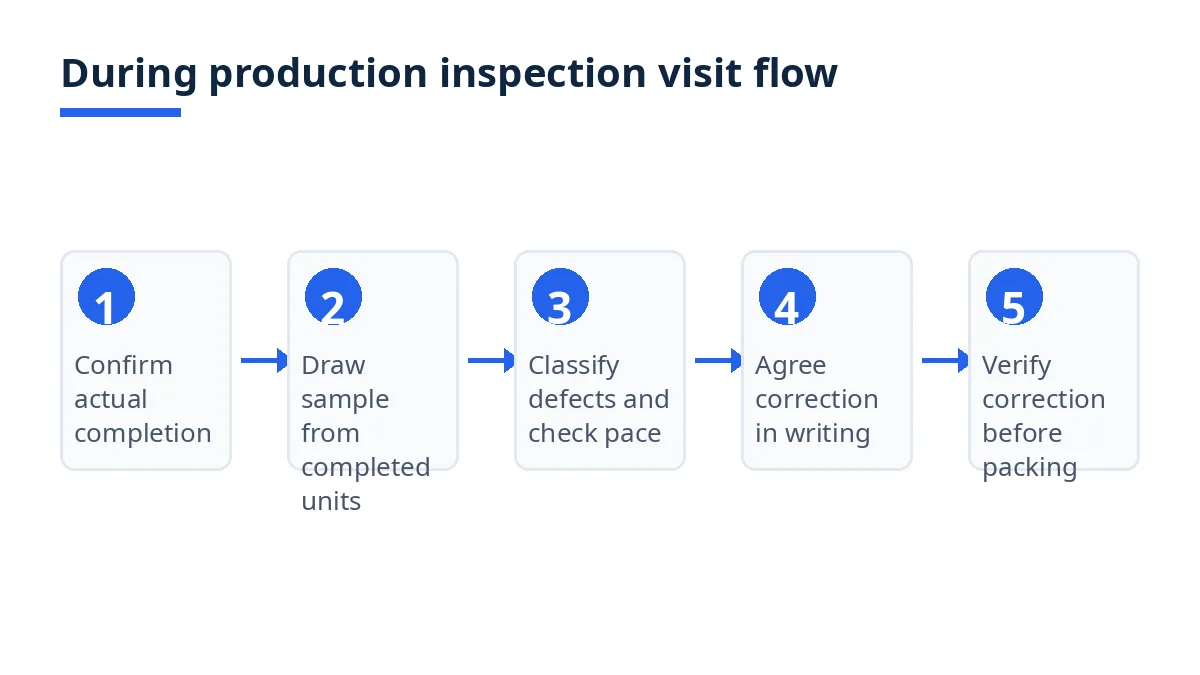
Work through these steps in order.
Agree the trigger in writing. State the trigger as a unit count or milestone, not only as a percentage, because reported and observed progress often differ.1 One firm describes the window as 20 to 60 percent complete, another as 20 to 80 percent.1 2 Pick one window and name the triggering unit count.
Send the full quote pack. Include the purchase order, specification, approved sample details, measurement chart, artwork and labelling files, packing specification, and variant list. Add the defect classification and the sampling plan for the completed portion.
Ask for the quote in components. Require separate lines for man-days, travel per site, tests, reporting, and any follow-up visit, plus the report turnaround in writing.
Confirm actual completion before dispatch. The most frequent cause of a rescheduled visit is a factory that is not as far along as reported, so confirm actual completion before fixing the date.1 Ask for three counts: produced, semi-finished, and packed. If nothing is packed yet, packing cannot be verified, and the quote should say so.
Hold the visit. The inspector draws the sample from completed units on the line, not from a set handed over by the factory. The visit covers materials in use, work in progress, finished-unit sampling against the approved sample, production pace, and packing material readiness.2 Work-in-progress checks reveal systemic issues that will affect every unit still to be produced.2
Agree the correction on the day. The report should produce a correction record: each finding, the fix, the owner, and the deadline.
Verify the correction, then plan the final inspection. A follow-up visit verifies the correction before production completes wherever possible.1 If the visit was clean, a standard final check may be enough; if it found systemic faults, consider tighter sampling at the final stage.2
Costs, timelines and documents
What drives the day count
The day count moves on the completed portion, not on the full order quantity. A 10,000-unit order with 4,000 units complete is sampled on the work the inspector can see that day; the remaining 6,000 cannot be sampled yet.
Sample size follows lot size and the agreed inspection level, and a tighter level means more units checked and more time.1 Agree which lot the plan applies to: the completed portion, with its own code letter and sample size, rather than the full order. Complexity moves the day count through models, colours, sizes, variants, checkpoints, and on-site verification.1 A single style in two colours is a short visit; five styles across four colours is longer, because every sampled unit must first be matched to the correct style, colour, and size.
Checks, tests, locations, and reporting add further time. Measurements, function checks, and barcode verification each add time beyond a visual check, while lab work is priced separately.1 Location moves cost through travel time and distance from the nearest inspector base; remote units cost more to reach than units in a major cluster.1 Split production means separate visits, one per site, and reporting depth matters: standard reporting versus extended photographic or video documentation is a different deliverable.1 Urgent bookings carry different economics than planned scheduling, and follow-up visits are a separate engagement.1
Cost component | What moves it on a during production visit | Ask for it as |
|---|---|---|
Man-days | Completed units sampled, variants, checks | Days and inspectors, sample base stated |
Travel | Distance from inspector base, extra sites | Included or separate, per site |
Tests | Test method, sample count, lab turnaround | Listed tests, priced apart from the day rate |
Reporting | Standard versus extended photo or video record | Contents and turnaround in writing |
Follow-up visit | Scope of the recheck after a correction | Full day or focused recheck, and who pays |
What are the typical costs and timelines?
There is no single market rate for a during production inspection in Bangladesh. One firm's 2026 pricing guide puts South Asia at 240 to 320 dollars per man-day, and notes that Bangladesh rates can be higher for non-textile products.3 The same guide states its own Asia pricing from 240 dollars per man-day, including travel, inspection, and a same-day report within its coverage.3 Treat that range as one firm's published range, not as a Bangladesh market rate, and ask every firm whether its quote is all-inclusive or inspector time only.
The add-ons are where quotes diverge. The same guide lists a travel surcharge for remote factories of 50 to 150 dollars, a weekend or holiday surcharge of 30 to 50 percent, and lab testing priced separately.3 A follow-up visit is a second man-day in most structures, with one firm noting discounted re-inspection rates of 50 to 70 percent of the full price.3
Example figures: 240 dollars per man-day for 1 man-day, plus 50 dollars of separately agreed travel, totals 290 dollars for the visit. A focused recheck agreed at a discounted rate is a second, separately priced line. Example figures only, not a typical fee or a quotation for any order.
For timelines, the binding dates are trigger, visit, correction, and recheck. One firm states that it schedules inspections within 48 hours of booking, with reports delivered within 24 hours.2 Treat that as one firm's stated service level, not an industry standard, and confirm the report turnaround in your own quote in writing.
How do I read the report while production is still running?
Read a during production report in a specific order: quantity and schedule first, then defect classification, then photographs.1 Check the three counts separately: produced, semi-finished, and packed, as observed, against the supplier's reported completion.1 Then check the sample base: how many completed units the sample was drawn from, how many were sampled, and whether the inspector selected them.
Next, read the defect classification against the agreed accept and reject numbers per class. ISO 2859-1 defines acceptance sampling schemes indexed by acceptance quality limit (AQL) for lot-by-lot inspection, and AQL is the quality level that is the worst tolerable process average for the sampling decision.4 Each class is judged against its own numbers: a blended rate across critical, major, and minor defects hides which class failed. The numbers describe the completed portion sampled that day, not units still to be made.
Then read the photographs as evidence. Each finding should carry a photograph that identifies the defect without ambiguity, and the packing section should state what could and could not be verified yet.1 Close with the correction record and the pace verdict: the fix, owner, and deadline for each finding, and whether the observed rate supports the delivery date.2
Which documents are needed?
The firm needs the purchase order, specification, approved sample details, measurement chart, artwork and labelling files, and packing specification, plus on-site tests. For multi-style orders, include the full variant list, because it lets the firm estimate the workload. Add three items specific to a mid-run visit: the production schedule with the trigger count, previous findings for the same supplier or product, and the defect classification with AQL values per class. Keep the report with the order file afterward, with the correction record and recheck evidence.
Bangladesh-specific rules and tips
Bangladesh orders are usually garment orders, and that shapes the cost conversation in two ways. First, long garment runs drift: fabric lot variation, dye consistency, sizing accuracy, and stitching quality change across a run, so a mid-run check is checking for drift, not only for one-off faults.2 Second, product type moves the price within the published range: one firm's guide notes that Bangladesh rates can be higher for non-textile products.3 If your order is not garments, say so early and ask whether the quote assumes textile inspection time.
Three practical tips follow. Confirm actual completion in units, not percentages, before the inspector travels, because the most frequent cause of a wasted visit is a factory that is not as far along as reported.1 If your order splits across two factories, budget two visits with two travel lines. Keep the two bookings as separate lines with separate payers for rechecks. No Bangladesh rule changes the sampling method: the plan, defect classes, and accept and reject numbers are agreed for the order before production starts.
Mistakes and red flags
What are the most common mistakes?
Booking on a planned percentage instead of an actual count. A visit fixed for "40 percent" when the factory has only cut fabric samples nothing useful. Confirm produced, semi-finished, and packed counts first.1
Booking too late to correct anything. A visit at 80 percent or later, with packing under way, leaves almost no correction window, so the factory can no longer fix the fault cheaply.2
Treating a mid-run pass as shipment approval. A pass on the completed portion says nothing about units not yet made or packing not yet started. Shipment approval belongs to the final inspection.2
Accepting a blended defect rate. A single percentage across defect classes cannot be checked against the agreed plan. Insist on separate counts per class against separate accept and reject numbers.4
Letting the factory select the sample. A neat set handed to the inspector produces a passing result without changing anything on the line. The inspector must draw the sample from completed units.
Leaving the correction without an owner or a deadline. A finding without an agreed fix, owner, and deadline will still be open at final inspection, when it costs more to close. Agree all three before the inspector leaves.
Leaving the recheck payer blank. Decide in the purchase order who pays for a follow-up visit after a fault, and name the payer in the same document as the correction.1
Comparing day rates instead of totals. A low day rate with separate travel, a paid report, and a full-price recheck can exceed a higher all-inclusive rate. Compare totals for the same sample base and scope.3
Checklist
Before you book, every line should be answered in writing.
Visit trigger agreed as a unit count and milestone, not only as a percentage.1 2
Sampling plan written for the completed portion: standard, level, sample size, AQL, accept and reject numbers per class.4
Quote pack sent: purchase order, specification, approved sample, measurement chart, artwork and labelling files, packing specification, variant list, tests.
Quote in components: man-days, travel per site, tests, reporting, recheck terms, report turnaround.
Totals compared on the same sample base and scope, not day rates alone.3
Actual completion confirmed in units: produced, semi-finished, packed, before the inspector travels.1
Inspector selection confirmed; factory-prepared sets excluded.
Correction record agreed on the day: finding, fix, owner, deadline.
Recheck payer and scope agreed in the purchase order; recheck completed before packing finishes.1
Final inspection still booked for the finished, packed lot; mid-run pass never treated as shipment approval.2
How Exportain helps
Exportain does not inspect goods itself. Its supplier verification is a document review by staff, not a factory inspection, and a badge is not a guarantee of production capacity, product quality, or delivery.5 Browse suppliers and post a request for quotation on the RFQ board stating your inspection timing, sampling plan, and defect classes, so suppliers quote against the same specification and timeline. When you accept a quotation, Exportain creates one order and issues one proforma invoice from the accepted terms.5
For the inspection itself, contract directly with the inspection firm and read its quote against this guide's component list. Before you set values for a new product, read the pre-shipment inspection guide and the AQL guide, and keep the two visits as separate bookings with separate scopes.
FAQs
What should I know first about during production inspection cost in Bangladesh?
Know first that the price is built from workload on the completed portion, not from order value or the full order quantity: a man-day rate multiplied by the man-days the sample needs, plus travel, tests, and any follow-up visit.1 3 There is no single Bangladesh market rate; one firm's 2026 guide puts South Asia at 240 to 320 dollars per man-day, with Bangladesh higher for non-textile products.3
What are the typical costs and timelines?
There are no typical figures a buyer can rely on, because each firm prices the visit for your completed sample, variants, sites, and tests. The add-ons that move the total are travel per site, weekend or holiday surcharges, lab tests priced separately, and a follow-up visit priced separately.3 For timelines, agree the trigger count, visit date, report turnaround, and correction window before packing starts.1
Which documents are needed?
The firm needs the purchase order, product specification, approved sample details, measurement chart, artwork and labelling files, and packing specification, plus the variant list and on-site tests. A mid-run visit also needs the production schedule with the trigger count, previous findings for the same supplier or product, and the defect classification with AQL values per class.1 4 Keep the report, correction record, and recheck evidence with the order file.
What are the most common mistakes?
The most common mistakes are booking on a planned percentage instead of an actual count, booking too late to leave a correction window, treating a mid-run pass as shipment approval, accepting a blended defect rate, letting the factory select the sample, and leaving the correction without an owner, deadline, or named recheck payer.1 2 4 Compare totals on the same sample base and scope, not day rates alone.3
Next steps on Exportain
Browse suppliers, then post your inspection timing, sampling plan, and defect classes on the RFQ board so suppliers quote against the same specification. Before you book, read how much pre-shipment inspection costs in Bangladesh so both visits are budgeted separately.
Sources
- During Production Inspection. Ornate Quality Services (accessed )
- During Production Inspection. Tetra Inspection (accessed )
- How Much Does Product Inspection Cost? 2026 Pricing. Tetra Inspection (accessed )
- ISO 2859-1:2026 - Sampling procedures for inspection by attributes — Part 1: Sampling schemes indexed by acceptance quality limit (AQL) for lot-by-lot inspection. ISO (accessed )
- Trust & Safety Center. Exportain (accessed )
About the author
Sourcing from Bangladesh?
Post a request for quotation and suppliers on Exportain can send you their quotes directly.
Post an RFQ


