

How Much Does Pre-Shipment Inspection Cost in Bangladesh?
A PSI quote is man-days plus travel, lab tests and re-inspection. What sets the day count for Bangladesh orders, how to compare totals, and how to read the report line by line.
Short answer
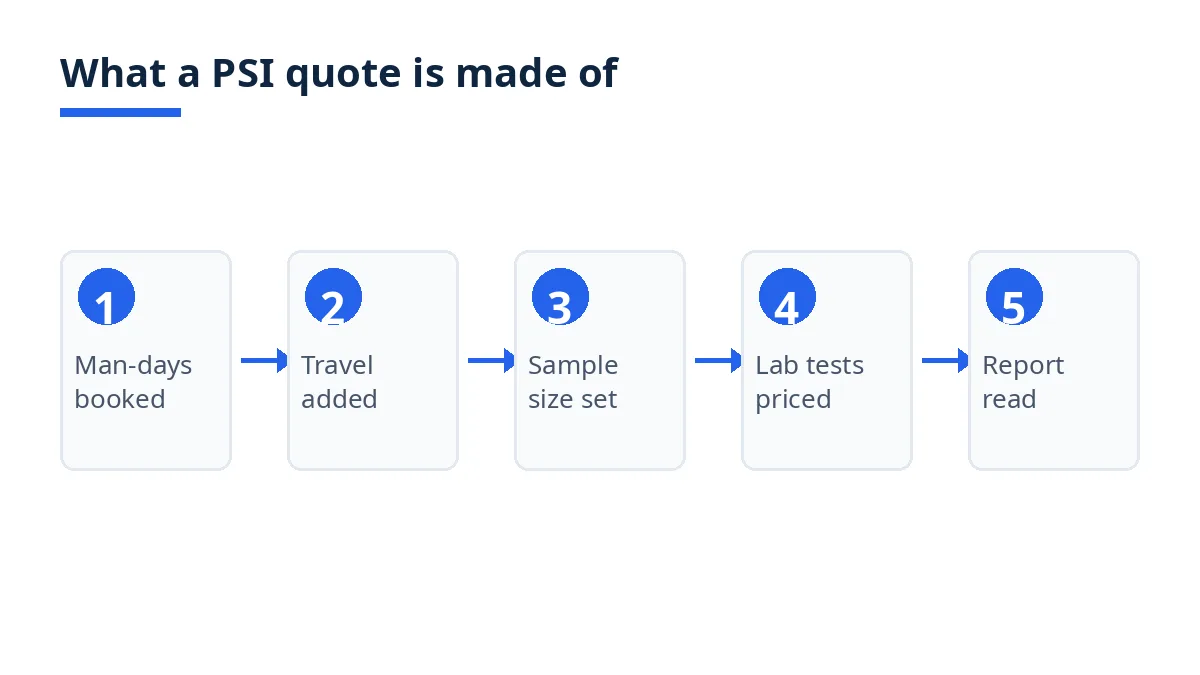
Pre-shipment inspection cost in Bangladesh has no single market rate. Firms price by workload: a man-day rate multiplied by the man-days your lot needs, plus travel, lab tests and any re-inspection. The day count moves with sample size, product variants, checks per unit, test time and factory locations. Compare written quotes by total for identical scope, and read the report against the agreed AQL and acceptance numbers before authorizing shipment.
On this page
Key takeaways
PSI pricing is built from workload, not order value: a man-day rate multiplied by the man-days your lot needs, plus travel, lab tests and any re-inspection.
The day count moves with sample size, product variants, checks per sampled unit, slow tests, and the number of factory locations.
Compare quotes by total for identical scope, not by day rate: a lower day rate with more days and separate travel can cost more.
There is no single Bangladesh market rate; one firm's published 2026 guide puts South Asia at 240 to 320 dollars per man-day, with Bangladesh higher for non-textile products.
Read the report against the agreed plan: lot, sample size, AQL with Ac and Re per defect class, defect counts with photographs, measurements, and packing findings.
A pre-shipment inspection quote that shows a single number hides the decision you actually need to make. The useful question is not whether the day rate looks low, but how many days the job needs, what sits outside the day rate, and what the report will let you verify afterward. Most third-party inspection is priced by workload rather than by order value, in man-days: one man-day usually means one person working for one inspection day.1
This guide works through that quote line by line for Bangladesh orders: the cost components, the sampling choices that move the day count, the timelines that prevent a second paid visit, the documents a firm needs to price accurately, and how to read the report.
Why this matters for buyers and sellers
For the buyer, the inspection fee is small next to the cost of shipping a failed lot and dealing with returns, rework abroad, or a missed season. For the seller, a clear scope protects the shipment too: when the checklist, sampling plan, and pass criteria are written down before production ends, a pass is a shared result rather than a surprise.
A day-rate quote rewards precise scoping: fewer variants, one location, and a complete reference set keep the day count down. A vague scope does the opposite. Settling who pays for a re-inspection before production starts costs nothing to write down.
Step-by-step: how it works
Getting an accurate PSI price is a scoping exercise. Work through these steps in order, keeping every answer in writing so competing quotes describe the same job.
Define the lot and the locations. State the total quantity, the styles, colors, and sizes, and every factory or warehouse address where goods will sit. A quotation for one site is not a quotation for another, and samples taken at one factory cannot represent goods held at a second site.1
Fix the sampling plan before you ask for prices. Write down the standard, the inspection level, and the AQL for each defect class. ISO 2859-1:2026 defines acceptance sampling plans for inspection by attributes, indexed by acceptance quality limit (AQL) for lot-by-lot inspection.2 Without those inputs, two firms can quote different sample sizes for the same order.
Send the full quote pack. Include the purchase order, the product specification, the approved sample details, the measurement chart, artwork and labeling files, packing requirements, and any agreed on-site tests.1 A firm prices from these files; disagreements must be resolved before the visit, not by the inspector on site.
Ask for the quote in components, not one total. Require separate lines for man-days, travel, lab tests, and re-inspection, plus what the report includes and when it arrives.
Book at the right readiness point. A normal final random inspection is arranged when production is 100 percent complete and at least 80 percent packed, so the sample covers the shipment including its packing.1 Booking earlier can mean a second visit once the rest is ready, at a second charge.
Read the report against the plan, then decide. Check the lot size, sample size, AQL and acceptance numbers per defect class, defect counts with photographs, measurements, and packing findings. On a pass, authorize shipment in writing. On a fail, agree the correction and re-inspection before anything ships.
Costs, timelines and documents
What drives the man-day count
The man-day count is where most quotes differ, and it moves on five inputs.
Sample size. Lot size and inspection level set the sample size, and the AQL sets the acceptance and rejection numbers per defect class.3 ISO 2859-1 provides three general levels and four special levels: Level I uses a smaller sample, Level II is the default, Level III uses a larger sample, and S-1 to S-4 use very small samples for destructive or costly tests.3 Moving from Level II to Level III, or tightening an AQL, raises the sample and the time on site.
Product variants. Total quantity alone does not describe the workload. One published cost guide contrasts 10,000 identical pieces in one color with 2,400 pieces spread across 24 variants, noting that every sampled unit in the second order still has to be matched to the correct model, accessory, and label.1 Apparel multiplies this quickly: five styles in four colors and five sizes produce 100 combinations to track.1
Checks per sampled unit. A visual check takes one amount of time; adding measurements, function tests, or barcode verification adds more. Slow tests compound: twenty samples at ten minutes each take 200 minutes if done one after another, before the workmanship and packing work is counted.1
Locations and travel. Travel sits inside some quotes and outside others. One firm's pricing guide lists a travel surcharge for remote factories of 50 to 150 dollars, and notes that a quote covering inspector time only can cost more than an all-inclusive quote once travel, report, and booking fees are added.4 Always ask whether travel is included and which address the price covers.
Lab tests and separate services. Some checks need laboratory equipment or a controlled test method, and those services are priced separately from the factory-site inspection.1 Chemical analysis, material testing, and compliance testing fall in this group, as does a container loading check, which supervises loading and sealing rather than sampling finished goods.4 A 100 percent full inspection is a different job from a sampled inspection and is priced on its own basis.1
Cost component | What moves it | Ask for it as |
|---|---|---|
Man-days | Sample size, variants, checks per unit, test time | Number of days and inspectors |
Travel | Distance from inspector base, extra sites | Included or separate, per site |
Lab tests | Test method, sample count, lab turnaround | Priced per test, apart from the day rate |
Re-inspection | Scope of the recheck after a fail | Full day or focused recheck, and who pays |
Report and booking | Photo report, turnaround, cancellation terms | Included in writing, with timing |
What are the typical costs and timelines?
There is no single market rate for a pre-shipment inspection in Bangladesh, and any guide that states one without naming its source should be treated with care. Published guides agree on the structure: a day rate multiplied by the man-days required, plus separately agreed work.1 One firm's published 2026 pricing guide puts South Asia at 240 to 320 dollars per man-day, and notes that Bangladesh rates can be higher for non-textile products.4 Treat that range as one firm's published range, not as a Bangladesh market rate.
Example figures: 250 dollars per man-day for 2 man-days, plus 30 dollars of separately agreed travel, totals 530 dollars. A lower day rate can still cost more in total if it needs more days or adds travel separately: the same published guide compares 190 dollars per man-day for 2 man-days plus 30 dollars travel, totaling 410 dollars, against 250 dollars per man-day for 1 man-day with normal travel included, totaling 250 dollars.1 Example figures only, not a typical fee; the day rate is that guide's example rate, not a fixed price.1
For timelines, the binding dates are readiness, inspection, and report. Confirm the factory's realistic completion date before booking, since a visit booked too early can require a second visit once production is complete.1 Confirm the report timing in the quote as well, because a shipment decision cannot be made on a verbal result. Weekend or holiday inspections can carry a surcharge of 30 to 50 percent, according to one firm's guide.4 Leave room before the loading deadline for correction and a recheck.
How to read the report
A report you can verify reconstructs the decision. Start with the lot: the finished, packed quantity actually presented, not the purchase-order quantity. Then check the plan: the standard, inspection level, sample size, and AQL with its acceptance number (Ac) and rejection number (Re) per defect class. A worked example from a sampling guide shows the mechanics: a lot of 3,200 units at General Level II gives code letter K and a sample of 125 units, with Ac 3 and Re 4 at AQL 1.0 for major defects and Ac 7 and Re 8 at AQL 2.5 for minor defects.3 Each class is judged separately.
Next, read the defect evidence, not just the verdict. Each defect class should show its count against its own Ac and Re, with photographs that identify the defect without ambiguity. Measurements should show values against the size chart and its tolerances, and packing findings should cover carton assortment, marks, and barcode readability where those were in scope. A report blending all defects into one rate, or stating a pass with no Ac and Re numbers, cannot be checked against the agreed plan. Treat it as unverified and ask for the missing lines before authorizing shipment.
On a fail, the report doubles as the rework instruction: use its counts and photographs to agree what will be corrected, sorted, or remade, and whether the recheck covers the full sample or only the corrected points.1 Record who pays for the recheck in the same document.
Which documents are needed?
The firm needs the purchase order, the product specification, the approved sample details, the measurement chart, artwork and labeling files, and the packing requirements, plus the agreed on-site tests.1 For multi-style orders, include the full variant list: the SKU sheet is what lets the firm estimate the workload before the visit.1 Keep the report with the shipment file afterward, alongside the packing list and commercial invoice.
Bangladesh-specific rules and tips
Bangladesh orders are usually garment orders, and that shapes the cost conversation in three ways. First, the sampling defaults buyers use for garments are buyer-selected values, not values the standard mandates for apparel: critical defects are commonly held at AQL 0, major defects at 2.5, and minor defects at 4.0, agreed in writing before production.3
Second, product type moves the Bangladesh price. One firm's published guide notes that Bangladesh rates can be higher for non-textile products within its South Asia range of 240 to 320 dollars per man-day.4 If your order is not garments, say so early and ask whether the quote assumes textile inspection time or something slower.
Third, keep multi-site orders honest. One purchase order can still split across two factories, and the second site needs its own sample and travel line.1 If a supplier consolidates goods from another site before the visit, confirm that consolidation is real and documented.
Mistakes and red flags
What are the most common mistakes?
Comparing day rates instead of totals. A low day rate with more days, separate travel, and a paid report can exceed a higher all-inclusive rate. Compare totals for the same scope, sites, and sample plan.
Booking before the goods are ready. A visit at partial completion cannot sample the missing portion. Confirm 100 percent completion and at least 80 percent packed first.1
Leaving the re-inspection payer blank. Decide in the purchase order who pays for a recheck after a fail, before production starts rather than after a failed result.
Accepting a blended defect rate. A single percentage across all defect classes hides which class failed. Insist on separate counts per class against separate Ac and Re numbers.3
Treating AQL as a promise about every unit. AQL is a sampling decision rule, not a guarantee: an accepted lot can still contain defective units that were not sampled.2
Skipping the variant list. Sending only a total quantity produces a rough quote. Send the style, color, and size breakdown, the factory addresses, and the test list.1
Paying for lab work inside a day rate without checking. Lab tests are priced separately from site inspection.1 If a quote bundles them, ask which tests, how many samples, and what the turnaround is.
Checklist
Before you book, every line should be answered in writing.
Lot defined: total quantity, styles, colors, sizes, and every inspection address.
Sampling plan written: standard, level, and AQL per defect class.2 3
Quote pack sent: purchase order, specification, approved sample details, measurement chart, artwork and labeling files, packing requirements, on-site tests.1
Quote in components: man-days, travel per site, lab tests, re-inspection terms, report timing.
Totals compared on the same scope, not day rates alone.
Readiness confirmed: production complete and packing substantially done before the visit date.1
Re-inspection payer and scope agreed in the purchase order.
Report checked line by line: lot, sample, Ac and Re per class, defect counts with photographs, measurements, packing findings.
Shipment authorized in writing on a pass; correction and recheck agreed on a fail.
How Exportain helps
Exportain does not inspect goods itself. Its supplier verification is a document and photo review by staff, not a factory inspection, and a badge is not a guarantee of production capacity, product quality, or delivery.5 Browse suppliers and post a request for quotation on the RFQ board that states your inspection and AQL requirements, so suppliers quote against the same specification and timeline. When you accept a quotation, Exportain creates one order and issues one proforma invoice from the accepted terms.5
For the inspection itself, contract directly with the inspection firm and read its quote against this guide's component list. Before you set values for a new product, read the pre-shipment inspection guide and the AQL guide.
FAQs
What should I know first about pre-shipment inspection cost in Bangladesh?
Know that the price is built from workload, not order value: a man-day rate multiplied by the man-days your lot needs, plus travel, lab tests, and any re-inspection agreed separately.1 There is no single Bangladesh market rate in published guides; one firm's 2026 guide puts South Asia at 240 to 320 dollars per man-day, with Bangladesh higher for non-textile products.4
What are the typical costs and timelines?
Typical costs cannot be stated as fact, because the day count moves with sample size, variants, checks per unit, test time, locations, and lab work. Compare totals for identical scope. For timelines, book when production is complete and packing is substantially done, confirm the report timing in the quote, and leave room before loading for a recheck.1
Which documents are needed?
The firm needs the purchase order, product specification, approved sample details, measurement chart, artwork and labeling files, packing requirements, and the agreed on-site test list, plus the full variant breakdown for multi-style orders.1
What are the most common mistakes?
The most common mistakes are comparing day rates instead of totals, booking before the goods are ready, leaving the re-inspection payer undecided, accepting a blended defect rate with no Ac and Re numbers, and treating an AQL pass as a promise that every unit is defect-free.2 3
Next steps on Exportain
Browse suppliers, then post your inspection and AQL requirements on the RFQ board so suppliers quote against the same specification. Before you book, read the pre-shipment inspection guide and the AQL guide.
Sources
- Pre-Shipment Inspection Cost Guide | Man-Days, Pricing Factors & What Buyers Pay For. UTS Inspection (accessed )
- ISO 2859-1:2026 - Sampling procedures for inspection by attributes — Part 1: Sampling schemes indexed by acceptance quality limit (AQL) for lot-by-lot inspection. ISO (accessed )
- AQL Sampling Explained: Tables, Levels, Examples. MetricMech (accessed )
- How Much Does Product Inspection Cost? 2026 Pricing. Tetra Inspection (accessed )
- Trust & Safety Center. Exportain (accessed )
About the author
Sourcing from Bangladesh?
Post a request for quotation and suppliers on Exportain can send you their quotes directly.
Post an RFQ


