Dried Fish Price in Bangladesh: FOB Cost Breakdown for Buyers
No single dried-fish price exists without a species, method and weight basis. This guide shows how to read a dried-fish FOB quotation line by line: drying-method bands, moisture weight, salt share, packing and port validity.
Short answer
A dried-fish FOB quotation cannot be judged by its headline price. Compare quotations only after converting each to the same species, form and drying method, with moisture and salt percentages on stated bases, net weight excluding packing, a named port of shipment and a validity period covering drying and loading. Under the Incoterms 2020 rules, each rule allocates cost, risk and obligations, so quotations must be compared on the same term.

On this page
Key takeaways
A dried-fish FOB quotation cannot be judged by its headline price: convert every offer to the same species, form and method before comparing prices.
Moisture and salt are weight: a quotation must state both percentages with their bases, and the price must apply to net weight excluding packing.
Species and method set the band, since raw-fish input per kilogram of dried product differs sharply by species and drying method.
Packing must prevent moisture re-absorption, and the FOB line needs a named port and a validity period covering drying, packing and loading.
Exportain verification is a document and photo review, not a factory inspection, and a badge is not a guarantee of any shipment.
A dried-fish quotation does not price fish alone. It prices fish after water has been removed, salt added, and the result packed against taking water back. Two quotations for the same species can differ honestly, and the lower price per kilogram can still be dearer once moisture, salt and packing are on the same basis.
The work is conversion before comparison: same species, form and method, stated moisture and salt, net weight excluding packing, and one delivery term.
Dried fish sits under heading 0305 of the Harmonized System, which covers fish, dried, salted or in brine, smoked fish, and flours, meals and pellets of fish fit for human consumption.1 Within that heading, dried fish other than cod falls under subheading 030559, while dried cod falls under 030551.1 A quotation should name the species and form, not only the heading. See the HS code for dried fish guide.
Why this matters for buyers and sellers
For the buyer, the weight basis is the price: dried fish is sold by weight, and water and salt both weigh. A quotation omitting moisture and salt leaves the buyer unable to tell how much fish is in each kilogram paid for, or to compare two suppliers. Packing matters the same way: fish that takes moisture back in transit gains weight, softens, and arrives different from the approved sample.
For the seller, the same lines explain the price. A 2025 study of major drying yards in the Cox's Bazar district found that one kilogram of finished dried product required, on average, 3.25 kg of raw pomfret, 2.8 kg of raw mackerel, 4.5 kg of raw sardine, 4.01 kg of raw anchovy and 5.5 kg of raw Bombay duck.2 The same study found salt use from 3 percent to 16 percent across surveyed species, and mostly traditional methods in those yards.2 Species, method, moisture and salt are therefore not paperwork: they explain the price.
Step-by-step: how it works
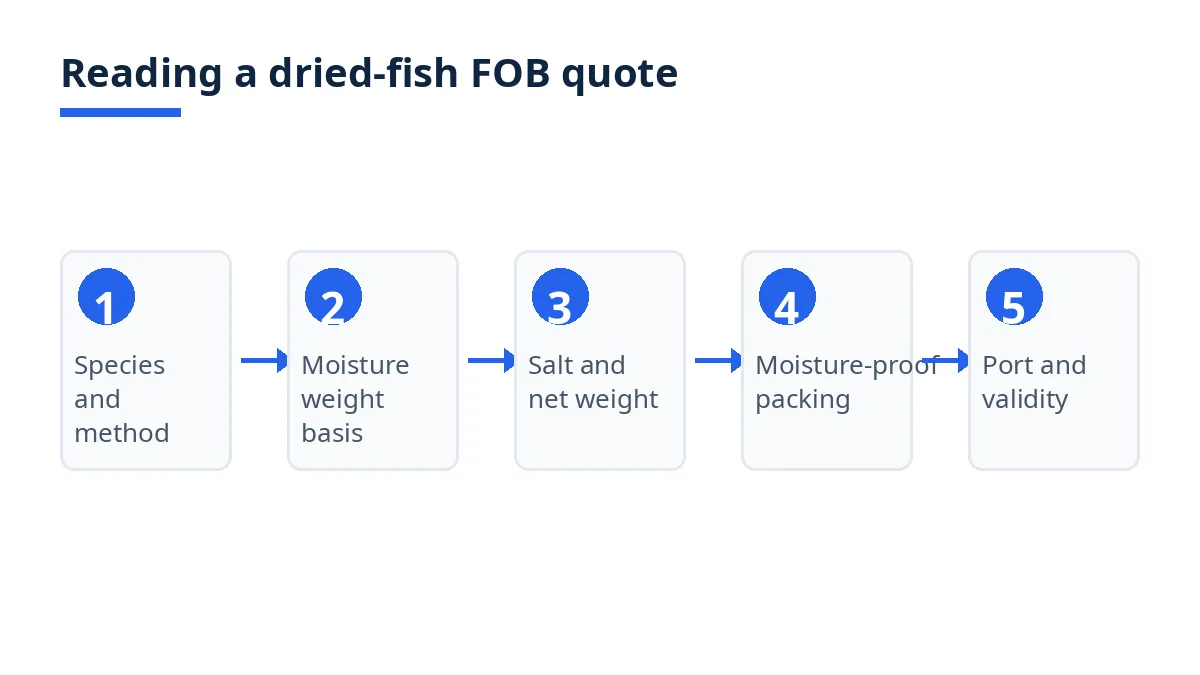
Ask for species, form and drying method in full. Whole, split, filleted or headed and gutted; sun-dried, salted sun-dried or smoke-dried.
Ask for the weight basis. Moisture and salt percentages, the basis of each, and net weight excluding packing.
Convert every quotation to the same basis. Use the worked method below before ranking by price.
Check packing against moisture re-absorption. Inner liner, seal, carton spec and net weight.
Check the FOB line. Named port, validity period, and cost lines inside the price.
Approve a sample on the same lines. Measure it on the same moisture, salt and packing terms as the bulk order.
Put every agreed line on the purchase order. Species, form, method, moisture, salt, net weight, packing, port, validity and documents.
Reading species and drying-method bands
A band is set first by species and then by method, because raw-fish input and work per kilogram differ on both. A species needing 5.5 kg of raw fish per kilogram of dried product carries more raw material than one needing 2.8 kg, before labour, salt and packing.2
Band | Quotation must state | Price driver |
|---|---|---|
Unsalted sun-dried | Species, form, sun-drying only | Raw-fish input, drying time, breakage |
Salted sun-dried | Species, form, salting method, salt percentage and basis | Raw-fish input, salt quantity, drying time |
Smoke-dried | Species, form, smoking and drying steps | Raw-fish input, fuel and labour, lower moisture level |
Ask for the method in those terms, not "dried" as a description, and ask how the batch is dried.2
Reading dried weight against rehydration yield
Dried weight is the weight at dispatch. Rehydration yield is what the buyer gets back when the product is soaked before use. Ask for both: dried net weight per carton, and the supplier's stated rehydration method with its yield.
The method must be stated, because yield depends on soak time, water temperature and cut. Ask for sample weight, soak time, water temperature, draining time and weight after draining in writing, then run the same method on the pre-shipment sample. Example figures: a 100 g dried sample soaked and drained as described, reaching 250 g, gives a yield of 2.5 times the dried weight. The example shows the arithmetic only.
Codex figures need the same care. The Codex standard for smoke-dried fish describes smoke drying as reaching a water activity of 0.75 or less, stated as 10 percent moisture content or less, so the product can be stored and transported without refrigeration.3 That is a benchmark for smoke-dried fish under that standard, not a rule for all dried fish.
Reading salt content and net weight
Salt preserves, adds flavour and adds weight, and the quotation must separate those roles. The Cox's Bazar study found salt use from 3 percent to 16 percent across the species surveyed.2 Quotations inside that range are not automatically comparable: 3 percent and 16 percent describe very different products.
Ask two questions. First, what is the salt percentage, and on what basis: wet basis, dry basis, or salt in the water phase. A percentage without a basis cannot be compared with one on another basis. Second, is the salt weight part of the net weight, and does the buyer pay the fish price for it.
Codex salt figures are product-specific. The Codex standard for salted fish and dried salted fish of the Gadidae family describes fish preserved by partial saturation to a salt content not less than 12 percent by weight, and heavy-salted fish fully saturated with salt.4 That 12 percent figure belongs to Gadidae species under that standard, not to dried fish in general.
Net weight follows the same discipline. Ask for gross, packing and net weight per carton, and confirm the price applies to net weight. A carton at 20 kg gross with 1 kg of packing holds 19 kg of product.
Example figures: on 100 kg stated at 20 percent moisture and 10 percent salt on a wet basis, 70 kg is fish solids. On 100 kg stated at 30 percent moisture and 15 percent salt on the same basis, 55 kg is fish solids. At example prices of 4.00 and 3.50 per kilogram, the costs per kilogram of fish solids are 5.71 and 6.36. The cheaper headline price is the dearer purchase on the comparable basis. The example shows the method only; replace its figures with the supplier's stated figures.
Reading packing against moisture re-absorption
Packing is part of the product for dried fish. The Codex standard for smoke-dried fish defines packaging for that product as putting the fish in a container to avoid contamination and prevent rehydration.3 The same test applies to any dried-fish quotation: does the packing keep water out.
Ask for the packing line in full: inner liner material and seal, whether the liner is sealed or only folded, carton material and strength, inner bags per carton, and net weight per carton. Put the agreed packing on the purchase order.
On arrival, check packing before accepting weight: weigh a sample of cartons, compare gross and net weight with the packing list, and look for damp liners, soft cartons or condensation inside the liner. See the dried fish quality control checklist for carton, moisture and appearance checks.
Reading port, validity and the FOB line
An FOB quotation is incomplete without a named port of shipment and a validity period. The Incoterms 2020 rules set out 11 rules with a clear allocation of cost, risk and obligations.5 Comparing FOB quotations from different ports, or with a quotation on another term, compares different offers. See the FOB free on board guide.
Ask for the FOB line in writing: named port, validity dates, and cost lines included. Ask which of raw fish, salting, drying, grading, packing, inland transport, export clearance and loading sit inside the price, and what happens if loading slips past validity. A validity period ending before drying and loading finish is a gap, not a detail.
Costs, timelines and documents
What are the typical costs and timelines?
There are no typical costs or timelines a guide can state as fact for dried fish, because species, method, moisture, salt, packing, order size and port all move price and schedule. Ask for cost lines itemized: raw fish, salt and inputs, drying labour and fuel, grading, packing, inland transport, export clearance and loading.
Ask for drying, grading, packing, inspection and loading dates as separate lines. Ask what happens if a batch fails the moisture check: re-drying, re-grading or replacement, and who bears the delay.
Which documents are needed?
For export clearance in Bangladesh, goods may not be loaded unless an export declaration, the Bill of Export or Shipping Bill, is submitted to Customs and approved.6 Enclosed documents include the export contract or purchase order where there is no export letter of credit, the commercial invoice, the packing list, the EXP form certified by an authorized dealer, and a certificate of origin issued by the EPB or a Chamber of Commerce and Industry.6 The packing list must carry quantity, weight and packing information.6
Product-wise additional certification may be necessary for some categories, and a Department of Fisheries quality control certificate is necessary where the destination country requires it for fish products.6 Confirm destination requirements before ordering. The order documents are the itemized quotation, the purchase order carrying every agreed line, the commercial invoice and the packing list.
Bangladesh-specific rules and tips
Ask where the fish is dried, not only where the supplier is registered. The Cox's Bazar study surveyed major drying hubs in that district, including yards at Moheshkhali, Sonadia, Teknaf and Cox's Bazar sadar, with Nazirertek the largest surveyed.2 An office address does not say where drying happens. Ask for drying location, batch size per cycle, and cycles needed.
Confirm the HS subheading for the species and form. Dried fish other than cod sits under 030559, dried cod under 030551, and fillets, salted fish in brine and smoked fish under their own subheadings within 0305.1 A wrong subheading can delay clearance.
Keep one legal name across every paper. The export declaration specifies the exporter, foreign buyer and transport operator, with goods description and value.6 The name on trade licence, quotation, proforma invoice, packing list and payment account should match.
Treat traditional methods as a question, not an assumption. Processors in the surveyed yards used mostly traditional methods.2 Ask how moisture is checked, how batches are graded, and how a batch missing the moisture figure is handled.
Mistakes and red flags
What are the most common mistakes?
Comparing headline prices per kilogram. A lower price at higher moisture or salt can be dearer per kilogram of fish solids.
Accepting a species or method label without detail. "Dried fish" without species, form and method cannot be priced or inspected with confidence.
Paying the fish price for packing weight. Gross weight quoted as net weight overcharges on every carton.
Leaving moisture and salt without a basis. A percentage without a stated basis cannot be compared, checked or enforced.
Ignoring validity. Validity ending before drying and loading finish leaves the price open to change.
Leaving packing unspecified. A folded liner and a sealed liner are different offers.
Reading a badge as a guarantee. Verification is a document and photo review, not a factory inspection.7 See how supplier verification works on Exportain.
Checklist
Species and form: whole, split, filleted, or headed and gutted.
Drying method and drying location: sun-dried, salted sun-dried, or smoke-dried.
Moisture percentage, with the basis it is measured on.
Salt percentage, with the basis it is measured on.
Net weight per carton, excluding packing.
Conversion done: cost per kilogram of fish solids on the same basis for every quotation.
Packing: liner, seal, carton, inner bags.
Rehydration method and yield, sample tested by the same method.
Named port and validity period covering drying, packing and loading.
FOB cost lines itemized: inside versus outside the price.
Inspection agreed: moisture, salt, appearance and carton checks.
Documents agreed: invoice, packing list, EXP form, certificate of origin, Bill of Export, destination certificate.6
HS subheading confirmed for the species and form.1
How Exportain helps
On Exportain, browse suppliers and post a request for quotation (RFQ) on the RFQ board with the full specification from this guide: species, form, method, moisture and salt with their bases, net weight per carton, packing, named port and validity period. Ask each reply for missing lines by name rather than for a lower price.
Read badges for what they record. Exportain Verified means Exportain has checked identity, phone, email and business registration, Export Verified means it has checked the Export Registration Certificate (ERC), and Factory Verified means it has reviewed photos of the manufacturer's factory.7 Verification is free, membership plans never grant a trust badge, and verification is a document review, not a factory inspection.8 When a quotation is accepted, Exportain creates one order and issues one proforma invoice from the accepted terms.7
FAQs
What should I know first about dried fish?
Know the weight basis before the price. Dried fish falls under HS heading 0305.1 A usable quotation names species, form and method, with moisture and salt on stated bases, net weight excluding packing, a named port and a validity period.
What are the typical costs and timelines?
There are no typical figures to rely on: species, method, moisture, salt, packing, order size and port move both. Ask for cost lines itemized and for drying, packing, inspection and loading dates separately. Compare only on the same Incoterms rule and named port.5
Which documents are needed?
The order documents are the itemized quotation, the purchase order, the commercial invoice and the packing list. The export set is the Bill of Export, the export contract or purchase order where there is no export letter of credit, the commercial invoice, the packing list, the EXP form certified by an authorized dealer, and a certificate of origin issued by the EPB or a Chamber of Commerce and Industry.6 Confirm destination certificates separately.6
What are the most common mistakes?
Comparing headline prices without converting to the same moisture and salt basis, paying the fish price for packing weight, accepting percentages without a stated basis, and letting validity lapse before loading. Reading a badge as a guarantee is another: verification is a document and photo review, not a factory inspection.7
Next steps on Exportain
Browse suppliers, then post your full dried-fish specification, with moisture and salt bases, packing and validity, on the RFQ board so suppliers quote on comparable lines. Before you confirm, read how supplier verification works on Exportain and the how to import dried fish from Bangladesh guide.
Sources
- Classification Detail — HS Code 0305. United Nations Statistics Division (accessed )
- Marine Fish Drying in Major Drying Yards: An Explorative Study in the Bay of Bengal of Bangladesh. WorldFish Bangladesh and South Asia (accessed )
- Standard for Smoked Fish, Smoke-Flavoured Fish and Smoke-Dried Fish (CXS 311-2013). Codex Alimentarius Commission (accessed )
- Standard for Salted Fish and Dried Salted Fish of the Gadidae Family of Fishes (CXS 167-1989). Codex Alimentarius (accessed )
- Incoterms® 2020. International Chamber of Commerce (ICC) (accessed )
- Customs Clearance Procedures for Export. Bangladesh Customs, National Board of Revenue (accessed )
- Trust & Safety Center. Exportain (accessed )
- Supplier verification: Earn trust badges buyers can see. Exportain (accessed )
About the author
Sourcing from Bangladesh?
Post a request for quotation and suppliers on Exportain can send you their quotes directly.
Post an RFQ