Typical MOQ for Dried Fish in Bangladesh (and How to Negotiate It Down)
No single dried fish MOQ in Bangladesh: the minimum is set per species, per drying method and per carton, counted in dried weight at an agreed moisture level. Learn how the batch is built and how to negotiate it down.
Short answer
There is no single typical MOQ for dried fish from Bangladesh. Each supplier sets its minimum per species, per drying method and per carton, because each combination is a separate drying batch, and quantity is counted in dried weight at an agreed moisture level. Ask for the MOQ on each basis in writing, then negotiate the batch: fewer species, one method, one standard pack, a consolidated shipment or a repeat commitment.
On this page
Key takeaways
There is no single typical MOQ for dried fish from Bangladesh, because each supplier sets its minimum per species, per drying method and per carton.
Quantity is counted in dried weight at an agreed moisture level, and about 2 to 5 kg of fresh fish makes 1 kg of dried fish.
Season and rack capacity shape the batch window, with peak marine drying mainly August to April and freshwater drying mainly September to March.
Negotiate the batch, not just the number: fewer species, one drying method, one standard pack, a consolidated shipment, a repeat commitment, or priced trial terms.
Exportain verification is a document and photo review, not a factory inspection, and a badge is not a guarantee.
Before you ask a Bangladeshi dried-fish supplier for a price, settle how the quantity will be counted. Dried fish loses most of its fresh weight in drying, it is made in separate batches per species and drying method, and it is packed by the carton. A single total without those bases is not a quantity you can compare, plan storage around, or negotiate down.
This guide explains the mechanics behind a dried-fish MOQ and the levers that move it. It covers dried, salted, brined and smoked fish only. Every quantity illustration here is labelled "Example figures" and shows structure only; it is not a market rate, and no typical MOQ is claimed.
How a dried-fish MOQ is built: batch, moisture and carton
A dried-fish MOQ is built from four parts. Change one part and the minimum changes with it.
Species and drying-method batch. Large-scale drying and fermentation are concentrated in the Chittagong and Cox's Bazar areas, with freshwater drying centred in the Sylhet-Mymensingh-Comilla region and other areas including Khulna-Barisal-Patuakhali.1 At a yard, raw fish are washed, sorted, degutted and salted, especially high-value fish, before sun-drying on bamboo racks, and drying time depends on fish size, sunshine and weather.1 Each species needs its own sorting, salting and rack time, and each method is a separate run, so a split order carries several minimums, not one.
Moisture-loss weight basis. About 2 to 5 kg of fresh fish is required to make 1 kg of dried fish, so the dried weight is a fraction of the fresh weight that went onto the racks.1 That ratio is why the weight basis must be written into the order: dried weight at an agreed moisture level, weighed at packing. Dried fish in humid storage can take up moisture again, so kilograms without a moisture basis can drift between packing and arrival.
Pack and carton quantity. Dried fish is sold by inner pack and master carton, and the carton count is often the binding minimum. A supplier filling cartons by the rack batch will set the MOQ in cartons, because a part-filled format means a second packing run. State inner pack weight, packs per carton and carton weight, and ask for the MOQ in cartons per species and method.
Seasonal drying capacity. Fish drying continues round the year, but the peak marine season is mainly August to April, and freshwater drying generally lies between September and March, varying with location.1 Outside the peak, a yard may wait for raw fish, sunshine or rack space, and a small low-season order can sit behind larger batches. Season is therefore part of the MOQ.
MOQ basis | What sets it | What to ask for |
|---|---|---|
Species | Sorting, salting, rack time per type | MOQ per species, in cartons |
Drying method | Separate run per method | MOQ per method |
Moisture and weight basis | Fresh-to-dried yield, moisture at packing | Dried weight, moisture target, weighing point |
Pack and carton | Inner pack and carton format | Cartons per species and method |
Season and capacity | Rack space, sunshine, raw-fish supply | Batch window for your order month |
Example figures: if one rack batch yields 200 kg of dried fish and the carton holds 10 kg, the batch is 20 cartons. A buyer asking for 5 cartons of each of four species is asking for four batches, not one small order.
Why this matters for buyers and sellers
For the buyer, the MOQ decides how much capital sits in storage and how much quality risk a first order carries. Dried fish is stored at ambient temperature, and a slow-moving species ties up shelf space while its moisture, flavour and pest exposure change. A buyer ordering five species to "test the range" may find one sells in weeks while another sits.
For the seller, the MOQ protects the drying batch. Racks are loaded per species and method, fish are sorted and salted by hand, and the batch is packed only when the run is dry. A part batch leaves racks half-used and a packing run short of a full carton count. That shared logic is why negotiation works: a buyer who reduces the batch burden gives the seller something real in return for a lower minimum. A buyer who only asks for a lower number asks the seller to absorb the same batch cost over fewer kilograms.
Step-by-step: how it works
Work through the MOQ in this order.
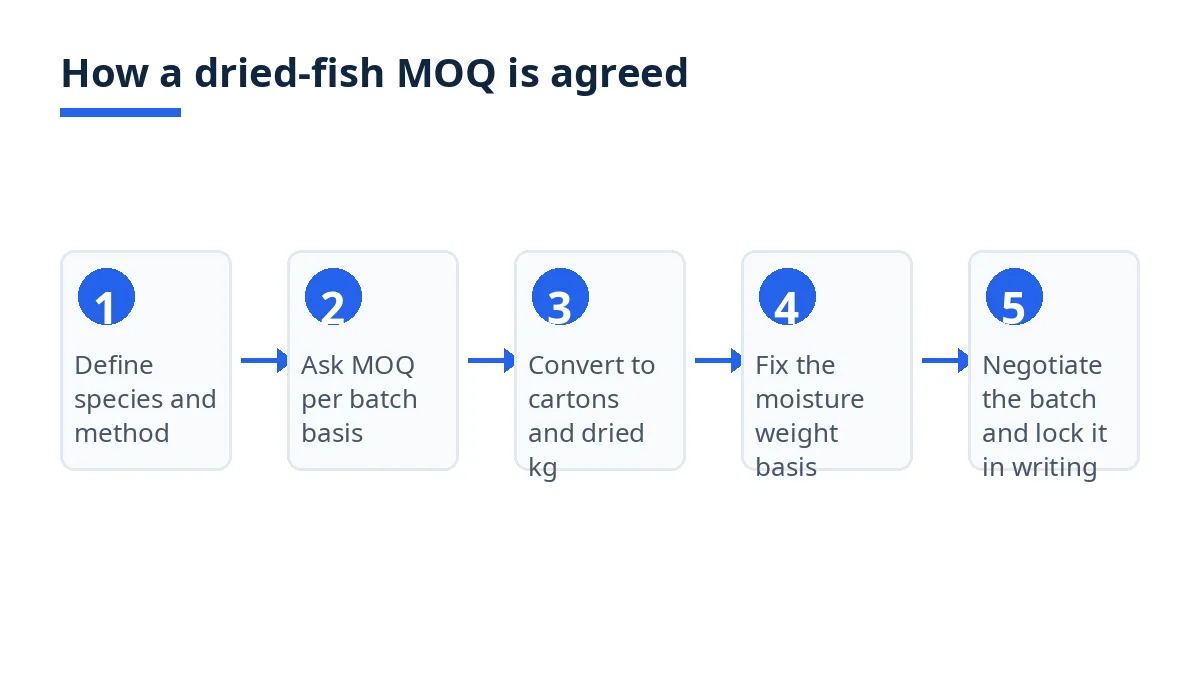
Define the product in full. Species, whole or cut form, size grade, drying method, salt treatment, moisture target, inner pack weight and master carton weight.
Ask for the MOQ on each basis, separately. Per species, per method and per carton format. A supplier quoting only a total has not said whether each species inside it is acceptable.
Convert every MOQ into cartons, then dried kilograms. Example figures: a carton of 10 kg times 20 cartons is 200 kg of dried fish. Converting to cartons shows whether the order fills whole batches.
Fix the moisture and weight basis in writing. State dried weight, the moisture target, the weighing point and what happens if a reweigh at arrival differs. This clause matters most for dried fish.
Test the species split against your sales. For each species, ask how long that species alone would take to sell through your channel. If one would sit for months while others move in weeks, that species is the problem, not the total.
Price the levers before you ask. List what you can offer: fewer species, one method, a standard pack, a consolidated shipment, a longer window, a repeat commitment, or priced trial terms.
Negotiate the batch, not just the number. Ask which change lets the yard run the order as one batch: dropping a species, merging pack formats, joining an existing run, or shifting into the peak season. Record the agreed change, not just the quantity.
Lock the specification and MOQ basis in writing. The purchase order should state species, method, size grade, moisture target, pack format, carton count, dried-weight basis, delivery term and MOQ basis.
Costs, timelines and documents
What drives the price. The price of dried fish varies with species, size, taste and moisture content.1 The cost drivers for your quotation are the species and size grade, drying method and salt treatment, moisture target, pack format and carton count, and delivery term. Freight is charged on shipped weight and volume, so a lower moisture target means less shipped weight per carton but more fresh fish per dried kilogram. Ask for the unit price, pack cost and any batch charge as separate lines.
Timelines. Sun-drying itself takes two to three days, depending on fish size, sunshine and weather.1 The order timeline is longer: raw-fish supply, batch queue, sorting and salting, packing, inspection and export clearance all sit around the drying time. Ask for the batch window for your order month and the date the batch will be weighed and packed, rather than a single delivery date.
Documents. For export clearance from Bangladesh, the Bill of Export is submitted with the export letter of credit or, where there is none, the export contract, purchase order or export guarantee approved by the negotiating bank, together with the commercial invoice, packing list, EXP form certified by an authorized dealer, certificate of origin, VAT registration certificate and taxpayer identification number.2 Product-wise additional certification may also be necessary; the customs guidance gives a Department of Fisheries quality control certificate as the example for fish where the destination country requires it.2 Confirm which fish documents your shipment needs, and name them in the order.
Bangladesh-specific rules and tips
Use the right customs line for the method. Heading 0305 covers fish, dried, salted or in brine, and smoked fish, whether or not cooked before or during smoking, plus flours, meals and pellets of fish fit for human consumption.3 Within it, dried fish other than cod sits under 030559, salted or brined fish under the 03056 group, smoked fish under the 03054 group, and dried or salted fillets under the 03053 group.3 A sun-dried whole fish, a salted fish and a smoked fillet are therefore different customs lines, with different MOQs and destination rules. Confirm the line for each species and method.
Know the hubs and the season. The largest marine fish drying facilities named in the industry account are Dublar Char in the Sundarbans, Khulna, and Nazirar Tek and Sonadia in Cox's Bazar, while freshwater fish are mainly dried in the Sylhet-Mymensingh-Comilla region.1 If your supplier is far from the drying yard, ask where the fish is dried, who runs the yard, and how stock is stored between drying and packing. A trader buying dried stock has a different batch logic from a yard drying its own fish.
Ask about pest control and testing directly. Dried fish production has been criticised for pesticide contamination, with pesticides sometimes used in drying and storage, especially during the rainy season, to prevent flies, maggots and other insects.1 Do not accept a general assurance here. Ask which pest-control method the supplier uses, whether it is documented, and whether a laboratory residue test can be supplied for your batch. Put the agreed method and test requirement in the specification.
Check the licensing and standards position. Under the Fisheries and Fish Products (Inspection and Quality Control) Act, 2020, the central competent authority determines standards for the import, export, production, transportation, storage, marketing and processing of fish and fish products, and no person may export fish and fish products or establish and operate a factory or establishment without obtaining a licence.4 Ask the supplier for its licence position and production standards, and keep copies with the order file.
Fix the delivery term. Incoterms 2020 allocates cost, risk and obligations between seller and buyer for each rule, and the rules have been used globally in trade contracts since 1936, updated in 2020.5 For dried fish, the delivery term decides who pays for inland transport, who bears the risk while cartons sit in humid storage before loading, and who arranges insurance. State the Incoterms rule, named place and version year in the order.
Mistakes and red flags
Accepting a total MOQ without the per-species, per-method and per-carton split. The split is the MOQ.
Pricing on fresh weight, or on kilograms with no moisture target or weighing point. The dried weight is the product.
Mixing species and methods in one request and expecting one batch price. Each combination is a batch.
Ordering a multi-species range in the low season and expecting peak-season batch windows. Season is part of the minimum.
Treating a trial quantity as a discount. A priced trial needs its own terms: smaller batch, separate pack run, and a unit price reflecting the part batch.
Accepting a moisture claim without a test or reweigh clause. Moisture drift is a common dried-fish dispute a contract clause can prevent.
Taking a quality or safety claim at face value. Ask for the licence, pest-control method and any test document, and file them with the order.
Paying for a full batch before the specification is locked.
Checklist
Species, form, size grade, method fixed per line
MOQ stated per species, per method and per carton format
Dried-weight basis, moisture target, weighing point, reweigh tolerance in writing
Inner pack weight, packs per carton, carton weight confirmed
Batch window for your order month confirmed, with packing date
Pest-control method and any residue test agreed and documented
Licence position and applicable standards checked and filed
Customs line under heading 0305 confirmed per species and method
Delivery term, named place and Incoterms version stated in the order
Sample checked against agreed moisture and pack before batch confirmation
Read the dried fish quality control checklist for the quality checks behind this list.
How Exportain helps
On Exportain, buyers browse suppliers, compare quotations and post a request for quotation with the specification attached, so each supplier replies against the same terms. Verification on Exportain is a document review by staff, not a factory inspection and not a check against any government database, and a badge is not a guarantee of production capacity, product quality or delivery.6 Approved checks earn badges for identity, phone and email, business registration, export registration and facility photos, and verification is free and never purchased.6 The seller verification page states the same position: verification is a document and photo review, not a factory inspection.7 Use badges as a starting point, then apply this guide's checks: licence, pest-control method, moisture clause and batch window.
FAQs
What should I know first about dried fish?
Dried fish is sold by dried weight at an agreed moisture level, made in separate batches per species and method, and packed by the carton. About 2 to 5 kg of fresh fish makes 1 kg of dried fish.1 Fix species, method, moisture target and pack format before discussing quantity, because each choice sets its own minimum.
What are the typical costs and timelines?
There is no typical cost or timeline to quote, because price varies with species, size, taste and moisture content.1 Sun-drying takes two to three days depending on fish size, sunshine and weather, but the order timeline also includes raw-fish supply, batch queue, packing and clearance.1 Ask for the unit price with pack and batch charges shown separately, and for the batch window.
Which documents are needed?
For Bangladesh export clearance, the Bill of Export goes with the export letter of credit or approved contract, commercial invoice, packing list, EXP form, certificate of origin, VAT registration certificate and taxpayer identification number, plus any product-wise certification the destination requires.2 Under the 2020 Fisheries Act, fish and fish products may not be exported or produced in a factory or establishment without a licence, and standards are set by the central competent authority.4 Confirm destination requirements for your species and method before shipment.
What are the most common mistakes?
The most common mistakes are accepting a total MOQ without the per-species and per-method split, pricing on kilograms with no moisture basis, ordering a multi-species range in the low season, and taking quality claims without documents. Each is avoidable at quotation stage by asking for the split, moisture clause, batch window and licence and test documents in writing.
Next steps on Exportain
Browse suppliers, then post your species, method, moisture target and pack format on the RFQ board and ask each reply for its MOQ per species, per method and per carton. Before you confirm, read the seller verification page.
Sources
- Dried Fish Industry in Bangladesh: Issues and Concerns. INFOFISH (accessed )
- Customs Clearance Procedures for Export. Bangladesh Customs, National Board of Revenue (accessed )
- Classification Detail — HS Code 0305. United Nations Statistics Division (accessed )
- The Fisheries and Fish Products (Inspection and Quality Control) Act, 2020. InforMEA (accessed )
- Incoterms® 2020. International Chamber of Commerce (ICC) (accessed )
- Trust & Safety Center. Exportain (accessed )
- Supplier verification: Earn trust badges buyers can see. Exportain (accessed )
About the author
Sourcing from Bangladesh?
Post a request for quotation and suppliers on Exportain can send you their quotes directly.
Post an RFQ