Top Dried Fish Manufacturers in Bangladesh: How to Find and Verify Them
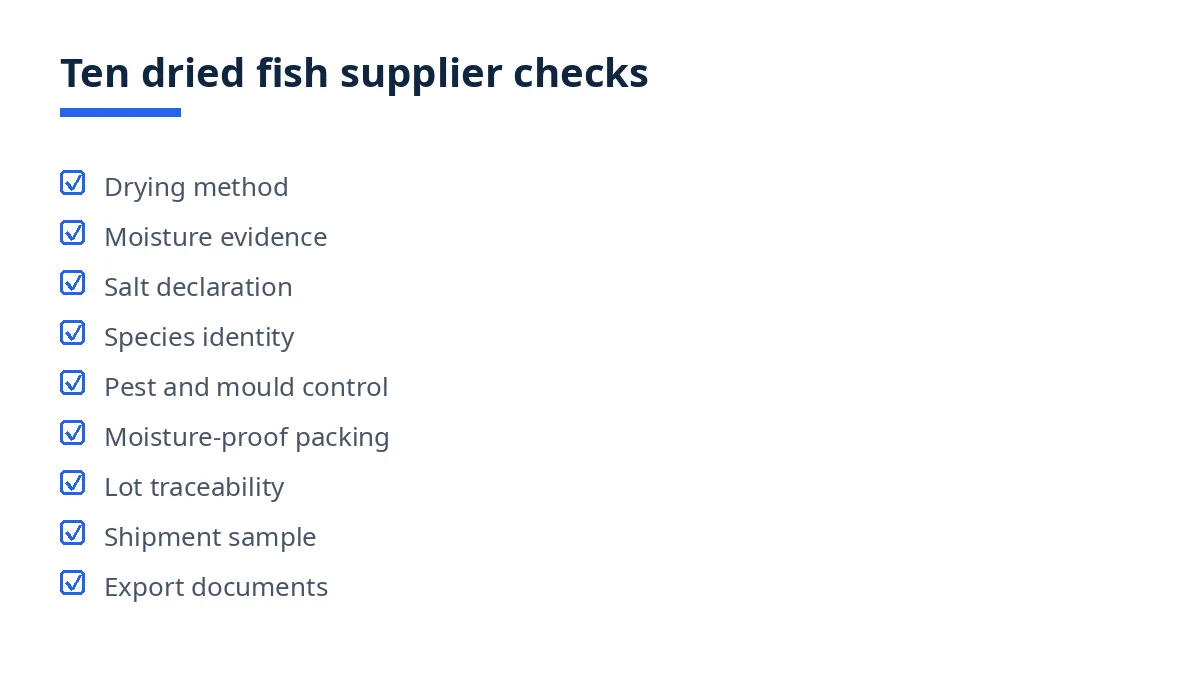
Dried fish manufacturers in Bangladesh, checked the buyer way: ten lot-level checks covering drying method, moisture evidence, salt declarations, species identity, storage, packing, traceability, samples, documents, and MOQ.
Short answer
To find dried fish manufacturers in Bangladesh, run ten lot-level checks before comparing price: drying method and record, moisture or water-activity evidence, salt and additive declaration, species identity, pest and mould controls, moisture-resistant packing, lot traceability, a shipment-lot sample, export documents for your market, and per-species MOQ and seasonality. A supplier passes only when each check is documented for the lot you are buying.

On this page
Dried fish from Bangladesh is bought on evidence, not on a catalogue photo. A supplier passes when it can show how the fish was dried, how dry the lot is, what salt and additives went into it, which species is in the bag, and how the lot can be traced to a drying batch. This article gives buyers ten checks that cover those points, in the order to run them, with what to ask, why each answer matters, and what to do when an answer is weak.
Key takeaways
Dried fish quality is set during drying and storage. Moisture that returns after drying allows mould and pest damage to start again.
Ask for lot-level evidence: a drying record, a moisture or water-activity result, a salt and additive declaration, and a species statement for the lot you are buying.
Sun drying and mechanical drying can both produce a sound product. The difference a buyer should test is control: covered drying, even drying, and a recorded finish point.
Do not compare suppliers on price until the specification matches: same species, cut, salt level, moisture limit, pack, and inspection point.
A supplier that cannot name the drying site, the lot, and the documents for your destination market is not ready for an export order, whatever the quotation says.
The list: ten checks for dried fish manufacturers in Bangladesh
The checks below replace a ranking. No supplier is named and none is ranked, because a dried fish offer is only comparable once the buyer fixes the product and the evidence. Work through the list in order, and keep every answer in writing against the lot number it describes.
1. Drying method and drying record
What to ask. Is the lot sun dried, mechanically dried, or dried by a combination of the two, and what record covers this lot: drying dates, drying surface or equipment, and the finish point used? Why it matters. Drying time and temperature depend on fish species, size, and how the fish are handled and stacked, and drying at too high a temperature can harden the outer layer and stop the inner flesh drying.1 If the answer is weak. Ask for dated drying notes or equipment logs for the lot, and a sample drawn from that lot rather than from stock. If neither is available, treat the lot as ungraded or move to a supplier that records its lots.
2. Moisture and water-activity evidence
What to ask. What is the moisture or water-activity result for this lot, who tested it, and what limit was applied? Why it matters. The Codex code of practice for fish and fishery products states that smoke-drying continues until the finished product has a moisture content below 10 percent or a water activity below 0.75.1 For boiled dried salted anchovies, the Codex standard sets a maximum water activity of 0.75.2 Those figures are product-specific benchmarks, not a single rule for every dried fish, but they show why a buyer should ask for a number rather than accept the words dry or well dried. If the answer is weak. Set your own limit in the specification and require a test result for the shipment lot before dispatch.
3. Salt and additive declaration
What to ask. How much salt is in the finished product, by what method was it salted, and which additives, if any, were used? Why it matters. Salt level changes taste, shelf life, and the weight a buyer is paying for. Codex describes two salted-fish approaches for the Gadidae family: fish fully saturated with salt, and fish partly salted to a salt content of not less than 12 percent by weight.3 For boiled dried salted anchovies, the Codex standard caps sodium chloride at 15 percent by weight on a dry basis and permits no food additives in that product.2 If the answer is weak. Require a written declaration per lot covering salt percentage, salting method, and every additive by name, and check it against your destination market rules before you agree a price.
4. Species identity in dried form
What to ask. Which species, by common name and scientific name, is in this lot, and how is it kept separate from other species during drying and packing? Why it matters. Drying changes appearance: size, colour, and shape all shift, so a dried fish is harder to identify by eye than a fresh one. The Codex code of practice directs that salted fish be sorted into species, sizes, and trade quality categories for the relevant market.1 If the answer is weak. Require the species and size grade on the quotation, the packing list, and the carton label, and check the pre-shipment sample species by species.
5. Pest and mould controls in storage
What to ask. How is the finished lot stored, what pest controls are in place, and what happens to a lot where mould or insect damage is found? Why it matters. The Codex code of practice lists insect infestation as a defect risk at cooling and storage, and directs that dried fish be handled with care and that rehydration be avoided during storage.1 A clean drying record means little if the lot then sits in a damp, open store. If the answer is weak. Ask for storage photos and a description of the store: raised pallets, covered storage, pest monitoring, and separation of new and old lots. Inspect the shipment lot for mould, insect damage, and off-odour before packing, and reject a lot that shows active damage rather than accepting a discount for it.
6. Packaging against moisture re-absorption
What to ask. What packing material is used, is it food grade, and how does it protect the lot from moisture during shipping? Why it matters. Packaging for dried fish should be dry, clean, sound, durable, and of food-grade material, and it should protect the product from moisture or humidity that could raise water activity and allow mould or pathogen growth.1 Dried fish re-absorbs moisture from humid air, so a permeable or damaged pack undoes good drying during a sea voyage. If the answer is weak. Specify the pack in the order: material, inner liner, carton strength, and labelling, and require a sealed sample pack to test.
7. Batch and lot traceability
What to ask. Can this lot be traced back to a drying batch, a drying date, and a raw-material source, and does the lot number appear on every document? Why it matters. Traceability is what turns a complaint into a fix: with a lot number, the supplier can check the drying record, the test result, and the storage history for that lot alone. If the answer is weak. Make lot numbering a condition of the order: one lot number per drying batch, printed on cartons, the packing list, and the test result.
8. A shipment sample that matches the lot
What to ask. Will the pre-shipment sample come from the shipment lot, in the shipment pack, and can the buyer hold a sealed reference sample? Why it matters. A sample from a different lot, season, or hand-picked grade proves nothing about the shipment. The Codex approach to dried and salted fish is lot-based: lots are examined and tested against the standard.2 If the answer is weak. Agree in writing that the sample is drawn from the shipment lot, that breakage, size mix, and salt level in the sample are the acceptance measures, and that the sealed reference sample is kept until arrival.
9. Export documents and destination-market rules
What to ask. Which export documents will accompany this shipment, and has the supplier shipped dried fish to your market before under those documents? Why it matters. Bangladesh has moved fish and seafood licences, inspection certificates, health certificates, test reports, and certificate issuance onto an online system run with the Department of Fisheries.4 For the European Union, food of animal origin is subject to specific hygiene rules, and importers must be able to show the product meets those rules and the applicable import conditions.5 If the answer is weak. List every required document in the order, with the issuing body named, and confirm the document set with your own customs broker before production, not after the goods are packed.
10. Capacity, seasonality, and MOQ realism
What to ask. How much of this species and grade can the supplier deliver in your window, from which drying site, and what is the minimum order quantity per species and grade? Why it matters. Much of the coastal drying in Bangladesh is seasonal. A study of the south-east coast describes drying at Nazirertek in Cox's Bazar running from mid-August to mid-April or May in a good season, using traditional solar methods on bamboo mats, scaffolding, or shelves, with species including ribbon fish, Bombay duck, and croaker among those dried.6 If the answer is weak. Split the order by species and drying window, and agree a per-species MOQ and delivery window in writing, with the drying site named for each lot.
Summary table
Check | Ask for | Refuse or fix when |
|---|---|---|
Drying method and record | Method plus dated lot record | No lot record, method described only in general terms |
Moisture and water-activity evidence | Lot test result and limit applied | No number, only a claim that the fish is dry |
Salt and additive declaration | Salt percentage, method, additives by name | Any additive or salt level left undeclared |
Species identity | Species and size grade per lot | Mixed species or mixed grades under one label |
Pest and mould controls | Covered, raised, monitored storage | Damp or open storage, active mould or insect damage |
Packaging | Food-grade, sealed, moisture-resistant pack | Reused or unlined sacks, damaged cartons |
Batch and lot traceability | One lot number across cartons and documents | Mixed lots under one number |
Shipment sample | Sample drawn from the shipment lot | Sample from a different lot or season |
Export documents | Named document set for your market | Vague promises, documents confirmed only after packing |
Capacity, seasonality, MOQ | Per-species MOQ and delivery window | One MOQ for all species, out-of-season volume promised |
Price, capacity and MOQ
Price for dried fish follows the specification, not the supplier. Species, cut, size grade, salt level, moisture limit, and pack each move the price, and raw-to-dried weight loss differs by species, so a per-kilogram dried price cannot be compared across species or grades. Order quantity matters because drying, sorting, and packing are batch work: a small order of one species in one grade carries the same handling steps as a larger one, which is why suppliers set MOQ per species and grade rather than per order. Season matters too, since coastal drying follows weather and catch seasons, and an out-of-season order may need stored stock, a different grade, or a later window.6 For how minimum order quantity works in general, read the guide to MOQ in the supply chain.
How Exportain helps
Exportain is a B2B marketplace for sourcing from Bangladesh. Buyers can search supplier listings, review the verification information shown on each profile, and message suppliers through the platform so questions and answers stay in one thread. Supplier verification information on Exportain covers document and photo checks reviewed by the Exportain team, and the guide to how supplier verification works sets out what each badge covers and what it does not cover.7 Buyers can also post a request for quotation stating species, grade, quantity, destination, and required documents, and compare the quotations that come back against the same specification.8 Use the platform as the starting filter and the record of the deal, then run the ten checks above on the shortlist. Exportain is a marketplace and is not a party to the goods contract, so the specification, the lot number, the test result, and the inspection terms in your order are the documents that protect the shipment.
FAQs
What is the biggest mistake buyers make when sourcing dried fish from Bangladesh?
Buying on price and species name alone, without a moisture limit, a salt declaration, and a lot number. Two lots of the same species can differ in drying method, salt level, moisture, and storage history, and those differences decide whether the fish arrives sound or mouldy.
How can I avoid it?
Fix the specification before you ask for a price: species and size grade, drying method, moisture or water-activity limit, salt percentage and additives, pack, lot numbering, and the pre-shipment sample rule. Send the same specification to every supplier, require a lot test result before dispatch, and keep the sealed reference sample until the goods arrive and are checked.
Who is responsible for quality, the supplier or the buyer?
Both, at different points. The supplier is responsible for drying, storing, and packing the lot to the agreed specification and for supplying the documents that describe it. The buyer is responsible for making that specification complete and checkable, and for inspecting the shipment lot against it before accepting it. When a dispute starts, the side with the written specification, the lot test result, and the sealed sample holds the evidence that counts.
Where can I get help verifying a supplier?
Start with the records that exist: the Department of Fisheries online certification services for licences, inspection, and health certificates,4 the destination market rules that apply to your shipment,5 and an independent inspection provider for the pre-shipment check against your reference sample. On Exportain, read what each profile badge covers before relying on it, and keep your questions and the supplier answers in the platform thread.7 The dried fish quality control checklist turns these checks into a shipment-level list.
Next steps on Exportain
Browse Bangladeshi suppliers and filter the dried fish listings by the verification information shown on each profile. Before you order, read how supplier verification works on Exportain so you know what each badge covers. Then post a free RFQ with your species, grade, moisture limit, salt declaration, and destination market, and compare the quotations that come back against that one specification. If you need the ordering and shipping steps that follow, the guide to importing dried fish from Bangladesh covers them.
Sources
- Code of Practice for Fish and Fishery Products (CXC 52-2003). FAO and WHO, Codex Alimentarius (accessed )
- Standard for Boiled Dried Salted Anchovies (CXS 236-2003). Codex Alimentarius (accessed )
- Standard for Salted Fish and Dried Salted Fish of the Gadidae Family of Fishes (CXS 167-1989). Codex Alimentarius (accessed )
- Bangladesh rolls out online certification system to simplify fish and seafood trade. International Collective in Support of Fishworkers (ICSF) (accessed )
- Regulation (EC) No 853/2004 laying down specific hygiene rules for food of animal origin. European Union (accessed )
- Socio-Economic Context and Community Resilience among the People Involved in Fish Drying Practices in the South-East Coast of Bangladesh. International Journal of Environmental Research and Public Health (accessed )
- Supplier verification: Earn trust badges buyers can see. Exportain (accessed )
- How to source and buy from Bangladesh. Exportain (accessed )
About the author
Sourcing from Bangladesh?
Post a request for quotation and suppliers on Exportain can send you their quotes directly.
Post an RFQ