Dried Fish Lead Time From Bangladesh: Production and Shipping Timeline
Dried fish lead time from Bangladesh runs on the drying yard calendar: drying method, season, moisture and salt targets, grading, pest and mould checks, packing, inspection and transit.
Short answer
There is no single typical lead time for dried fish from Bangladesh, because the drying yard sets the date: the drying method, the species and size, the salt treatment, the moisture target, the grade mix, and the destination inspection gate. Plan around the drying season and the moisture check, not a single week count.

On this page
Key takeaways
There is no single typical lead time for dried fish from Bangladesh: the drying method, species and size, salt treatment, moisture target, grade mix, and destination inspection gate set the date.
The peak drying season runs mainly August to April with a winter focus, so a monsoon order needs a longer allowance, a mechanical or solar drying plan, and a re-drying answer.
Sun-dried fish mostly holds 20 to 30 percent moisture, while solar, smoke, curing, and freeze-drying bring it below 15 percent, so the drying method is a storage decision, not a cost line.
Put the moisture target, test method, tolerance, and fail action in the purchase order, and keep the moisture check, packing, and inspection close together.
Exportain verification is a document and photo review, not a factory inspection, and a badge is not a guarantee of drying quality.
A dried fish order from Bangladesh does not run on a factory calendar. It runs on a drying yard calendar: the catch, the weather over the racks, the days the fish needs to dry, and the checks that prove it is dry enough, salted as agreed, and packed against moisture, mould, and pests before it ships. A buyer who plans around a single week count will miss the order.
There is no single typical lead time for dried fish from Bangladesh. The drying method, species and size, salt treatment, moisture target, grade mix, and destination inspection gate all move the date. This guide follows the dried-fish sequence: sampling, drying, sorting and grading, pest and mould control, packing, inspection, export clearance, and transit.
Why this matters for buyers and sellers
For the buyer, the drying stage decides what arrives. Dried fish that leaves the yard too wet can gain mould in transit, and dried fish salted differently from the sample can fail a destination check. The order is finished when the dried lot matches the sample on species, size, salt, moisture, and packing, and the papers name the same lot.
For the seller, the drying stage decides what can be promised. Fish drying continues through the year, with the peak season mainly August to April and a focus on the winter season.1 A seller who confirms a large order for a single size in the monsoon, when sun-drying slows and pest pressure rises, has promised a drying window the weather may not give.
What should I know first about dried fish?
Dried fish, known in Bangladesh as shutki, is fish preserved by drying, sometimes with salting, fermentation, or smoking.1 The large-scale marine drying yards sit in the Chittagong and Cox's Bazar areas, with freshwater drying concentrated in the Sylhet-Mymensingh-Comilla and Khulna-Barisal-Patuakhali regions, and the largest marine yards at Dublar Char, Nazirar Tek, and Sonadia.1 About 2 to 5 kg of fresh fish is required to make 1 kg of dried fish, so price follows species, size, taste, and moisture content.1
Three distinctions set the timeline before any date is discussed. First, the drying method: open sun-drying on bamboo racks, solar drying, mechanical drying, or a combination. Second, the treatment: unsalted, salted, or salted and seasoned. Third, the form: whole fish, headed and gutted fish, fillets, or fermented product.
In the Harmonized System, heading 0305 covers fish, dried, salted or in brine, and smoked fish, with flours, meals, and pellets of fish fit for human consumption.2 Dried fish that is not smoked and not cod falls under subheading 0305.59, while dried fillets fall under 0305.31 to 0305.39 depending on the species group.2 State the species, form, and treatment in the enquiry: those lines decide the code, moisture target, and destination checks. See the HS code for dried fish guide.
Step-by-step: how it works
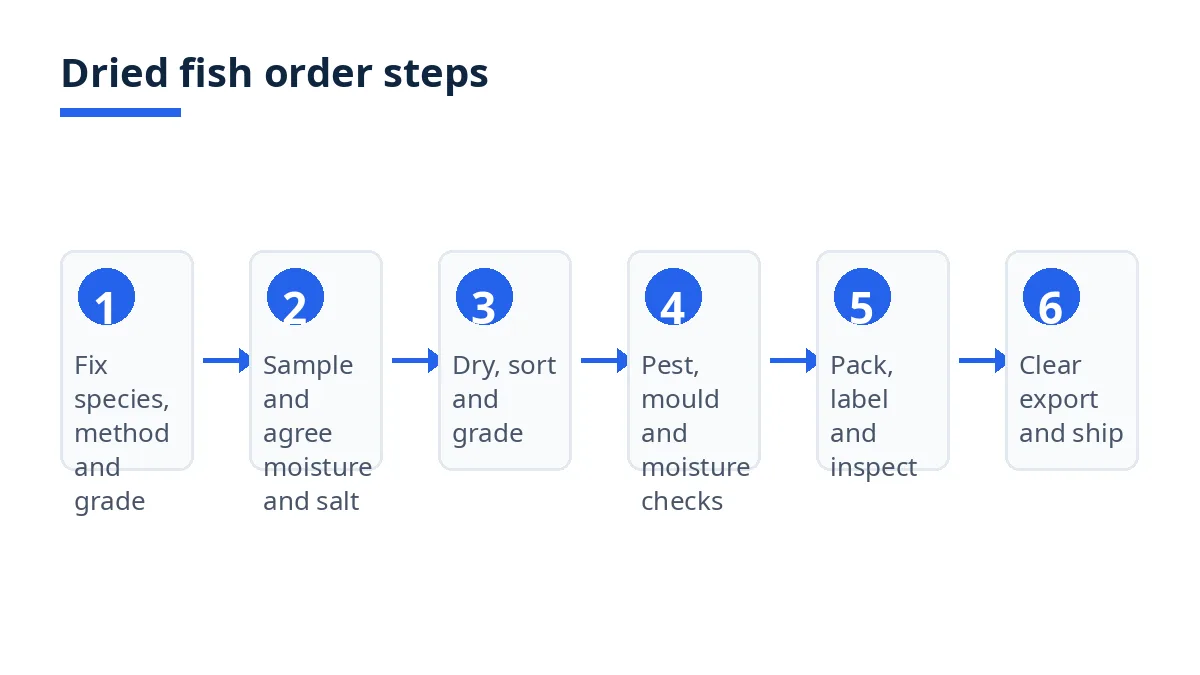
Fix the specification before you discuss a date. State the species, whole or gutted form, size range, drying method, salt treatment, moisture target, grade, and packing. A quotation for "dried fish" without these lines is not comparable with another quotation.
Sample against the same specification. Ask for a sample from the same yard and the same drying method as the bulk lot, and agree the salt level, moisture, colour, odour, texture, and size mix in writing.
Confirm the drying window and the season. Ask which months the yard dries this species, whether the order falls inside the peak season, and what happens to the date if rain interrupts drying. Fish drying continues round the year, but the peak season is mainly August to April, focusing on the winter season.1
Dry, sort, and grade. The raw fish received by the dried fish yards are generally washed, sorted, degutted, and salted, especially for high-value fish, before going for traditional sun-drying on vertical and horizontal bamboo racks, and after two to three days in the sun the dried fish are stored before packing.1 The drying period depends on the size of the fish, the available sunshine, and the weather conditions.1
Run the pest, mould, and moisture checks before packing. Agree the moisture test, the visual mould and pest check, and what happens to a lot that fails: re-dry, re-sort, or reject. Pesticides are sometimes used in the drying and storage process, especially during the rainy season, to prevent flies, maggots, and other insects.1 Ask how the supplier controls pests without unauthorised chemicals, and put the answer in writing.
Pack for moisture and transit, then inspect. Agree the inner and outer packing, the moisture barrier, the carton marking, and the inspection point. Packing that lets humid air back into sun-dried fish undoes the drying week, so the packing date and the inspection date should sit close together.
Clear export and ship on the agreed term. Confirm the vessel or flight, the port, the delivery term, and the document set before the cartons are sealed. The Incoterms 2020 rules set out 11 rules with a clear allocation of cost, risk, and obligations.3 Compare quotations only on the same rule and named place. See the Incoterms for shipments from Bangladesh guide.
Costs, timelines and documents
What are the typical costs and timelines?
There are no typical costs or timelines that hold for every dried fish order. The price follows the species, size, taste, and moisture content of the fish,1 and the timeline follows the drying method, the season, the lot size, and the inspection queue. A small lot from existing dried stock can move in days. A large lot that needs a new catch and a single size grade needs weeks.
Planning ranges, not typical figures: ask the supplier to fill each line for your order.
Stage | What sets the time | Ask for as a separate line |
|---|---|---|
Sampling | Yard stock, drying method, courier | Sample dispatch date, approval date |
Drying | Species, size, method, weather | Drying start, drying days, re-dry allowance |
Sorting and grading | Landing mix, grade tolerance | Grade mix, rejection rate, re-sort time |
Pest, mould, moisture checks | Test method, lab or yard check | Check date, moisture result, fail action |
Packing | Carton spec, moisture barrier | Packing date, carton count, marking |
Inspection and clearance | Certificate needs, customs queue | Inspection date, certificate date, sailing |
Transit | Routing, mode, destination clearance | Sailing or flight, arrival, clearance |
For costs, the same split applies. The drying method, salt treatment, grade mix, packing, inspection, and delivery term each sit in the price. A lower price on sun-dried fish with a loose moisture target is a different offer from a higher price on solar-dried fish with a tested moisture result. Compare only replies to the same specification on the same delivery term.3
Example figures: consider two orders of the same species. In the first, the buyer orders a mixed size from dried stock in the winter season, the lot passes its moisture check, and the cartons ship on the next sailing. In the second, the buyer orders one tight size grade in the rainy season, the first drying run comes back too wet, and the lot needs re-drying and re-sorting before packing. The example shows structure only, not a typical timeline or price.
Which documents are needed?
For export clearance in Bangladesh, goods may not be loaded unless an export declaration, the Bill of Export or Shipping Bill, is submitted to Customs and approved.4 The documents for obtaining the Shipping Bill include the export letter of credit or purchase order, the commercial invoice, the packing list, the EXP form certified by an authorized dealer, and a certificate of origin issued by the EPB or a Chamber of Commerce and Industry.4
Add the dried-fish lines to that set: species and scientific name where the destination requires it, form, drying method, salt treatment, moisture result, grade and size mix, and net and gross weight per carton. Check that the same lines appear identically on the invoice, the packing list, and any health or quality certificate.
For the European Union, imports of fishery products for human consumption must comply with health requirements related to health approval by an authorised country, an approved establishment, health certificates, and health control.5 Confirm which certificate the destination requires before the fish is packed.
Bangladesh-specific rules and tips
Plan the order around the drying season, not around the sailing. The peak drying season runs mainly August to April with a winter focus,1 and the freshwater drying season generally lies between September and March, varying with location.1 An order placed in the monsoon needs a mechanical or solar drying plan, a longer allowance, and a written answer for rain-interrupted lots.
Treat the drying method as a quality decision, not a cost line. Sun-dried fish carries relatively high moisture, most of it in the range of 20 to 30 percent, while smoke, solar, curing, and freeze-drying bring moisture below 15 percent in the studies reviewed.6 A buyer who needs longer shelf life or a humid destination market should ask for the method that reaches the lower moisture result.
Put the moisture and salt numbers in the purchase order. Moisture and salt are the two numbers that decide whether the lot stores well and tastes as sampled. State the target, the test method, the tolerance, and the action on failure: re-dry, re-sort, discount, or reject.
Ask how pests are controlled, and what is never used. Pesticide use during drying and storage, especially in the rainy season, is a documented concern in the Bangladesh dried fish chain.1 INFOFISH recommends that unauthorised chemicals and pesticides along the dried fish value chains be monitored closely by the Fish Inspection and Quality Control Division of the Department of Fisheries.1
Ask where the fish is dried, and how far the yard is from packing. The large marine yards are at Dublar Char, Nazirar Tek, and Sonadia,1 and the finished product moves from yard to depot before distribution. A supplier who cannot describe that chain is describing a hope, not a timeline.
Keep the lot identity from yard to carton. The species, drying method, salt treatment, grade, and moisture result should travel with the lot from the rack to the carton label, so a destination check opens a carton and finds the same answers the sample gave.
Mistakes and red flags
What are the most common mistakes?
Ordering by weight without a moisture target. Two lots of the same weight can hold very different amounts of water. Sun-dried fish mostly ranges from 20 to 30 percent moisture, while solar, smoke, curing, and freeze-drying bring it below 15 percent.6 Without a moisture target, the buyer pays dried-fish prices for water weight and stores a mould risk.
Accepting a sample from a different drying method. A solar-dried sample does not approve a sun-dried bulk lot. Sample and bulk must share the method, the yard, and the salt treatment.
Confirming a tight size grade without sorting time. One landing dries into mixed sizes. A single tight grade needs sorting time and a rejection allowance. Build both into the date, or accept a wider grade in writing.
Letting packing wait after the moisture check. Dried fish that passes its moisture check and then sits unpacked in humid air can fail again by packing day. Keep the check, packing, and inspection close together.
Treating a profile or a badge as a drying guarantee. A profile is a starting point for enquiries. Exportain verification is a document and photo review, not a factory inspection,7 so drying, moisture, and pest-control checks stay with you. See the dried fish quality control checklist for grade, moisture, and packing points.
Checklist
Species, form, size range, and grade stated, with the grade tolerance.
Drying method stated: sun, solar, mechanical, or combined, same for sample and bulk.
Salt treatment stated: unsalted, salted, or salted and seasoned.
Moisture target, test method, tolerance, and fail action in the purchase order.6
Sample approved in writing against the same specification as the bulk lot.
Drying window confirmed: season, drying days, rain-interruption plan, re-dry allowance.1
Pest control method named, with confirmation that no unauthorised chemical is used.1
Packing agreed: inner and outer packing, moisture barrier, carton marking, carton count.
Inspection and certificates agreed: who applies, what is needed, how long it takes.5
Delivery term stated: one Incoterm and named place for every quotation.3
Sailing or flight confirmed: vessel or flight, port, packing date.
Document set agreed: invoice, packing list, EXP form, certificate of origin, Bill of Export, plus health or quality certificates where required.4
Lot identity kept from yard to carton: species, method, salt, grade, moisture on the label.
How Exportain helps
On Exportain, browse suppliers and post a request for quotation (RFQ) on the RFQ board with your species, form, size range, drying method, salt treatment, moisture target, grade, and delivery term, so suppliers quote against the same drying specification. Ask each reply for its drying window, moisture result, pest control method, and certificate timing.
FAQs
What should I know first about dried fish?
Dried fish, or shutki, is fish preserved by drying, sometimes with salting, fermentation, or smoking.1 The first decisions are the species, the form, the drying method, and the salt treatment, because those lines set the moisture result and the timeline. Heading 0305 covers dried, salted, brined, and smoked fish.2
What are the typical costs and timelines?
There are no typical figures for every dried fish order. Price follows species, size, taste, and moisture content,1 and the timeline follows the drying method, the season, the lot size, and the inspection queue. Ask for each stage as a separate dated line, and compare quotations only on the same specification and delivery term.3
Which documents are needed?
The export set is the Bill of Export, commercial invoice, packing list, EXP form certified by an authorized dealer, and certificate of origin issued by the EPB or a Chamber of Commerce and Industry.4 Add the dried-fish lines, identical on every document, plus the health or quality certificate the destination requires.5
What are the most common mistakes?
The most common mistakes are ordering by weight without a moisture target, accepting a sample from a different drying method, confirming a tight grade without sorting time, and letting packing wait after the moisture check. Sun-dried fish mostly holds 20 to 30 percent moisture, while solar, smoke, curing, and freeze-drying bring it below 15 percent.6 A badge is not a guarantee of drying quality.7
Next steps on Exportain
Browse suppliers, then post your species, drying method, salt treatment, moisture target, and grade on the RFQ board so suppliers state their drying window and moisture result. Before you confirm, read the dried fish quality control checklist and the Incoterms for shipments from Bangladesh guide.
Sources
- Dried Fish Industry in Bangladesh: Issues and Concerns. INFOFISH (accessed )
- Classification Detail — HS Code 0305. United Nations Statistics Division (accessed )
- Incoterms® 2020. International Chamber of Commerce (ICC) (accessed )
- Bangladesh Trade Portal FAQ: Export Registration Certificate (ERC). Bangladesh Trade Portal (accessed )
- Health and consumer protection for animal and plant product. European Commission, Access2Markets (accessed )
- Nutritional Composition of Dried Fishes from Bangladesh and Functional Properties of Their Protein Isolates. University of Manitoba (accessed )
- Supplier verification: Earn trust badges buyers can see. Exportain (accessed )
About the author
Sourcing from Bangladesh?
Post a request for quotation and suppliers on Exportain can send you their quotes directly.
Post an RFQ